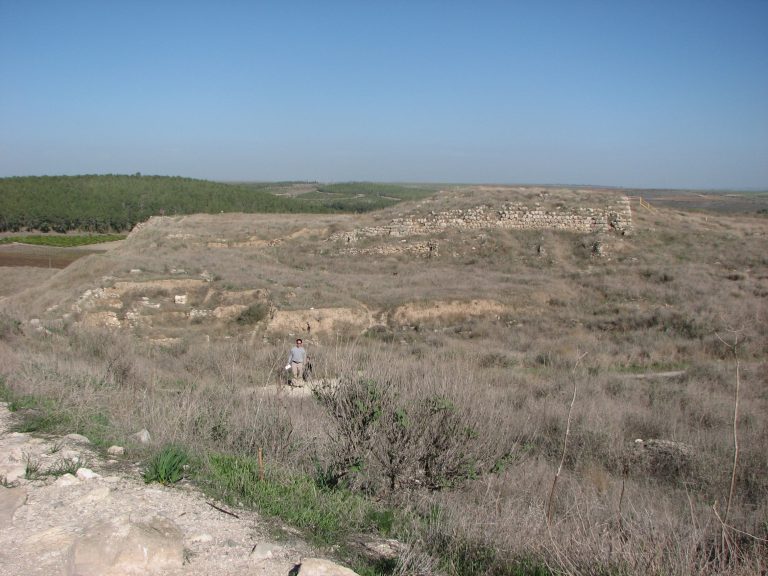
Two grains of barley helped archaeologists date a piece of pottery found at Tel Lachish. The pottery carries traces of early alphabetic writing. The grains lay in a small patch of burnt material beside it. The connection between them depended on careful notes about soil and walls, and on measurements taken at two laboratories. By following the investigation, you can learn to ask what exactly an archaeologist dated. A piece of pottery, an episode of burning, and the writing on the pottery can each have a different place on the calendar. Höflmayer and colleagues, archaeological context and dating.
We believe the Bible is true and accurate. That conviction makes it worth attending closely to the history of the places it describes. Lachish occurs in Joshua’s account of the campaign in southern Canaan and again, many generations later, in Kings’ account of Assyrian pressure on Judah. The times and settings differ. The same mound can preserve traces of many communities, and the work of dating helps us see which evidence belongs to which phase. The little sherd gives us a chance to practice the method before drawing broader historical connections.
What you’ll learn
- How archaeologists use layers and walls to put activities in order.
- Why a radiocarbon test on barley can help date a deposit containing pottery.
- What the Lachish team’s ranges say about when the sherd went into the ground, and which dates still need separate evidence.
Put the layers in order
Imagine a household replacing a worn earthen floor. People level the surface, leave shards and dirt behind, and put down a new floor. The earlier activities take place before the new surface is laid. A later family might dig a pit through both floors and fill it with debris from elsewhere. An excavator distinguishes the edges of that cut from the older layers around it. Where layers are undisturbed, the one beneath usually precedes the one above. Where a later action cuts through earlier material, the cut and its fill have their own place in the sequence.
This work is called stratigraphy. It starts with relationships anyone can learn to notice. A layer lies against a wall. A floor seals an earlier deposit. A foundation trench cuts through an occupied surface. Those descriptions can be drawn and checked by people reading the excavation record. They put building, use, repair, and burial into relative order. The order is useful even without a calendar year. People can then examine pottery, inscriptions, or samples whose dates are known or can be estimated and see how those dates constrain the episodes around them.
Follow the sherd to its findspot
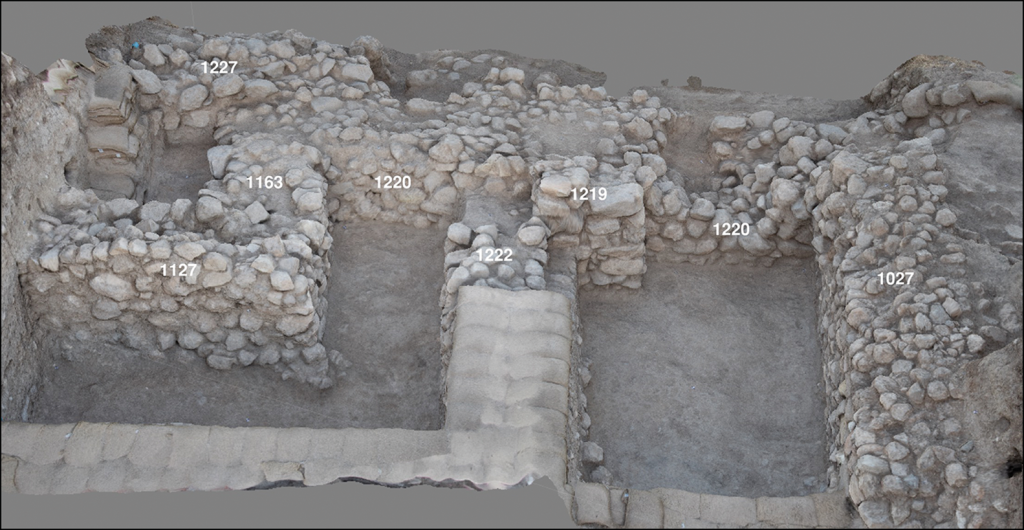
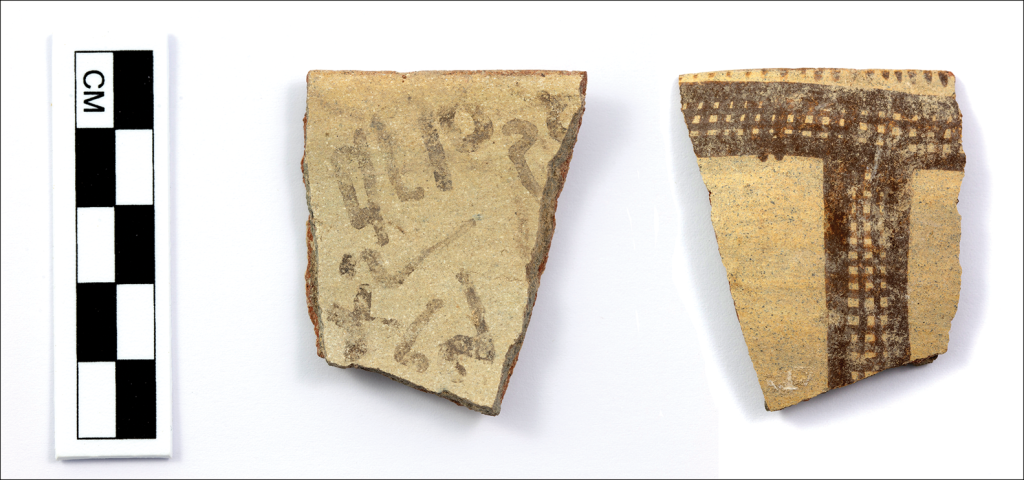
The Austrian expedition found the inscribed fragment in 2018 in Area S at Tel Lachish. It is a rim fragment measuring roughly four by three and a half centimeters, from a vessel of the ceramic tradition called Cypriote White Slip II. The investigators identified its archaeological layer within a sequence they call S-3. That sequence includes construction and reuse of a substantial building and its surroundings. The sherd lay beside the building’s southern wall, near a city wall, and below later walls in the same overall sequence. Its relationship to those later structures helps place its deposition before their construction. Excavation description and Area S plan, figures 3–4.
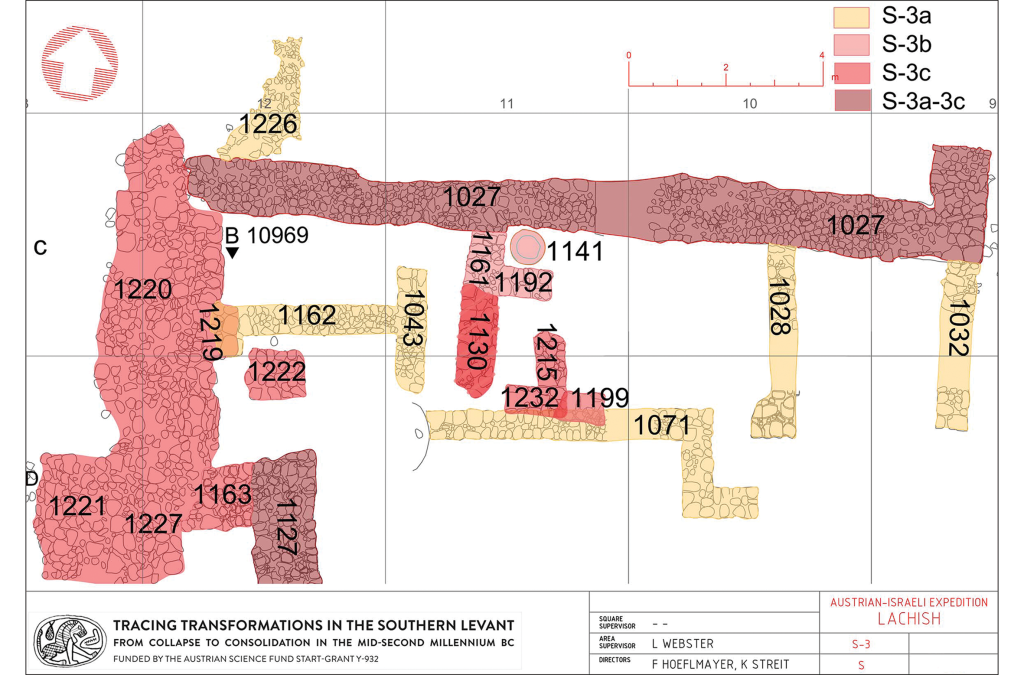
The team was exposing and sampling a thin patch of burnt material, called a lens, when they found the sherd. It was at the boundary between three excavation units. The publication describes direct contact between the sherd and the burnt layer. The excavators could see that association precisely because they had recorded how the units met. They considered whether the pottery and organic material had entered the deposit together and judged that the contact placed their deposition at essentially the same time. That is an inference from a particular physical relationship documented at the site. Höflmayer and colleagues on L1150, L1117, and L1114.
What the laboratories measured
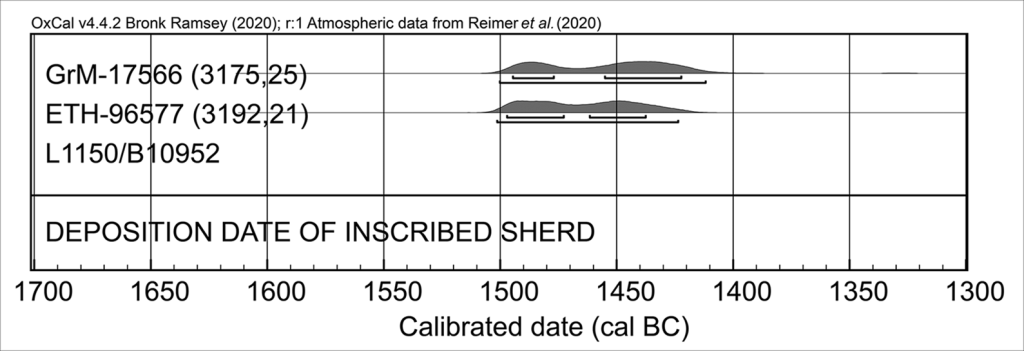
The ceramic itself was outside the sampling question. The two laboratories, at Groningen and ETH Zürich, took measurements on separate barley grains from the burnt lens. A growing plant exchanges carbon with its surroundings. After it stops growing, the amount of radioactive carbon-14 associated with that material falls at a known rate. Measuring the remaining proportion gives an estimate in radiocarbon years. Archaeologists often prefer short-lived material such as grain when the context supports it. One growing season gives less room for a gap between the age of the sample and its collection than decades contained in a long-lived tree. The Lachish samples, figure 5.
Radiocarbon years require calibration before we can read them as calendar dates. The amount of carbon-14 in the atmosphere has varied, and a curve built from independently dated material accounts for those changes. Calibration can give several likely stretches of time instead of a single year. Höflmayer and colleagues used the IntCal20 calibration curve and presented the barley results together. Both grains fall within the fifteenth century BC, and the team judged them most likely to date before its final quarter. Two separate grains provide a useful comparison. Their agreement increases confidence in the measurement, while the excavation record tells us how to relate that result to the sherd. IntCal20 calibration research · Figure 5 and sample discussion.
Step from a sample to the date it constrains
The Lachish team brought measurements from several nearby layers into a statistical model. The model incorporates the order of the deposits, information already in the excavation record, to narrow the set of dates that fit the whole sequence. For the sherd’s find context, the authors report about 1460–1430 BC at the narrower of two published probability intervals and about 1485–1425 BC at the wider one. The wider interval covers more of the estimated likelihood. Think of those as results from the measurements and the documented sequence together. The precision of the numbers belongs to the proposed chronology of that context. Bayesian model and reported intervals, figure 6.
A short-lived sample still needs a convincing context. Imagine a grain from an earlier harvest swept off a floor when someone later cleared the room. The carbon test would point back to the season in which the grain grew. Its eventual burial could be considerably later. A piece of mature timber can involve another kind of gap. Its inner rings formed well before the tree was cut, and builders may have moved the beam from one structure to another. Short-lived barley reduces the gap between the growth of the sampled tissue and harvest. The burnt lens, the positions of the two grains, and the relationship of the sherd to that deposit are what let the Lachish team set the laboratory results beside their archaeological sequence.
That brings us to three questions worth keeping nearby whenever a headline announces the age of a discovery.
- What was measured? Two carbon-bearing grains from a burnt deposit supplied the direct laboratory evidence.
- What did the excavators date using that evidence? They inferred the time the sherd entered the adjacent deposit through the grains, their direct contact with it, and the surrounding stratigraphy.
- What is the date of writing? The signs were already on the sherd before its deposition. Its contextual date provides a latest limit within the model. The writing could be earlier.
A date becomes useful when we can say what was measured and explain how the result reaches the object we want to understand.
Here the phrase terminus ante quem means a latest limit. If an inscribed object lay in a deposit before another floor was built above it, the writing belonged to some time before the later construction. An independently dated deposit can tighten that limit. There is also an earliest limit, called a terminus post quem. If an identifiable coin was minted in AD 43 and lay in a mosaic’s foundation during construction, that work could take place in AD 43 or later. The Magdala Stone’s synagogue context offers an actual case of such a coin. Putting the two kinds of limit in ordinary words makes it easier to avoid treating either as the day a building opened.
Try the reasoning with a new observation
Suppose a bulldozer uncovered the same lettered sherd in a pile of loose soil and a laboratory could still measure the grains in an excavator’s bag. The bowl’s shape, clay, and letters would remain evidence. You might compare them with similar finds from dated contexts. The laboratory could still estimate the age of the plant material. The two findings would need another way to come together. Careful digging and recording preserved the relationship that made the separate lines of evidence work together at Lachish. The hypothetical comparison is also a practical reason to read about an object’s findspot and context before deciding what to make of its date.
Suppose instead that researchers discovered a new line of closely comparable writing on another sherd in a well-sealed floor. They could ask whether its context supports roughly the same period and compare how the letters were made. Pottery specialists could examine both vessel types. Several lines of inquiry can strengthen the chronology when the contexts are carefully recorded and the methods answer distinct questions. Sometimes a new date prompts researchers to revisit a sequence they already thought they knew. The Lachish study reports a substantial revision of the date assigned to one previously excavated phase in Area S. The sherd is part of a larger argument about the history of this section of the mound. Discussion of strata S-3a, S-3b, and S-3c.
Read a date alongside Scripture
Joshua 10:31–33 names Lachish during the southern campaign. The pottery fragment shows that early alphabetic writing was present at Lachish in the Late Bronze Age and lets us date that practice more closely. The text on the sherd and the barley context speak to writing and settlement. To connect a particular layer with an episode involving Joshua would require a separate historical argument. Centuries later, 2 Kings 18 names Lachish in the account of Sennacherib and Hezekiah. A battle ramp, a royal account, and a palace relief belong to the questions we bring to that episode. The town supplies a shared place name, and each phase requires its own investigation. Joshua 10 and 2 Kings 18.
The biblical record gives us people and events worth knowing in their historical settings. Digging into how archaeologists date materials adds specificity to our reading. At Lachish we can picture a fragment small enough to hold in a hand, recorded beside carbonized grains whose growth ended in a season many centuries ago. From that contact, scientists could trace a limited period in the much longer life of a fortified town. The next time you see a museum date, ask what was tested and how that test is connected to the object. You’ll be following the same line of reasoning the excavators used to understand their find.
Sources and further reading
- Felix Höflmayer and colleagues, Early alphabetic writing in the ancient Near East — Open primary publication. Archaeological context and dating, figures 3–7, give the stratigraphy, separate samples, and modeled deposition range.
- Paula J. Reimer and colleagues, The IntCal20 Northern Hemisphere Radiocarbon Age Calibration Curve — Published calibration curve used by the Lachish team. Explains why radiocarbon age is calibrated to calendar time.
- Joshua 10 and 2 Kings 18 — Biblical passages naming Lachish in distinct phases.