In John 9, a man born blind makes his way through Jerusalem with mud on his eyes. Jesus has sent him to wash in a pool called Siloam. The Gospel says he goes, washes, and returns seeing. It gives him a destination that readers in Jerusalem could have recognized. The place name survived long after the Roman destruction of the city, but for centuries visitors saw a small pool near the mouth of an ancient tunnel. In 2004, maintenance work uncovered stone steps at a second spot nearby. They led archaeologists to a much larger pool from the time of the Second Temple. The first excavators identified it with Siloam. New excavations have reopened the question of which of the two places carried that name in John’s day.
What you’ll learn
- How sewer work exposed a late Second Temple pool and why archaeologists disagree about its ancient name.
- How coins, stone steps, and the surrounding streets establish the setting and its date.
- How to read the man’s walk to the water as the beginning of a longer account of faith and public testimony.
A pool at the foot of Jerusalem
Start at the lower end of the narrow ridge often called the City of David. The ridge runs south from the Temple Mount, with the Kidron Valley on the east. The low ground at its southern end collects water that descends into it. Jerusalem’s builders used that terrain for storage and distribution over many centuries. Settlement, defenses, houses, streets, and waterworks all came and went around the same slope. A surviving place name can continue to refer to a neighborhood even when the buildings it described have changed.
The Gihon Spring on the eastern slope supplied water to more than one system. The long Iron Age tunnel under the ridge and the six-line inscription near its outlet are the subject of a separate article on the Siloam Inscription. The work of Hezekiah in 2 Kings 20:20 and 2 Chronicles 32 belongs to that earlier history. In John 9, centuries later, we are looking for a pool that someone could approach and use in the city around the first century AD. The name helps narrow the search to the right area. Construction and excavation evidence help establish which remains fit that later period.
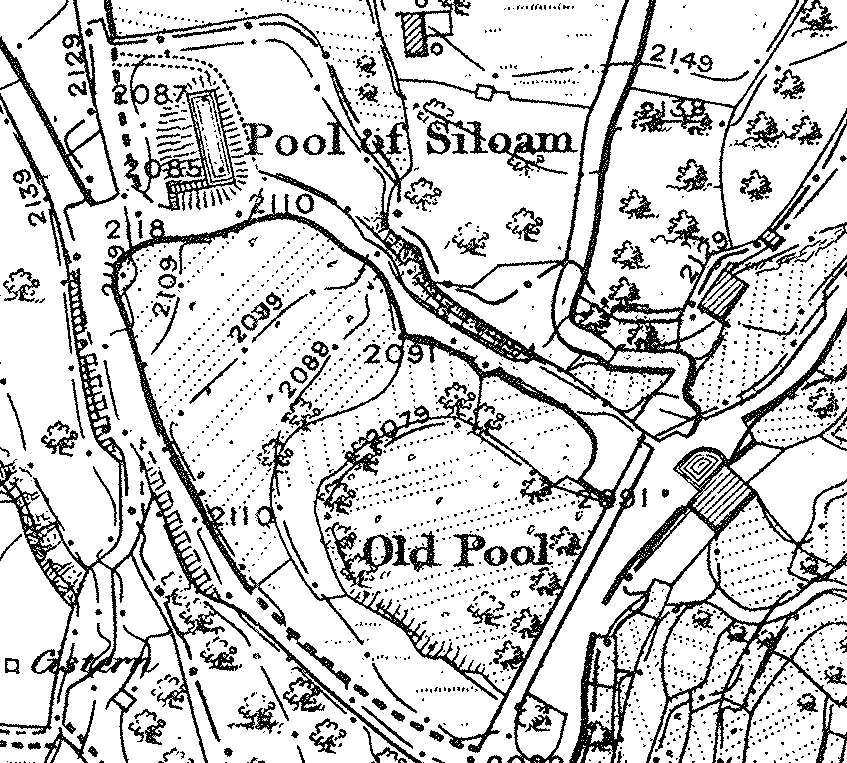
The little pool near the tunnel outlet preserved the name in the period when this map was made. It is associated with later rebuilding, including the Byzantine use of the area. Excavation distinguished that smaller installation from a larger stepped pool in the low ground nearby. Place names, old maps, and surviving masonry all supply information. In this case they work together better when you give each source its own date. A nineteenth-century survey documents what nineteenth-century observers could see. It gives you a way to ask how a traveler before the discovery would have understood the name Siloam. Reich and Shukron’s archaeological study of the pool and its surroundings.
Use the old map to get your bearings before you look at the steps. Find the upper pool by the tunnel outlet first, then follow the ground toward the lower pool. Notice the short distance between the places and the ways the adjacent slopes constrain them. Historic maps can guide a modern description even when their labels or boundaries reflect a different phase of knowledge. The name at the upper pool tells us that the memory of Siloam endured. The large structure uncovered lower down raises a more precise question about where a person in Jerusalem of the first century could have washed.
What appeared in 2004
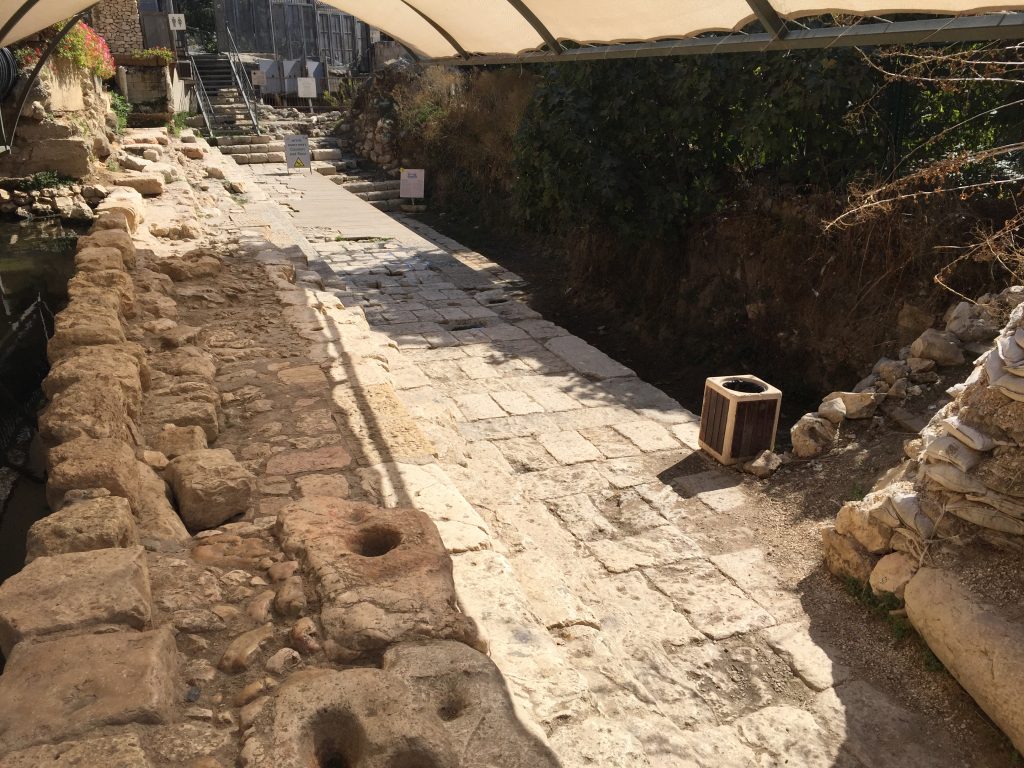
Municipal workers doing sewer work exposed old stone in the area in 2004. Archaeologist Eli Shukron recognized that the exposed pieces merited investigation. Excavation with Ronny Reich revealed a run of carefully built stone stairs and then more of the installation to which they belonged. The team found groups of steps interrupted by landings. The excavators interpreted that arrangement as a way to approach the water as its level changed. A long edge of stairs answers a different problem from a ladder, well shaft, or narrow channel. Many people could approach a large body of water from an accessible edge. Excavation account and photographs of the first exposures.
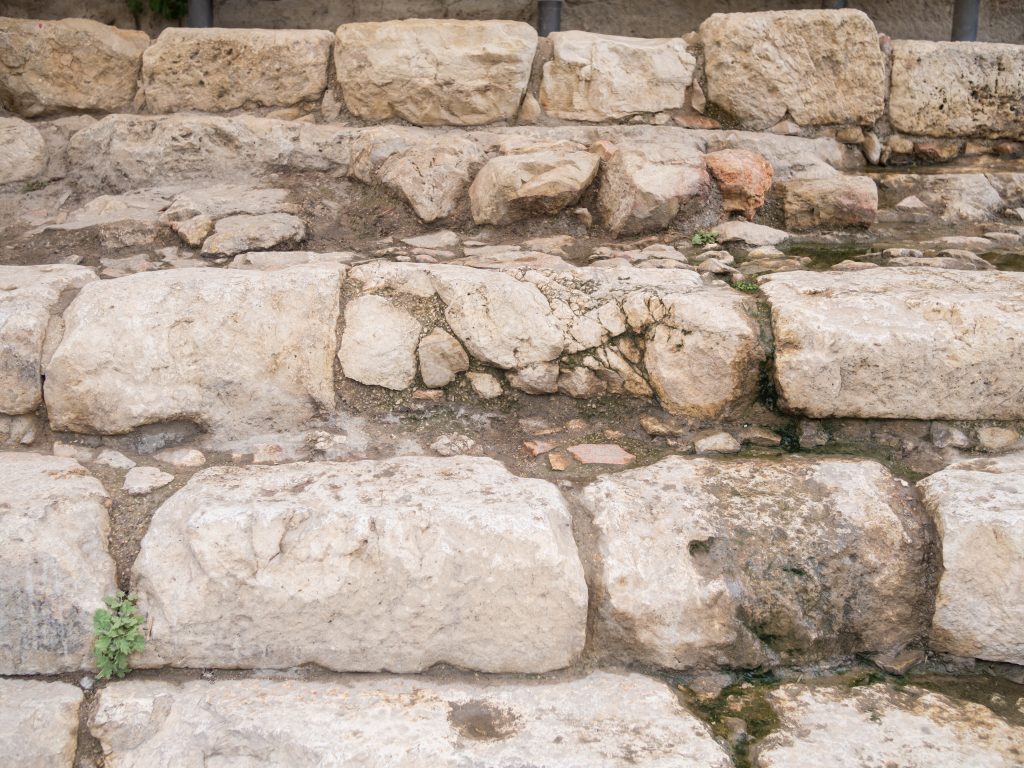
Finding a stretch of an ancient structure lets an archaeologist reason from that part to the whole, with appropriate limits. A turn at a corner gives a direction for the next edge. Steps that go down into a basin suggest where water could collect. An unfinished excavation still leaves stretches beneath later deposits or property. Reconstructions of the entire pool draw on its exposed portions, the shape of the ground, and the evidence of separate excavations. In a photograph, you are looking at the preserved material somebody can point to in the trench. An outline of the whole pool necessarily combines that evidence with inference.
The excavators traced more than 225 feet along an exposed side in the early work. They saw corners and understood that the alignment was more complicated than a simple square. Those observations explain why the shape in a reconstruction can differ from the square pool a reader may have imagined. A set of descending stairs worked along a broad edge. The descent was broken up by flat landings, so you could come to the water along a choice of approaches as the level permitted. On the published excavation photographs, the nearest lines of surprisingly regular stonework are more informative than the modern surfaces and supports around them. The excavators’ measurements and early site photographs.
What four small coins can tell us
One of the most informative features sat beneath the dressed stones. The excavators describe an early plastered phase and later stone facing. They reported coins of the Hasmonean ruler Alexander Jannaeus embedded in plaster. A coin gives an earliest possible date for the deposit that trapped it. It could have been used for years before it was lost or incorporated into the construction. The coins help put the first phase in the late Second Temple era, and their position in plaster supplies a better date for that phase than a coin collected from loose soil above it. The excavation account’s discussion of the plaster and coins.
Other coins came from near the pool and belong to the Jewish revolt against Rome in the late 60s AD. Their presence in excavated deposits helps establish activity in the area near the end of the Second Temple period. When several groups of coins come from different places in an excavation, it is worth asking what each group dates. A coin in a step belongs to one question. A coin lost on or near a terrace belongs to another. Together they help show why the large pool is a plausible part of the city known to the Gospel writers.
- Coins in building material give a lower chronological limit for that material.
- A plastered surface and the stone added over it can represent successive phases of renovation.
- Later losses and fill help tell the story of use, abandonment, or changed movement in the area.
The type of evidence matters especially in a city where soils wash downhill and builders rework earlier material. Imagine the same small coin in two different contexts. If it is pressed into wet plaster as that plaster is being laid, its age helps constrain when the surface was made. If it comes from debris carried into the pool long afterward, it may tell you more about fill than about construction. When you read a report, look for both the object’s date and the sentence describing what surrounded it. In this case that sentence is what makes the little coins relevant to a first phase of a very large structure.
Which pool carried the name Siloam?
Reich and Shukron identified the large pool at Birkat al-Hamra with Siloam in the late Second Temple period. In 2023, archaeologist Nahshon Szanton set out a different identification. He argues that the larger pool is better understood as Solomon’s Pool and that the ancient Siloam Pool should be located at the smaller Silwan Pool near the tunnel outlet. He brings the archaeology of the two structures together with the locations and names preserved in ancient sources. He also suggests different functions for the two pools, including ritual immersion at the smaller installation. These are separate questions. Date and location can be established materially even when matching an ancient place name takes further argument. Szanton’s comparative study in the Israel Antiquities Authority’s ‘Atiqot.
Excavations in 2023 and 2024 gave the later team another reason to reconsider the outline of the lower pool. They traced where part of the exposed staircase ends and found that it does not extend as far south as earlier reconstructions had suggested. Their preliminary publication uses that observation to question whether the monumental steps originally surrounded the basin. It also explores the possibility that some of the tiers served as seating. The excavated steps still belong to the archaeology of late Second Temple Jerusalem. Their newly documented limits change what one can infer about the entire structure and how people used it. Szanton, Vukosavović and Berko’s report, especially pp. 33*–38*.
A street, a gathering place, and the question of why people came
The pool sat near a means of moving between the lower city and the Temple Mount. Further excavation has traced sections of a monumental stepped street. The excavators associate the paving of the documented sections with the first century AD, drawing on coins sealed below it. A paved street establishes connectivity between different parts of the city. It also helps a modern visitor imagine more than an isolated basin at the edge of a map. The pool and surrounding routes were part of Jerusalem’s urban life. Israel Antiquities Authority report on the Stepped Street.
The purpose of each pool is a separate question from its date and location. The potential uses have included public water storage, bathing, ordinary washing and ritual immersion for those traveling to or within the city. A single installation could serve different needs over its life. John 9 supplies a particular use on a particular occasion. Jesus tells the man to wash. The account makes sense at an accessible pool while leaving its layout and everyday operation outside the scene.
There is also a much older structure to keep in view. A study published in 2025 dated plant remains trapped in the construction mortar of a monumental dam in the Siloam area, placing its construction around 800 BC. It gives the lower valley a longer history as a reservoir site. The date in that study concerns the dam investigated by that team. The dated dam and the late Second Temple stairs speak to successive phases of managing water in the same low area. That is one way to understand how two sets of excavators can work near one another and return with dates hundreds of years apart. Regev and colleagues’ study of the earlier Siloam Dam.
The stairs give us a place to picture the man’s obedience. John gives us the words with which he explains what happened.
Water also matters in other scenes in John. At the festival in chapter 7, Jesus speaks about coming to him to drink, and the narrator explains that he is speaking about the Spirit. Jewish accounts of festival practice help explain why some readers think about Jerusalem’s water sources when they read that passage. John 7 itself gives no journey to Siloam. Its place in the Gospel makes a significant comparison with John 9, where the story does name which pool the man should visit. The difference lets the two texts illuminate one another without treating an excavated water installation as an illustration for every verse about water.
Read the whole of John 9
Jesus and his disciples encounter the man before the pool enters the scene. The disciples ask whose sin accounts for his blindness. Jesus directs their attention toward what God will do, makes mud, puts it on the man’s eyes, and sends him to wash. John pauses to explain the meaning of Siloam as “Sent.” He lets the name of a known place participate in a story full of the question of who sent Jesus and by whose authority he works. We read John’s testimony as true. Jerusalem’s excavated streets and steps let us picture the plain and particular act with which the healing enters the man’s public life. John 9.
As the chapter continues, the man must tell people what he knows. Neighbors dispute his identity. Religious authorities question him and summon his parents. He describes what Jesus did and the result, eventually challenging the people who have asked him to repeat it. Knowledge grows through the chapter. At first he can give Jesus’ name. Later he calls him a prophet and insists on the significance of what happened. The encounter ends with Jesus finding the man again and the man believing and worshiping. It is worth following him all the way past the stairs because the water gives the story its turning point and the questioning reveals the cost of speaking about it.
The excavated installations help us read John with a more precise sense of the neighborhood. We can trace plausible places to go from a spring or street toward the water and see how the city invested in making water available. The identification of the exact installation John meant remains debated. John identifies the man’s destination by name and says what happened there. Begin again at verse 7 after looking at the photographs and the survey. A familiar phrase about going to wash now has a slope, several possible approaches, and a place in an inhabited city.
Sources and further reading
- Ronny Reich and Eli Shukron, The Pool of Siloam in Jerusalem of the Late Second Temple Period and Its Surroundings — Excavators’ extended presentation, Unearthing Jerusalem (2011), pp. 241–256.
- Nahshon Szanton, Ritual Purification and Bathing — Proposal distinguishing the smaller Silwan Pool from the larger Birkat al-Hamra, and separating their possible functions.
- Szanton, Vukosavović and Berko, New Archaeological Discoveries in the Excavations of Birket al-Hamra in Jerusalem — Preliminary findings from the 2023–2024 excavations, including the extent and proposed uses of the monumental terraces.
- Hershel Shanks, The Siloam Pool, with Reich and Shukron’s excavation evidence — Early account and site photographs of the step profiles, plaster and the two coin groups.
- Israel Antiquities Authority, Jerusalem, City of David, the Stepped Street — Archaeological context and the paved street linking areas near the pool and Temple Mount.
- Regev and colleagues, Radiocarbon Dating of Jerusalem’s Siloam Dam — Results for the earlier dam and its distinct Iron Age water system.
- John 9 — Jesus sends the man to wash, and the rest of the chapter follows the questions and testimony that result.