What would a bed of ivory have looked like in the eighth century BC? The wood of an ancient frame can disappear underground while the carved panels that once covered it survive. Excavators at Nimrud found thousands of pieces of ivory, including fragments of furniture, fittings, and small containers. Their original surfaces sometimes retain traces of color that a modern display can make easy to miss. They give us a way to picture the rich rooms that Amos asks his readers to imagine. They also show how much work and how many journeys could lie behind a costly furnishing in an Iron Age palace.
What you’ll learn
- Where separate groups of carved ivories were recovered at Nimrud, including in wells and storerooms.
- How researchers use the backs, borders, and imagery of individual pieces to understand their former settings.
- How the objects help us picture ivory furnishings in 1 Kings and read the prophet Amos with attention to the people he addresses.
The finds from a capital and an arsenal
Nimrud, ancient Kalḫu, lies south of Mosul in present-day Iraq. Royal buildings occupied part of its large enclosed area. Excavators found ivories at several points in the city, including the Northwest Palace and an extensive building at another edge of the site, known as Fort Shalmaneser. Although the palace and arsenal were part of the same capital, it matters which building and which room yielded a piece. A panel found in a storage room records a place it had reached before burial. A fragment found down a well tells us something about how an artifact was lost or discarded. Similar objects can have different histories of burial and recovery. Nimrud project overview of Fort Shalmaneser.
The major modern discoveries came out of mid-twentieth-century campaigns. In the late 1940s and 1950s Max Mallowan and his team recovered ivories from the Northwest Palace, including three features recorded as wells NN, AB, and AJ. Work at Fort Shalmaneser continued under David Oates and brought to light further groups of furniture pieces. Many were recorded in rooms leading off the southeast courtyard. Groups within the fort gave researchers material for comparing matching panels and components. Dates quoted for the ivories usually refer to manufacture or the life of the building. The date of a particular excavation season is a different piece of information. Met catalogue on the excavation campaigns and objects.
One well in the Northwest Palace held objects of several materials. The presence of a fine carving at the bottom of a well does not reveal when it was made or explain who last owned it. It can preserve the last stage we can observe in that object’s ancient life. Similarly, a concentration of missing, unfinished, damaged, or older furniture pieces in a storage room might have reached the room through more than one route. Looting during the city’s final years, storage by the palace, and normal reuse have to be assessed in light of the particular group. The publication of a group together is therefore valuable even when individual masterpieces eventually go on display in different museums. Nimrud project’s Northwest Palace finds and wells.
What a small fragment can show
A researcher would usually begin with features one can measure, including the width of a border, the depth of the carving, and the way a back was finished. These can help distinguish a panel made to cover a flat surface from a piece made to project. Repeated dimensions and mirrored elements can make a proposed reconstruction more persuasive. Even a physically coherent reconstruction presents one stage of a furnishing’s history. The maker can have replaced a broken panel, and the people who acquired a piece later can have mounted it on something else. Looking for wear and repairs is one way to ask whether the surviving arrangement was also the original one.
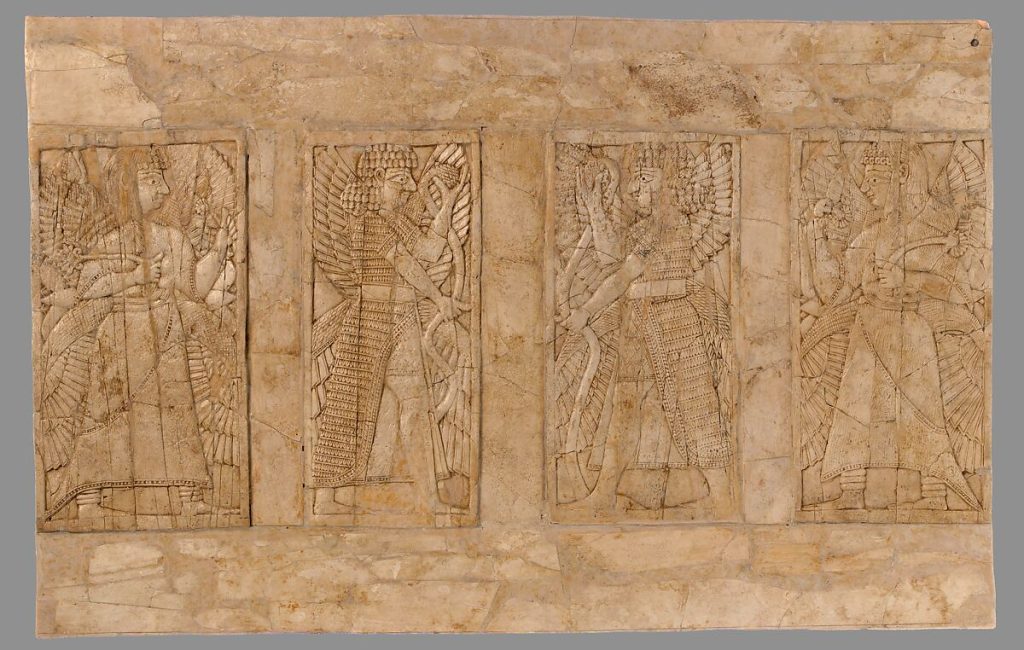
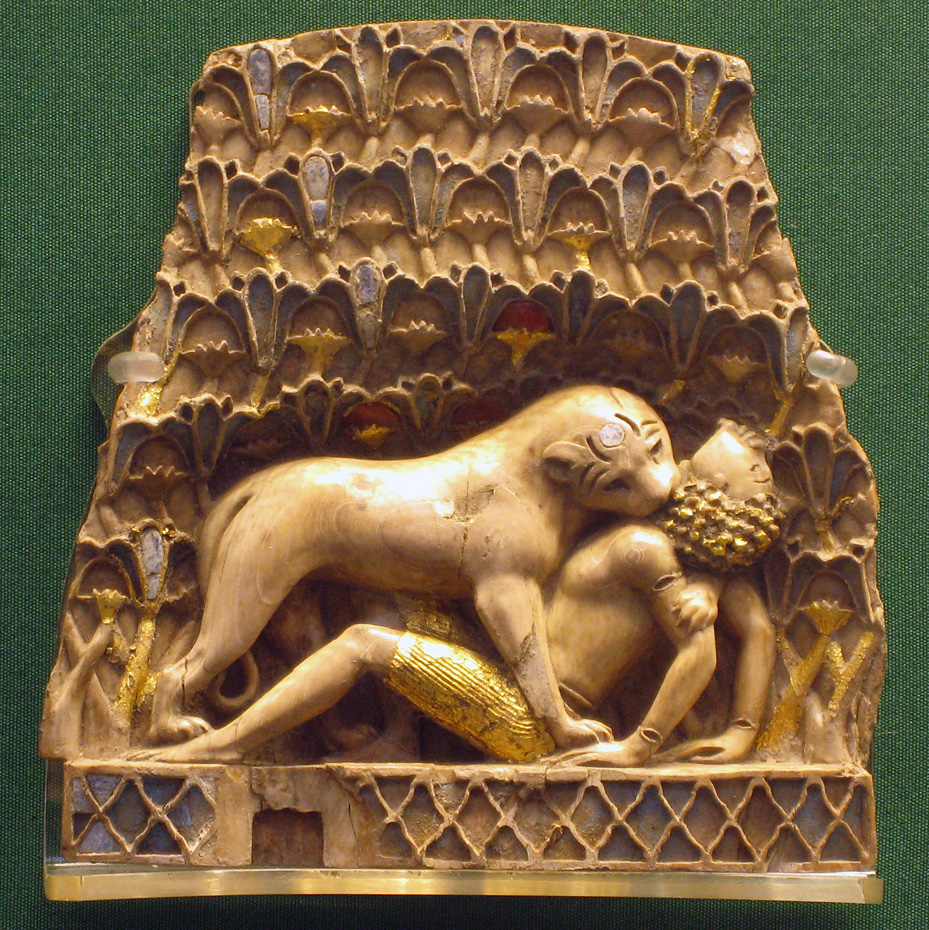
Look at the chair-back panel in the featured photograph. It covers considerable width as a finished work, and the pattern would have been seen again and again by people looking across a room. Small rectangular plaques had a different role. Many were fastened or fitted into a larger object. Breaks, flat backs, and borders help a researcher decide how adjoining pieces once met. A row of fragments with similar motifs and measurements may have belonged to a decorative program, though matching designs by themselves cannot prove the pieces came from one chair. Some ivories were made as parts of small boxes, fittings for horses, or personal adornments. A catalogue can distinguish among functions a photograph alone leaves open. Metropolitan Museum Journal study of furniture panels from Fort Shalmaneser.
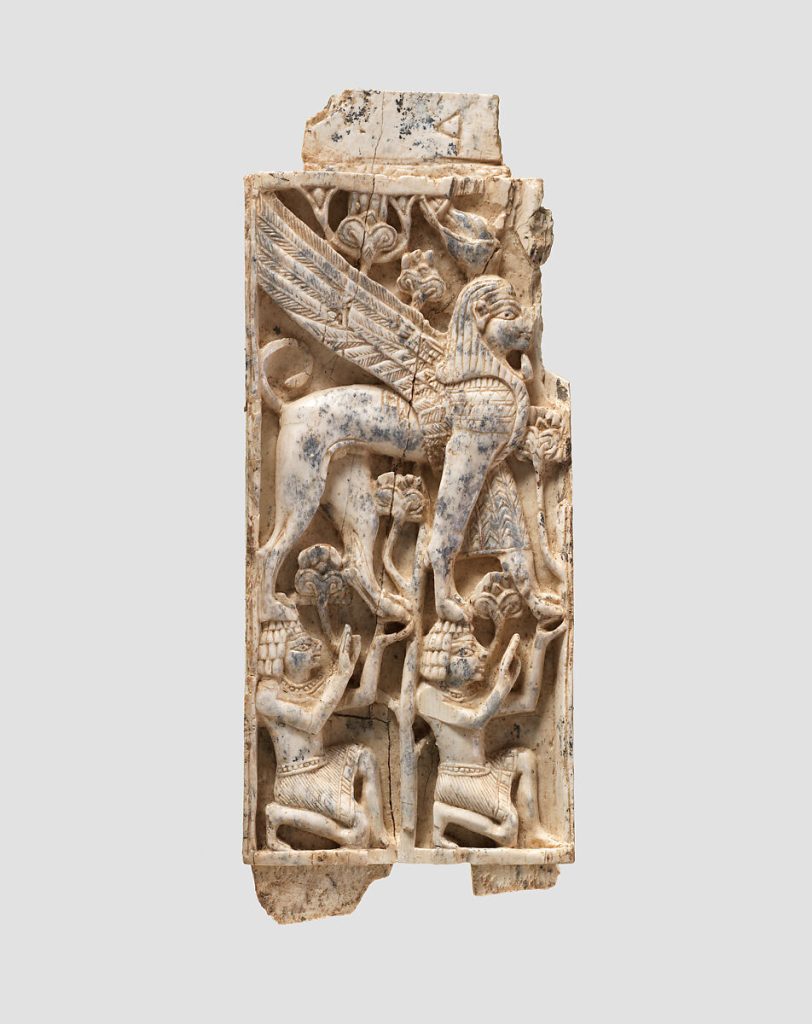
On the Fort Shalmaneser plaque the sphinx has a falcon’s head, wings, and a crown. The kneeling figures wear elements resembling Egyptian costume. The Met’s object account also draws attention to carving features associated with North Syrian works. It would be easy to identify the object as Egyptian by looking only at the figures’ clothes. The piece instead shows an artist drawing on designs that could travel between workshops and patrons. Researchers use the degree of relief, treatment of the face and hair, and repeated garment details to compare groups. Such stylistic judgments remain at a different level of certainty from a documented findspot in an Assyrian building. Met object record for plaque 64.37.6.
The wood of a chair can disappear while a strip of carved decoration survives. Follow the border and the backing to imagine how the pieces once belonged to a piece of furniture.
The surviving carved surfaces invite a second look at the materials. Some craftsmen used inserts of colored material or decorated parts of a plaque with metal foil. The brighter details changed how the surface caught light. The raw ivory itself had value even before a worker cut, smoothed, and carved it. Both elephant and hippopotamus ivory appear in the sources associated with Assyria and its external contacts. Identifying the species for a particular artifact takes object-level evidence. Historical terms for a material and the surviving properties of a piece can be used together, especially where repeated trade in raw material may have connected a number of distant communities to the same product.
How ivory reached an Assyrian palace
City and artifact can also have different kinds of dates. Fort Shalmaneser was associated with a ninth-century ruler, while the people who used its rooms in later generations had their own furniture and stores. The destruction of the Assyrian capital at the end of the seventh century provides a historical boundary for material sealed in that episode. A particular object could already have been old by then. To date the craftsmanship, compare closely related pieces, their individual contexts, and inscriptions where they exist. To date the end of a room’s use, compare its floor deposits, the debris that buried them, and the building’s wider sequence. Both questions help make sense of a museum label giving a range of centuries.
Royal inscriptions list ivory among the goods that kings received. Ashurnasirpal’s inscriptions describe tribute from communities on the Mediterranean coast. Records from the time of Shalmaneser III also mention ivory among valuable goods. One possibility for some of the finished objects recovered at Nimrud is that court officials collected them in campaigns or through tribute. Purchase, exchange, and workshops overseen by local rulers provide other historical paths a piece could have taken. An excavated room gives us evidence about where an object ended up. A record of tribute shows that some goods were transported under imperial demands. Connecting an individual uninscribed panel with a named ruler or payment takes further evidence. Nimrud project’s study of ivory, manufacture, and tribute.
The categories that scholars call Assyrian, Phoenician, and North Syrian are primarily tools for comparing the appearance and treatment of the objects. There were artists who shared techniques across regions and patrons who wanted a carving to look like work they admired elsewhere. Once goods arrived at a royal house, they could be kept for an extended time, turned into new furnishings, or placed in storage. Those processes explain why an early style might occur in a room that fell out of use later. They also account for a surprising range of carving styles within one modern museum case. An archaeological group can represent an accumulation over time.
Ahab’s ivory house and Amos’s beds
In 1 Kings 22:39, the writer refers to Ahab’s ivory house among the works remembered from his reign. Archaeologists also found carved ivory at Samaria, the capital associated with Ahab. The closest geographical parallels for the biblical wording come from Samaria. The assemblages at Nimrud give evidence from another major Iron Age city for how ivory was actually used in furniture and interior decoration. Together, the sites help us picture halls with fittings assembled from woods, ivory plaques, and sometimes contrasting colors. The Bible’s concise reference is compatible with the kinds of ornate furnishings that excavators have recovered. Met curator on ivories from Nimrud and Samaria.
Amos spoke in a later generation. In chapter 3 he calls attention to violence and oppression in the strongholds of Samaria and announces that houses of ivory will perish. In chapter 6 he addresses people reclining on beds of ivory, eating meat, and drinking from bowls while remaining unmoved by the ruin of Joseph. The prophet puts private comfort beside public injury. The expensive room is part of his evidence, because it shows what the people could afford to notice and whom they could choose to ignore. Reading 3:9–15 alongside 6:1–7 makes the social criticism clearer than reading the words about ivory in isolation.
A Christian reading takes the prophet’s warning seriously. The Lord sees how wealth is used, how people gain it, and how quickly comfort can teach a household to look away from someone in need. The archaeological pieces add substance to that reading. The labor invested in a carving and the networks that carried it to a palace make the furniture an especially telling sign of what rulers could command. Their beauty deserves careful attention. Amos asks us to give the same attention to the people hidden from view by the beauty of the room. For the architecture of this Assyrian capital, see the winged guardians of Nimrud.
Sources and further reading
- Nimrud ivories research — Nimrud project on finds, carving traditions, loot, and tribute.
- Fort Shalmaneser — Project account of the arsenal and storage rooms.
- Northwest Palace — Find contexts of wells and the palace’s later history.
- Met catalogue — Published excavation, artifact, and collection context.
- Furniture Panels from Nimrud — Published study of one group of carved objects.
- Met chair back 59.107.3 — Catalogued dimensions, material and context.
- Met sphinx plaque 64.37.6 — Catalogued imagery and excavated context.
- Ancient Near Eastern Ivories and the Bible — Met curatorial comparison with Samaria and Amos.