An ox breaks loose and kills somebody. The owner says it has never done anything like this before. A neighbor says everyone already knew that the animal was dangerous. That difference in what people knew changes the outcome in two ancient collections of laws. One survives on a basalt monument associated with the Babylonian king Hammurabi. The other belongs to the laws spoken to Israel in Exodus. The cases offer a surprisingly practical way into the archaeology of law and a chance to read the Bible’s account of responsibility in its own setting.
What you’ll learn
- How a Babylonian monument ended up at Susa, where it was found in the early twentieth century.
- Why knowing that an ox is dangerous changes the judgment in both legal collections.
- How the wording, penalties, and larger settings of the cases shape the question of their relationship.
A stone made in Babylonia and found in Susa
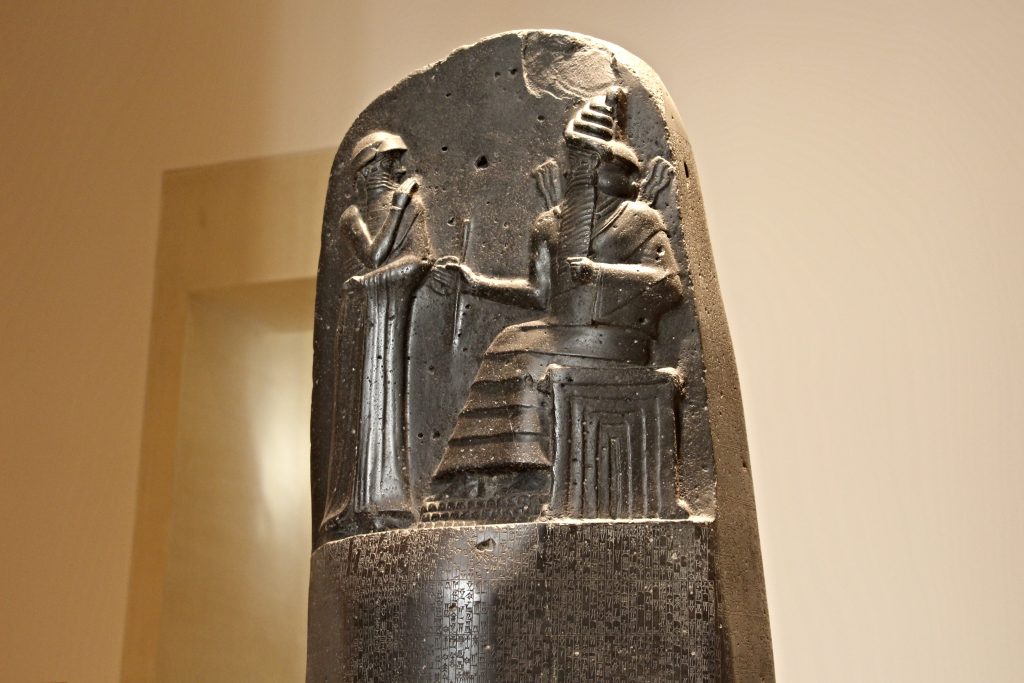
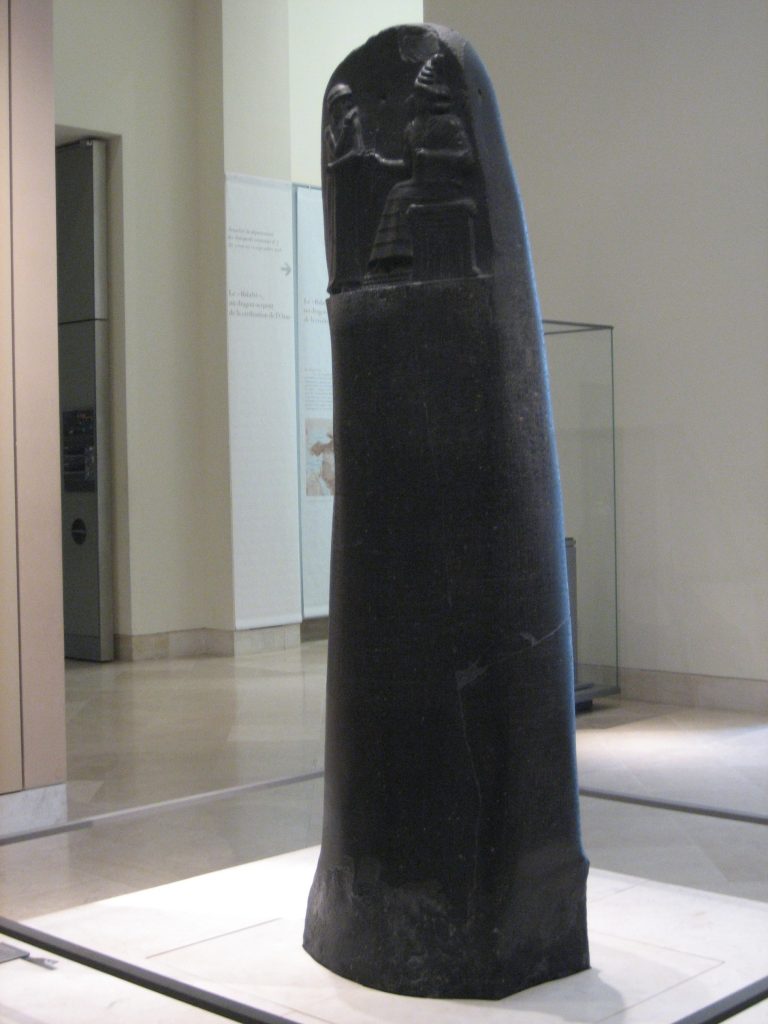
The Louvre’s stele is cut from dark basalt and stands more than 2.25 meters high. Its carved text dates to around 1750 BC in the museum’s presentation, near the end of Hammurabi’s reign. The relief occupies the top, with the written collection beneath it. Seen at this scale, the stone looks more suitable for display than ordinary writing or bookkeeping. Its size and the expense of creating it are part of what it communicates. Whoever stood before the installed stele encountered a royal claim about the king’s role in justice as well as a long and detailed text. Louvre, the Code of Hammurabi.
Excavators found the broken monument during French work at Susa in present-day Iran around the turn of 1901–1902. The Louvre identifies it as a Babylonian object brought to Elam as spoil centuries after it was made. Its findspot therefore tells us about a later chapter in its history. Susa’s excavations establish where the fragments were recovered. The inscription and relief refer to a Babylonian king and belong to the world of his reign. Keeping those two contexts in view is a way of understanding the object’s significance before and after it was moved. The modern museum arrangement joins a third chapter to both. Louvre collections record, Sb 8.
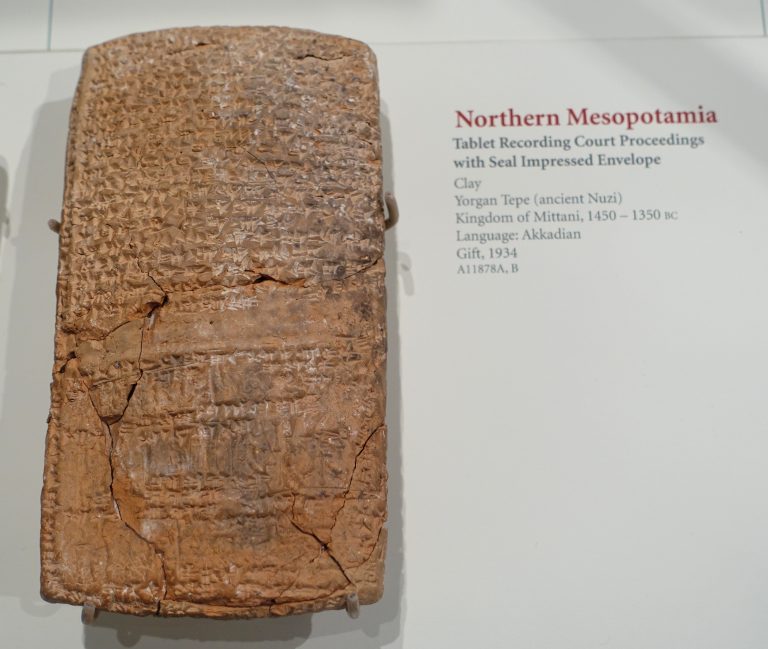
A stone monument is only one kind of evidence for law. A contract documents an agreement. A letter may show people asking for advice or a court’s intervention. An inscription that presents a ruler’s justice can show the kinds of dilemmas scribes and the court thought worth preserving. One document of this kind cannot establish how judges decided every comparable case in every Babylonian town. It can tell us what questions the literary collection expected readers to separate and how it formulated its answers. The words conventionally translated as laws repay a very close look.
Look first at the relief, then at the cases
At the summit, Hammurabi stands before Shamash, the sun god associated with justice. Shamash’s rays give him a recognizable identity, and the image presents the king in the presence of divine authority. The Louvre describes the objects held out to the king as insignia of power. In the written prologue and epilogue, Hammurabi presents his reign as an administration of justice. The arrangement of image and text makes that claim visible from the top down. It also prepares the reader to ask how this ruler presents his authority before the text introduces disputes over injury, property, family, work or debt. Louvre discussion of the carved relief.

The text conventionally called the Code contains a long series of cases, many phrased around a condition followed by its consequences. Modern editions number them for reference. Starting with a number makes it possible to compare a particular question instead of trying to summarize every rule in the monument. For example, the cases about injury in numbers 196–199 distinguish situations according to a person’s social position. Readers who have heard that the stele contains a rule about an eye for an eye can check the surrounding cases to see how the collection also calls for different responses under different circumstances. The numbered Hammurabi cases in L. W. King’s translation.
The dangerous ox makes the ancient question concrete. A person’s responsibility depends on what the person already knew.
Compare the ox cases
In the group conventionally numbered 250–252, the Babylonian collection gives one treatment to an ox that kills unexpectedly in the street and another to an animal with a known history of goring. In the latter case the owner has reason to contain it. Neglect exposes the owner to a financial penalty if the ox kills. The text distinguishes offenses involving people of different status when determining the payment. The importance of the animal’s history is worth looking at before the sums. The case turns on what risks the owner could be expected to recognize and what precautions should have followed. Hammurabi, cases 250–252.
Exodus 21:28–32 makes an equally recognizable distinction. An ox that gores a man or woman to death is to be stoned, and its flesh is excluded from eating. The owner in the first case is clear of the penalty. If the animal was known to gore and the owner had been warned, the owner is liable for death as well. The text then allows for a ransom where one is imposed. It gives a separate amount when the dead person was enslaved. As in the Babylonian collection, reading the neighboring cases matters. They specify whose history or status the law takes into account and what changes when there was warning. Exodus 21.
- Read the first case in each collection to see what happens when the attack comes without an established history of danger.
- Find the words marking prior knowledge and ask what each owner was expected to do.
- Compare the result for the owner and the treatment of the animal. Those details distinguish the judgments even where the cases share a pattern.
This is a more instructive example than searching for a famous phrase alone. Two people could use the same phrase for comparable injuries while arriving at it independently. Here the order of the cases also matters. A common practical problem is broken up according to the animal’s history and the owner’s knowledge. That is a particular structure as well as a shared topic. At the same time, the two texts assign different consequences and organize them within different moral and social worlds. The details matter in both directions. Similarity prompts a question about relationship. Differences show where the two texts cannot substitute for one another.
Exodus also distinguishes victims within these cases. Verses 28 and 29 speak of an attack on a man or a woman. Verse 31 brings a son or daughter within the same rule. Verse 32 addresses an enslaved victim and stipulates a payment to the person who owned the slave. The ancient institution of slavery is part of the setting in which these laws speak. Reading all the provisions helps us see the protections, obligations and differences in financial liability actually discussed. A single slogan about the law would miss the effort the writer makes to work across several kinds of case.
How closely were the collections related?
David P. Wright reads the parallels as evidence that the Covenant Code in Exodus used and revised the Laws of Hammurabi. In his chapter on the goring ox, he argues from the sequence and wording of the cases as well as their subject. A relationship of that kind is a stronger claim than saying the two texts reflect concerns shared by people who kept cattle. It makes a claim about an author’s access to specific legal material and about how that material was adapted. To weigh it, compare a series of cases rather than one phrase, and look for credible ways such collections could have been transmitted through scribal communities. Wright, The Goring Ox and Negligence.
A finding engraved around 1750 BC gives us a firm point in the history of one written witness. It supplies neither the date when every kind of case first arose nor the chain by which a similar case might have reached another society. Practices shared over time can give rise to related cases. A literary author may also select and reshape earlier material. These possibilities call for careful reasoning about the surviving evidence, and a date alone cannot do that reasoning for us. The comparisons remain valuable even where readers disagree about an exact line of dependence.
We can test the comparison with one other set of property cases. Hammurabi 53–54 describes consequences if a person fails to keep a dike in repair and water damages fields. Exodus 22:5–6 addresses the losses caused when animals graze in another person’s field or a fire spreads. Each text gives practical attention to damage that reaches another household. The concrete circumstances differ, and so do the ways the collections group and resolve them. Reading one parallel with other kinds of comparison in view helps a reader assess what is distinctive about the goring ox cases. Hammurabi 53–54.
There is a further question of genre. A monument beside a statue, a copy made for scribal study and an account of a court case can all contain legal language. Their makers chose different ways of addressing an audience. A royal stele holds out a model for judging, and subsequent readers can ask how closely it was followed in practice. The laws in Exodus belong to a narrative of God speaking to his people. A historical explanation of shared legal vocabulary leaves those different purposes visible.
Read the laws inside the story Exodus tells
Exodus frames its laws within the covenant the Lord establishes with Israel. The people have been brought out of Egypt. They hear commandments and cases, promise obedience, and enter the covenant in the ceremony described in chapter 24. That setting is worth restoring when the goring ox is read as a small excerpt. An owner’s responsibility is one question about a community’s life before God. Would the owner take a warning seriously? How should a community judge a failure to act when another person’s life is at risk? The law gives those questions a concrete form.
As Christians, we trust the Bible’s account of the God who delivered Israel and called the people to live within his covenant. Seeing an ancient Babylonian text address a similar problem helps us imagine why such cases mattered in an agricultural community and why the distinctions in Exodus are so precise. Give each passage its own full reading. The stele preserves Hammurabi’s monumental presentation of royal justice. Exodus gives the goring ox a place within the covenant’s demands about ordinary life. Reading those contexts alongside the shared legal question leaves the resemblance visible and gives us more reason to attend to each text.
Sources and further reading
- Louvre, The Code of Hammurabi — Museum interpretation of the material, approximate date, relief and later recovery.
- Louvre collections, Code de Hammurabi, Sb 8 — Object identification, iconography, production and findspot.
- L. W. King, Code of Hammurabi, Yale Law School Avalon Project — Numbered English translation, especially cases 196–199 and 250–252.
- David P. Wright, The Goring Ox and Negligence — Comparative proposal on wording, sequence, and the relationship of Exodus 21 to the Babylonian cases.
- Exodus 21 — Injury and liability cases, including the attack by an ox and neighboring laws.