In John 5, Jesus goes to a pool in Jerusalem and meets a man who has been ill for thirty-eight years. The Gospel gives the place an extraordinary little detail. It had five covered colonnades. A pool with a colonnade around each side would have four. Why did this one have five? Near St Anne’s Church, excavators found the remains of two adjoining basins with a substantial division between them. A fifth covered walkway along that division is the leading explanation of John’s count. Once you see how two pools share a middle line, the description becomes surprisingly easy to picture. Shimon Gibson’s structural study of the Bethesda complex.
For Christians who receive the Bible as true and accurate, the excavation invites us to slow down over a feature John expected his readers to retain. The pool was a place where people waited, watched and hoped for help. Its architecture matters because the covered spaces took a role in the life John describes. The site also contains later buildings and accumulated debris. To read it well, we have to distinguish the place Jesus visited from what later residents, worshippers and excavators left in the same ground.
What you’ll learn
- Why a double pool provides a plausible layout for five porticoes.
- What Schick and later investigators found, and how they distinguished older pool engineering from the buildings that followed.
- How the Bethesda setting helps us understand the man’s circumstances and the dispute after his healing.
Look for two basins and a middle wall
The complex lies in the northeastern part of the Old City, near St Anne’s Church and north of the ancient Temple platform. John locates it by the Sheep Gate or the Sheep area, depending on how readers supply the implied reference in the Greek. A Sheep Gate also appears in Nehemiah. That earlier reference gives us a biblical name associated with this part of Jerusalem. Fixing the exact position of a gate in different centuries requires further evidence. The association in John gives the pool a location within a recognizable part of the city. Gibson on Bethesda and the Sheep Gate, pp. 22–23.
A portico is a roofed walkway or open-sided colonnade. Imagine four around the outside of a pool complex. Now add the long division across its middle. A roof along that division gives a fifth covered strip and makes it possible to face water on either side. The pool outlines drawn by investigators are irregular, and this simple count of walkways is a way to grasp their relationship. The central division is substantial enough to account for why the additional line of circulation makes sense. An image showing five complete walkways represents an archaeological reconstruction of the former arrangement. Gibson’s layout of the two pools and barrier, pp. 23–25.
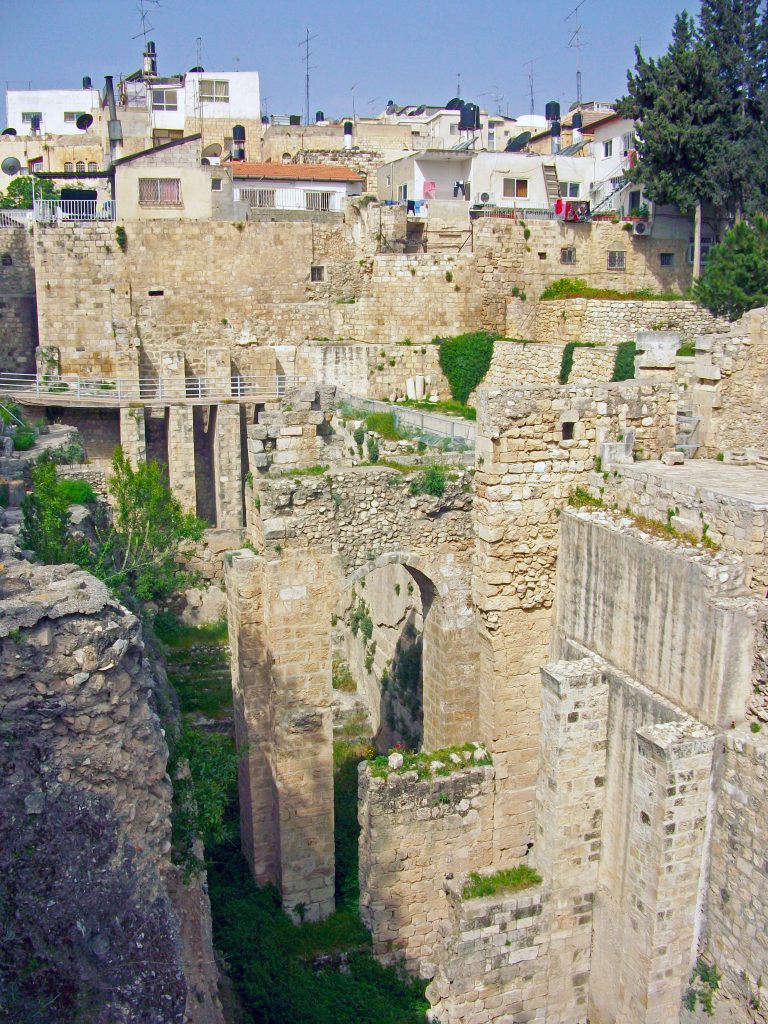
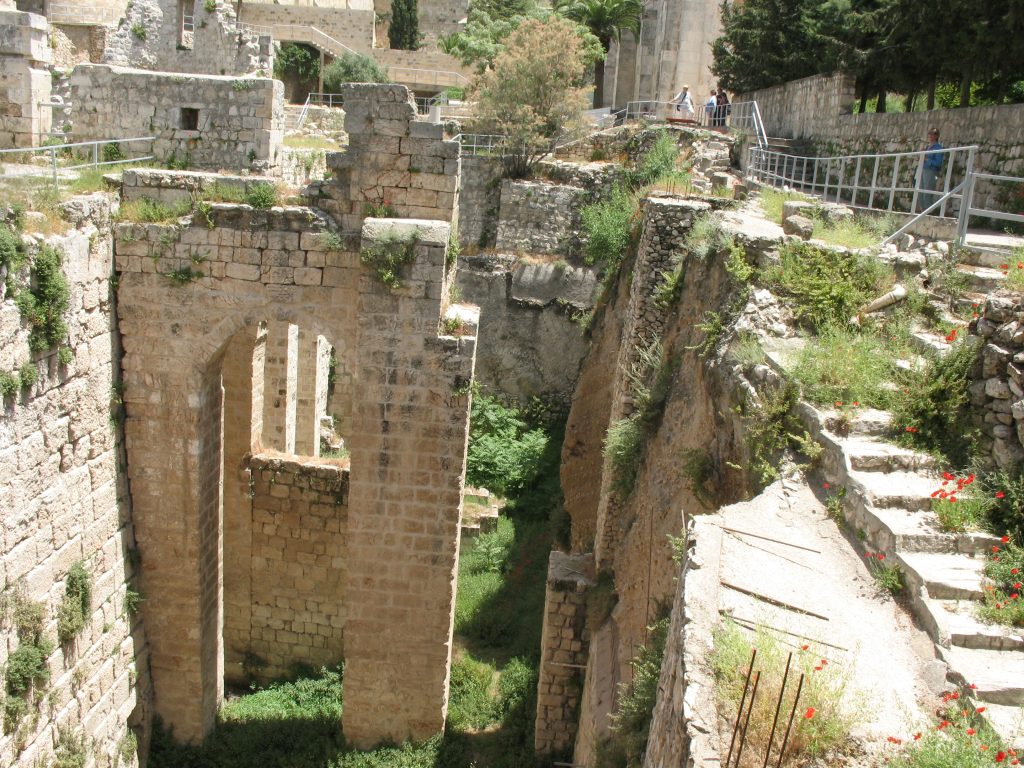
The depth of a wall in the photograph can take you by surprise. The bottom of a large reservoir may lie well below the surface a visitor uses to get around the site. Today, railings and paths mark the modern view. Above and beside the older work sit walls that belong to other centuries. The image is a useful check on any reconstruction. It shows why archaeologists have to follow masonry across several heights and through places where later builders removed or covered earlier features.
How the site came back into view
Excavation near St Anne’s began in the nineteenth century. Conrad Schick’s 1888 report describes the investigations and connects the remains with earlier accounts and the pool named in John. Other investigators, including members of the École Biblique, continued uncovering and documenting features in the twentieth century. A search that began with a familiar biblical name came to depend on architectural work. Where did an exposed wall continue? Which surfaces were plastered to hold water? How could two openings be placed in relation to the same large barrier? Questions like those give a suggested identification something a reader can test. Conrad Schick, Pool of Bethesda, 1888 · Gibson’s excavation history.
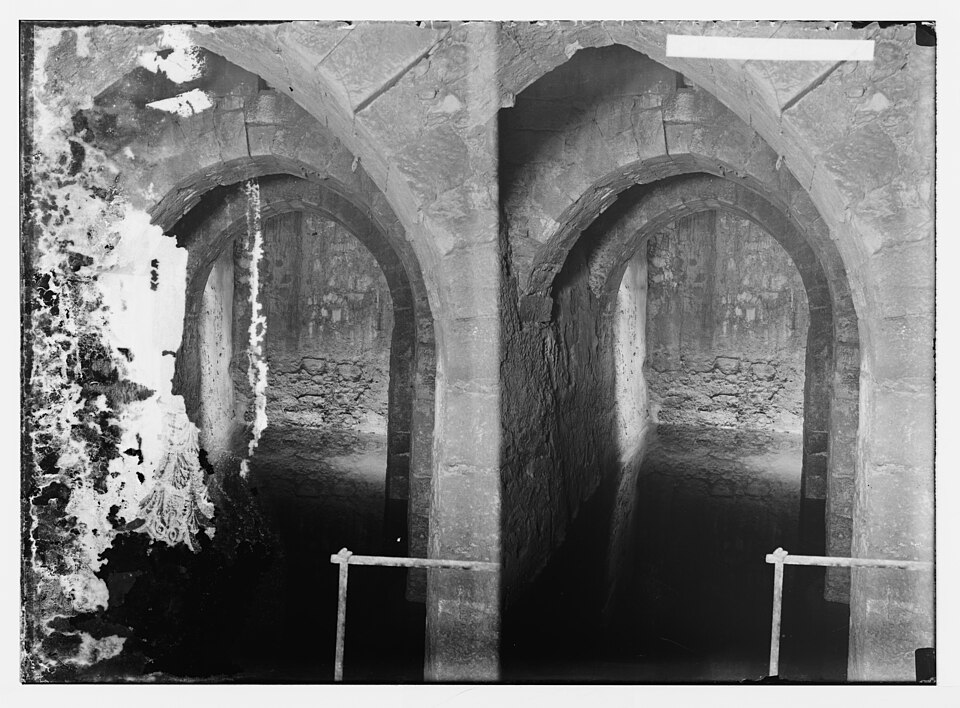
The historic photograph gives us one stage in that long process. The view records visible openings, walls and debris at the time it was taken. Look at the dark space below the masonry and at the higher surfaces that continued beyond it. An excavator maps both so later researchers can compare the drawing with what survives. Gibson’s project, which began in 1999, reexamined the visible remains, including openings below ground, and compared plaster, stonework and structural relationships. The work shows how an old excavation can yield new historical information when someone systematically measures features left exposed and considers them together. Gibson on the project’s survey and recording methods, pp. 19–21.
The written record between the Gospel and the excavators matters here. The account of a traveler from Bordeaux who visited Jerusalem in AD 333 describes twin pools in that part of the city and associates them with five porticoes. Later descriptions give their own accounts of what a visitor could see or what people remembered standing there. The fourth-century testimony helps explain why some nineteenth-century investigators looked for a divided pool in this area. It also needs to be read at its own date. Those travelers were walking through a city that had changed radically after the first century. George van Kooten’s review of early descriptions of the site.
Scholars have also asked what John’s present-tense description of the pool can tell us about the date of the Gospel. That is a separate step from identifying the place. Archaeology can establish that a plausible site existed and show how later buildings affected it. To use the wording as evidence for when the Gospel was written requires an argument about the writer’s choice of tense and the visibility of the site at that time. The pool’s layout can help us understand the account even where readers reach different judgments about when its description was written.
A water system with a long history
Gibson’s reconstruction gives the two basins different roles. The northern held collected water. The southern had steps that could give access at different heights as the level changed. He associates the design with Jewish ritual purification and describes openings in the dividing wall that regulated the transfer of water. Earlier researchers proposed different construction sequences, and the exact chronology of the initial work has been debated. Take the physical evidence first. There were adjoining basins, a substantial barrier, openings for water and stepped access in the southern part. The reasons for each design feature are explored by comparing their relationships and the water installations known elsewhere in Jerusalem. Early Roman period, barrier and steps, pp. 22–27.
The site later acquired healing associations in Roman times. Votive objects, offerings made at a shrine, belong to the investigation of that later setting. A large Byzantine church was built over part of the complex in the fifth century, and a medieval chapel introduced more construction at the site. Older walls sometimes served as foundations for installations with entirely different purposes. A column lying beside a pool wall can therefore belong to a church built long after the pool was first used. The lesson applies to other Jerusalem sites, including the pools and waterworks associated with Siloam. Ask what part of the structure a photograph shows before deciding how closely it illustrates a particular century. Gibson’s Late Roman, Byzantine and Crusader sections.
The fifth portico becomes easier to imagine when you see that the pool had a middle as well as an edge.
Read the encounter in John’s setting
John places people with illnesses or disabilities at the pool. When Jesus asks one man whether he wants to be made well, the man describes an obstacle that belongs to life in a crowded place. He has nobody to put him into the water when it is stirred, and someone else gets down before him. Broad steps can make entry possible for many visitors. A person with limited mobility can still depend on help to use them. The relationship between the covered gathering areas and the accessible water gives the man’s answer a physical setting. It also brings into focus what he lacked during his repeated attempts to reach the pool. John 5:1–9.
Readers may notice a difference between Bible editions at this point. Some include a line explaining the disturbance of the water by an angel. Several early Greek manuscripts omit that wording, and many translations print it in a note. The man’s own explanation about the stirred water in verse 7 remains part of the account. Investigators have discussed ways water could move in a system with channels and controlled flow. The physical possibility of moving water can help us picture the setting. The study of manuscripts answers a separate question about the wording copied at this point in John. NET Bible textual note on John 5:3–4.
Jesus tells the man to get up, take his mat and walk. The verse gives the action in quick succession. After a scene structured around the man’s unsuccessful attempts to enter the water, he carries his mat away. John then gives special attention to the fact that the healing took place on the Sabbath. The man faces questions about carrying the mat and identifies Jesus only after meeting him again in the Temple. A compassionate act in an ordinary gathering place moves into a public dispute about the authority with which Jesus works. John 5:8–18.
Follow the account beyond the pool
Jesus’ reply directs attention to the work of his Father. The rest of John 5 develops that relationship and speaks of the Son giving life, exercising judgment and deserving honor. The location and detail of the healing give a beginning to that argument. The Gospel joins what a man could do with his own legs to what Jesus says about his authority. We can appreciate the actual walls, water and access routes around the narrative, then read through the exchange to see how John uses the healing to teach readers about the Son. John 5:17–29.
At Siloam in John 9, Jesus sends a man there to wash. At Bethesda in John 5, Jesus speaks to a man who has remained near the pool and tells him to rise. The two accounts deserve their own settings. Bethesda’s linked basins help us recognize one memorable detail in John 5 and imagine how a crowd could gather beside the water. The visible remains repay a second look with that image in mind, especially when you pause to separate the old pool work from the later walls. Then return to John’s account and see what the man carries into the rest of the chapter.
Sources and further reading
- Conrad Schick, Pool of Bethesda (1888) — Early public excavation account and identification of the twin pool remains.
- Shimon Gibson, The Excavations at the Bethesda Pool in Jerusalem — Primary structural study and excavation history. Early Roman section discusses reservoir, steps, barrier and five-portico reconstruction.
- George van Kooten, The Pre-70 CE Dating of the Gospel of John — New Testament Studies 71, 2025, pp. 29–55. Reviews historical testimony about the five porticoes and the site’s later phases while proposing a dating argument.
- John 5 — The healing, the subsequent Sabbath controversy, and Jesus’ teaching about the Father and the Son.
- NET Bible, textual notes on John 5:3–4 — Explains the manuscript variation in the explanatory wording about stirred water.