At ancient Corinth, a line of large letters runs across a set of paving stones. Most of the metal that made the letters visible to a Roman pedestrian has disappeared. The channels cut to hold it remain. They preserve the name Erastus and a statement that he paid for paving in connection with his office as aedile. In Romans 16:23, an Erastus sends greetings and is identified with a different title, in Greek, as a city official. The two records make a striking comparison. Whether they name one man depends on when the pavement was laid, what each office was, and how much weight the shared name can carry. John Harvey Kent, Corinth VIII.3, no. 232.
What you’ll learn
- How discoveries in 1928, 1929 and 1947 completed the surviving wording.
- Why historians disagree about the date of the paving and the Greek office in Romans.
- What the pavement contributes to a reading of Paul’s greetings even without a settled identification.
Pieces of a public gift
The decisive slab was recorded in place in April 1929 in the square east of the theater’s stage building. A fragment of an adjoining slab had already been found in 1928 in the eastern entrance passage to the theater. A further piece, recovered in 1947 in a later building southwest of the theater, helped complete the wording. The find contexts distinguish one slab anchored to the arrangement that excavators observed from pieces moved in antiquity. That difference matters when the date assigned to the adjacent buildings is used to date the inscription. Fragments of one monument can have different archaeological histories after they leave their original positions. Kent, find details and reconstruction · David Gill, the pavement and text.
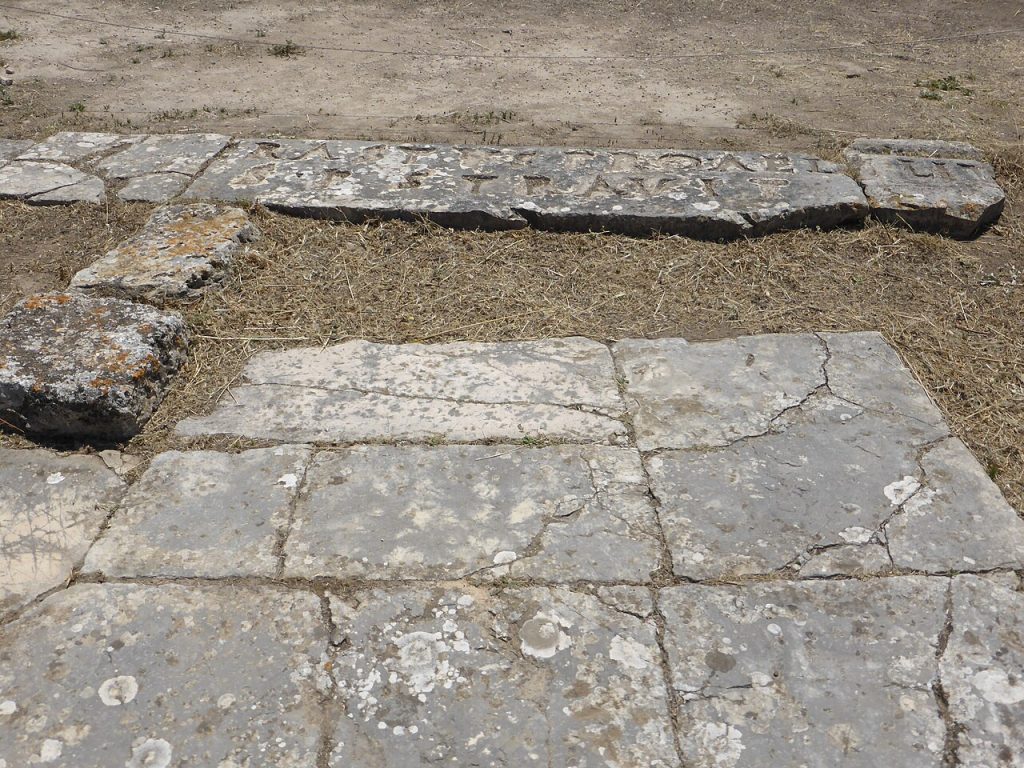
The stone was gray limestone from Acrocorinth. The monument would have spanned three slabs, with letters about eighteen centimeters tall. A gutter ran along the edge of the paving above the inscription. Most of the lettering survives as cuttings, though Kent reported metal still in place in two punctuation marks. The workmanship has practical and public dimensions. The stones had to serve as paving. The inscription had to catch the attention of people crossing the space. Its scale and position are good reasons to see the text as part of how a public gift was represented to the people who used it. Kent, no. 232 and plate 21.
The 1947 fragment also helps explain an error that a reader can still meet in reproductions of the first report. From the letters PRO AED, some early readers tried to reconstruct two different offices. The near-complete ending makes a single construction, pro aedilitate, the well-supported reading. The phrase connects the gift with the aedileship. The words abbreviated near the end indicate that he paid from his own money, and the verb identifies an act of paving. The missing start may once have named him more fully. The surviving part establishes Erastus, while the rest of his name remains unavailable for comparison with other records. Kent’s account of the early readings and the later join.
A stone can name a man with unusual clarity while leaving his precise date and relationship to another source open.
Why the date is still discussed
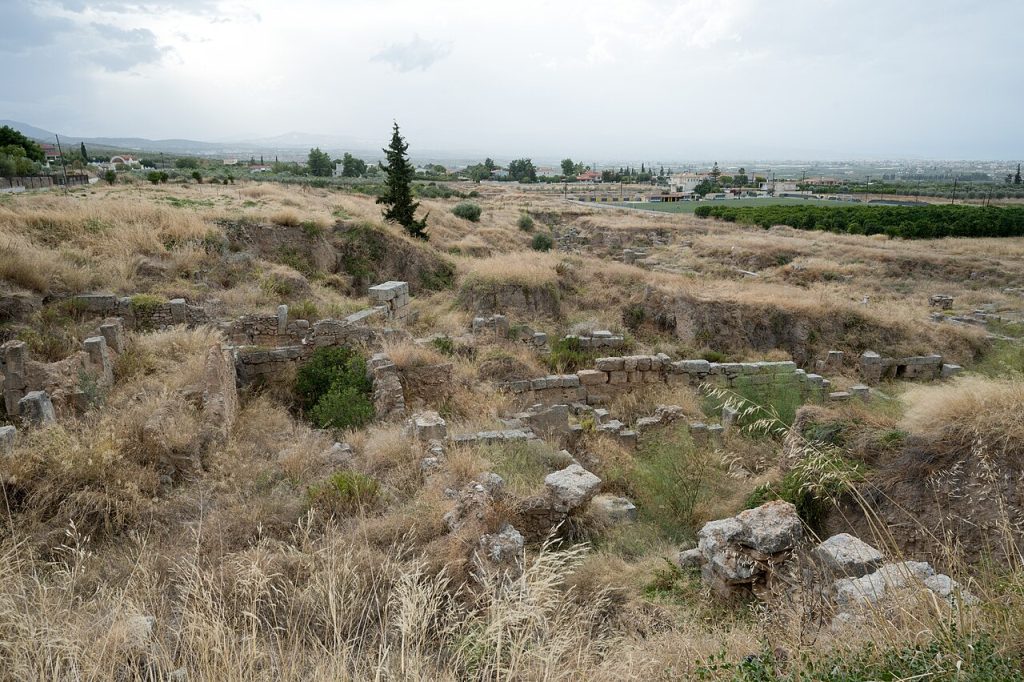
John Harvey Kent’s excavation catalogue assigns the pavement to around the middle of the first century AD. That is compatible with the usual dating of Romans to the AD 50s and is part of the positive case for an identification. A dated name on a paving stone could give an independent contemporary association with the city that Paul knew. The argument depends on the archaeological date, however, and the name engraved on the stone is no shortcut to that date. Archaeologists have to look at the histories of the adjacent structures, the paving and each deposit used to connect them. Kent, no. 232.
Steven Friesen has argued for a later sequence. In his account, the paving is tied to alterations near the theater that postdate the last use of an adjacent latrine in the Hadrianic period. If the inscribed monument belongs to that episode of work, its installation would be no earlier than the second century AD, too late for the aedile to be the Erastus sending greetings in Romans. Friesen also explains why the dating stops short of certainty. The key is how securely the inscribed slabs are linked to that phase of the plaza. Proposed dating based on associated work is as strong as the relationship between that work and the object being dated. Friesen, discussion of the date of the Erastus inscription.
The distinction can be tested with a simple question. If a stone was found where feet once passed over it, does that mean every wall around it was built at the same time? A street can be repaved. A drain can be covered. A dated deposit sealed beneath one surface can supply a lower bound for that work while leaving another surface to be dated separately. Excavation records are especially valuable here because they let later scholars revisit where each feature sat and which reconstruction uses which relationship. An overlap between one possible archaeological date and the biblical date remains a reason for comparison, while the chronological debate lowers the certainty of the match.
What the two titles mean
An aedile held a Roman municipal office. In a colony such as Corinth, the office belonged to public life and was associated with duties including aspects of the upkeep or regulation of the city. The pavement’s language presents the gift in relation to that office. In this setting a public dedication can show the relationship between private expenditure and civic standing. Others would walk across the results of the officeholder’s expenditure and repeatedly encounter his name. The stone says nothing about whether Erastus belonged to a Christian assembly. Its concern is the public gift and the office that supplied the occasion. Gill, the Corinthian aedileship.
Paul calls his Erastus oikonomos tēs poleōs, a Greek phrase many English Bibles render city treasurer. Scholars disagree about which position that description corresponds to in a Latin-speaking colonial administration. Gill judged a connection with the aedileship plausible. John Goodrich argued, from inscriptions including evidence at Patras, that a municipal quaestor was a closer equivalent. Alexander Weiss countered that this office has not been shown to exist at Corinth itself. Another view places Paul’s Erastus lower in the administrative hierarchy. Each approach illustrates the same difficulty. A Greek expression in a personal letter and a Latin title in civic stone have to be compared within the institutions of a particular city. Gill’s interpretation · Goodrich on the quaestor proposal · Weiss’s response.
Someone could hold different responsibilities over a career, and it is sometimes suggested that the two titles refer to an earlier and a later role. To establish that, we would need an independent indication of which offices this Erastus actually held, and when. A separate inscription naming both offices or preserving a distinctive fuller name would strengthen the comparison. The evidence now available explains why some researchers favor the identification and others question it. Name, place, civic connection and one plausible date are real points of comparison. Disputed chronology and uncertain equivalence of office are meaningful constraints.
Read the surviving abbreviation for personal expense next to the missing part of the name. Each teaches a different lesson about how an inscription is restored. A usual civic formula, plus a nearly complete verb and the physical place of the letters, can give grounds for an editor to expand an abbreviation. No comparable formula can supply a specific person’s missing name. An editor can indicate that the opening probably accommodated parts of a Roman name without inventing those parts. The difference makes it possible to say something definite about how Erastus represented the cost of the gift while remaining uncertain about the clues that would identify him elsewhere. Kent’s editorial notation, no. 232.
The city official in Paul’s closing greetings
Romans 16 shows a letter passing through a network of people. Phoebe is associated with Cenchreae, Corinth’s eastern port. Tertius identifies himself as the one who wrote down the letter. Gaius appears as a host, and Erastus and Quartus send greetings. Together with Paul’s travel plans in Romans 15, these associations help explain why many readers place the sending of the letter in Corinth or its vicinity. Erastus also appears as a name in Acts 19:22 and 2 Timothy 4:20. Those short notices do not give us a secure means of deciding whether all three passages refer to the one person. It is worth reading the immediate context of each before putting the names together.
The pavement brings the public city into view alongside that network. One text speaks in the voice of a benefactor putting his name into civic space. The other puts a civic official’s name among people exchanging greetings between communities. As Christians, we receive Paul’s letter as true and can listen to what his manner of naming people tells us. He places a man with a city responsibility in an ordinary line of greeting, alongside a brother he calls Quartus. A city, an office, a writing hand and a house that offered hospitality are all present in the closing chapter. The history of public office at Corinth lets us hear those names in the world where they were spoken.
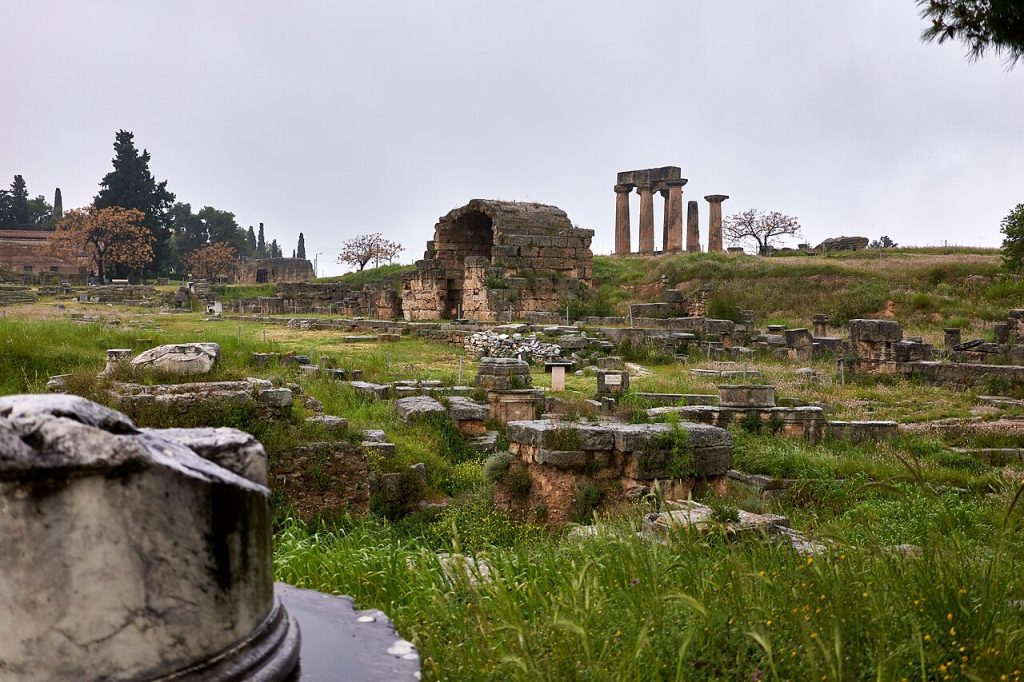
For another way an inscription illuminates the same city, see Gallio’s inscription at Delphi. The Delphi stone supplies an imperial context for a Roman officeholder named in Acts. The pavement illustrates a different kind of connection. It confirms a civic name and a public act at Corinth, and it invites further work on the connection with a person known through a letter. Read the last lines of Romans again with the surviving letters underfoot in mind. The town where someone could pay for a pavement was also a place from which Paul’s coworkers and acquaintances could send a greeting to Rome.
Sources and further reading
- John Harvey Kent, Corinth VIII.3, The Inscriptions 1926–1950 — No. 232, pp. 99–100 and plate 21, principal catalogue of the surviving slabs and text.
- David W. J. Gill, Erastus the Aedile — The pavement, public gift, colonial offices and arguments for a possible identification.
- Steven J. Friesen, The Wrong Erastus — Case for a later context and distinct administrative role, and qualifications on the pavement’s dating.
- John K. Goodrich, Erastus, Quaestor of Corinth — Epigraphic argument for understanding the Greek designation as a municipal financial office.
- Alexander Weiss, Keine Quästoren in Korinth — Counterargument about the municipal evidence for quaestors at Corinth.