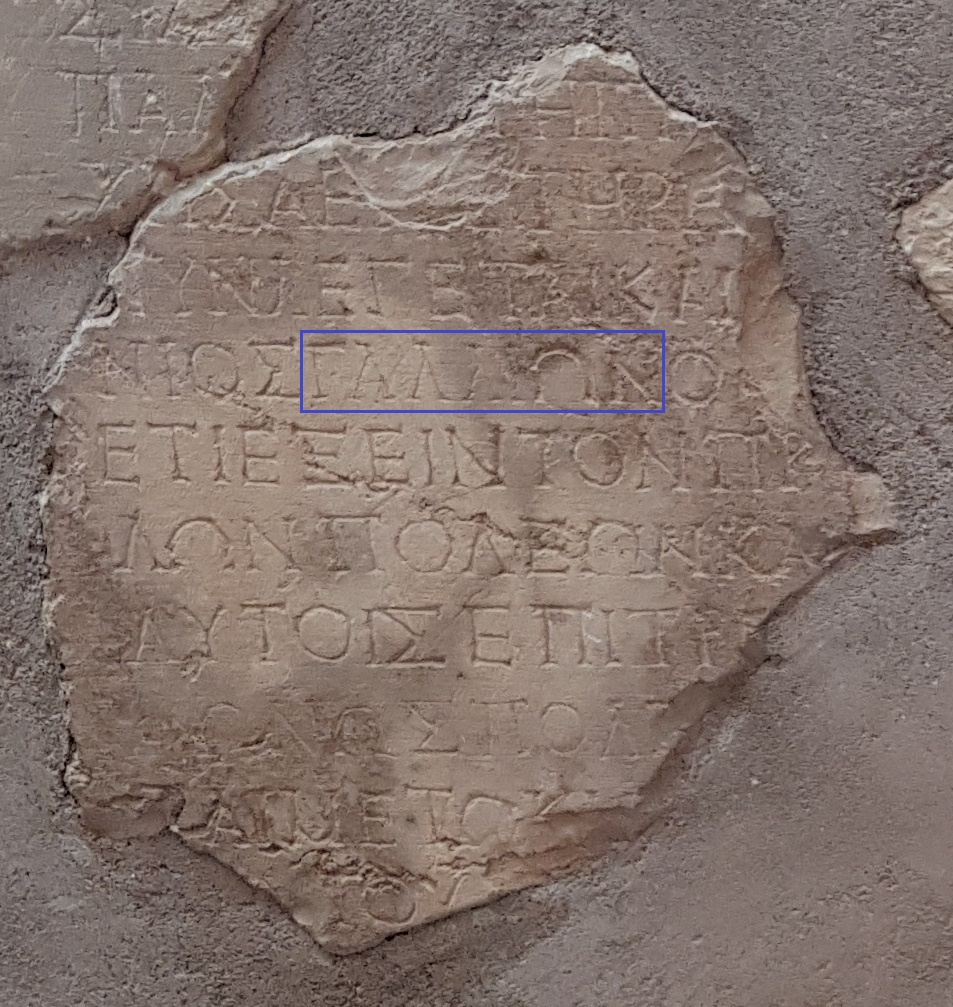
A Roman emperor wrote to an old Greek city about its dwindling population. Preparing his response, he referred to information from a man called Gallio. A copy of that letter was cut into stone at Delphi, and French excavators recovered pieces of it near the sanctuary of Apollo in the course of their work at the site. The text was first published in the early twentieth century, and later studies brought the surviving fragments together. Its most significant words for readers of the Bible tell us what office Gallio held around the time the emperor wrote.
In Acts 18, Luke says that Paul’s accusers brought him before Gallio, the proconsul of Achaia. The Bible gives a real man, the office he held, and the place where his decision mattered. The stone adds a date we can work toward from outside the Bible. As Christians who receive Scripture as true and accurate, we can take satisfaction in how a letter about a civic problem at Delphi helps illuminate the months Paul spent serving the Lord in Corinth. The letter and Luke’s narrative deserve to be heard in their own words and contexts.
What you'll learn
- What survives of the letter Claudius sent to Delphi and how epigraphers read its fragments.
- How two Roman inscriptions help place Gallio’s time in office around AD 51–52.
- What Gallio decided about Paul in Acts 18 and how his decision fits the surrounding account.
A letter in fragments
Delphi was a city as well as a sanctuary. Its association with Apollo gave it lasting religious prestige, but its residents still faced practical questions about the fortunes of the community. In the first century the emperor Claudius addressed the city’s situation. The surviving Greek letter refers to the city as lacking citizens and shows the emperor considering ways to restore its population. Gallio comes into the letter as the person who had informed the emperor of the problem. Read in that context, the reference connects this local matter with a Roman provincial official who could report it to Claudius. Oliver’s study of Claudius’s letter.
Nine pieces preserve parts of the text, now identified as Fouilles de Delphes III 4, no. 286. The Greek edition published by the Packard Humanities Institute represents a stone fragment with an editorial text that can be read line by line. Square brackets show where letters have been restored. A dot below a letter signals that the reading is uncertain. At the place where Gallio appears, a reader can compare the visible part of his name with the reconstruction of the fuller wording. Scholars read it as naming Lucius Junius Gallio and identifying him as the emperor’s friend and proconsul. The Greek text, lines 1–7.
The gap between surviving fragments has a different meaning from a blank left by the original stonecutter. Each gap is a loss of evidence. Some restored words follow almost automatically when their surviving letters, grammar, and formulaic setting agree. Other reconstructions leave room for substantial debate. The inscription opens with parts of the emperor’s name and titles, a formula attested in other documents written under Claudius. That shared pattern makes the surviving numerical information unusually useful. The stone is damaged, and enough remains for scholars to make a well-grounded argument about the period when the letter was issued.
An ancient book copied by hand can survive in several manuscripts that each preserve the same line. An inscription often survives in only one material copy. For this letter, epigraphers can compare the fragments with each other and with established wording elsewhere. They can also compare the photographs and drawings with archival impressions taken from the inscriptions. The surviving stone and the modern transcription provide two ways into the evidence. A photograph shows shape, damage, and letter spacing. An edition makes it easier to see how those separate pieces form a continuous document.
How an imperial title helps establish a date
One of the numbers belongs to Claudius’s imperial acclamations. These were occasions on which he was hailed as imperator, an honor that could be counted repeatedly during his reign. The Delphi letter refers to the twenty-sixth acclamation. A reader can compare that count with the one given elsewhere in an inscription with independently datable information. The emperor’s formal titles were an ordinary feature of official correspondence. Here an ordinary convention lets modern readers place the text much more closely in time than many inscriptions surviving from the first century.
The next acclamation appears in an inscription associated with the dedication of Claudius’s aqueducts at Rome in AD 52. That comparison and the other surviving titulature put the Delphi letter into a relatively narrow span in AD 52, generally before August. Gallio’s term is commonly dated to about AD 51–52. These conclusions work at different levels. The imperial title dates the letter. Its wording places Gallio in the proconsular office during the relevant period. The incident narrated in Acts belongs to his time in office. The day on which Paul stood before Gallio would require evidence with a finer resolution. The Oxford Handbook of Early Christian Archaeology.
This is a good example of how researchers build a chronology around one firmly placed event. Paul traveled between cities, spent intervals with particular churches, and wrote to people he had met. His letters rarely supply equivalents of modern calendar dates. When another source helps situate a civil official mentioned during one of his stays, scholars can use that point to evaluate a sequence of earlier and later events. Exact dates assigned to other stages of Paul’s travels still depend on how one interprets the elapsed time and sequence in each relevant passage.
The letter pins Gallio to an identifiable moment in Roman history, and Acts puts Paul before that same official in Corinth.
The hearing in Luke’s account
Acts 18 begins with Paul coming to Corinth from Athens. He meets Aquila and Priscilla, who had come from Italy after Claudius ordered Jews to leave Rome. Paul shares their trade and works with them while reasoning in the synagogue. As the mission develops, Crispus, the ruler of the synagogue, believes with his household. Luke also tells of opposition and of many Corinthians hearing, believing, and being baptized. Paul receives encouragement through a vision in which the Lord tells him to keep speaking. Luke reports a stay of a year and six months in which he taught the word of God.
During Gallio’s proconsulship, Paul’s accusers bring him before the public judgment seat and say that he persuades people to worship God contrary to the law. Gallio replies that he would hear them if the issue were a wrong or a crime. He takes their complaint to concern words, names, and their own law, and he dismisses them. Luke records Gallio’s understanding of this particular dispute in Corinth. The account gives readers Paul’s situation before one provincial governor, whose judgment determined what would happen at that hearing. Acts 18:12–17.
When the hearing breaks up, people seize Sosthenes, identified in Acts 18:17 as a ruler of the synagogue, and beat him in front of the judgment seat. Gallio ignores it. That last incident keeps us from treating the official as a protector of everyone around him. His dismissal grants Paul room to remain in Corinth, and Luke also records what happens to a man who is exposed to violence. The first letter to the Corinthians greets the church in the names of Paul and a brother named Sosthenes. The shared name invites a question. Acts and the epistle leave his identification open.
Delphi and Corinth contribute different evidence
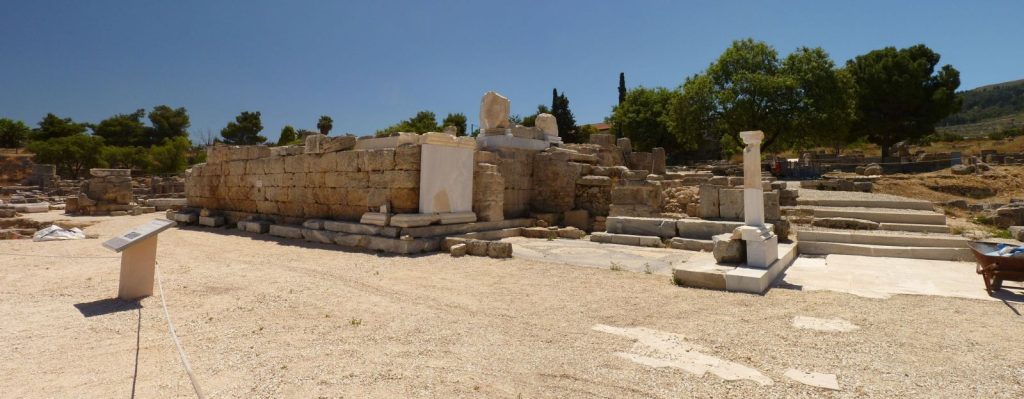
The city of Delphi preserves the letter that ties Gallio’s office to an emperor and a date. At Corinth the archaeological record preserves settings associated with civic activity, including an elevated platform in the Roman forum commonly identified as the bema, or public speaker’s platform. A Greek reader of Acts would understand a bēma as the raised place where a public figure could stand or an official could sit in judgment. The platform at Corinth shows the scale and public visibility of a structure suited to that purpose. Its traditional association with the hearing gives visitors a place from which to picture Luke’s account. Corinth excavation publication on the bema.
Corinth and Delphi also demonstrate how the evidence for biblical events can take different forms. The platform illustrates what a Roman public judgment setting could look like. The Delphi fragments actually preserve the name of the official who heard Paul’s accusers. A related example is the Pilate Inscription from Caesarea, which names a governor from the Gospels in connection with a building dedication. In each case the inscription had an independent civic purpose. As historical witnesses, those everyday purposes are precisely why these ancient documents are worth comparing with the New Testament.
What Paul was doing while Gallio governed
The dates gain their significance from what Luke says was happening in Corinth. Paul earned his living, reasoned from Scripture, and bore witness that Jesus is the Christ. A Roman court could hear an allegation, and the Lord already knew the people who would hear the gospel. Acts 18:9–10 puts the Lord’s promise before the account of Gallio’s judgment. The narrative’s order focuses the reader on the command to keep speaking and then shows Paul continuing in Corinth after the accusation failed. Luke’s account makes room for a Roman decision as part of the story of how the message went forward.
Paul’s own words in 1 Corinthians help us consider what he taught there. He remembers proclaiming Jesus Christ and him crucified in a manner that showed the power of God rather than dependence on the speaker’s status. Corinth had a forum, magistrates, argument, and public judgment. Paul brings readers back to the message of the cross in that very setting. Begin with Acts 18, then look at the spaces and fragments in the two photographs. The city and the letter locate Paul’s ministry in a specific province and decade. Scripture tells us what Paul went there to say and why he stayed to say it.
Sources and further reading
- Fouilles de Delphes III.4, no. 286, Packard Humanities Institute — Greek edition of the letter, with marks indicating damaged and restored text.
- James H. Oliver, The Epistle of Claudius Which Mentions the Proconsul Junius Gallio — Published study of the inscription and its wording.
- The Oxford Handbook of Early Christian Archaeology — Academic account of the discovery, surviving fragments, and value of the imperial acclamations for dating the letter.
- American School of Classical Studies at Athens, Corinth excavations — Archaeological background on Corinth and the excavation of its public spaces.
- Corinth VIII.3, The Inscriptions 1926–1950 — American School excavation publication discussing epigraphic and archaeological evidence for the bema.




