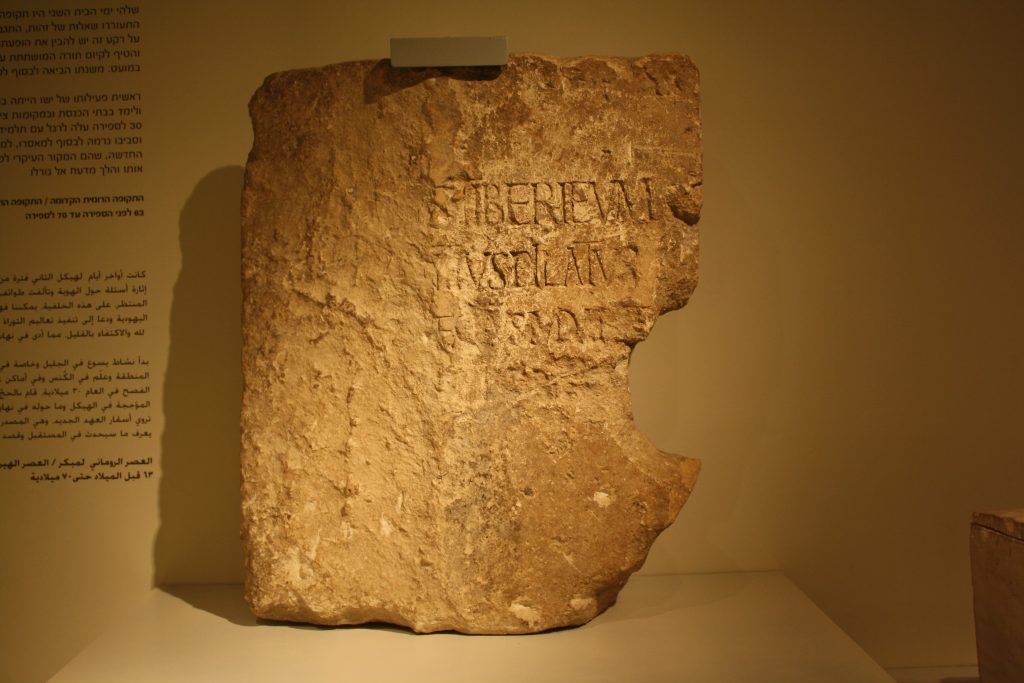
The name is easier to see if you begin in the middle of the stone. On a battered limestone surface, capitals still spell enough of Pontius Pilatus for the reader to recognize Pontius Pilate. The line beneath it is damaged too, but its surviving letters are enough for Latin epigraphers to read his office as prefect of Judaea. A building dedication from Caesarea, where Roman officials governed on the Mediterranean coast, thus gives us a contemporary public record of the man who authorized the crucifixion of Jesus. Its recovery began with the discovery of a reused building stone. Latin inscription and bibliography
What you’ll learn
- Why a stone found in a theater staircase can tell us about an earlier building.
- How scholars distinguish surviving letters from the parts they restore.
- What Pilate’s title contributes to a reading of Luke and John.
A dedication with a second life
In 1961 excavators working at the Roman theater of Caesarea Maritima found the limestone block incorporated into a staircase. It had already been taken from its original place and put to work in a later structure. The new use is the reason the theater appears in every account of its discovery. It is also the reason the theater cannot tell us where Pilate originally erected the inscription. The stone’s archaeological findspot belongs to its reuse. Its text belongs to a first-century Roman prefect. Keeping those two facts apart makes the story of the discovery more interesting. Helen K. Bond on the discovery and text
Archaeologists use the word spolia for building material reused in a later structure. A durable block may be useful long after the purpose it once served has disappeared. The letters on this block were vulnerable when its shape was adapted, and much of the left side of the text is gone. The losses carry their own information about the stone’s history. A photograph of the original shows an unexpectedly irregular surface for a formal monument. If you compare it with a transcription, begin by finding the physical edge where a line of letters disappears. You can see which part of the puzzle the stone has left to its readers.
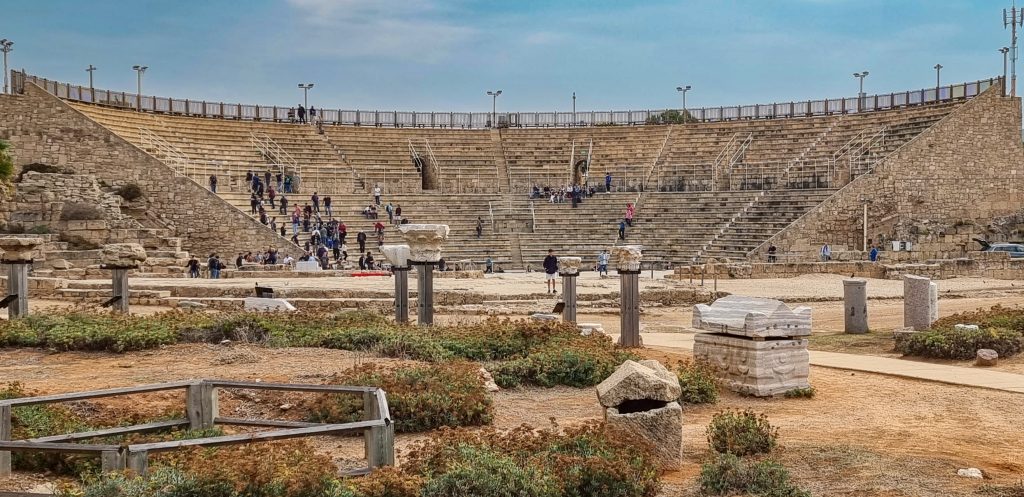
Pilate governed Judaea under Tiberius beginning about AD 26. He left the province around AD 36 or 37. By his time, Caesarea was a coastal center of Roman government. Herod the Great had developed the city and its harbor before Rome took direct control of Judaea. The dedication belongs to that public setting, where a governor had reason to put the emperor’s name on a monument. Luke’s account of Jesus’ trial unfolds in Jerusalem, in the charged setting of Passover. The coastal location of the dedication helps us see that the Roman administration in the Gospels had a reach and a public face beyond the precinct in which Jesus was questioned. Inscription and date range. Caesarea National Park.
How much Latin is really on the stone?
Three portions do much of the work. A line near the top preserves the word Tiberieum, the name of a structure associated with the emperor Tiberius. The line below preserves most of Pilate’s name. The next one yields the office of prefect of Judaea when its damaged ends are restored. Editors use brackets to make clear where they are supplying letters. When a bracketed reading is persuasive, the surviving strokes and the ordinary patterns of Latin names and titles are doing real work. An honest transcription makes it possible for a reader to see both what is legible and where an editor has made a judgment. Latin text with restored letters marked
The emperor’s monument is harder to picture. Several reconstructions of the opening and closing words have been proposed, leading to different translations of what Pilate built, dedicated, or restored. The university edition and the Roman Palestine inscriptions database illustrate this. Their supplied words differ, even while the name, title, and reference to a Tiberieum remain recognizable. The inscription gives the structure a name. Excavation would have to identify the structure itself before we could say what it looked like or where it stood. Its function is a genuine question and a rewarding example of why a source can yield information at different levels of certainty. Inscription database and alternative reconstruction
A single stone can tell us who governed a province and leave the location of his monument an open question.
Prefect of Judaea
Luke opens his account of John the Baptist’s public ministry by naming several authorities. He moves from Tiberius to Pilate in Judaea, then to regional rulers and the high priests. It is a way of situating a prophetic summons within the political world in which it was heard. Luke’s language describes Pilate as governing Judaea. The dedication supplies a narrower piece of information. In formal Latin, Pilate identified himself as praefectus Iudaeae. The two witnesses fit because a narrative description of someone governing a region and an official title can refer to the same man at different levels of precision. Read Luke 3:1–6
The distinction also matters in reading other Roman-era writers. The ancient historian Tacitus, writing generations after the events, calls Pilate a procurator in his account of Nero’s persecution of Christians. The word is familiar from broader Roman provincial administration. The stone gives us the contemporary title carried on a public inscription in Judaea, which is why scholars use prefect when describing Pilate’s position under Tiberius. Two ancient sources may have been written at different times and for different audiences. When they use slightly different language, an inscribed title can help us ask which usage belongs to the officeholder’s own day. Tacitus, Annals 15.44
Pilate in other ancient accounts
Josephus describes disputes during Pilate’s administration over military standards and the use of sacred funds for an aqueduct. He also reports that Pilate’s handling of a gathering of Samaritans led the governor of Syria to order him to Rome. The Jewish writer Philo tells a separate story about shields that Pilate set up in Jerusalem. Those texts have their own concerns and must be read in context. Together they give us a Roman official who had to manage the consequences when exercises of imperial authority collided with local convictions. They help us read the Gospel encounters with the public pressure and official power in view. Josephus, Antiquities 18 Bond on Philo’s account
This difference between types of evidence is worth carrying over to other objects. A dedication often identifies a person by an office and a relationship to a patron. Coins usually give still less room for language and can advertise a ruler through conventional designs. A narrative writer has space to name an action and describe how other people responded. Pilate’s stone is especially valuable because it preserves a substantial place-name and office together, even after much of the dedication was lost. The persistence of the word Judaea next to the office takes an otherwise ordinary Roman administrative title and fixes it to the province Luke names.
For the same reason, the surface of the stone counts as evidence. If the found slab had preserved only Tiberieum, a reader could infer a connection with the emperor and know nothing of the official who commissioned it. If only Pilatus were legible, a name by itself would leave more work to do. It is the association across the surviving lines that makes the recognition so strong. A formal title attached to a name and province is a better identification than a seeming resemblance between an isolated set of letters and a name we hope to find.
From the dedication to the trial
In John 18 and 19, Pilate moves between the people presenting the case and Jesus. Questions of kingship, accusation, and loyalty to Caesar run through the scene. After declaring that he finds no guilt in Jesus, Pilate faces pressure connected with how his handling of a claimant to kingship might be perceived. John then reports that Pilate delivered Jesus to be crucified. Reading these chapters with the word Tiberieum fresh in mind makes the invocation of Caesar sound especially concrete. The official hearing the case was a man publicly associated with Tiberius even in the monuments of his provincial capital. Read John 18:28–40 and 19:1–22
John mentions another written object, the notice Pilate put on the cross. The Gospel gives its wording and mentions the languages in which it was read. Whatever the full language of the Caesarea dedication, the words surviving there use a recognizable idiom of provincial office and imperial honor. The notice in John takes those questions of authority into a very different scene. For Christian readers, the inscription at Caesarea makes the name of the official visibly historical. The Gospel tells us how that official used the authority behind his name when the king he was questioning stood before him.
We receive the biblical account as true and accurate. The anchor our faith has in real history matters here. In Acts 4 the praying church names Pilate together with other rulers and groups involved in the events leading to Jesus’ death. Their prayer recognizes human action within God’s saving purpose. A damaged dedication brings us back to the material world in which those events took place, and Scripture teaches us why the crucifixion means more than a Roman verdict. Looking from the stone to the Gospel takes us from a governor’s title to the exercise of that power, then to the hope the church proclaimed after the resurrection. Read the prayer in Acts 4
This is a good object to practice reading slowly. Compare the original photograph with two published transcriptions. Notice which words appear in both despite the different restoration. Then read Luke’s opening lines again and locate the name of the emperor, the jurisdiction of Pilate, and the arrival of the word of God to John in the wilderness. The dedication documents public office. Luke starts in a world of offices and provinces and follows what God was doing among people who lived under them. For another example of how that kind of Roman title can help us place a New Testament episode in time, read about Gallio’s inscription at Delphi.
Did the stone come from the place where Jesus was tried?
The inscription was found at Caesarea, reused in a theater staircase. The Gospels place Jesus’ trial in Jerusalem. The find establishes Pilate’s identity and official title in the province, while its exact first location at Caesarea remains unknown.
Sources and further reading
- Latin inscription of Pontius Pilate — Latin text with marked restorations and references to the original and subsequent epigraphic editions, AE 1963.104.
- Helen K. Bond, Pontius Pilate in history and interpretation — Discussion of the circumstances of the find, partially preserved text, and literary sources.
- Database of Military Inscriptions and Papyri of Early Roman Palestine §371 — Provenience, dates, and a scholarly translation representing a different restoration.
- Josephus, Antiquities of the Jews, book 18 — Sections 55–62 and 85–89 for disputes during Pilate’s administration.
- Tacitus, Annals 15.44 — Later Roman literary reference to Pilate and the death of Christ.
- John 18:28–19:22 — The narrative of the trial, the appeal to Caesar and the notice on the cross.




