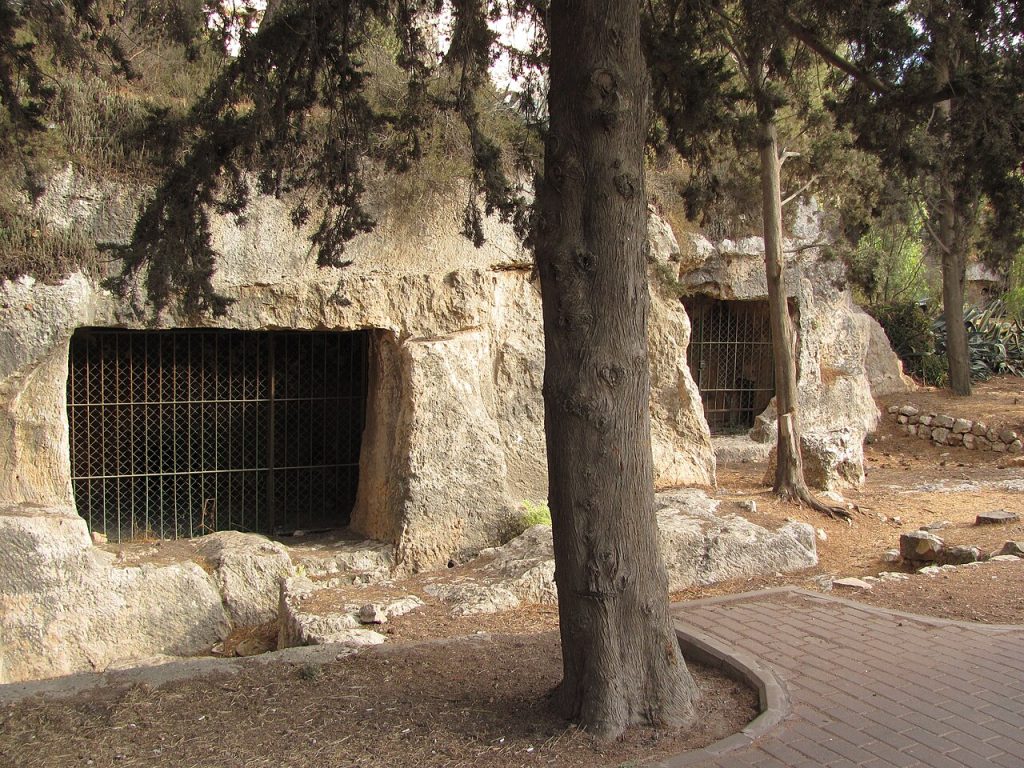
In 1968, construction opened a burial cave at Giv‘at ha-Mivtar in northern Jerusalem. Vassilios Tzaferis’s excavation recorded stone boxes for the bones of the dead. One of them carried the name Yehohanan in Hebrew letters. Among the remains inside was the right heel bone of an adult man, pierced by an iron nail and still associated with fragments of wood. The burial preserved physical evidence of a punishment better known from ancient writings. It also preserved something easily overlooked in a discussion of Roman power. Someone had cared for the dead man and placed his remains in a burial chamber. Vassilios Tzaferis’s 1970 excavation report. Israel Museum’s object account.
Key takeaways
- A rock-cut tomb at Giv‘at ha-Mivtar, excavated in 1968, held an ossuary associated with a man crucified in Roman-era Judea.
- Joseph Zias and Eliezer Sekeles showed that the surviving nail was through the right heel alone. Their work revised several claims made after the excavation.
- The ossuary held remains from more than one person. The inscription is part of the case for calling the crucified man Yehohanan, with some uncertainty about its assignment.
- The find puts actual Roman punishment and Jewish burial practice beside Gospel accounts of Jesus’ crucifixion and his burial by Joseph of Arimathea.
From a burial cave to a named ossuary
An ossuary is a container for bones. It belongs to a different stage of burial from the first laying out of a body. In the kind of tomb documented at Giv‘at ha-Mivtar, the chamber and its burial spaces could be used more than once. After a body had decomposed, the bones could be gathered into a stone box and kept in the tomb. Archaeologists call the gathering and placement secondary burial. The arrangement made it possible for people to return to a place associated with their dead, and it allowed more than one burial event within the same chambers. The published tomb and ossuary context.
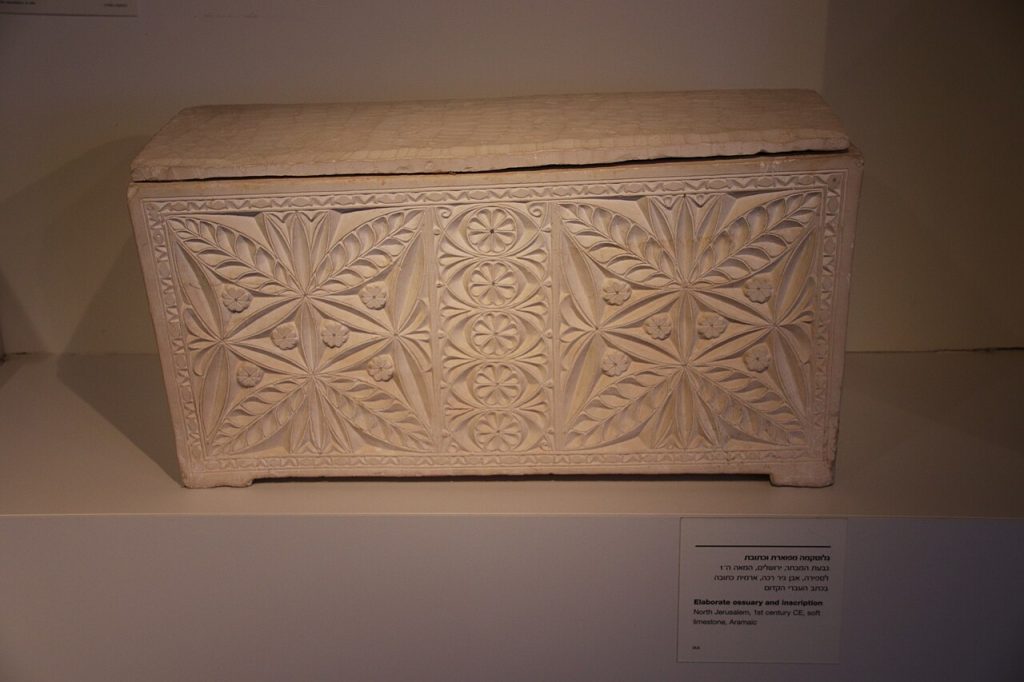
Names on such boxes are worth reading with a degree of care. The Israel Museum gives the familiar reading Yehohanan son of Hagkol. The scholarly inscription corpus records alternative readings of the second name and discusses the uncertainty about which individual in the box the text names. The remains include the crucified adult, a partial second adult, and a young child. That makes the association of the name with the adult a reasonable convention to explain as we use it. The decisive evidence for the execution is the condition of one bone, independent of how the letters are read. Joseph Naveh’s initial study of the inscriptions. Corpus Inscriptionum Iudaeae/Palaestinae, Jerusalem, no. 50.
A dated field record and an ancient name tell different kinds of history. We can name the year in which the cave came to light because excavators recorded modern events and published their work. The first-century Jewish burial setting is supported by the contents and form of the tomb, with the corpus expressing the dating of the ossuary broadly across the late Second Temple period. We have no dated execution record for the individual. His family’s place in the city, the authority who sentenced him, and the charge he faced remain outside the surviving evidence. The find is rare partly because the things that would answer those questions usually disappear. Excavation report. Scholarly catalogue of the tomb inscriptions.
The cave setting and the secondary burial matter when considering Roman policy. The archaeological facts are that a person with this injury received burial and that his bones ultimately went into a box kept in a tomb. Several stages could stand between those points, and the excavation cannot retrace the people’s actions at each one. What looked to an ancient family like a single process of care gives an archaeologist several separate deposits and associations to account for. The place of the box, the inscription, the different individuals, and the surviving iron all belong in the argument. Keeping those pieces separate makes the burial evidence useful when comparing other cases.
What two examinations found
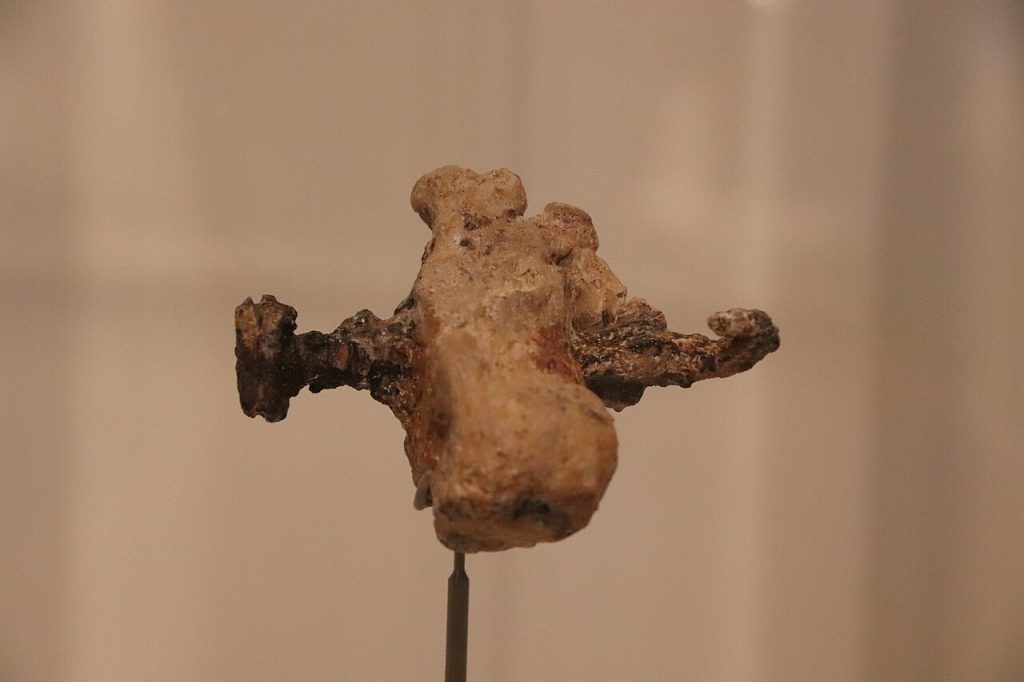
Tzaferis published the excavated setting in 1970. Nico Haas’s skeletal examination appeared in the same issue of the Israel Exploration Journal. Haas interpreted a small piece of bone adhering to the nail as part of a second heel and proposed that one nail had pierced both heels. He also proposed that certain other marks or breaks were associated with the execution. Those claims became well known. When reading an account of the find, it helps to check whether a drawing or description is based on Haas’s original interpretation or on the later examination. The same object appears in publications with quite different reconstructions. Nico Haas’s 1970 study of the skeletal remains.
In 1985 Joseph Zias and Eliezer Sekeles published a reassessment based on examination before reburial and on photographs, casts, and radiographs. They found that the extra fragment belonged to a long bone. Its shape ruled out the identification as part of a second heel. Their analysis of the nail and its position established that the firmly documented injury involved the right heel. They also found the proposed diagnosis of forearm nailing unpersuasive and the earlier attribution of lower-leg breaks to the execution unsupported by the condition of the bones. Some breaks could have arisen after death. Zias and Sekeles, The Crucified Man from Giv‘at ha-Mivtar: A Reappraisal.
A small detail shows how the second examination worked. Tiny fragments of wood had survived in contact with the iron. Zias and Sekeles sent them for specialist identification. The remains from one end could be identified as olive wood, while those from the other were too small for a species determination. That finding made it possible to correct an earlier proposed assignment of the wood to parts of the execution apparatus. The reason to keep the detail is that it shows the division of labor behind the result. The shape of the bone, the state of the iron, and even the small organic traces were assessed with different kinds of expertise. Reappraisal, section IV on the wood.
These corrections reduce the number of details we can confidently reconstruct and sharpen the case for the one most important observation. The fragmented heel and the condition of the forearm also teach us how to read negative evidence. If the bones fail to show a reliable mark, we can say that the mark has not been demonstrated. It is a further step to claim that the body could only have been secured in a certain way. Zias and Sekeles distinguish what they observed in the bone from their suggestions about the wider procedure. Reappraisal, conclusions.
The heel tells us a man was crucified. The tomb tells us that his burial was part of the life of a community.
The reappraisal also points to the value of the excavation record after the burial place changes. The original study and the later work included photographs made at a time when the researchers could see things that a visitor to a museum display cannot examine. Radiographs permitted comparison of the internal organization of different fragments. Written documentation kept the anatomical identifications open to criticism. Taken together, the records make it possible to distinguish a reconstructed arrangement from a feature that was observed when the material was first studied. This is one reason the scholarly history of the discovery remains part of its value. Zias and Sekeles on the photographs and radiographs they used.
The range of Roman practice
Josephus describes people being crucified around Jerusalem during the Roman siege in AD 70. In The Jewish War 5.449–451, he reports that soldiers used different positions, a detail about the cruelty of that particular episode. The account and the bone give independent evidence of Roman crucifixion in Judea. The episode Josephus narrates belongs to a particular wartime moment, while the burial comes from a tomb with its own chronology. The similarities help us place this execution within a known Roman punishment, and the differences in context give us reason to describe each case on its own evidence. Josephus, The Jewish War 5.449–451.
The archaeological record also reaches beyond Jerusalem. An archaeological project at Fenstanton in Britain documented another Roman-period burial with a nail retained in the right heel. The site was excavated in 2017 and the crucifixion evidence was reported publicly in 2021. That comparison is useful because the cases survived in very different burial settings at widely separated ends of the empire. They show how unusual it is for evidence of an ancient execution to enter a burial context, stay in place, and then be found during controlled work. Claims that the Jerusalem find is the world’s only known example belong to older accounts. University of Cambridge report with the Fenstanton researchers.
Read the crucifixion and burial in the Gospels
Mark 15:21–47 takes the reader from the road to Golgotha to Jesus’ death, then to the request made by Joseph of Arimathea. Mark says Pilate checked with the centurion before granting Joseph the body. Joseph wrapped it in linen and placed it in a rock-cut tomb, and the women saw where Jesus was laid. The chapter separates the decisions of Roman authority from the acts of people who cared what happened to Jesus after his death. The Giv‘at ha-Mivtar tomb gives us material evidence that a person put to death by crucifixion could receive burial in Jerusalem’s Jewish world. The particular events of Mark’s account are told in the Gospel itself.
John 19:17–42 makes the approaching Sabbath part of the setting. It describes the requests concerning the bodies, then names Joseph and Nicodemus in Jesus’ burial. Deuteronomy 21:22–23 gives an older scriptural setting for the urgency about burial, commanding that the body of someone hung on a tree be buried the same day. Its setting is Israel’s law. Following that concern into John helps explain why the handling of a body could become an urgent matter alongside the pressure of sacred time. The excavation reveals that the care of burial could continue beyond the day of death. The Gospel tells why its named witnesses and their acts matter here.
John returns to the crucifixion wounds after the empty tomb scene. In John 20:24–29, Thomas’s encounter with Jesus leads to a confession about who stands before him. The injuries are part of the way the Gospel identifies the risen one with the one who died. Seeing the importance of those wounds in John helps a reader understand why ancient crucifixion evidence has drawn so much Christian interest. The Judean burial keeps the historical setting in view. John asks us to follow Thomas beyond curiosity about physical evidence and to consider the person whose death and rising are at the center of the Gospel.
For Christians, the truth of Jesus’ death and burial is inseparable from the news of his resurrection. Paul joins all three in 1 Corinthians 15:3–8 and names witnesses who saw the risen Lord. That gives this act of archaeological reading a purpose. We can take the death seriously as an event in a real place under Roman rule and notice how much the Gospel says about what happened after it. The heel and the tomb illuminate historical conditions. Scripture tells the story of Christ’s death for our sins, his burial, and his rising. For the official who appears in the burial accounts, see the Pilate Inscription from Caesarea.
What the excavation records let us compare
- The box and the cave. These are evidence for burial at a specific Jerusalem site. The inscriptions can be studied separately from the bones.
- The bone and the radiograph. These record the evidence of an execution. The images help clarify which conclusions rest on the preserved heel.
- The Gospel accounts. Read Mark and John as accounts of the death and burial of Jesus, in a setting that archaeology helps us understand.
Questions readers ask
Is the heel evidence for how Jesus’ feet were fixed to the cross?
The find documents one anatomical detail of a different execution. The Gospel accounts give their own details of Jesus’ crucifixion. The heel gives a physical example from the broader Roman practice.
Why is the name spelled several ways?
Yehohanan, Jehohanan, and Yeḥoḥanan represent ways of rendering the Hebrew given name in Latin letters. Some variation in the second name also comes from reading an uncertain inscription.
Sources and further reading
- Vassilios Tzaferis, Jewish Tombs at and near Giv‘at ha-Mivtar, Jerusalem — The 1970 excavation publication, Israel Exploration Journal 20, pp. 18–32.
- Joseph Naveh, The Ossuary Inscriptions from Giv‘at ha-Mivtar — Primary publication of the inscriptions, Israel Exploration Journal 20, pp. 33–37.
- Nico Haas, Anthropological Observations on the Skeletal Remains from Giv‘at ha-Mivtar — Initial anthropological study, Israel Exploration Journal 20, pp. 38–59.
- Joseph Zias and Eliezer Sekeles, The Crucified Man from Giv‘at ha-Mivtar: A Reappraisal — Reassessment of the material and the early anatomical identifications, Israel Exploration Journal 35, pp. 22–27.
- Israel Museum, Heel Bone and Nail from the Ossuary of Yehohanan — Museum account of the artifact and its association with the burial.
- University of Cambridge, First Example of Roman Crucifixion Found in Britain — Institutional account of the Fenstanton excavation and comparative osteological finding.