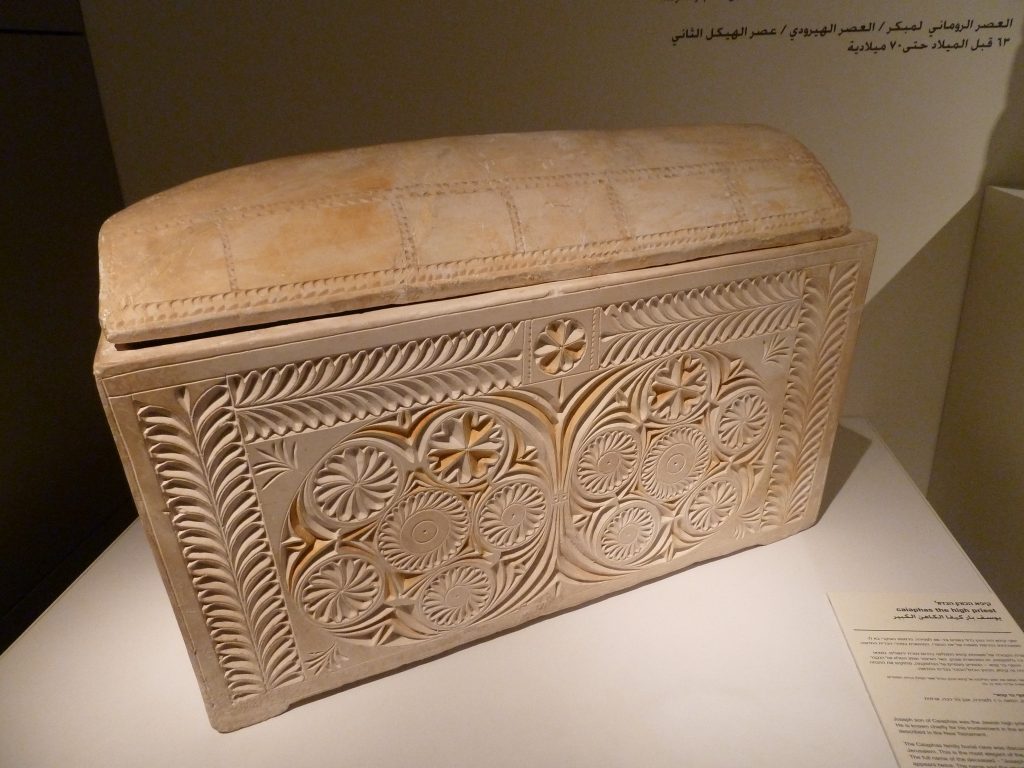
The front of the limestone box is covered with carefully cut decoration. The smaller marks that made the find famous take longer to notice. On its surfaces are two forms of an Aramaic inscription commonly read as Joseph son of Caiaphas. Excavators found the box in a cave south of Jerusalem’s Old City in 1990. A few old scratches brought an official from the Gospel accounts into the discussion. To see how far the identification can go, start with the cave, then compare the names on the box with the way a Jewish historian refers to the high priest.
What you’ll learn
- What an ossuary was and how a 1990 rescue excavation documented this family burial cave.
- How the rare name Caiaphas connects the archaeological find with Josephus and the Gospels.
- Why a plausible identification of the family and a secure identification of individual bones are different conclusions.
A rescue excavation in a Jerusalem hillside
In November 1990 construction work cut into a burial cave in the Peace Forest area of southern Jerusalem. Archaeologist Zvi Greenhut came to document what the works had opened. His account distinguishes the boxes that were still in their original niches, the ones moved by workmen, and the disordered remains left by older disturbances. The team counted twelve ossuaries, some complete and others in pieces. Treating each part of the find according to its actual condition made it possible to reconstruct more of the use of the chamber than a photograph of any single box would suggest. Greenhut’s published account and plan of the tomb.
The chamber had narrow burial recesses cut into its sides. Archaeologists call one of these niches a loculus. The box associated with Joseph Caiaphas had remained in one of the niches beside another ossuary. A find that can be recorded in place gives the excavators a direct connection between its container, its niche, and the larger burial space. A box loose in the chamber can still be studied for form and inscription. It comes with fewer clues about its original location and the use of that particular corner of the tomb. Greenhut’s observations let a reader tell those kinds of evidence apart.
An ossuary is a container for bones collected after the initial burial. The first deposition could take place on a surface or in a recess cut for the body. After time had passed and the body had decomposed, people could return to gather the bones and put them into a smaller stone vessel. The practice allowed a tomb to receive multiple generations of a family. In one cave you might find several kinds of evidence at once: places used for the first burial, boxes used during later visits, and marks made when relatives needed to identify a lid or a particular container. The later return was itself a burial event.
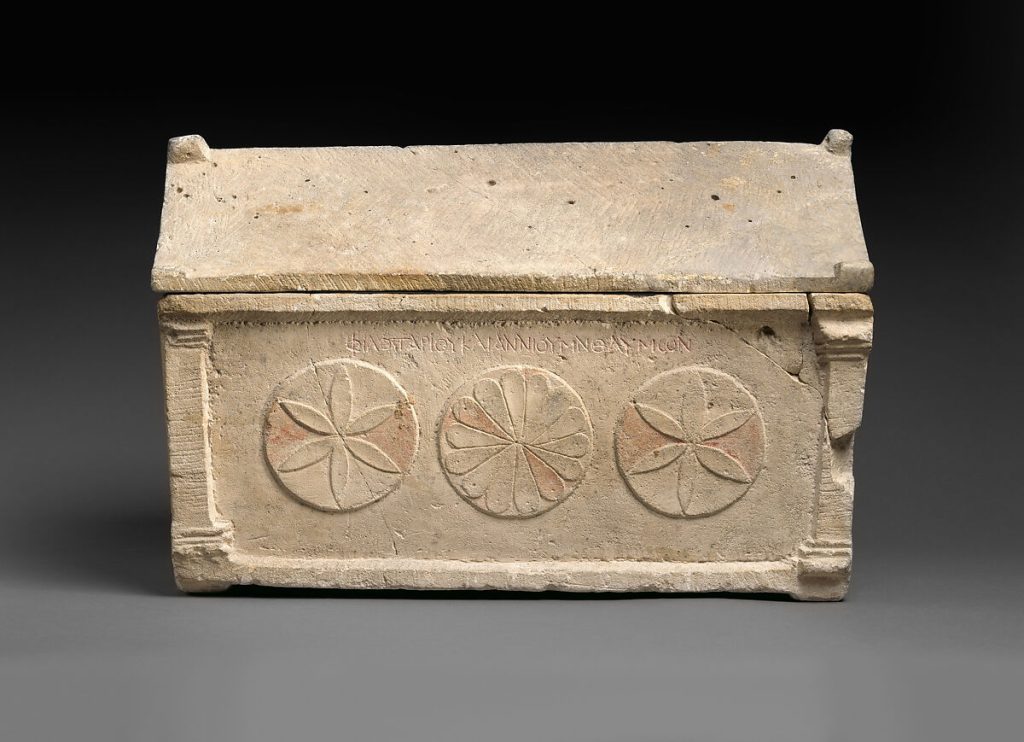
Compare the Metropolitan Museum ossuary pictured here. It too has rosettes, while its inscription is in Greek and names different people. That comparison makes the decoration on the Jerusalem box easier to place within a custom. A handsome carving can tell us something about care, taste, effort, and possibly the resources of the people who commissioned it. Rosettes were available to more than one family. Decoration alone would be too general to identify the owner. The text is what gives the decorated box found in 1990 a much narrower point of comparison with the surviving historical sources. The Met’s collection record and open image.
The practical marks on some of the boxes are worth a second look. Greenhut reports short marks on the end of two boxes and their lids that made it possible to match the pieces and align them. The same archaeological feature can be useful for several questions. The stone gives information about the preparation of containers. Writing may answer a question about family connections. Small alignment marks reveal how people expected to handle the parts. Keeping those functions separate makes it easier to imagine the process by which someone brought a lid into the cave or reopened an ossuary during another visit.
What the scratches say
The inscriptions from the tomb are short and informal. Ronny Reich describes the cursive Jewish script and reads them as Aramaic. Two forms of the name appear on the elaborately decorated bone box. One usually sees them rendered in English as Joseph son of Caiaphas, although the spelling of the second element differs slightly between the inscriptions. This is much closer to something a family might inscribe to identify a burial than a public text announcing a person’s office. A plain name had a use inside the tomb whether or not any visitor outside the family could recognize it. Reich’s reading of the ossuary inscriptions.
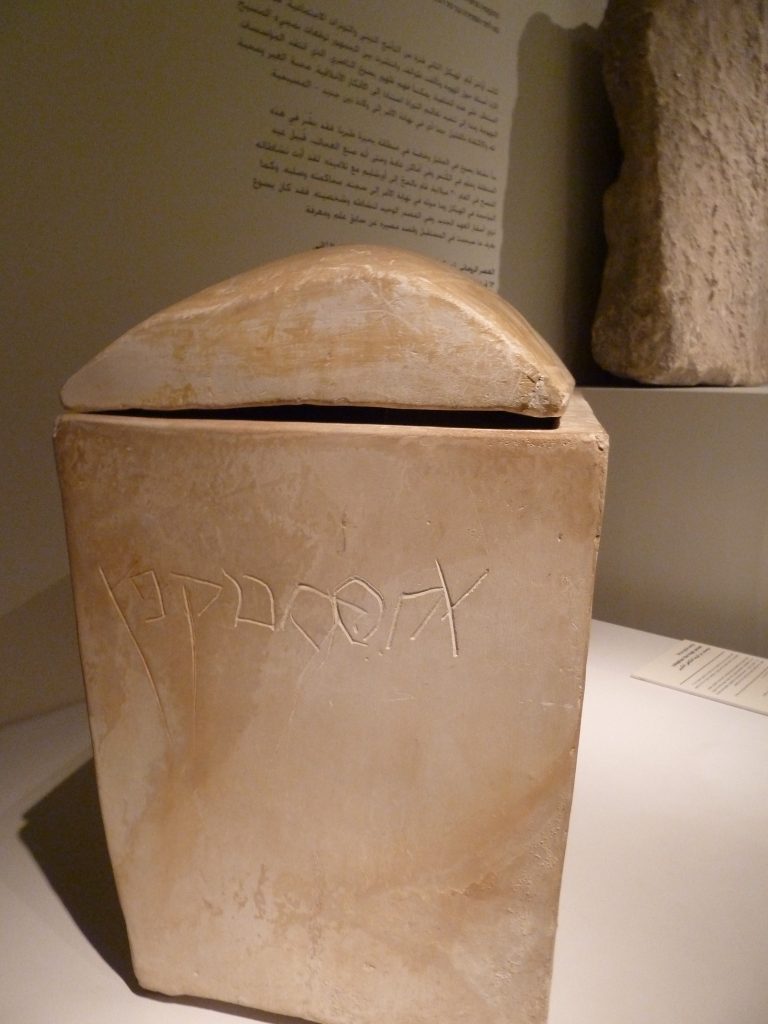
Joseph is a familiar name in the period. A reference to a Joseph by itself would yield a wide field of possibilities. The less common second name, taken together with the first and with the Jerusalem setting, is what has drawn the attention of historians. The spelling and language also matter. A Greek-speaking writer may describe the same family with a Greek form of a name that an Aramaic speaker wrote with different sounds and script. Literal letter-for-letter agreement across the two languages would be an unreasonable requirement. Scholars compare the forms and test them against names found elsewhere.
An ancient writer supplies a particularly close comparison. In the eighteenth book of his Jewish Antiquities, Josephus mentions the appointment of a high priest named Joseph Caiaphas by Valerius Gratus. Later in the same book, when recounting the actions of the Roman official Vitellius, he again names Joseph, also called Caiaphas, and says that Vitellius removed him from the high priesthood. Josephus’ wording is part of the evidence for treating Caiaphas as a name by which Joseph could be known. The Israel Museum connects its exhibition of the ossuary with this high priest, who held office during the governorship of Pontius Pilate. Josephus on the appointment and on the removal.
How strong is the identification?
These sources make a serious historical case. The cave, burial custom, script, names and independent historical setting fit the world of the high priest. The Israel Museum presents the object as associated with Caiaphas and his family. The inscriptions give a name and a family connection. An official title would tighten the identification further, and one is absent from the marks. A reader can therefore appreciate the unusually close association while recognizing that the box itself gives less information than the combination of box, cave, Josephus and Gospel.
- The excavated object bears versions of an Aramaic name comparable to Joseph Caiaphas.
- Josephus gives a personal name and an office within a Roman administrative setting.
- The Gospels identify Caiaphas in the events surrounding the trial and death of Jesus.
The question of the bones requires its own judgment. Greenhut’s account reports remains of several people in the decorated box, including an older man. A group of remains can be consistent with repeated use of a container and a family burial setting. Its presence gives very limited grounds for assigning any individual fragment to a person named on the limestone. Age and sex estimates can help describe a collection of remains. They are insufficient on their own to distinguish an individual historical Joseph Caiaphas from another older man from the same period. Greenhut’s discussion of the contents of the decorated ossuary.
A name can survive on limestone and still leave us with questions about the people who used the tomb.
Consider what would improve the identification in principle. A dated inscription naming the office alongside the personal name would give a firmer match than a name alone. More records of the same family in the area could help trace the name across generations. Contemporary naming practices also matter. A phrase that sounds to an English reader like a literal father’s name can sometimes preserve a wider family designation. The evidence at hand points toward the historical high priest’s family and justifies comparison with Josephus. The exact kinship represented by each inscription calls for more care than the shared name at first suggests.
Why John introduces Caiaphas before the trial
Start in John 11, after the raising of Lazarus. Members of the council fear that attention to Jesus will bring an intervention by Rome. Caiaphas argues that the death of one man would be preferable to the destruction of the people. The narrator then explains his words from a different perspective, as pointing beyond his immediate calculation to what Jesus’ death would accomplish. The historical office helps make sense of the scene. A high priest within the political world Josephus describes had reason to think about public order and Roman power. John places that political judgment within his testimony about God’s purposes. John 11:45–53.
The arrest narrative in John 18 calls Caiaphas the high priest and refers back to his advice. It also names Annas, his father-in-law, and places him earlier in the sequence of questioning. Matthew 26 describes Jesus being taken to Caiaphas and sets the proceedings among the scribes and elders gathered there. At a later stage in John, the authorities take Jesus from Caiaphas to the Roman governor’s headquarters. The person named on the Pilate Inscription provides a separate archaeological connection to the Roman side of that narrative. Each object helps specify a person or office within the setting. John 18:12–28.
We read the Gospel as true and understand the death of Jesus in light of the saving purpose John describes. That confession makes the ordinary family object an arresting find. A person remembered for his public office also belonged to a society with relatives, tombs, workmen, stone cutters, and small inscriptions that people expected family members to understand. Excavation brings those practices closer. Josephus lets us hear how a historian named the official. John tells us what Caiaphas said in the face of Jesus’ ministry and why his words meant more than the speaker intended.
Return to the photograph after reading John 11 and 18. Follow the large lines of rosettes first and then consider the tiny letters that originally caught the specialists’ attention. Those marks speak on the scale of a household. Compare what they can establish with the longer narrative of an appointed high priest and a man brought to questioning. An archaeological find becomes more useful when its own evidence receives careful attention. The modest text on a burial box can add specificity to a story it would never have attempted to tell.
Sources and further reading
- Zvi Greenhut, Burial Cave of the Caiaphas Family — Excavator’s report with cave plan, photographs, find circumstances and discussion of the ossuaries.
- Ronny Reich, Ossuary Inscriptions from the Caiaphas Tomb — Early publication and reading of inscriptions from the tomb.
- The Israel Museum, Ossuary of Caiaphas — Museum exhibition record and identification of the artifact.
- Josephus, Antiquities of the Jews 18.35 — Appointment of Joseph Caiaphas during the tenure of Valerius Gratus.
- Josephus, Antiquities of the Jews 18.95 — Removal by Vitellius and identification of Joseph as also called Caiaphas.
- The Metropolitan Museum of Art, Limestone ossuary with lid — Comparative vessel, relief rosettes and inscription in Greek.
- John 11:45–53 and John 18:12–28 — Caiaphas’s council advice and its relevance to the later questioning of Jesus.