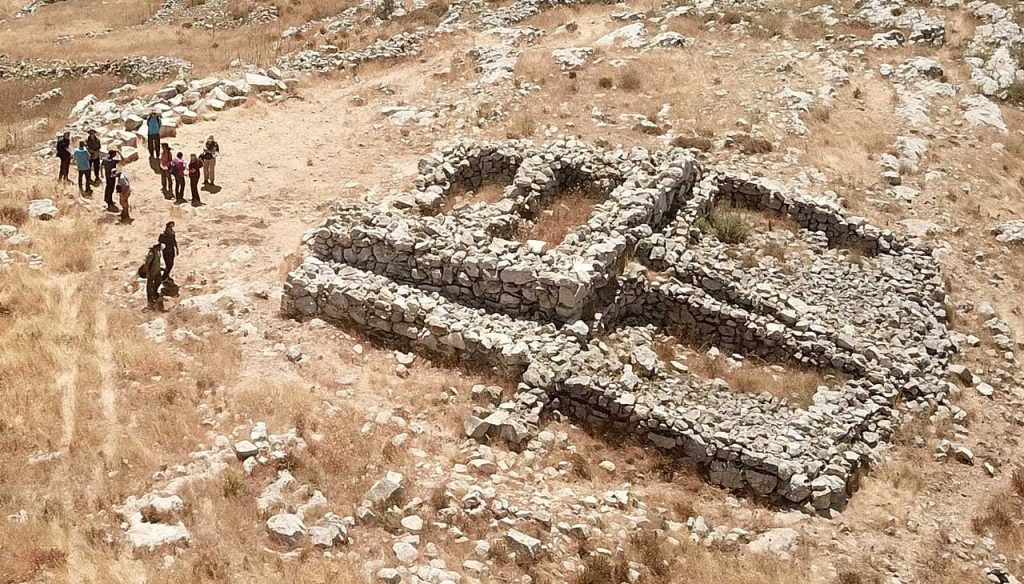
Mount Ebal rises over the valley where ancient Shechem stood. On a spur of the mountain, excavators uncovered a rectangular stone structure with two adjoining paved spaces and what may have been a ramp. They found pottery, ash, and many fragments of animal bone. Adam Zertal, who discovered the site in 1980 during a regional survey, believed it was a place of worship. He also proposed a striking possibility. Had he found the remains of the altar Joshua built on Mount Ebal?
Christians can begin with confidence in the truth of Joshua’s account and still ask what this particular excavation establishes. The evidence makes the best sense when we ask three questions in order. Did worship take place at the site? Did the surviving rectangular structure serve as an altar? Can any of the excavated remains be tied to Joshua’s particular ceremony? A case for one answer gives us a reason to consider the next question. Each answer requires evidence of its own.
What you’ll learn
- Where the discovery sits in relation to ancient Shechem and Mount Gerizim.
- Why pottery and two Egyptian-style scarabs help date the site.
- What bones, burning, and the apparent ramp contribute to the worship and altar interpretations.
- What Joshua 8 says about the altar and why linking the story to a particular layer remains difficult.
From a surface survey to an excavated site
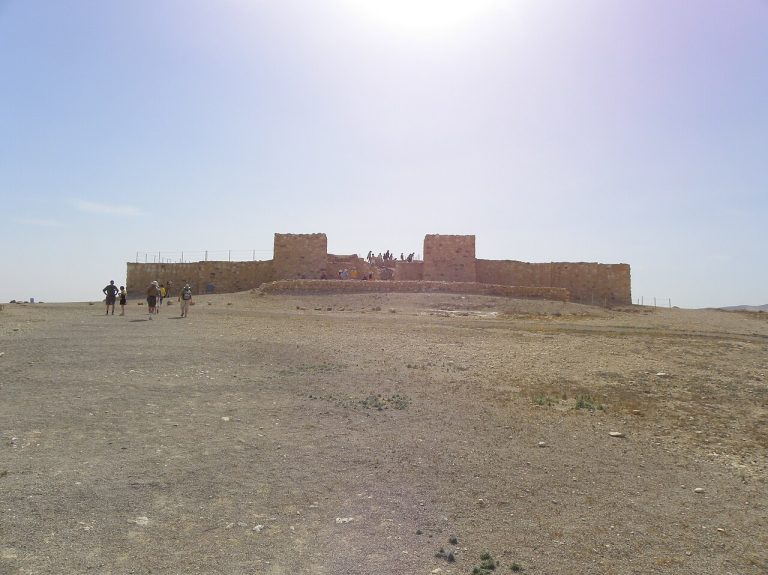
The site is commonly called el-Burnat after the spur on Mount Ebal where it lies. It sits in the highlands of the West Bank, northeast of the mountain’s summit. The location gives a view across nearby slopes and valleys, and the main structure sits inside a smaller stone enclosure that forms part of a wider complex. At the scale of the mountain, the rectangular stones occupy a small part of the exposed ridge. Zertal’s survey put the surface remains on record in 1980. Excavation began in 1982 and continued through 1989. His major preliminary report covers the work through 1987. Zertal’s preliminary excavation report and Winter and Bar’s later excavation-area summary
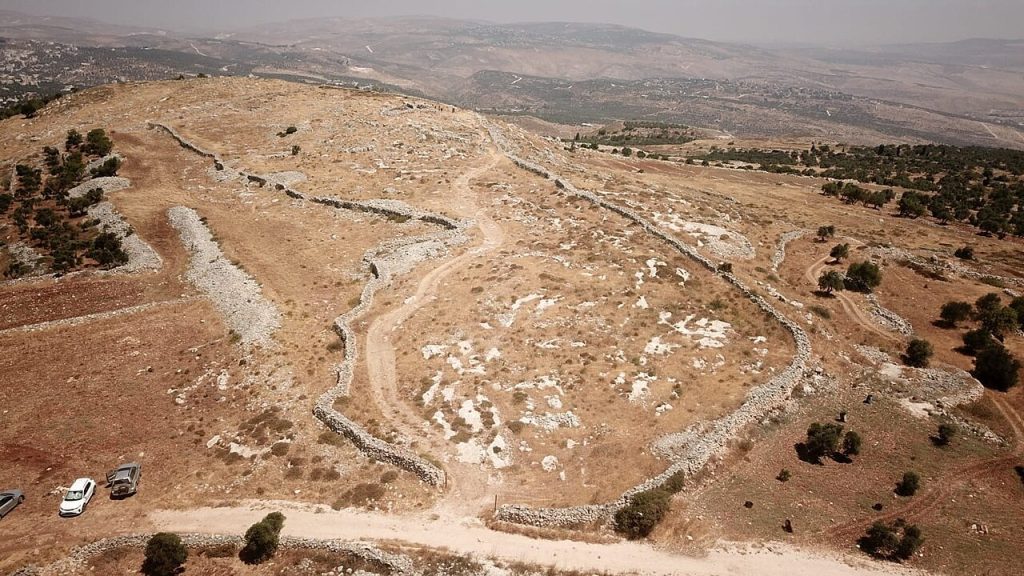
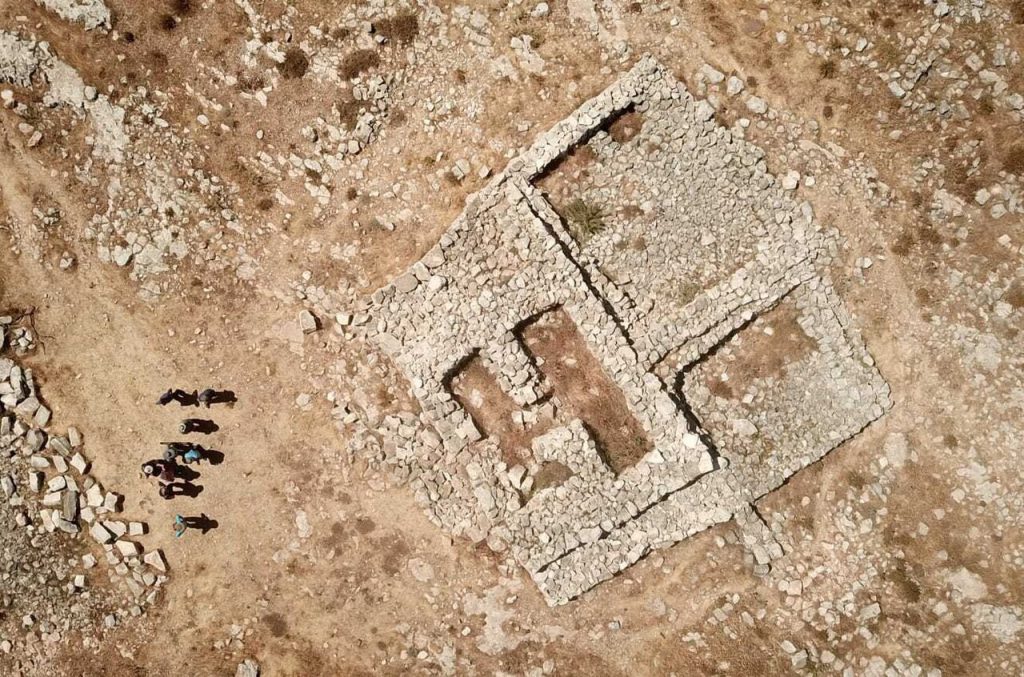
Excavation showed that the visible rectangular structure was a later part of the site’s ancient use. Beneath it the team recorded an earlier installation and wall fragments on the bedrock. The upper construction included the large stone rectangle, two adjacent courts, and smaller installations nearby. Builders reused ground on which people had already been active. The resulting plan is easiest to understand if you give the walls in the overhead photograph a sequence in your mind. Some features were already buried or superseded when the main structure went up, and separate excavation areas did not all provide direct physical connections by which their deposits could be matched. Excavation areas and strata in Winter and Bar, pp. 84–86
Pottery is one of the main reasons archaeologists place the site near the beginning of the Iron Age. They compare forms with pottery found at other excavated sites, where sequences of layers show when such forms were used. Haim Winter and Shay Bar use a broad date of about 1240–1100 BC for the occupation at Ebal, spanning the later Late Bronze Age and early Iron Age I. The borders between archaeological periods are approximations and vary by region. Archaeologists use them to compare the remains of communities whose tools and vessels changed gradually. Winter and Bar’s chronology
Two small Egyptian-style scarabs found at the site provide a different kind of evidence. These beetle-shaped objects commonly carry designs or inscriptions underneath. Baruch Brandl compared the Ebal examples with objects found elsewhere in the eastern Mediterranean and proposed a late thirteenth-century BC date for their manufacture. One bears the name of Thutmose III, a much earlier king. Brandl understood that example as a later object recalling the earlier king. Scholars have questioned some of these dates and comparisons. A portable object might circulate for years before it entered the deposit where it was found. The manufacture date, the deposit date, and the building date each have to be worked out. Brandl’s scarab report and Hawkins’s analysis of the objects and where they were found
Did people worship at the site?
Zertal pointed to the combination of an unusual layout and the deposits associated with it. Smaller stone installations in and near the courts yielded pottery or deposits with ash and bones. The large rectangle contained fill with stones, soil, pottery, and animal remains. Animal bones at a site can reflect meals, meat processing, offerings, or fill moved from somewhere else. Archaeologists ask what animals they represent, whether certain body parts are unusually common, and how the finds are distributed across the excavation. Several patterns together can support an interpretation that would be weak if it rested on a single ash layer. Zertal’s report on the building and finds
Liora Kolska Horwitz studied the animal remains. Of 2,862 bones in her study, 770 could be identified. Sheep, goats, cattle, and fallow deer made up most of the identifiable material. Bone was relatively concentrated around the main structure, an area that also yielded a greater share of burnt and cut-marked examples. The pattern differed in several respects from other Iron Age habitation sites used for comparison. Horwitz also noted that fallow deer is a wild animal and falls outside the stated animals for burnt offerings in Leviticus 1. Deer could be eaten, as Deuteronomy 12:15 illustrates. Even at a place of worship, some bones may come from preparation and eating. The sample is most informative when interpreted as a group, with attention to the different contexts in which bones were found. Horwitz’s primary faunal study
Later research offers a useful check on how the case is made. Early accounts reported an absence of flint sickle blades, a clue some took as support for ritual use without much agricultural activity. Winter and Bar found sickle blades in the surviving records of the flint assemblage. They also identified debris left when people fashioned tools from local stone. People could cut, prepare, and process materials at a gathering place, too. The later analysis makes the original claim about the absence of sickles untenable, and highlights how much remains to be learned from the ordinary artifacts recovered there. Winter and Bar’s study of the flint tools
What was the rectangular structure?
A separate question is what took place on or inside the main structure. Zertal described a rectangle built of fieldstones, without a doorway or normal room floor in the excavated remains. A stone feature between the two paved courts rises toward it. He read it as a ramp providing access to the top and interpreted the main structure as an altar for burnt offerings. The enclosed spaces, unusual building form, and concentrations of material associated with burning are parts of his case. His description also distinguished the prominent structure from the earlier installation exposed beneath it. Zertal’s illustrated account of the structure and ramp proposal
Aharon Kempinski proposed a watchtower and read the sloping wall differently. A thick base can support a building whose occupied floor stood higher than the surviving foundation. An uphill or sloping feature can also reflect changes or collapse in a wall. Zertal pointed in response to the way the feature met the main building and questioned whether the spur was a useful place to watch over traffic. Ralph Hawkins later compared the remains with examples of towers, farmsteads, and places of worship and defended a ritual interpretation. The published disagreement helps explain why a photograph can make the layout clearer without resolving what the upper part of the structure looked like or how people used it. Biblical Archaeology Review’s diagrams of the competing readings and Hawkins’s comparative study
A community could use this wider area for worship even if the rectangular structure had served a different purpose or undergone changes. Some researchers find the case for ritual use persuasive while leaving the identification with the episode in Joshua open. That is an important distinction when a headline calls the whole place by the name of one possible altar. The discovery of an early gathering place with evidence of unusual activities is historically interesting in its own right. It also helps readers recognize that a proposed interpretation applies to particular remains, while the biblical narrative describes a community and an event. Winter and Bar’s review of interpretations
The stones give us the layout of a place people used. Joshua gives us the people, purpose, and words of a particular gathering on the mountain.
Reading Joshua 8 on the mountain
Deuteronomy 27 directs Israel to build an altar of unworked stones, make offerings, and put the words of the law on plastered stones. Mount Gerizim and Mount Ebal are assigned roles in the blessing and curse. In Joshua 8:30–35, Joshua builds the altar on Ebal and reads the law with the people gathered in relation to the two mountains, on both sides of the ark. The account includes elders and officers alongside the rest of the assembly. It specifically includes women, children, and resident foreigners. Taken together, the two passages show a people hearing the words by which they were to live. The offerings and the public reading belong to that setting of covenant obedience.

The biblical place names are useful. Ancient Shechem at Tell Balata lay near the eastern opening of the valley between the mountains. The relationship between Ebal and Gerizim makes a geographically specific scene possible. The excavated structure is indeed on Ebal, which makes the comparison worth pursuing. Joshua 8 gives the mountain and the character of the altar and ceremony, but gives no dimensions, route, or architectural plan that picks the excavated rectangle out from other possible places on the mountain. A match in building material is consistent with the account. Fieldstones were also widely available and serve many uses. The importance of the site is bound up with how those observations fit together.
A direct link to Joshua would require something that identifies this phase of use with the ceremony, or a convergence specific enough to distinguish it from other activities on the mountain. The existing excavation evidence can take us a long way toward understanding what people did there in the early Iron Age. It leaves the identity of the builders and the exact occasion undecided. Christian readers can take the account as truthful and appreciate how the landscape, architecture, and excavation bring its setting closer. The book of Joshua also gives a reason to linger over the scene after looking at the photographs. At Ebal the people heard what God had spoken and were called to order their life in the land by his words.
Sources and further reading
- Adam Zertal, An Early Iron Age Cultic Site on Mount Ebal (1987) — Institutional record and DOI for the primary excavation report, with site description, phases, plans, and interpretation.
- Adam Zertal, Has Joshua’s Altar Been Found on Mt. Ebal? (1985) — Excavator’s preliminary account of the architecture, inclining stone feature, and altar proposal.
- Baruch Brandl, Two Scarabs and a Trapezoidal Seal from Mount Ebal (1987) — Original study of the scarabs and seal, including proposed Egyptian parallels and dates.
- Liora Kolska Horwitz, Faunal Remains from the Early Iron Age Site on Mount Ebal (1987) — Institutional record and DOI of the primary study of species, burning, cut marks, and distribution.
- Haim Winter and Shay Bar, The Flint Assemblage from the Early Iron Age I Site on Mount Ebal (2023) — Open article on excavation areas, chronology, chipped stone tools, and the evidence for sickle blades.
- Biblical Archaeology Review, Kempinski Takes the Altar Apart (1986) — Diagrams and summary of Kempinski’s watchtower reading and Zertal’s response.
- Ralph K. Hawkins, The Iron Age I Structure on Mt. Ebal: Excavation and Interpretation (2012) — Comparative monograph on the excavated contexts, alternative readings, and relationship to Scripture.
- Ralph K. Hawkins, Propositions for Evangelical Acceptance of a Late-Date Exodus-Conquest (2007) — Analysis of the pottery, scarabs, and how their contexts bear on the site’s date.