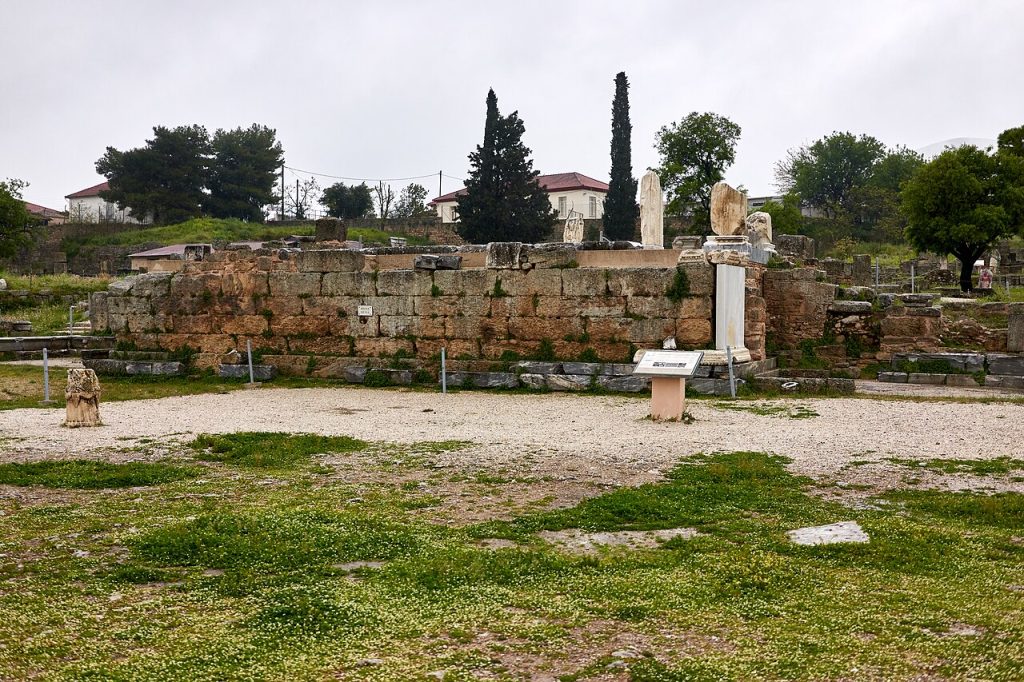
At ancient Corinth a wide platform stands above the lower part of the Roman forum. Today the stonework is exposed to the weather and the square is quiet. In Roman times, a person on the platform could address people gathered below. That arrangement makes the remains a natural place to think of Paul and Gallio. Acts 18 says that Paul’s opponents brought him before Gallio at a bēma, a judgment seat or tribunal. The standing platform is a strong candidate, and the archaeology of a second building shows why the location is still open to discussion.
We receive Scripture as true and accurate. Luke records the Roman official, the dispute put before him, and the setting in the civic life of Corinth. Excavations bring some of the city’s architecture within sight. They also give readers a chance to ask a specific question. What is the difference between identifying one of Corinth’s platforms as the rostra and identifying it as the very place where a named hearing took place?
What you’ll learn
- Excavators exposed a substantial public platform on the central terrace of Corinth’s Roman forum in the 1930s. Inscribed fragments help identify it as the rostra.
- The platform was an appropriate venue for public proceedings. The nearby Julian Basilica offers another plausible setting for a hearing involving the provincial governor.
- The Delphi inscription dates Gallio’s time in office. It answers a different question from the archaeology of where the hearing took place.
A platform built into the forum
The Romans refounded Corinth as a colony in 44 BC, and by Paul’s day the city served as the administrative center of Achaia. Civic buildings and monuments shared the forum with shops and passages. The terrain divided the forum into upper and lower areas, and the terrace between them became part of the arrangement of the square. The platform sits along that terrace, facing into the lower forum. Standing in front of it and then looking back from above gives two different perspectives on the same space. Its height and placement made it suitable for official appearances and public speech. Excavation project history of Roman Corinth and Scranton’s architectural publication
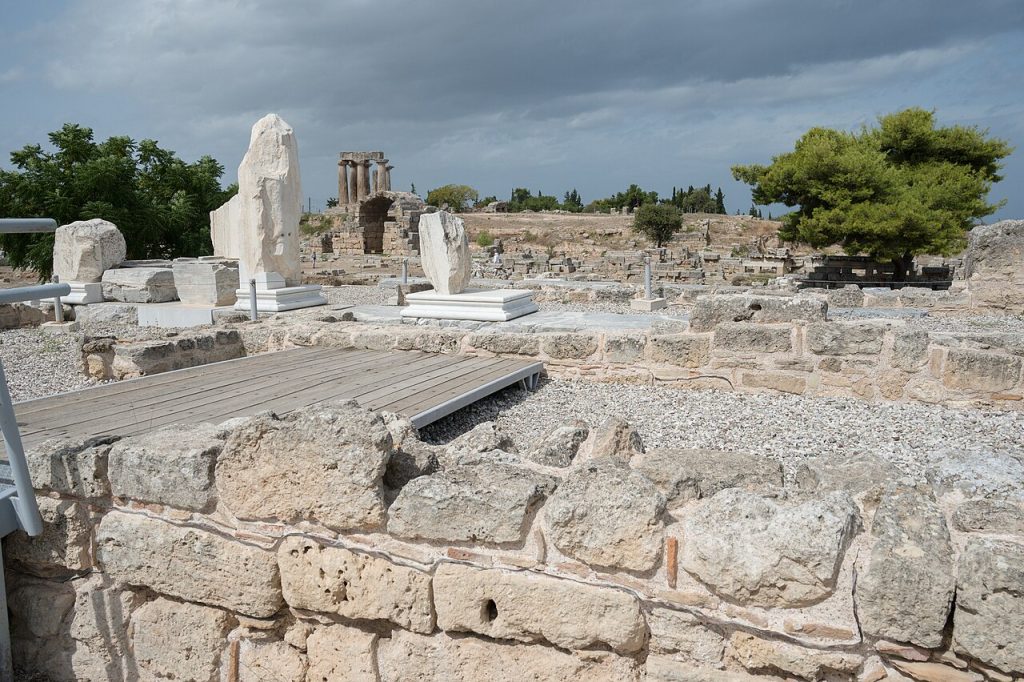
The American School of Classical Studies at Athens identifies 1936 as the discovery year of the structure. Oscar Broneer worked on its identification as the forum rostra. Robert Scranton’s later volume examined the masonry, nearby passages and shops, and remains of the exterior finishes. Builders used a core of rubble and concrete faced with blocks of a local limestone archaeologists call poros. They eventually supplied elements in contrasting marble. That is worth remembering when looking at the tan blocks today. The remains of the structure record part of how the platform looked at its best, while most of the finished exterior has disappeared. ASCSA on the excavation and identification and Final architectural report
There are good reasons to distinguish the building’s original core and its later finish. Individual pieces of marble survived even when most of a facing was lost. The places where the poros blocks were trimmed or left carefully dressed can also suggest whether they were supposed to be seen. The proposal that an earlier limestone structure was faced with marble later makes sense of both kinds of evidence. It leaves room to ask exactly when particular additions went into the project. Roman Corinth’s main public buildings developed over time, so descriptions that give the platform a single date can miss its changes. Kent’s discussion of the stonework and marble, inscription no. 322
Scranton observed that the platform stands off center in the overall run of the terrace. The rows of shops that meet it are unequal. One explanation is that later builders had to work around a platform already in place. That makes the joints between the monuments worth as much attention as the most impressive blocks. A façade that looks continuous from across the square can turn out to have a long building history. Here the position of the podium supports an early phase. The fitted marble addresses a later stage, and the two lines of reasoning do different work. Scranton’s treatment of the shops and bema
What the Latin inscription identifies
John Harvey Kent published a group of weathered inscribed marble pieces as no. 322 of the Corinth excavation inscriptions. He restored the Latin word rostra as part of the damaged text. Several pieces were recovered in or near the forum platform. Kent compared the marble’s thickness and the treatment of its back with surviving parts of the platform’s facing. Those details help explain why he assigned the inscribed slab to the platform and dated its marble facing to the first half of the first century AD, probably the second quarter. The reading and the assignment both depend on fitting together small pieces of written and architectural evidence. Kent’s catalog, no. 322, pp. 128–129
The inscription is important even though it does not mention either Gallio or Paul. It identifies a civic structure and indicates that it had a form appropriate for official use by around the time of Paul’s visit. Another Corinthian inscription records that a governor’s decision in an unrelated matter was read from the rostra. That gives us a concrete example of how a court or government decision could reach people in the city. It also shows why the forum needed a place where words from officials could be read aloud. Kent’s edition of the governor’s letter, no. 306
Notice what the governor’s letter contributes to the comparison. An official decision could be issued in writing and then publicized orally. The place where it was announced need not be the room or platform where the matter was examined. In Acts, the proceedings include an accusation, a governor’s immediate judgment about the complaint, and a dismissal. Luke presents them as parts of one encounter. The inscription records a different event in which a decision reached the public through a formal reading. The distinction helps us avoid turning secure evidence that an official announcement took place at the rostra into a general rule about where all legal business in Corinth happened.
In Greek, bēma could refer to a raised place or to a place where a magistrate heard a matter. Luke uses the same word for Festus’s tribunal in Acts 25, when Paul appears before a Roman official at Caesarea. In Corinth the forum’s rostra is a good match for the kind of civic place the Greek word can describe. The word gives the reader the nature of the setting. It is the work of archaeology and historical comparison to ask which specific location the participants used.
The marble helps identify the rostra. Acts tells us who was brought before Gallio and what the hearing was about.
Why the Julian Basilica is also in the discussion
A substantial Roman building stood toward the eastern end of the same forum. Excavators call it the Julian Basilica. In this context, a basilica was a Roman civic hall. Its modern name comes from an archaeological identification and does not make it a church in Paul’s day. The published study reconstructs a public building with large interior spaces and a substantial collection of sculpture associated with the imperial family. Its authors argue that the basilica was the likely place where the imperial court of law for Achaia normally met. Scotton, Vanderpool, and Roncaglia’s final volume
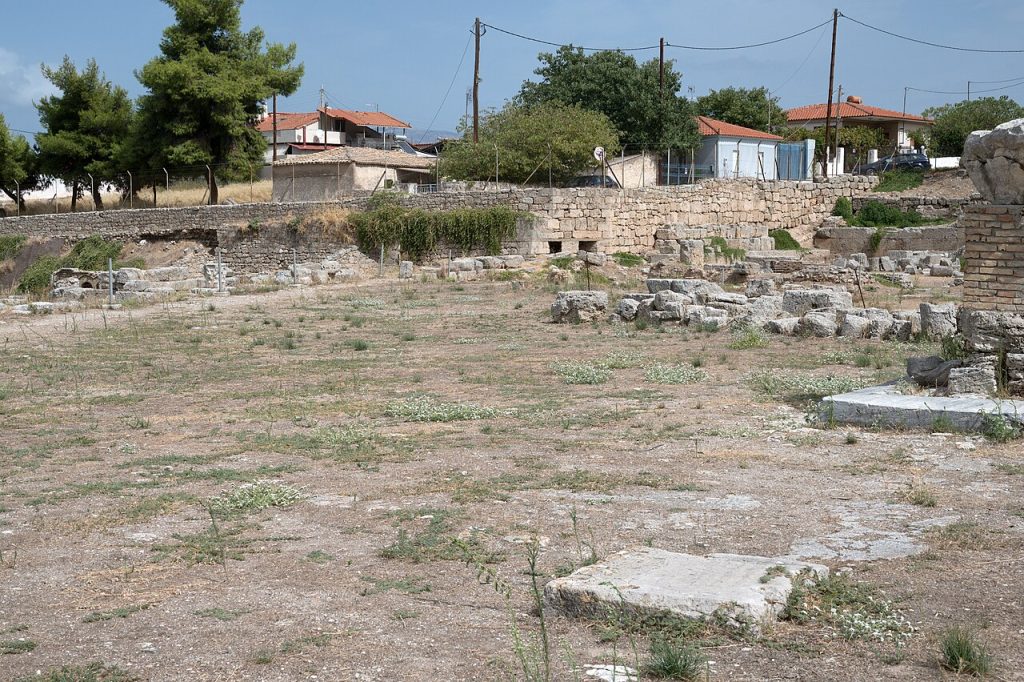
The two locations propose different settings for the same event. On the open forum platform, the issue would be presented in view of an assembly standing in the square. In an official hall, provincial authority would be exercised inside a designated building. Luke writes that people brought Paul to the tribunal, that Gallio dismissed them from it, and that Sosthenes was beaten in front of it. Such a group of people and the events that followed could fit the public character of the forum. The existence of a formal venue raises a real alternative. The wording of Acts does not give the building name or the direction from which the crowd came. The Julian Basilica’s place and form within the forum
It is useful here to compare three questions a reader might bring to the remains. What public structure was in use? What work normally happened there? Where did the participants in this particular account meet? Architectural remains and inscriptions address the first two. A securely dated independent source for a single event would be especially valuable to the third. The Delphi inscription naming Gallio helps identify the years he served as governor rather than where he sat on the day described. The Erastus pavement illustrates a similar difference between identifying an official’s name at the site and establishing his relationship to someone named in Scripture.
Why Luke takes us to the tribunal
In Acts 18, Paul has been working alongside Aquila and Priscilla, speaking in the synagogue, and teaching in Corinth. The accusation brought against him concerns how he is persuading people to worship God and whether that teaching is contrary to law. Before Paul can answer, Gallio says he would hear a charge of wrongdoing but regards the dispute before him as a matter of words, names, and the accusers’ own law. His refusal ends that proceeding. Acts does not present it as a broad declaration about all Christian activity in the Roman Empire. The public platform helps us imagine the force of a governor ending a hearing before the accused speaks.
Luke then tells us that the people seized Sosthenes, the synagogue leader, and beat him before the tribunal. Gallio pays no attention. The event gives the legal scene a harsh aftermath. A governor’s refusal to proceed against Paul and what then happened to Sosthenes are two different actions. Christians reading the account can see the protection Paul experienced in a particular moment while recognizing that public order and the treatment of individuals could be very uneven. The related question of whether the Sosthenes named in the greeting of 1 Corinthians 1 is the same man remains open.
When you look at the two excavated places, picture them as working spaces before picturing a particular event. The rostra faced a public square and gave an official a place from which to speak. The Julian Basilica supplied a different kind of authority in the same civic center. The archaeology of Corinth gives the account its proper urban scale. Acts gives us the names and the dispute that brought Paul there, and records what the exercise of Roman authority meant for the people standing in front of it.
Sources and further reading
- Robert L. Scranton, Corinth I.3: Monuments in the Lower Agora (1951) — Primary architectural account of the bema and central terrace, especially pp. 91–102 and 122–126.
- John Harvey Kent, Corinth VIII.3: The Inscriptions, 1926–1950 (1966) — Primary edition, no. 322, pp. 128–129, and no. 306 for public use of the rostra in transmitting a governor’s decision.
- American School of Classical Studies at Athens, History 1882–1942, chapter IV — Institutional history on the forum excavations, Broneer’s identification, and the 1936 discovery.
- American School at Athens, History of Corinth — Excavation project overview on Roman Corinth, the forum, and the bema as a possible setting for Acts 18.
- Paul D. Scotton, Catherine de Grazia Vanderpool, and Carolynn Roncaglia, Corinth XXII: The Julian Basilica (2022) — Final study of the civic basilica and the evidence that it contained the provincial law court.
- Catherine de Grazia Vanderpool and Paul D. Scotton, Contending with the Past in Roman Corinth — Open chapter from the project researchers describing the Julian Basilica’s urban location, raised podium, and sculpture.
- Corinth Computer Project, Central Shops, Bema, and Temple of Hermes — Site plans and interpretation of the platform’s relationship to the terrace and later shops.