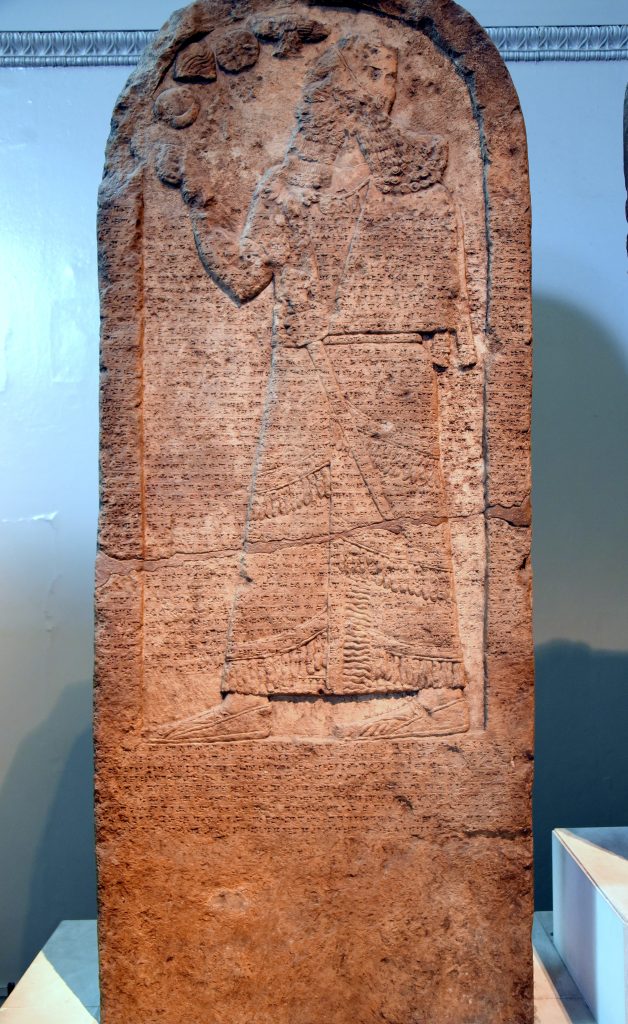
Ahab is familiar to readers of 1 Kings as the king who built a temple for Baal and confronted the prophet Elijah. On a limestone monument from the upper Tigris region, he turns up in a scene that will be new to many Bible readers. In 853 BC Shalmaneser III of Assyria encountered a coalition of rulers at Qarqar in Syria. Among the forces he claims to have fought were those of Ahab the Israelite. An imperial record brings one of the Bible’s most closely scrutinized kings into view as a participant in a major regional confrontation. Kurkh Monolith inscription, column ii Omer Sergi, The Two Houses of Israel, pp. 92–94
What you'll learn
- What John George Taylor found at Kurkh in 1861 and how to recognize Shalmaneser’s monument.
- Where Qarqar fits into the geography and conflicts of the ninth-century BC.
- What the Assyrian battle list says about Ahab and why the exact number of his chariots remains open.
- How Ahab’s appearance in the Assyrian annals adds historical setting to the account of his reign in 1 Kings.
From the upper Tigris to the British Museum
In October 1861, British consul John George Taylor found two inscribed monuments at Kurkh, near present-day Diyarbakır in southeastern Türkiye. His report, published in 1865, described the ruins and the finds. One monument belongs to Ashurnasirpal II. The other belongs to his son Shalmaneser III, who ruled Assyria in the ninth century BC. Both entered the British Museum in 1863. The British Museum number BM 118884 identifies Shalmaneser’s stone, which is the one that preserves the record of Qarqar and Ahab. Looking for the accession or catalogue number is a reliable way to distinguish the two when both appear under the name Kurkh Monoliths. Taylor’s first-hand report, pp. 22–23 CDLI object record for BM 118884
The stone stands about 2.2 metres high. On the front, Shalmaneser faces emblems of the gods. Lines of cuneiform cover the surface around the image and continue across the reverse. The figure and the writing make related claims. The visual image connects the ruler with divine authority. The inscription opens with titles and presents the king as the agent of Assyria’s gods, then recounts his campaigns. A person who could recognize the image could receive part of the message even without reading Akkadian. The picture beside the signs helps us remember that this was a monument intended to make a visible impression. ORACC, Shalmaneser III Lauren Ristvet, “An Imperial Audience,” pp. 325–326
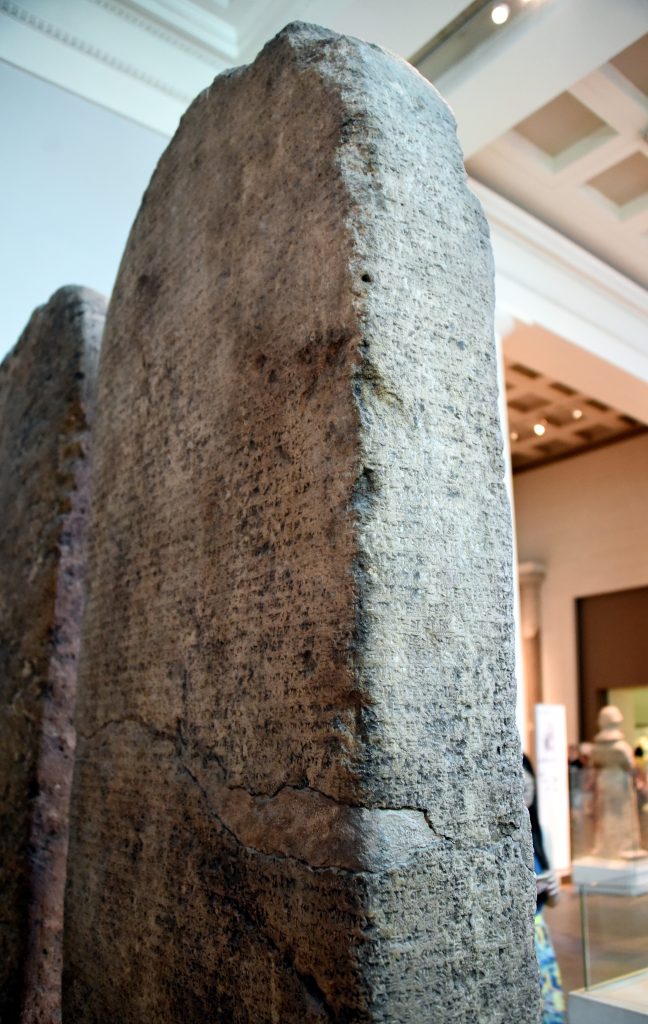
The stele’s modern findspot and the battlefield belong on two different parts of a map. Kurkh was in the upper Tigris region. Qarqar was in the Orontes valley in what is now western Syria, in the territory of Hamath. Shalmaneser’s annals tell of a western campaign and of his movement through the lands he crossed. A statement written at the Assyrian king’s behest was therefore placed where it could commemorate his reach far from the valley in which the fighting took place. The connection with Israel comes through the people listed in the text, across a still greater span of geography. Campaign route in the Kurkh inscription Sergi on the geography of the campaign
An Israelite king in the Assyrian battle list
Go to the second column of the transcription, near lines 89–96, to find the forces at Qarqar. Shalmaneser lists Hadadezer of Damascus, Irhuleni of Hamath and Ahab the Israelite early in the account. More contingents follow. The Assyrian record gives each of these leading opponents a place in a larger coalition. Even through a foreign spelling, Ahab’s name and association with Israel are recognizable. In 1 Kings 16:29 the same man is introduced as Ahab son of Omri, reigning over Israel in Samaria. The combination of name, kingdom and period is a much stronger basis for identification than a name in isolation. Assyrian text, column ii, lines 89–96
The figures next to the names deserve to be read as part of Shalmaneser’s account. Hadadezer and Irhuleni are credited with chariots, cavalry and soldiers. The stone attributes 2,000 chariots and 10,000 troops to Ahab. The chariot count is especially large relative to those of the first two kings. Nadav Na’aman proposed that the numeral for 2,000 reflects a scribal error and that 200 would be more plausible. That proposal is an interpretation of the number, while the scholarly edition prints the figure found on the stone. We can report the ancient number plainly and leave the underlying strength of Ahab’s contingent open. Recorded force totals in the Kurkh inscription Na’aman on the chariot figure
The end of the passage changes from the preparations of the rulers to Shalmaneser’s account of the fighting. He credits divine assistance and claims a great victory. The rest of the regional chronology helps test the reach of his claim. Assyria would campaign against a coalition in the west again in subsequent years, and scholars have pointed out that the Qarqar account reports no lasting subjection or tribute from Hamath. The careful conclusion is that the monument gives a detailed Assyrian account of the encounter, and that the scale and permanence of the success claimed by the king need separate evaluation. Shalmaneser’s account of the battle Sergi on the subsequent campaigns
At Qarqar, Assyria had to reckon with a king whose story Scripture measures by something deeper than the size of his army.
What the date connects
The year 853 BC comes from the Assyrian chronology. The campaign account names the official whose tenure identified the year, Dayyan-Aššur. Assyrians distinguished years by naming them after designated officials, and historians can use surviving sequences of those names to place many campaigns on a common calendar. Israelite accounts in Kings usually place a ruler’s accession in relation to the reign of a ruler in the other Israelite kingdom. The Kurkh text lets us put one event involving Ahab at a date in an independent system. Discovering a link like that is especially valuable because the two systems serve such different accounts of the past. Kurkh inscription, column ii, from line 78
There is a difference between dating an encounter and dating every object that records it. The Qarqar episode took place in 853 BC. The carving that includes that campaign must have been made in connection with or after the event it commemorates. Sergi places the carving in 852 BC, the following year. On a museum label a date may refer to the object, whereas in a history of the campaign it refers to the fighting. That small distinction matters here because the strongest chronological link is to the presence of Ahab’s forces in the campaign account. Omer Sergi, pp. 92–94
From Samaria to the Orontes and back
The appearance of Ahab alongside the ruler of Damascus can surprise a reader coming from 1 Kings 20. The chapter recounts war with Aram and then negotiations after an Israelite victory near Aphek. In 1 Kings 20:34, the Aramean king promises to restore cities and allow Ahab to set up trading arrangements in Damascus. The two make a covenant, and Ahab lets him go. That account illustrates how rapidly rulers in the region could move between hostility and accommodation. It gives us a setting in which cooperation against another power is comprehensible. The terms of the agreement at Qarqar are beyond what either text describes. Cambridge University Press, analysis of the regional coalition
The final battle in 1 Kings 22 belongs to a separate event. Ahab goes with Jehoshaphat of Judah to fight for Ramoth-gilead, east of the Jordan. The prophet Micaiah warns him, and Ahab is struck by a bowshot as the fighting unfolds. Qarqar took place farther north in Hamathite territory and concerned the coalition facing Shalmaneser. Putting the Bible and the stele side by side therefore adds an encounter to our knowledge of Ahab’s reign. The clear name and kingdom on the stone give a point of contact with Scripture while allowing the campaigns to retain their own settings, participants and outcomes. Sergi, chronology of Ahab and later Israelite rulers
Ahab’s period also helps explain the importance of the events carved on the Black Obelisk. Around twelve years after Qarqar, Shalmaneser recorded a payment from Jehu, who had taken power from Ahab’s dynasty. Ahab’s army is listed among the forces opposing the Assyrians. Jehu’s tribute is recorded in connection with a campaign against Hazael of Damascus. Those entries belong to different years and come from different monuments. Reading the two records together lets us trace a changing relationship between Israel, Damascus and Assyria while the narrative in Kings follows the rise and fall of the ruling families. Shalmaneser’s record of Jehu’s payment, columns iii–iv
What Kings wants readers to see in Ahab
First Kings introduces Ahab’s reign in 16:29–34 by telling us how he provoked the Lord. It names his marriage to Jezebel and records his building of a temple and altar for Baal in Samaria. At Mount Carmel in chapter 18, Elijah brings the choice between the Lord and Baal into the open before Israel. Chapter 21 moves closer to home. Ahab desires Naboth’s vineyard, Jezebel arranges false testimony and Naboth is killed. Elijah condemns what happened, and the Lord sees Ahab humble himself when judgment is announced. Scripture makes room for the king’s public and private acts and for God’s response to both.
A text commissioned by Shalmaneser names the resources he had to face. Scripture shows us what power looked like in the court and at the vineyard of a citizen who had inherited his land. As Christians we take that biblical account as true. Its attention to worship, justice and responsibility gives the history of Ahab lasting significance. Learning where he stood when an Assyrian army advanced helps us picture the choices facing a ninth-century ruler. Reading 1 Kings helps us see why the right use of royal power mattered even when another king’s inscription was concerned with how many chariots it brought to a battlefield.
It is worth going back to the face of the monument at the end. Shalmaneser stands there in a posture designed to tell us about his standing with his gods. Below and behind the image, scribes itemized the rulers and forces that had resisted him. The collision between Assyria and an alliance from the west was important enough for its king to put it on stone. One of the names survives because of the particular story Shalmaneser wanted told. The same name comes to us in Kings because God chose to tell us what happened in Israel during his reign. The two lines of reading meet in the real ninth-century world Ahab inhabited.
Sources and further reading
- Royal Inscriptions of Assyria online, Shalmaneser III 002 — Scholarly transcription and English translation of the Kurkh inscription. See column ii, lines 78–102, for the campaign and coalition.
- Cuneiform Digital Library Initiative, BM 118884 — Object catalogue with provenance, British Museum registration and the cuneiform edition.
- J. G. Taylor, Travels in Kurdistan (1865) — Taylor's first-hand report. See pp. 22–23 for the two monuments and site observations.
- Nadav Na’aman, Two Notes on the Monolith Inscription of Shalmaneser III from Kurkh (1976) — Scholarly study of the inscription including a proposed scribal error behind Ahab's extraordinary chariot count.
- Omer Sergi, The Two Houses of Israel (SBL Press, 2023) — Chapter 3 places Qarqar and the campaigns that followed in the ninth-century political landscape. See pp. 92–94.




