Some ancient cities announce their extent with a ring of walls. At Tel Hazor the surprise is the large expanse below the familiar mound. The upper city held imposing buildings, but the lower city made Bronze Age Hazor far larger than its later Iron Age successor. Rooms sealed beneath burnt debris let archaeologists ask how the Canaanite city ended. A stone gate on the upper mound leads into another set of buildings and another time. The way to understand Hazor is to keep those places and periods in view together. That is also how readers can make sense of the different episodes in which the Bible names it. UNESCO nomination, Hazor plans and archaeological description.
What you’ll learn
- Where the upper and lower cities stood and how the ancient city grew.
- What the burnt palace, the lower-city gate and the scientific dates each show.
- How to read Joshua, Judges and Kings alongside a site that changed over centuries.
Why the city grew here
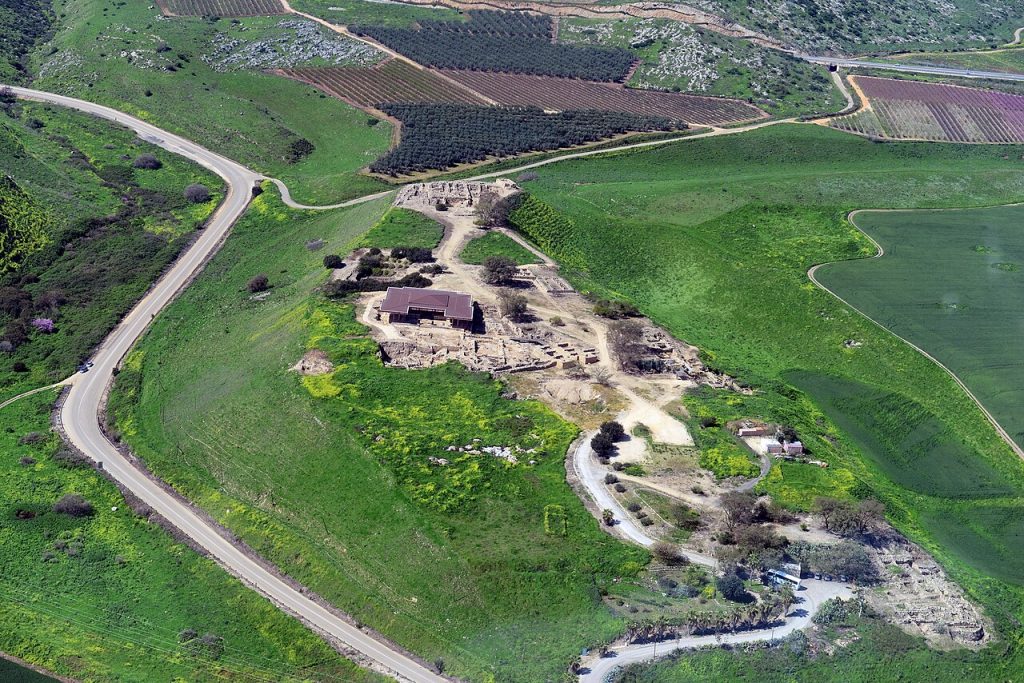
Hazor lies near the southern end of the Hula Valley in northern Israel, where routes connected the region with the Upper Galilee and points farther north and east. The Bronze Age city extended across both an elevated mound and a far larger enclosure. That scale matters when you read Joshua 11:10, in which Hazor is described as the head of a group of kingdoms. Hazor was known well outside its own valley. Eighteenth-century BC records from Mari shed light on connections with Mesopotamia, and correspondence preserved at Amarna in Egypt names Hazor in the Late Bronze Age. These texts give glimpses of two stages of contact across the region. Ben-Tor, site and textual evidence · Bechar, the Middle Bronze Age foundation.
The lower city was an archaeological question before it became a way to understand the Canaanite capital. John Garstang excavated probes in 1928. Yigael Yadin’s main campaigns in the 1950s, with additional work in the late 1960s, tested areas across the site. They demonstrated that the lower enclosure contained an extensive built settlement. A renewed expedition directed by Amnon Ben-Tor began in 1990. More recent work has revisited particular sectors, including the temple area in the lower city. The history of exploration is worth knowing. A map assembled from many seasons shows excavated windows through the site, with much of the space between them still represented by surface evidence and topography. Nomination, modern excavation history · Ben-Tor, excavation areas.
The ancient writers leave another trail. Cuneiform documents from Hazor itself attest to scribal activity, and some records relate to people and obligations beyond a single household. A form of the name Ibni-Addu appears in the earlier documentary horizon. Scholars have compared it with the form Jabin in the Bible. A shared name or naming pattern tells us something about the world in which such a name made sense. The ancient documents and the biblical texts belong to distinct episodes, and the similarity supplies no secure identification of an individual across them. Bechar on the Hazor–Mari connection · National park, interpretation of Hazor’s Bronze Age.
What the palace and temple leave behind
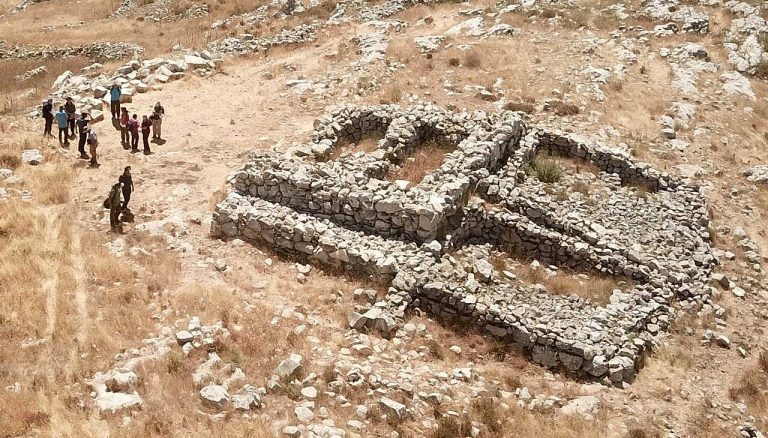
In the upper city, the remains of the Bronze Age ceremonial building make Hazor’s wealth physical. Builders used a combination of dressed stone, basalt slabs, wooden elements and mud brick. The excavators found fallen basalt slabs beside a wall in one room and traces of a carbonized wooden beam that had tied the masonry to the construction above. The display roof over the ruins is modern protection. The ruin below it allows us to distinguish the building materials that survive in place from parts that have fallen or vanished. Even a thick stone wall can tell only part of the original building’s story when its upper work was made of wood and mud brick. Ben-Tor, Bronze Age palatial building.
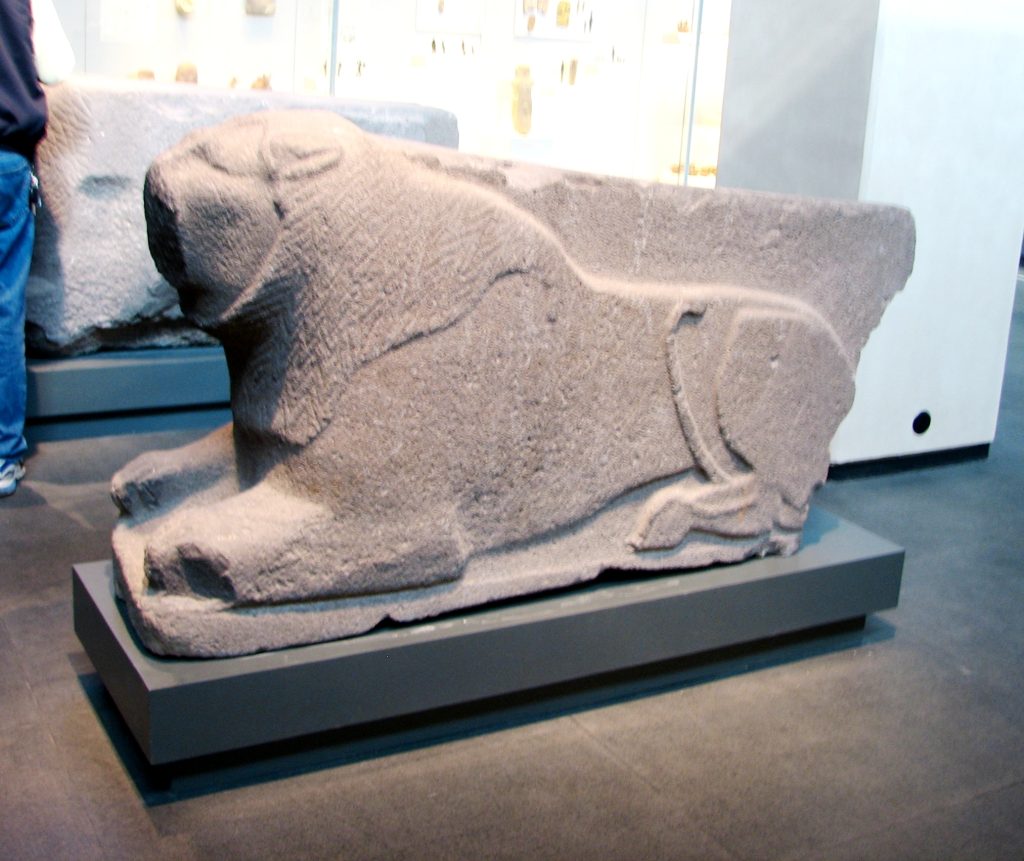
In the lower city, a carved basalt lion gives a different view of Canaanite public architecture. It was found in a pit near the entrance of the Orthostats Temple. An orthostat is an upright slab placed along the base of a wall or entrance. Some faces of the Hazor lions were left rough where they were set into the building. The position in which an object is excavated can differ from its original place in the design. Here the object’s working surfaces tell something about its first use, and the pit tells a later story. A similar lion found built into later construction on the upper mound presents a separate problem of reconstructing where it first stood. Ussishkin, §§1–2 on lion find contexts and proposed positions.
The destruction of Canaanite Hazor
The fire that ended the Canaanite palace left carbonized material and collapsed mud brick. Excavators have related that destruction to the final Bronze Age phase of the upper city, generally labeled Stratum XIII. The numbering in the lower city runs on its own sequence. A reader cannot line up two level numbers at sight and assume they represent the same year. To compare the two, investigators use finds such as pottery and Egyptian objects, dates from burned organic material and the order of deposits in each excavation area. Even a dated Egyptian object could already have been old when it was carried into a room. Bechar et al., stratigraphy and dating.
A recent multidisciplinary study offered two possible sequences for the end of the city, drawing on radiocarbon dates and on objects and deposits from the upper and lower parts. A separate microscopic study of the lower-city gate found evidence of repeated activity there and a major destruction ending its use. The evidence supports substantial burning at the end of the Bronze Age occupation, with the thirteenth century BC the main period under discussion. Debate remains over how closely the ends of particular buildings and districts coincide. Those are meaningful questions. A royal palace and the households below could experience different stages of disruption even if both ultimately fell out of use. Bechar et al., alternative destruction scenarios · Runjajić et al., lower-city gate fire and site formation.
At Hazor a burn layer can show what happened to a building. Connecting that event to an ancient campaign requires evidence about the date and the people involved.
Joshua and Judges tell different episodes
Joshua 11 places the king of Hazor, Jabin, at the head of a coalition against Israel. It says the battle took place at the waters of Merom and that Joshua later took and burned Hazor. The account singles out Hazor for burning among cities on their mounds. The picture of a nationally important Canaanite center and a ruin marked by intense fire explains the attention this chapter has received from excavators. The material witnesses have their own limits. Burnt wood can be dated, and a smashed or fallen object can be examined, but physical remains by themselves rarely tell us the names of the attackers.
Judges 4 opens with another Jabin, a king of Canaan associated with Hazor. Its scenes are different. Sisera, the commander, operates from Harosheth-hagoyim, and Deborah summons Barak to gather men and confront him. The story follows the chariots, the route of the battle and Sisera’s death at Jael’s hands. Judges 5 gives the event its own poetic treatment. Neither chapter describes a burning of the city. These details are good reasons to read the two narratives as separate episodes in Scripture. The recurrence of an associated royal name invites a historical question. Assigning their actions to the same excavated burn layer would bypass the distinct events the passages describe.
The Iron Age gate on the upper mound
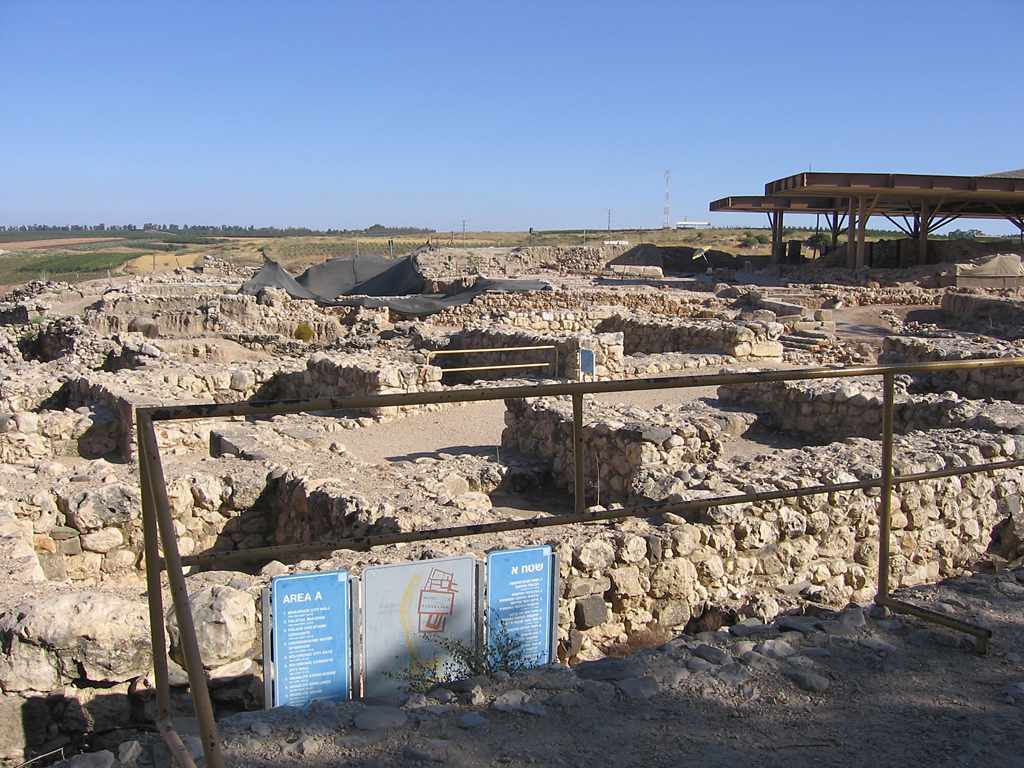
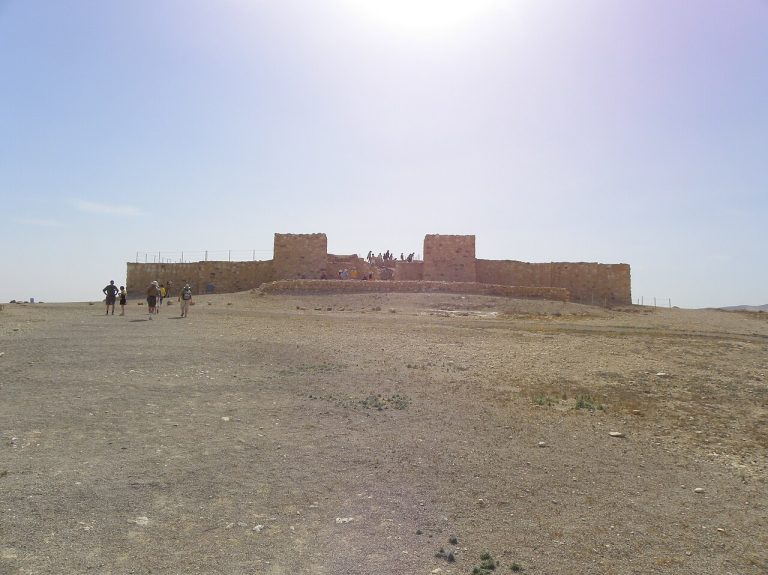
At the Iron Age entrance, the three chambers on either side make the passage clear. The gate connects to the defenses of a city concentrated on the upper mound. First Kings 9:15 mentions Solomon’s building work at Hazor, Megiddo and Gezer, and Yadin’s reading linked the gate and adjoining fortifications at Hazor to that statement. Comparing gate plans gives a starting point for the argument. Dating a particular structure also depends on its local relationship to walls, surfaces and pottery deposits. Archaeologists still debate both the date of early Iron Age construction and the way to correlate the later defenses. The name on a site sign is a convenient pointer to the traditional interpretation. Ben-Tor, Yadin’s attribution and chronology · Gilboa and colleagues, reassessment of Iron Age II phases.
The Iron Age water system gives you a second way to picture the later city. Cut down into the upper mound, its shaft and stepped passage allowed people to descend toward the water source with access from inside the defenses. A gate shows the effort to control the boundary. The water system shows an effort to keep a basic resource within reach of people behind that boundary. The relationship is easier to see in the park plan than in a photograph of the steps alone. It is also a reminder that two massive structures on one hill solve two different problems. Each had to be fitted to the place where it would actually work. Park guide, Iron Age water system.
Second Kings 15:29 names Hazor among the cities taken by Tiglath-pileser III during the reign of Pekah. That event belongs to the eighth century BC and to an Iron Age settlement, centuries after the Canaanite palace fire. Hazor’s changing footprint makes the difference visible. A site can keep an important name even when the space its inhabitants occupy and the kingdoms fighting over it have changed. For a southern example of how several wars can leave distinct remains at one mound, see the place guide to Tel Lachish.
Christians can take the historical claims of Scripture seriously while paying close attention to what a soil layer has survived to tell us. The text of Joshua remembers a powerful city and the burning that followed its defeat. Judges describes a later deliverance through Deborah, Barak and Jael. Kings names a city caught up in the advance of Assyria. By the time you have imagined the view across the lower settlement, seen the carved lion and followed the Iron Age gate passage, those passages belong to a more tangible landscape. They show how much can happen in the life of a single place and why the sequence matters when we read about it.
Sources and further reading
- UNESCO, Biblical Tels nomination dossier — Hazor’s location, upper and lower city plans, Bronze and Iron Age finds and excavation history.
- Amnon Ben-Tor, Hazor — Excavator’s overview of the site, plans, major discoveries, excavations and chronology.
- Bechar et al., The Destruction of Late Bronze Age Hazor — 2021 primary radiocarbon and stratigraphic synthesis, pp. 45–73.
- Runjajić et al., microarchaeology of the lower-city gate — Minerals, micro-residues and excavation observations on the gate occupation and burning.
- David Ussishkin, The Lion Orthostats From Hazor — Lower and upper mound lion find contexts and debated architectural reconstructions.
- Gilboa et al., Elusive Destructions — Reappraisal of Hazor’s Iron Age II sequence.
- Shlomit Bechar, The Middle Bronze I Foundation of Hazor — Evidence for development of the early urban site and connections with Mari.
- Israel Nature and Parks Authority, Tel Hazor — Description of visible palace, gate and other archaeological features.