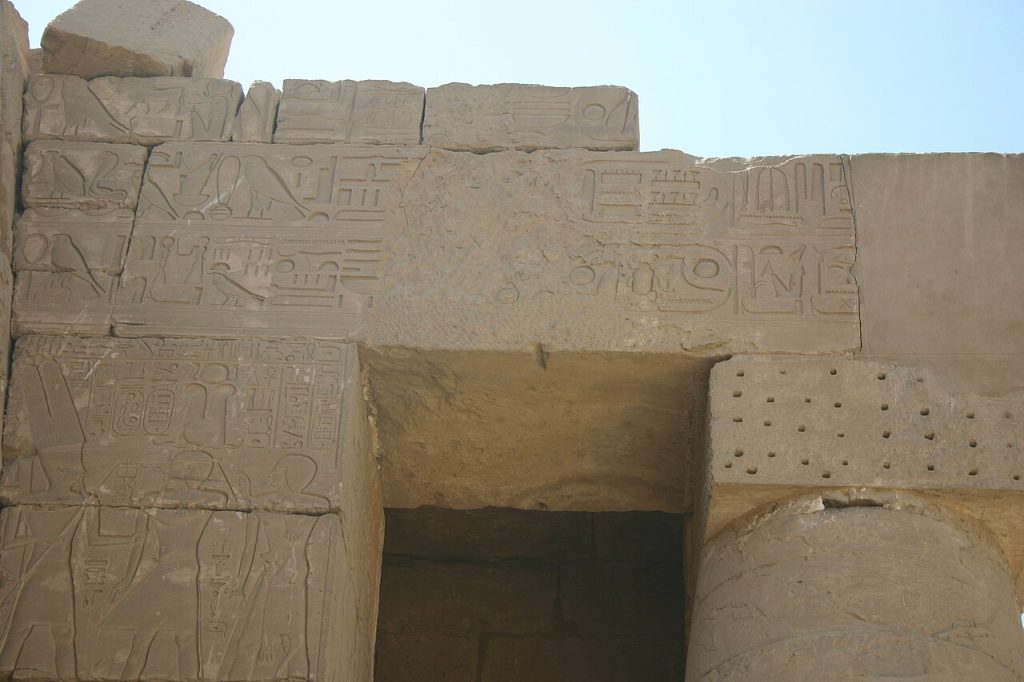
At Karnak, a pharaoh’s victory was made to look as permanent as stone. Rows of bound figures on the Bubastite Portal stand for places or peoples over which Egypt claimed power. The relief belongs to Shoshenq I, the tenth-century BC pharaoh widely identified with Shishak in Scripture. First Kings describes Shishak coming against Jerusalem during Rehoboam’s reign. In the surviving Egyptian list Jerusalem does not appear by name. The two records raise a good question. What kind of agreement should we expect between a monument to Egyptian power and a biblical account about what happened to Judah’s king and his people? Digital Karnak, Bubastite Portal Ancient Israel and Ancient Egypt, §2.2
What you'll learn
- Where the relief stands and how to recognize the place names within the victory scene.
- What the relief and the separately recovered inscription at Megiddo tell us about Shoshenq’s reach.
- Why historians identify Shoshenq with Shishak, and how the Bible reports Jerusalem’s experience.
An inscription on the outside of a temple
The Bubastite Portal is a doorway in the Temple of Amun precinct at Karnak, in modern Luxor. It opens near the first court between the Temple of Ramesses III and the second pylon. Shoshenq I built it as part of his work at the complex. Bubastite refers to the dynasty associated with Bubastis in Egypt. The relief we are concerned with is on the exterior of the gate. The broad sandstone surface gave artists room to arrange large figures and set rows of smaller images and words in relation to them. Someone standing at the wall could take in much of that effect from a distance. Digital Karnak, architecture and phases of construction
The portal was visible long before modern researchers could read all the signs. Jean-François Champollion and his contemporaries brought the monument into early nineteenth-century discussion as the decipherment of hieroglyphs made the names accessible again. That work gave interpretations in which some identifications would be revised. In the twentieth century the University of Chicago’s Epigraphic Survey combined photography and painstaking drawing of the surviving wall. Its 1954 volume lets you compare specific signs with the surface and see where the outlines fail. The published plates make an important distinction possible between something the ancient artists carved and something a modern reader proposes to restore. Chicago on the Nile, survey account Epigraphic Survey plates
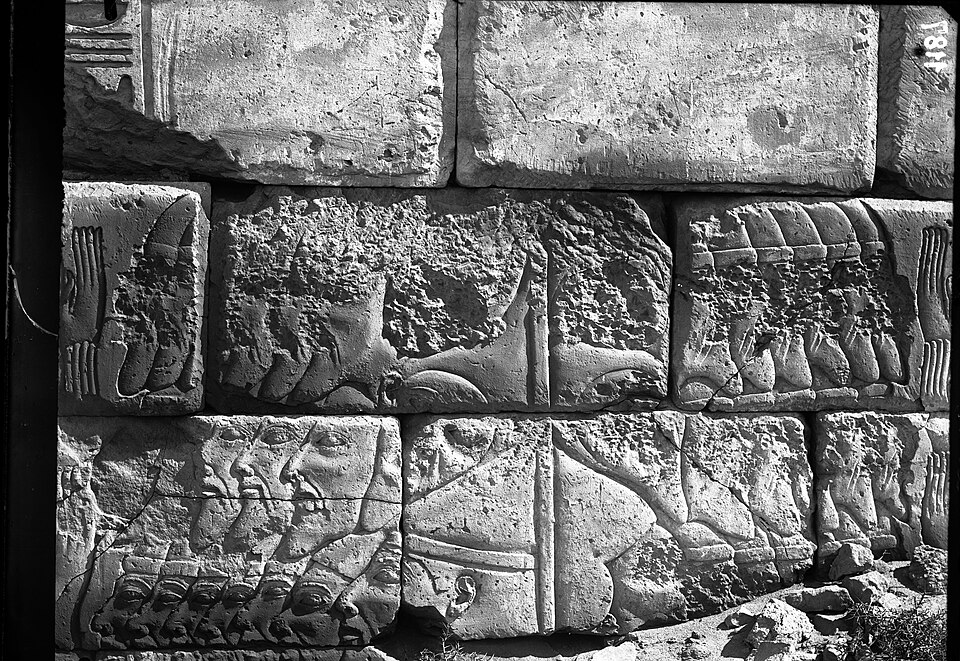
The image of the king offers a good example of what the surveyors had to do on the wall. They could find sections of his outline in shallow depressions. Some could be picked out from a distance. Others showed only when light fell at a favorable angle, and some left no visible trace. The surveyors proposed that the image had included comparatively delicate modeling and paint. A drawing that shows the trace of an arm or the king’s pose therefore gives the reader a way into details that an ordinary photograph may barely show. The survey volume records which of those details its authors observed and which parts they had to reconstruct. Epigraphic Survey, preface and plates 2–6
How a place becomes a captive in the carving
The king is shown striking enemies. Amun and a goddess of Thebes appear in connection with the bound captives. Look for the oval enclosure associated with each smaller figure. These enclosures, often called name rings, contain hieroglyphic spellings of names. A name ring is a way of turning a town, region or people into a recognizable component of the scene. The number of rings shows how extensively the wall presents the reach of the king’s power, though damage has made many entries hard or impossible to read. The order and arrangement are part of the visual presentation too. Digital Karnak, layout and 156 name rings
Place names in the surviving list have been compared with sites in the Jezreel Valley, including Megiddo and Taanach, and with places in the Negev farther south. A pharaoh’s scribe was representing foreign sounds with Egyptian signs, and more than one place may fit a damaged or abbreviated spelling. Another difficulty is whether a row presents the exact order in which an army traveled. Scholars have proposed different routes and different groupings, including organized branches of a campaign. Others ask whether an Egyptian monument could combine several operations or claims to authority in one display. The name rings supply evidence for geographic reach with less certainty about the movement of troops in sequence. Atwood, interpretation and itinerary proposals
The opening entries give another reason to resist treating the surviving rows as a travel diary. They include names in a conventional grouping that Egyptian texts used to represent enemies of the kingdom. That formula did not stop the artist from naming real places elsewhere on the same wall. It means a reader has to follow how the list combines inherited imagery and information useful for historical geography. The surveyors paid attention to the formula precisely because it helped them read the order of some damaged rings. A familiar pattern can help an epigrapher recover a word while also making a historian ask why the word was placed there. Epigraphic Survey notes on the opening entries Atwood, conventional lists and the routes they may describe
This is the kind of relief in which traditional images tell a viewer how to interpret particular place names. Bound captives and an overwhelmingly large king declare a victory before viewers have read a single name. Someone studying the inscription can take its individual entries seriously and still notice the purpose of the whole. The association of a place with Egypt’s triumph does not by itself tell us if the army sacked a town, received a payment or secured submission another way. Comparing a proposed identification with a securely dated local excavation is another step, and even a burned layer seldom names its destroyer. Ancient Israel and Ancient Egypt, §2.2, the uneven archaeological evidence
A piece of the Egyptian story turns up at Megiddo
Shoshenq’s name survives on a separate limestone fragment recovered at Megiddo by the Chicago expedition in 1925. The find came out of previously disturbed material, so its earliest position in the town had to be inferred. Researchers long described it as part of a free-standing stela. In 2023, Shirly Ben-Dor Evian and Israel Finkelstein reconsidered its thickness and unfinished sides and proposed that it was set within a structure. The alternative changes what we might imagine the standing monument looked like. The inscribed royal names remain direct evidence of an Egyptian monument at this strategic site, independent of the depiction in the temple at Karnak. Ben-Dor Evian and Finkelstein, the Megiddo fragment
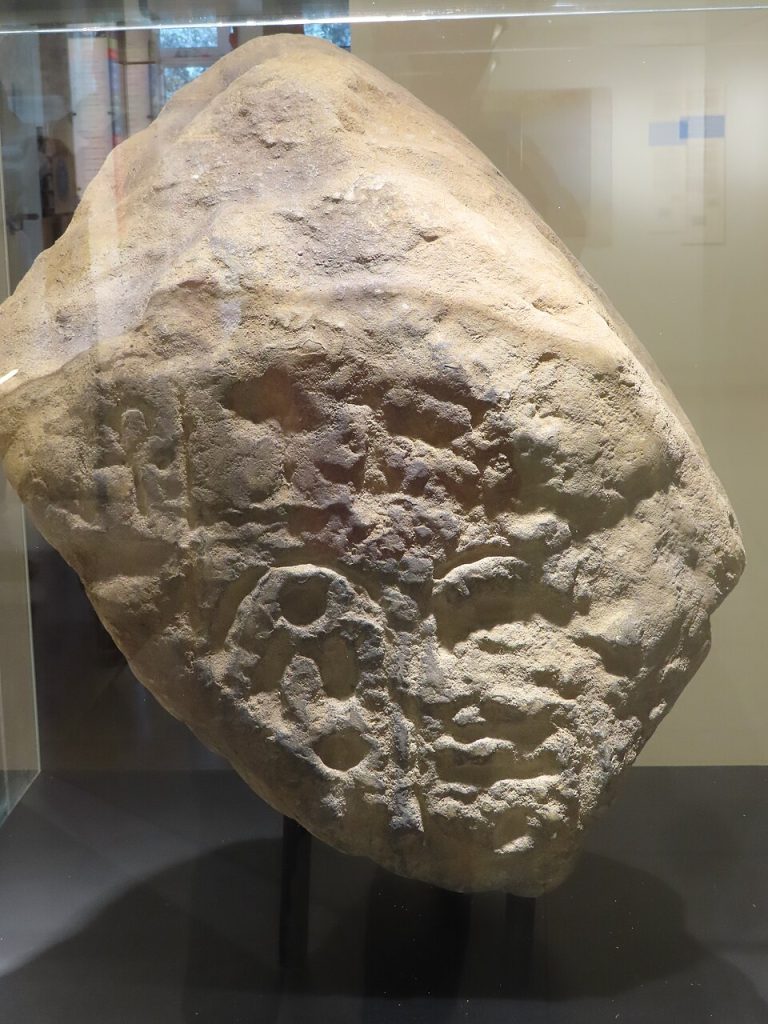
The same pharaoh appearing in two places is more useful than assuming that every signed object records a military operation. The wall in Egypt contains a program celebrating the ruler’s reach. The fragment at Megiddo puts his name into the local archaeological record. It is an important independent check because the marks on that piece of stone did not have to be inferred from the positions of broken signs at Karnak. It remains a partial find. Telling how the inscription was set up, and how people around it understood it, requires a good argument from those unsettled details about its original form. Ben-Dor Evian and Finkelstein, proposed architectural context
The temple wall preserves the empire’s claims. The fragment at Megiddo brings the pharaoh’s name into a town within their reach.
Shishak comes against Jerusalem
In 1 Kings 11:40, Shishak is the Egyptian ruler with whom Jeroboam takes refuge as Solomon seeks his life. When Shishak appears again in 1 Kings 14:25–28, Solomon’s son Rehoboam reigns. The Egyptian attacks in Rehoboam’s fifth year and takes treasures from the temple and the royal house. The name and historical setting fit Shoshenq I closely enough that the identification is widely accepted. Historians usually place the campaign in the later tenth century BC, often around 925 BC. That approximate modern date depends on how scholars align the ancient chronologies. The Bible gives its date relative to Rehoboam’s reign. Ancient Israel and Ancient Egypt, Shoshenq and Rehoboam
Jerusalem is missing from the readable place names on the portal. A damaged section might once have held information we no longer have. Another possibility is that the city’s submission and the taking of treasure were handled in a way that would not necessarily put it on an Egyptian list of victories. Neither possibility supplies the missing name. The biblical account is definite about Jerusalem and the valuables removed. The Egyptian monument provides its own evidence for activity across the region. Reading what each actually records allows us to take the biblical account seriously and also to be exact about what anyone can point to on the wall. Ancient Israel and Ancient Egypt, discussion of the missing city name
The city at the center of one account need not be the city that dominates the other. It helps to see what else the biblical writers were preserving. Kings remembers the losses in Jerusalem as part of Rehoboam’s reign. It has no interest here in listing places in the Jezreel Valley, where the Egyptian record extends the geographic picture. The series on the Gezer Calendar starts from an object of roughly this era that mentions the crops local people worked to bring in. The contrast in scale makes clear how much any one record selects. A full picture of the century needs both great and small records.
Second Chronicles 12 describes Shishak taking fortified towns of Judah before coming to Jerusalem. In that account the prophet Shemaiah addresses Rehoboam and the leaders, who humble themselves. The Lord grants them some deliverance while allowing them to experience subjection. The loss has a visible consequence in both Kings and Chronicles. Gold shields from Solomon’s reign go away, and the king has bronze ones made in their place. This detail makes the change in Judah’s fortunes almost tangible. The royal procession can still be staged, but its equipment now recalls what the kingdom lost and what its rulers had to learn.
As Christians we receive Scripture’s history as true, including the way Chronicles explains the Lord’s dealings with his people. The discovery at Karnak helps us appreciate the size of the power Rehoboam faced. Chronicles places the danger within a story of unfaithfulness, humility and measured mercy. The view from the temple in Egypt shows how a ruler wanted his power to be remembered. The view from Jerusalem directs the reader to a question gold shields could never settle. What would it mean for God’s people to turn back to him when their military advantage and wealth could no longer protect them?
Sources and further reading
- University of Chicago Epigraphic Survey, Reliefs and Inscriptions at Karnak III (1954) — Principal modern documentation of the relief. See plates 1–6 for location, overview and the topographical list.
- University of California Santa Cruz, Digital Karnak: Bubastite Portal — Architectural location, material, arrangement of the triumphal scene and name rings.
- Emily Teeter, Chicago on the Nile — The history of recording the monument, including the chapter on the 1931–1954 survey publication.
- P. L. Atwood, Toponyms on the Shoshenq Inscription — Study of specific groups of names and competing reconstructions of the campaign, especially pp. 12–15.
- Ido Koch, Ancient Israel and Ancient Egypt (2026) — See §2.2 for the identification, Jerusalem's absence in the list, alternative explanations and the scope of Egyptian policy.
- Shirly Ben-Dor Evian and Israel Finkelstein, The Sheshonq Fragment from Megiddo (2023) — Study of the inscription fragment found in 1925 and the alternative interpretation of its architectural form.





