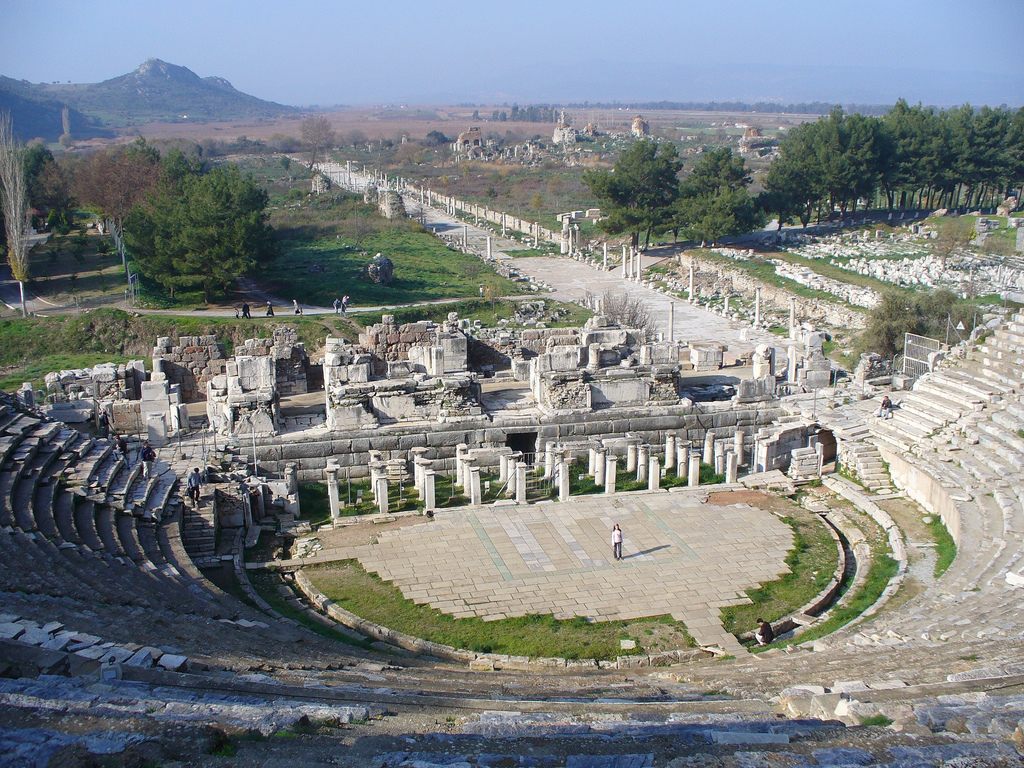
In Acts 19, people seize two of Paul’s companions and rush into the theatre at Ephesus. The story has been moving through streets and workshops. Suddenly it settles in a building large enough to gather a noisy part of a city. The theatre still stands. Seen from below, it rises in tiers against a hill. The building helps explain why a dispute about trade and worship could become a public matter there. Archaeologists can also show why the theatre people enter today looks different from the one known to the people in Acts. Acts 19:23–41 · Austrian Archaeological Institute on the theatre’s construction history.
Christians receive Scripture as true and accurate. We can follow Luke at the level of a walk across the city, a gathering in a public space, and a clerk who knows the channels available for resolving an accusation. Those details reward close attention. The story in Acts gives us the people who went into the theatre and the reason they spoke. Building archaeology gives us the shape and history of the place they entered. A later inscription adds an independent reason for seeing the theatre as a place where civic institutions and devotion to Artemis could come together.
What you’ll learn
- How the theatre fitted into the streets and public life of Ephesus.
- Which visible features belong to later building phases and how researchers tell.
- How the scene in Acts moves from a trade complaint to an unauthorized gathering and its dismissal.
From the harbour to the hill
Ancient Ephesus stood near present-day Selçuk in western Türkiye. Its harbour brought people and goods into contact with the city. The theatre occupied the western slope of the hill now called Panayırdağ, near important streets and public buildings. The harbour road leads toward it across relatively level ground before the seating rises against the hillside. On the site today the road points toward land beyond the ruins. Changes to the shoreline and sediment deposited over centuries explain why the water is no longer where an Ephesian arriving by ship would have expected it. UNESCO’s Ephesus site description.
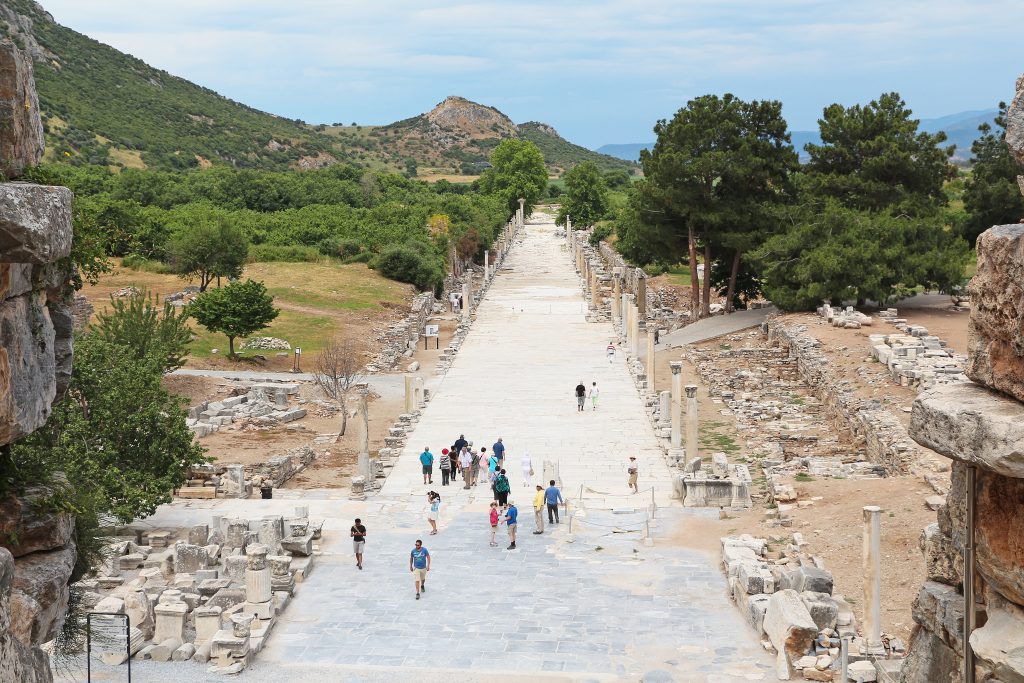
The photograph reverses the direction of arrival. Look down the paved line from the theatre toward the harbour area. The road as it appears now was shaped through successive periods of city building. Its direction is a useful way to picture the link between the lower part of the city and the theatre. It does not identify the street the crowd used in Acts. Luke tells us they rushed into the building together, and the site lets readers see why it worked as a destination readily known in the city. Austrian Archaeological Institute, urban research at Ephesos.
How an earlier theatre became the one visitors see
The building began in the Hellenistic period, before Rome transformed it. A theatre uses the slope to help carry the seats and give the audience a shared view of the space below. Over time the Romans rebuilt and enlarged the auditorium and its means of access. Austrian researchers traced the changes by mapping the building and looking at places where foundations and walls belong to separate construction phases. Excavation and building study also allow comparison with ancient inscriptions and other theatres. Their investigation extended work on the monument that had begun in the nineteenth century. Austrian Archaeological Institute on the research and its chronology.
The phase question matters when someone tries to imagine the scene in Acts. According to the current construction study, the huge vaulted corridors that later gave crowds access to rows of seats were part of an expansion begun toward the end of the first century AD. By the first half of the second century, the theatre had become one of the largest in Roman Asia Minor. The broad sweep of seats is useful for seeing what a public auditorium can do. When reading a claim about how many people were present in Acts, remember that the number of seats in the later building and the number of people in one earlier crowd answer different questions. Gudrun Styhler-Aydın’s architectural study of the auditorium.
Building phases can be hard to see from a single photograph. Imagine a wall built against another, an entrance narrowed or extended, or a support below a later row of seats. The engineer may be solving a new problem in a building that is already well known. The archaeologist then asks what work came first and which changes should be grouped together. Researchers at Ephesus also distinguished twentieth-century restoration from ancient stonework. A building used for hundreds of years leaves a record of alterations. The structure survives precisely because some people maintained it, others reused it and modern teams worked to conserve it. Early phases and modern conservation in the theatre study.
The theatre’s later grandeur can help us picture a gathering, while the earlier building belongs to the crowd Luke describes.
Why talk about Artemis in a theatre?
The sanctuary of Artemis stood apart from the theatre. Devotion to the goddess nevertheless had a place in the civic life conducted at the theatre. An inscription from AD 104 records the benefaction and arrangements of a man named C. Vibius Salutaris. His foundation provided for images to be carried in an official procession and displayed at the theatre on designated occasions. This was decades after the period of Paul’s mission. It gives us independent evidence that a public building devoted to more than one kind of gathering could also become part of the ceremonial life of Artemis in the city. Christina Kokkinia’s epigraphic study of the Salutaris foundation.
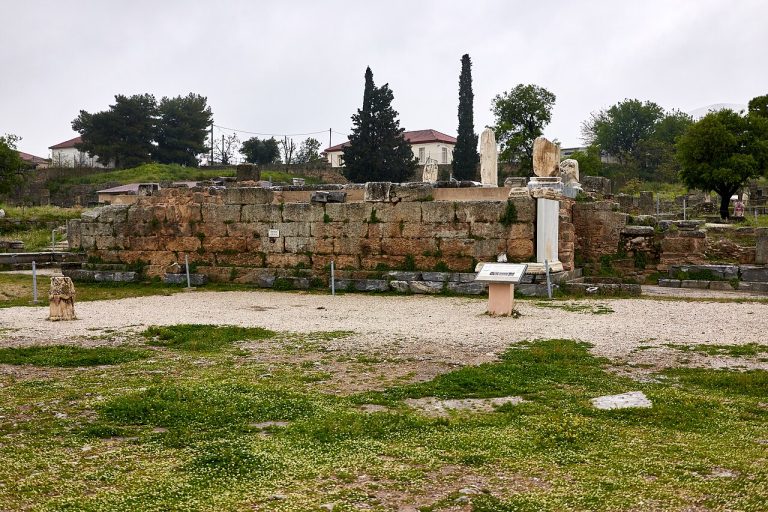
A statue base published in the Greek inscription corpus gives the relationship a concrete form. It bears a dedication to Artemis of Ephesus and to an Ephesian tribe, and part of the writing refers to putting the images on bases when the assembly met. It survives independently of the scene in Acts and belongs to that later benefaction. For our purposes, it shows people making careful arrangements for the same theatre to receive groups, images, and official gatherings. A modern reader can approach the site as a place of drama and also reckon with the ordinary civic and religious events ancient residents took there. Greek and Latin inscription on the statue base, Ephesos 824.
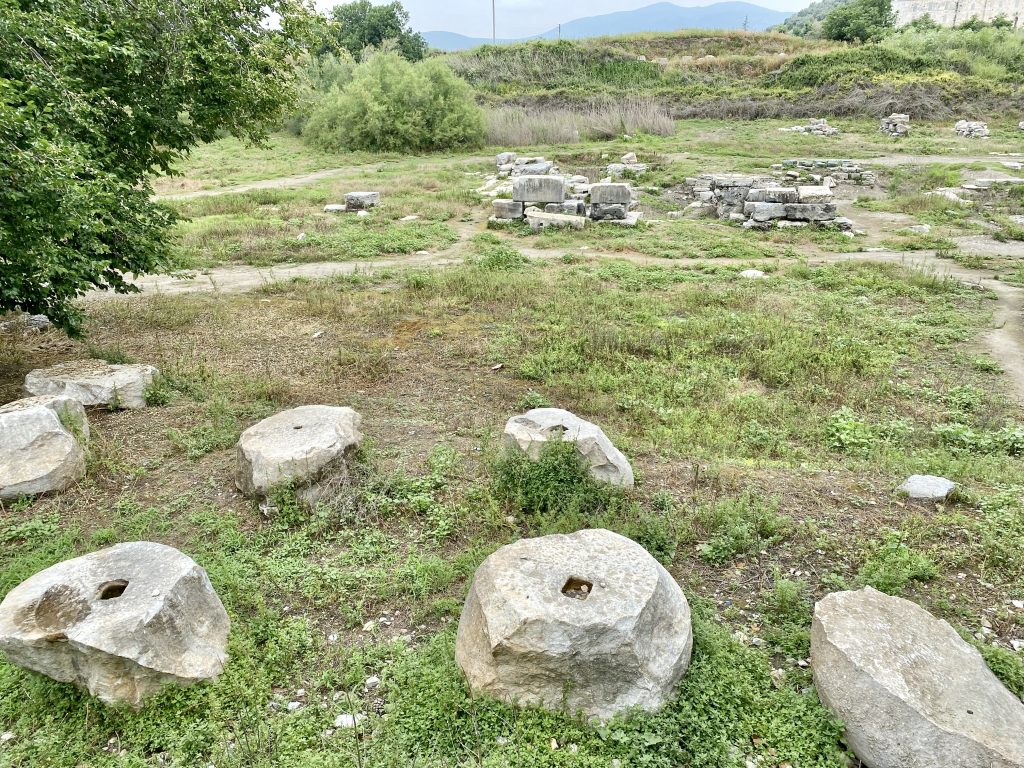
The present site of the Temple of Artemis preserves only a small part of what once stood there. The assembled column in the photograph helps locate the sanctuary. Its modern presentation gives little sense of the ancient building’s scale or the resources it attracted. Demetrius, the silversmith in Acts, points to the trade people earned from making silver shrines. He also appeals to the dignity of Artemis and to the standing of her temple. Financial interests and a city’s attachment to its goddess could come into one speech. The theatre was where the alarm he raised became a gathering large enough to concern officials. Demetrius’s speech in Acts 19:23–28.
Read the gathering in three movements
- The grievance spreads. Demetrius speaks to workers who have a stake in the trade. His concern becomes a crowd’s public declaration about Artemis.
- The crowd enters the theatre. People take Gaius and Aristarchus with them. The disciples and friendly provincial notables urge Paul to stay away.
- The clerk calls for proper procedure. He points to courts and a lawful assembly, then dismisses the gathering.
Luke makes an observation worth sitting with. Many of the people coming into the theatre did not know why they were there. A space that can hold a crowd can also hold a number of conflicting accounts of what brought it together. Some call out one thing and others another. When Alexander tries to speak, the crowd responds with a prolonged public acclamation of Artemis. The noise is part of the narrative. Imagine the change from a silversmith explaining his grievance to associates who know him to people listening, shouting, and watching across an entire theatre. Acts 19:29–34.
The city clerk then works with the audience he has. He acknowledges the city’s standing as guardian of Artemis’s sanctuary and says that the men brought before them have committed no sacrilege of the kind alleged. If Demetrius and his fellow workers have a complaint, he tells them how to pursue it. The officials and the recognized assembly in his speech point to a city with public procedures and responsibilities. He also sees a risk in an assembly whose conduct could be called to account. The people who had entered in confusion are sent out by the man who reminds them how a charge can properly be heard. Acts 19:35–41.
Paul himself is kept from entering this scene. That detail can get lost when people speak of the theatre as a place where he spoke. He wants to go in, and other believers and some Asiarchs, provincial dignitaries who are friendly toward him, send word against it. Gaius and Aristarchus are the companions drawn into the crowd. Their presence stresses that the disturbance places other people at risk even when Paul becomes the focus of the complaint. A comparison with the Roman public spaces of Philippi shows how each city supplied its own settings and officials for scenes in Acts. Acts 19:29–31.
Acts names another public interior that plays a different role earlier in the chapter. Paul reasons daily in the school of Tyrannus after leaving the synagogue setting. The chapter gives that venue the steady rhythm of teaching over time. The theatre scene moves much faster, from alarm to crowd to dismissal. Seeing how Luke uses these settings helps explain which one we are looking at in the photograph. The surviving theatre illuminates the gathering of the crowd. We follow Paul’s actual teaching in the earlier narrative, where a different room and a different audience receive their own place in the city’s story. Acts 19:8–10.
Follow the word back out into the city
Before the disturbance, Acts has described Paul teaching and people in the province hearing the word of the Lord. Demetrius says that Paul has been persuading people that gods made with hands are no gods. The economic danger he sees shows the social implications of a change in worship. For Christian readers, this is a reminder of how thoroughly belief can touch work, custom, and public loyalties. There are workshops and costly buildings behind people’s convictions. The people deciding how to live after they hear the gospel know they are living among neighbors who can be affected by those choices. Acts 19:8–10 and 19:23–27.
Take one more look at the curve of the stone seats and the route from the harbour area. See the space from the street as well as from the stage. The gathering in Acts had a place within a city whose temple, streets, and authorities all mattered to it. That city continued changing after Paul left. The archaeological record lets us look through those changes toward the earlier setting and read Luke’s account with a better sense of its streets, people, and habits. Then read the clerk’s last words again. A city’s theatre could fill with people before any one person had established what there was to answer.
Sources and further reading
- Austrian Archaeological Institute, Reconstructing the history of the Theatre in Ephesos — Reports results of the building study and chronology, including late first-century access expansion and modern restoration.
- Gudrun Styhler-Aydın, Der Zuschauerraum des Theaters von Ephesos — Primary architectural study of the theatre’s auditorium and construction sequence, published by the Austrian Academy.
- UNESCO World Heritage Centre, Ephesus — Description of the archaeological landscape, ancient harbour and distinct sanctuary site.
- Christina Kokkinia, A Roman Financier’s Version of Euergetism — Discusses the honorary and cultic arrangements of C. Vibius Salutaris’s inscription, IEph 27, AD 104.
- Packard Humanities Institute, Ephesos 824 — Greek and Latin text from a statue base of the Salutaris foundation. Preserves wording about placing images on bases in connection with the assembly.
- Acts 19 — Paul’s ministry, Demetrius’s accusation, the gathering in the theatre, and its dismissal.