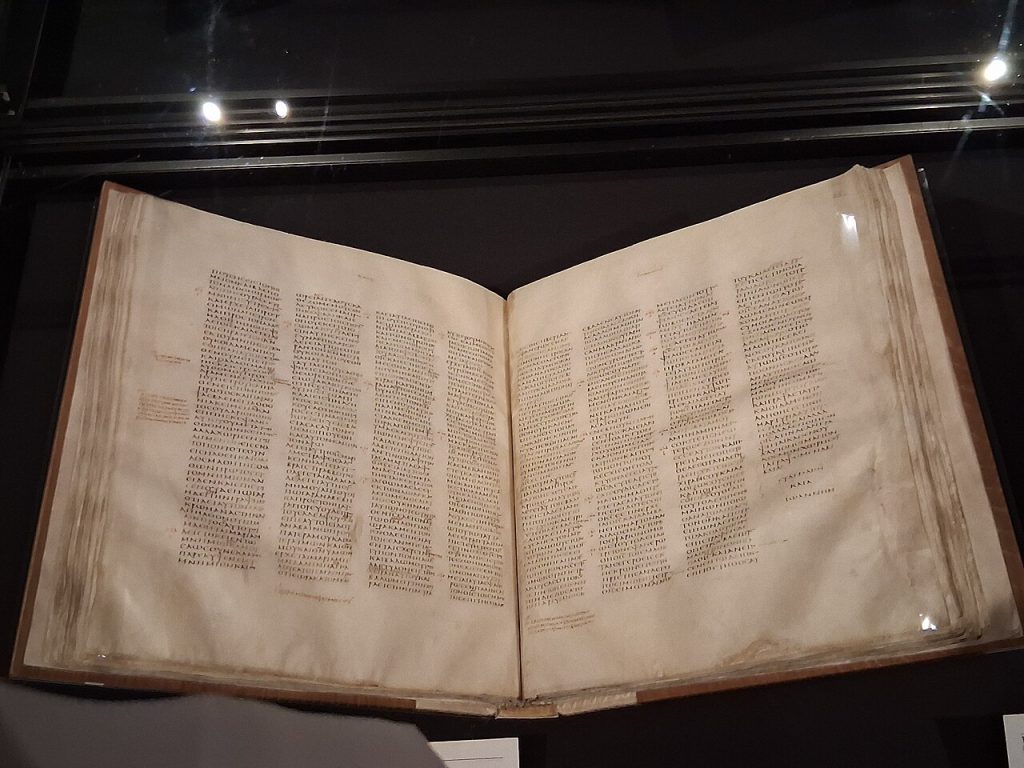
Open Codex Sinaiticus to the end of Mark and you can see a copyist bring one Gospel to a close and begin the next. The hand is trained, the letters tightly fitted, and the surface ruled for four columns of Greek. Mark tells how women found Jesus’ tomb open, heard that he had risen, and fled in astonishment. After what we call Mark 16:8, the copyist closes the book of Mark and moves on to Luke. That page offers a way into the history of the oldest surviving manuscript to contain the entire New Testament. It also shows why the form of a book can help us understand how Christians handed down Scripture. Center for the Study of New Testament Manuscripts, facsimile pages.
Key takeaways
- Codex Sinaiticus was copied in Greek in the fourth century. Its surviving leaves contain the complete New Testament and substantial parts of the Greek Old Testament.
- Its parchment, ruled lines, book titles, and corrections show the work of several scribes and generations of readers.
- Saint Catherine’s Monastery in Sinai preserved the book for centuries. Its modern dispersal involved separate acquisitions, a documented loan and donation, and later discoveries.
- Mark’s ending gives readers a concrete way to understand why modern Bibles sometimes include a note about ancient manuscripts.
How an ancient Bible was made
A codex is a book made from leaves bound along one edge. The size of Sinaiticus makes that simple definition worth pausing over. Its original contents probably occupied more than seven hundred leaves. To build a typical gathering, the makers laid four parchment sheets together and folded them, making eight leaves and sixteen writing surfaces. Each gathering is called a quire. A modern reader standing over a single open leaf can easily forget that its other half is elsewhere in the gathering, a physical relationship that can help identify a detached piece or understand what has gone missing. Smithsonian object study. Codex Sinaiticus Project guide to the physical structure.
The pages were prepared before a scribe began. Look at a photograph and you can make out some of the tracks that guided the lines and bounded the columns. On a regular prose page there are four narrow columns. In books such as Psalms and Job the text is arranged in two wider columns. The way the words sit on the page therefore tells us something about how the producers made the contents usable. They gave poetry a different visual form from prose, and a reader looking at two facing pages of text would see a pattern planned well before a pen met parchment. British Library description of ruling, columns, and writing.
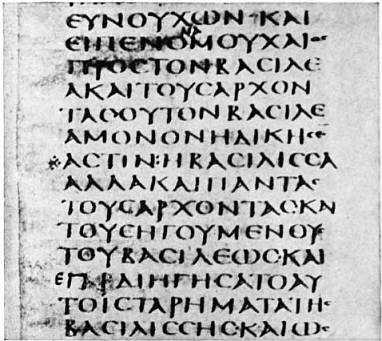
The letters are in a formal Greek book hand often called uncial. Several scribes worked on the manuscript. The British Library catalog gives at least three and allows for a possible fourth. An alert reader can also see work done after a first line was written: a word supplied, letters erased or replaced, or a correction entered in the margin. Some interventions belong to the production process itself and others to later users. The project’s transcription records many of these layers so a reader can ask whether a spelling, omission, or insertion belongs to the original hand or an identifiable later one. British Library evidence for multiple hands. Codex Sinaiticus Project transcription guide.
Conservators and editors record different things about those corrections. An editor might ask which reading can be recovered beneath an alteration. A conservator might look at where the writing falls in relation to a fold, how firmly the ink adheres to the parchment, and whether a trace on a facing page came from contact. These observations can inform each other. A mark near the binding may help a researcher consider how well an early corrector could reach that spot and whether the sheets were bound at the time. A modern photograph gives us many such details in a single view, and the condition record gives us a way to understand how they may have come to be there. The project’s documentation of ink, offset, and corrections.
The British Library dates the manuscript to the fourth century. The script is part of the evidence, alongside features of its production and writing. Its origin is less clear. The catalog lists the eastern Mediterranean, with Palestine suggested as a possibility. Notes by a later corrector have been used to argue for a connection with Caesarea. Such notes can record the history of another manuscript used for comparison, and proposals about the place of correction and the place of copying need to be evaluated separately. The name Sinaiticus comes from the monastery where the book was kept and became known to modern scholarship. British Library discussion of date and provenance.
What survives of the Christian Bible
The surviving New Testament includes all twenty-seven books familiar to Christians today. Their sequence differs in places from the order many readers know. In Sinaiticus, the letters associated with Paul are followed by Acts, then by the general letters and Revelation. The Epistle of Barnabas and surviving portions of the Shepherd of Hermas follow Revelation. These early Christian works were valued by some of the people who read and copied biblical books. Their presence is physical evidence of what this fourth-century manuscript put together. Its sequence makes room to discuss the life and reading of the early church as well as the biblical text itself. British Library contents and folio list.
The Old Testament is preserved less completely. Its surviving Greek pages represent the Septuagint tradition, in which Greek translations of Jewish Scriptures circulated with other writings in Greek. Isaiah, much of the Psalter, and other long stretches survive, while other leaves are missing or separated. A copy of Isaiah in a Greek Christian Bible and a Hebrew book in a Jewish collection can both illuminate the transmission of Scripture while answering different historical questions. To see how that looks in early Hebrew evidence, compare the Great Isaiah Scroll from Qumran. Smithsonian introduction to the manuscript’s original contents.
Esther gives a small example. In the passage pictured above, advice to the Persian king turns a dispute in the royal household into a matter of state. The surviving Greek excerpt lets us see a few lines of the story as they appeared to a reader of this codex. Comparing it with an English Bible is an exercise in paying attention to the history of translation as well as copying. An English Old Testament commonly translates Esther from Hebrew, while Sinaiticus presents the book in a Greek form with its own textual history. Before treating a difference as a copyist’s decision, a reader needs to identify the language and edition behind each text. The project’s guide to comparing its images and transcriptions.
On a single page you can see the work of the person who copied Scripture and the traces of people who kept reading it.
From Sinai to four collections
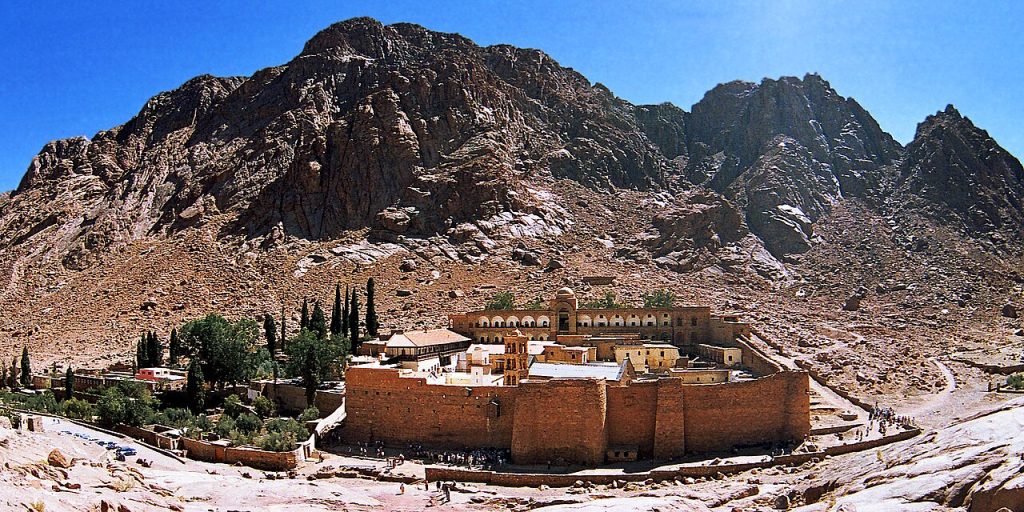
There is a familiar story in which the nineteenth-century scholar Konstantin von Tischendorf arrived at the monastery and rescued leaves headed for the fire. His own accounts are part of the record, and the four institutions that hold the codex have assembled a much fuller history from documents. A large Bible described there by Vitaliano Donati in 1761 may have been this manuscript. What can be traced securely is that Tischendorf encountered leaves in 1844 and took forty-three to Leipzig, then returned to Sinai later in his career. The details of his first encounter and the circumstances in which other leaves came to leave the monastery call for different kinds of evidence. Collaborative custodial history. British Library provenance record.
In 1859, Tischendorf was allowed to take the main surviving portion to Saint Petersburg and signed a receipt describing a loan for comparing the manuscript with his transcription as he prepared it for publication. His edition appeared in 1862. Documents recording a donation to the tsar were signed in 1869. The joint history sets out both the original loan and the later donation in the context of a complicated decade for Saint Catherine’s. Even in a concise account, those two stages are worth naming because a reader can distinguish terms agreed at one point from documents signed ten years later. Four institutions’ account of the loan and donation. National Library of Russia holdings and publication history.
The Soviet government sold most of the Saint Petersburg holdings to the British Museum in 1933. Those leaves are now in the British Library. The monastery’s monks found more leaves and fragments in 1975. The four institutions that preserve pieces today are Saint Catherine’s, Leipzig University Library, the National Library of Russia, and the British Library. Their digital partnership began in 2005 and the full project site went online in 2009. A reader can now move across pages held in different cities and compare a photograph with transcription and conservation information. The manuscript remains physically in four collections, each part with a history of its own. Joint chronology. Codex Sinaiticus Project and digital manuscript.
Read the end of Mark on the page
A modern chapter and verse number is a convenient address. On the ancient page itself, readers can follow the Greek text down the column to the women fleeing the tomb, then look for a concluding book title and the opening of Luke nearby. Together, those features establish where this copy ends the Gospel. Mark 16:9–20 is present in many other witnesses. Codex Vaticanus, another fourth-century Greek Bible, ends Mark at the same point as Sinaiticus. A Bible translation that marks off the longer ending or gives a note about the manuscripts is showing a reader something about the history of the text. The codex makes that history visible on the page. See the facsimile at Mark 16. H. A. G. Houghton’s study and summary of the manuscript evidence.
A familiar sequence helps separate two related questions. First ask what this particular copy contains. At that level the closing title and opening of Luke document a specific act of copying. Then ask what text can be recovered through comparison with other sources. Editors consider the age and relationships of manuscripts, early translations, and what ancient Christian writers knew about the passage. Houghton explains why a later witness that seems to end at the same verse can still require closer inspection if the surrounding material is presented as commentary. Evidence that a copy ends at verse 8 can be assessed directly. Conclusions about the history before that copy require a wider comparison. Houghton’s comparison of two later manuscripts.
We receive Scripture as true and accurate. That conviction calls us to take seriously what Mark actually narrates. Before the women run from the tomb, they are told plainly that Jesus of Nazareth, who was crucified, has risen, and they are given a message for the disciples and Peter. That resurrection announcement is present in Sinaiticus. Matthew 28:1–10 and 1 Corinthians 15:3–8 have their own accounts of the risen Jesus and the testimony to him. Read the complete scene in Mark first, then look at the manuscript and the note in your Bible. The historical question about the point at which copies end is worth investigating in its own right because the words God’s people received and passed on matter to us.
Three details to look for online
- Compare page shapes. Open a page of Psalms and a page of Mark, and count the columns. Notice how much the lines, margins, and breaks contribute to the act of reading.
- Follow a correction. In the project transcription, display the information about a correction. Compare the edited reading with the photograph to see what the evidence looks like.
- Read across a book boundary. Compare the last lines of Mark with the opening of Luke. Look for the place where a copyist marks the separation even within a single leaf.
Questions readers ask
Is Sinaiticus the earliest New Testament manuscript of any kind?
It is the earliest surviving copy with the complete New Testament. Older Greek manuscript witnesses preserve portions of individual books.
Does the name mean it was copied at Mount Sinai?
The name refers to Saint Catherine’s Monastery, which preserved the manuscript. The exact location of the fourth-century production of the codex is uncertain.
Sources and further reading
- British Library, Add MS 43725 — Catalog of the British Library leaves, including manuscript dimensions, contents, hands, binding, date, and provenance.
- Codex Sinaiticus Project, History of Codex Sinaiticus — Joint history by the four custodians, with surviving documents behind the modern distribution.
- Codex Sinaiticus Project, Physical Description — Conservation project documentation for parchment, ruling, and the structure of gatherings.
- Codex Sinaiticus Project, The Transcription — Guide to reading photographs and interpreting corrections and other scribal features.
- Smithsonian National Museum of Asian Art, Codex Sinaiticus — Collection exhibition essay on the contents, scale, and script of the fourth-century manuscript.
- Center for the Study of New Testament Manuscripts, GA 01 — Photographic facsimile pages of the codex and scripture selector.
- H. A. G. Houghton, Unfinished Business: The Ending of Mark in Two Catena Manuscripts — Primary textual study discussing the Sinaiticus evidence and Mark’s other manuscript endings.





