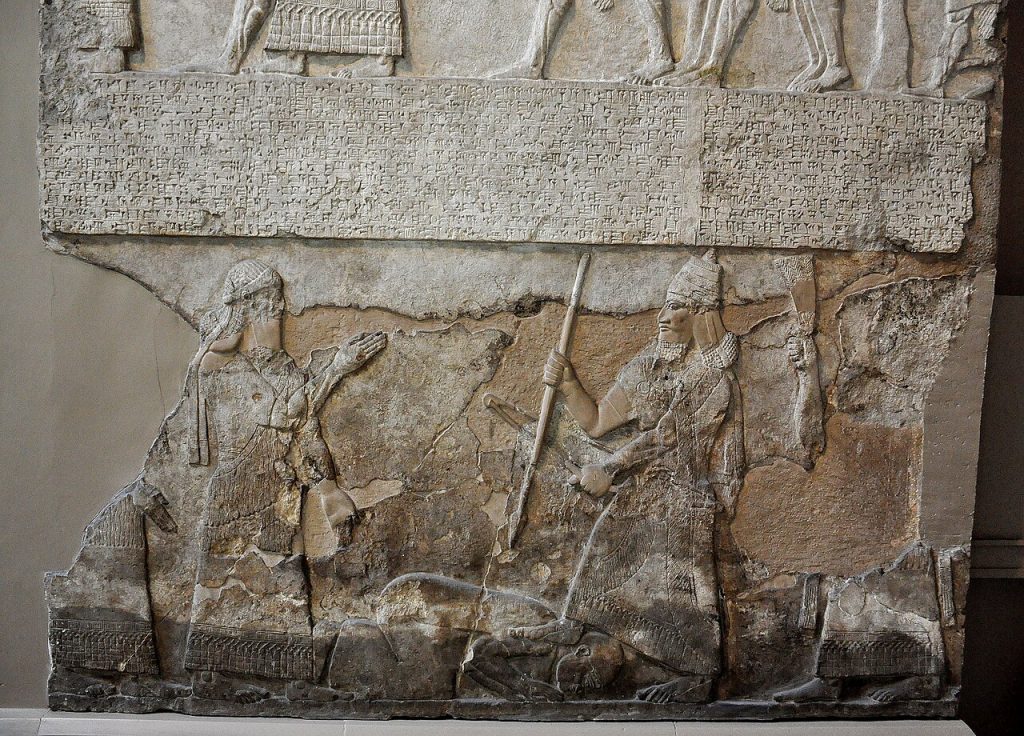
When Assyria came against Israel in the eighth century BC, the Israelite king Menahem raised silver from the wealthy men of his kingdom. Second Kings says he used it to obtain the support of Pul, king of Assyria, and strengthen his own hold on the throne. Over in Assyria, the royal scribes had a very different reason to record the exchange. They included Menahem of Samaria among the rulers whose tribute their king had received. Parts of the Assyrian record survived on stone from Nimrud and in a monument from western Iran. Together with Scripture, they let us see who paid for Assyrian support and who was in a position to demand the price. 2 Kings 15:16–22 · Assyrian royal inscriptions
Key takeaways
- The Assyrian annals from Nimrud and the Iran Stele both name Menahem of Samaria among western tributaries of Tiglath-Pileser III.
- Second Kings calls the Assyrian ruler Pul. The name Pūlu also appears in Babylonian records for the same monarch.
- Scripture says that Menahem exacted a levy on wealthy men to make the payment. The Assyrian lists place the tribute in a much wider imperial network.
The tribute list in the ruins of Nimrud
During his mid-nineteenth-century excavations at Nimrud in northern Iraq, Austen Henry Layard uncovered remains of the Assyrian city called Kalḫu. The royal palaces had been decorated with broad carved slabs. Where the inscriptions survive, their bands of cuneiform preserve Assyrian accounts of the campaigns, deliveries of wealth, and peoples the king brought under his control. Some of Tiglath-Pileser’s slabs had been moved for use in a later palace during antiquity. Part of the series that records Menahem’s payment was found in the Southwest Palace. Its copy was already in print in 1851, a point that helps date the modern recovery of the evidence. Tadmor and Yamada, text 14 · Catalog of the 1851 publication
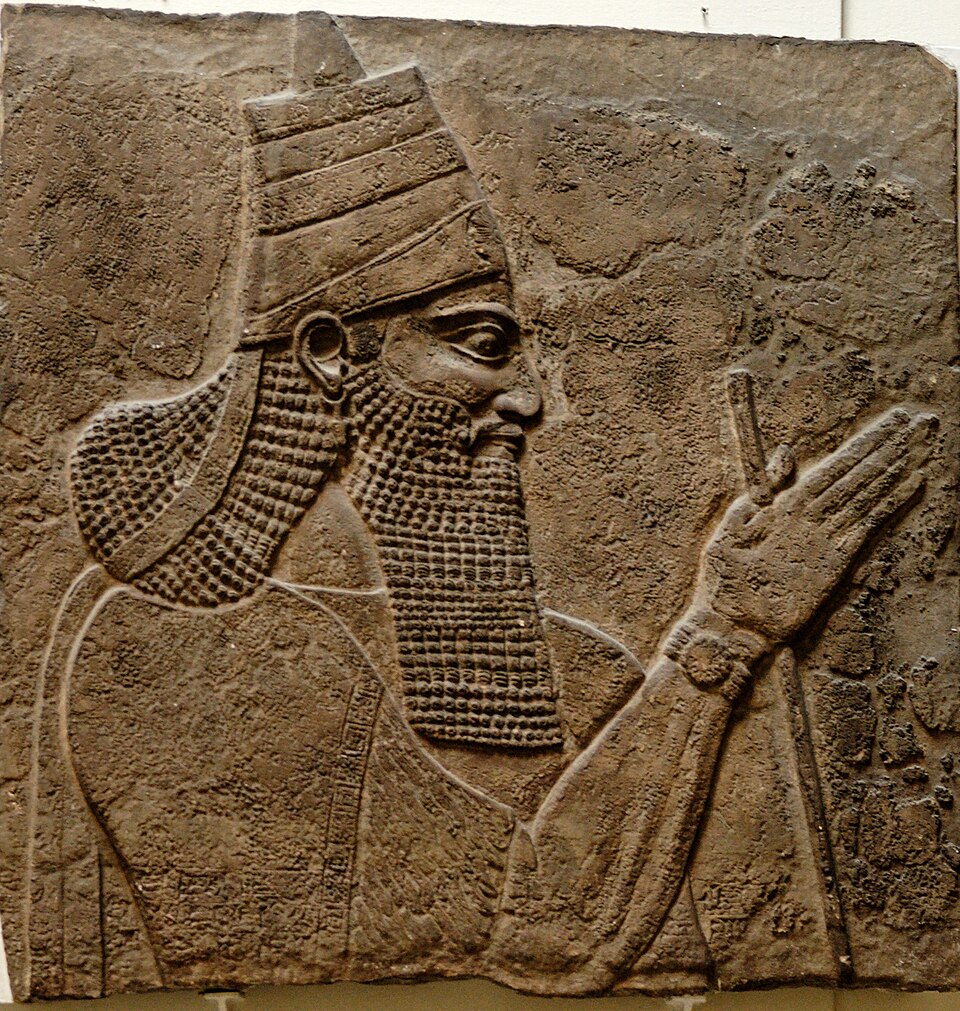
The surviving palace inscription is damaged, and what scholars read today is the work of more than one witness. The unit numbered 14 in the standard edition uses a fragmentary slab cataloged in the British Museum as BM 124961, some signs preserved by a handwritten copy Layard made, and parallel passages from other units of the annals. A break at the edge of a line is a real loss of evidence. A modern edition indicates the breaks and shows where an editor has supplied signs using another witness. The name Menahem is also found in a separate ancient object, so reading the name does not rest on an uncertain restoration in a single slab. Text 14 and editorial commentary · Catalog of the slab fragments
In the Assyrian list, Menahem appears next to Rezin of Damascus and among rulers of places including Tyre, Byblos, and Hamath. The collected goods range from precious metals to textiles, animals, and ivory. The placement shows how the court wanted readers to see the transactions. Kingdoms that looked independent on a map appear side by side in a list of people whose wealth the ruler claimed. That format is helpful for identifying Menahem’s realm and the network his neighbours faced. It speaks at the scale of the whole network, leaving us to look elsewhere for the material each king supplied and the means by which he obtained it. Kalḫu Annals, text 14, lines 10b–12
The material form of the Nimrud slabs also matters. Some palace reliefs show attendants, reception scenes, or campaigns, with writing set in a horizontal band across the stone. An official walking a palace corridor might pass the words and the images in sequence. The court commissioned these slabs to communicate a version of history in which Assyria’s successes followed one another. A list of deliveries made a claim about geography as well as wealth. It brought distant cities into the king’s story even though many people living in those places would never enter the palace.
The same name on the Iran Stele
A second witness is the Iran Stele, an inscribed stone monument associated with Tiglath-Pileser’s campaigns far to the east. Its surviving fragments are reported to come from western Iran, though their precise findspot is uncertain. The inscription celebrates the Assyrian king’s successes as of a campaign in 737 BC. In its account of the western rulers who paid tribute, it once again names Menahem of Samaria among people from Syria and the surrounding regions. The tribute it describes is commonly linked with Assyria’s western campaign of about 738 BC. The text’s date and the date of the payment therefore answer two different questions. Iran Stele, column iii A · Tadmor and Yamada, text 35
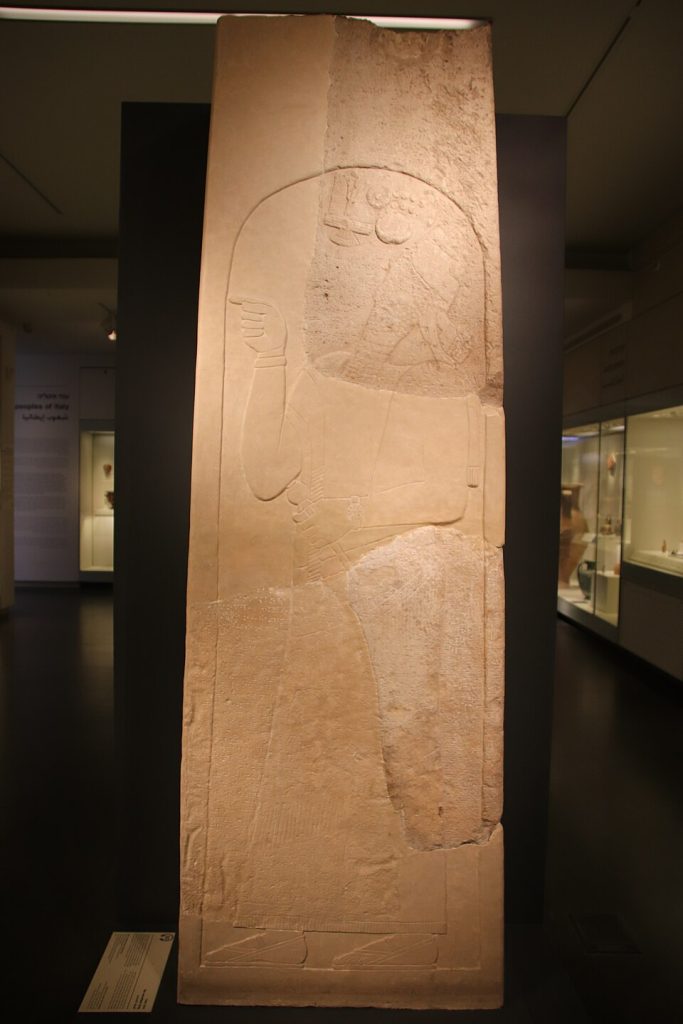
The lists have a core of rulers in common, but they also differ in order and in some names. For instance, the Iran Stele names a different ruler of Tyre from the one restored in the standard edition of the Kalḫu list. The differences raise questions about the relationship of these lists and whether the court was recording one regional collection in different forms or preserving more than one episode of tribute. For the comparison with Kings the key observation is narrower and firmer. Assyrian records can name Menahem by his capital and place him within the tributary system of a king whom Scripture also names. Galil’s comparison of the tribute lists
The inscription’s regional sweep is wider than the usual picture of Israel facing Assyria alone. Rezin’s appearance reminds us how often Samaria and Damascus faced pressure from the same direction, even when they pursued different policies. Tyre and Byblos were coastal cities, while Samaria lay in the hills and had different resources and routes. Assyria could receive different kinds of goods from these places and collect them under one heading. Reading a long list slowly gives us a more realistic sense of the political geography. Each name represents a ruler making decisions under pressure in a place with its own interests.
How Menahem paid for his throne
Second Kings introduces Menahem amid a series of coups. Shallum killed Zechariah, ending the line of Jehu on the throne. Shortly afterward Menahem came up from Tirzah, killed Shallum, and took his place. Scripture then records the violence Menahem inflicted at Tiphsah when it would not open to him. The account of Assyria’s intervention comes after these events and after the writer assesses his reign by the sin of Jeroboam. This is the setting of the payment. A ruler whose hold on Israel began with a violent seizure sought the backing of a power that could decide whether local kings kept their places. 2 Kings 15:8–20
According to Kings, the sum transferred to Pul was a thousand talents of silver. Menahem exacted fifty shekels from each wealthy man who was made to pay. A talent and a shekel were measures of weight, and describing them as bags of modern money would miss how the transaction worked. Silver itself could be weighed. The amount per man gives the episode a scale beyond the headline sum. Collecting it took people who could identify which households owed the levy, assess them, and bring a large amount of silver together. The Bible gives us an inside view of the way the royal bargain worked and the people who covered its cost. 2 Kings 15:19–20
The payment also puts a limit on what we can calculate from the surviving numbers. Multiplying or converting ancient weights can illustrate the size of the levy, but measures could vary, and Chronicles of the northern kings are lost to us. The verse is specific where its writer wants us to see the burden. The money came from the wealthy of Israel at a fixed stated amount per contributor. Even people with means were made to carry a cost that kept a ruler in office. That is information about power inside the kingdom that a display inscription from Assyria had little reason to preserve.
On Assyria’s list, the silver is tribute. In Kings, we can see which households had to provide it and whose rule it kept in place.
Why does the Bible call him Pul?
The king who receives Menahem’s tribute in 2 Kings 15:19 is called Pul. Later in the same chapter the king who takes territory under Pekah is called Tiglath-Pileser. Assyrian royal documents use the Akkadian name conventionally given as Tukultī-apil-Ešarra, the source of the form Tiglath-Pileser. The Babylonian King List A gives Pūlu for the same ruler in its sequence of kings over Babylonia. Those records show both names in use for one king. The difference in names is a reminder that translations and political traditions can preserve different forms. Here the combination of the name, the sequence of kings, and the western tribute records makes the identification secure. King lists in the edition’s introduction · 2 Kings 15:19 and 29
The immediate result in Kings is that the Assyrian king withdrew. The later history reveals how limited that relief was. In Pekah’s reign, Tiglath-Pileser seized a string of towns and districts in the north and deported inhabitants to Assyria. The history of those later campaigns helps explain how different arrangements could belong to the same imperial policy. A monarch could still govern and pay to retain support. When political conditions changed, Assyria could take districts directly under its own authority. The earlier Black Obelisk and its scene of tribute associated with Jehu provides an earlier example of the way Assyrian kings made tribute visible. 2 Kings 15:27–31 · Karen Radner on the western campaigns
The comparison the sources allow
- The Assyrian inscriptions identify Menahem of Samaria and place him among the king’s tributaries.
- Second Kings describes Menahem’s purpose, the total amount, and how the silver was raised.
- The Babylonian King List A preserves the shorter name Pūlu and helps explain the form Pul in Scripture.
The long view in Kings reaches beyond one king’s tenure. The history looks back to Jeroboam, who created worship centers to keep his people’s allegiance, and forward to the exile of the northern kingdom. Second Kings 17 explains that fall in terms of years of disobedience to the Lord. Hosea describes Ephraim turning to Assyria for help and finding the great king unable to cure the wound. Menahem’s particular payment cannot by itself settle when Hosea spoke those words. It illustrates why the diagnosis could land with such force. Assyrian recognition could preserve a man’s position for a time while the deeper disorder in his kingdom continued. 2 Kings 17:5–18 and Hosea 5:13
We read this history as Christians who trust the Bible’s truth and its judgment of Israel’s kings. It keeps the human transactions visible. Menahem had to contend with a real empire and found a way to pay, but we are also told what kind of king he was and what he did to his own people. A list carved to celebrate the Assyrian monarch happened to preserve Menahem’s name. The scribes of Israel left a record that lets us reckon with his decisions. The ancient evidence rewards close reading because the people and pressures are real, and the differences in what each record chooses to report bring them into clearer view.
Sources and further reading
- 2 Kings 15 — Biblical account of Menahem’s rise, his payment to Pul, and Assyria’s later intervention under Pekah.
- Hayim Tadmor and Shigeo Yamada, The Royal Inscriptions of Tiglath-pileser III and Shalmaneser V — Critical edition, texts 14, 27, 32 and 35, plus Assyrian and Babylonian lists in the introduction.
- Cuneiform Digital Library Initiative, Kalḫu Annals slabs — Catalog and image record for the fragments associated with the annals units edited as numbers 14–16.
- Assyrian Inscriptions in the Cuneiform Character, 1851 — Catalog for the volume in which part of the annals unit naming Menahem had already been copied by 1851.
- Chicago–Tübingen Expedition to Zincirli, Selected Inscriptions — Tadmor’s translation of the Iran Stele’s western tribute list in column iii A, hosted by expedition scholars.
- Gershon Galil, A New Look at the Inscriptions of Tiglath-pileser III — Original study comparing the lists of western tribute payers and discussing the chronology.





