A few fragments of reddish limestone gave Ehud Netzer’s team an important lead at Herodium in 2007. When the excavators worked down on the hillside, they uncovered a foundation about ten meters square. Around the building were pieces of its architecture and of three decorated stone coffins. Netzer thought the remains answered a question he had pursued for decades. Where at Herodium had Herod the Great been buried? Other archaeologists agree it was a significant tomb, and some dispute that the king was the person who occupied it. This is a case where a discovery and its interpretation deserve equally careful attention. Netzer and colleagues’ primary report, pp. 85–92.
Christians receive the Bible as true and accurate. Matthew places the birth of Jesus in the days of Herod the king and shows the ruler treating news from Bethlehem as a threat. The building at Herodium helps us become acquainted with the political and material world of that ruler. The Gospel supplies a different kind of testimony, about Jesus and the people threatened around him. To see how the history meets the excavation, start with the hill and the surviving pieces. Then ask which of the available sources puts Herod in which part of that setting.
What you’ll learn
- Why Netzer searched at Herodium and what appeared on the slope in 2007.
- How the excavated base, scattered blocks, and reassembled coffins led to the identification.
- Why researchers continue to debate the exact tomb even with Josephus’s account of the burial.
Start with a named place
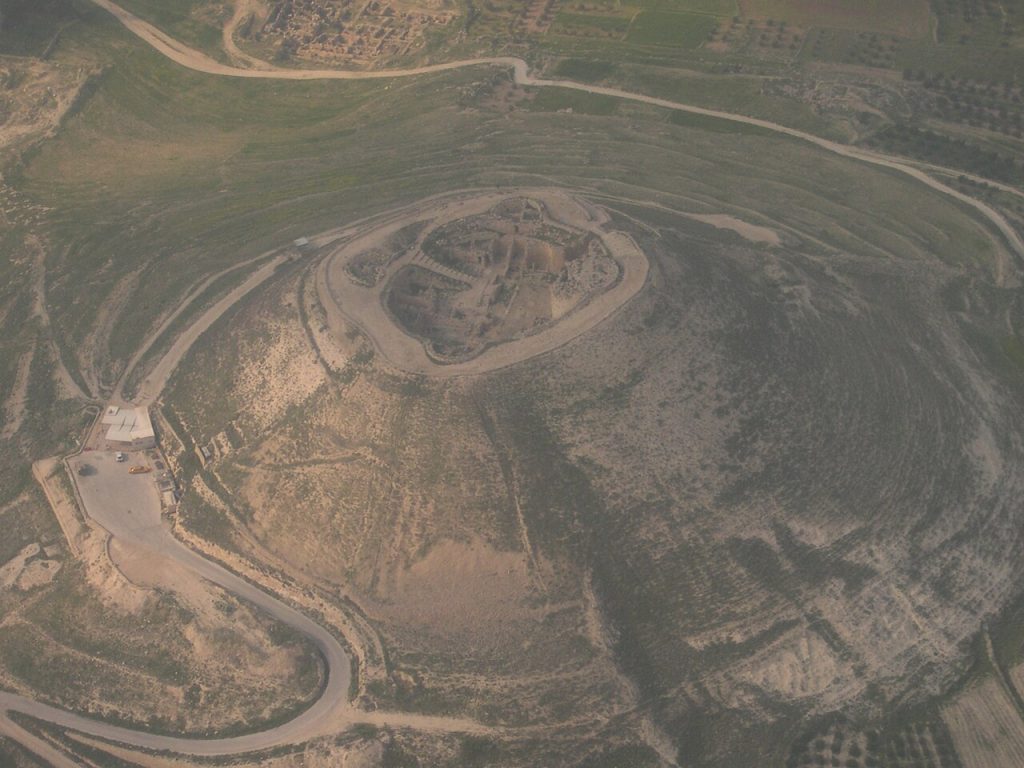
The hill stands southeast of Bethlehem in the present-day West Bank. The site includes a palace-fortress at the summit and buildings at its foot, an arrangement that gave excavators several places to look. The historical starting point comes from Josephus. He describes a procession after the king died, naming Herodium as the destination where Herod was buried. His description dwells on the bier and those who accompanied it. It gives the burial a setting and ceremonial scale. The archaeological problem was to find material traces of the monument within an extensive site that had been used and changed over time. Josephus, Jewish Antiquities 17.196–199.
It is useful to translate that problem into the questions the team would have faced on the hill. Does a large space at the foot of the slope belong to the approach or to the burial itself? Does a stairway lead straight to the structure it was built for, or past an earlier monument? Which stones are still in place? A historical writer can name the destination and tell us what was memorable about the procession. Locating a particular burial depends on following the relationship of the surviving pieces to a landscape that had many separate works built into it. Herodium Expedition, site and tomb research history.
What the excavators found on the slope
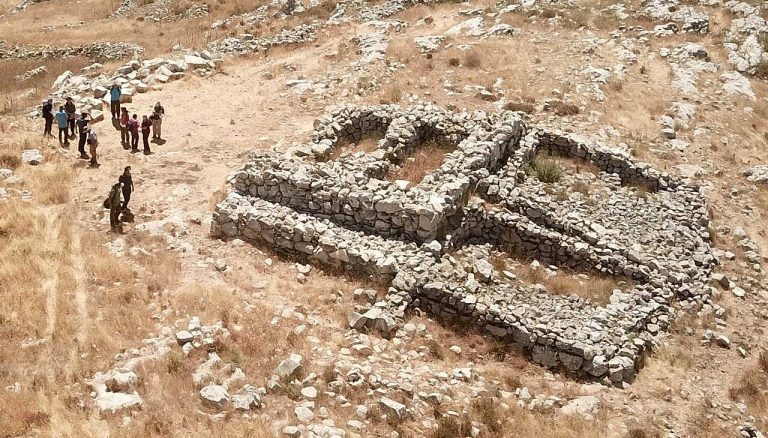
Netzer directed excavations at Lower Herodium beginning in the 1970s. Work there revealed a substantial complex without settling the location of the royal burial. The excavation on the slope eventually brought the team to reddish-coffin fragments and the white limestone base of a building east of the monumental stair. That discovery changed what they had to investigate. A massive base made of carefully dressed blocks, scattered pieces of its superstructure, and fragments of burial containers could all be considered in relation to one place. Netzer and his colleagues published the initial evidence and their reconstruction in 2010. Netzer and colleagues, search history and discovery, figures 3–6.
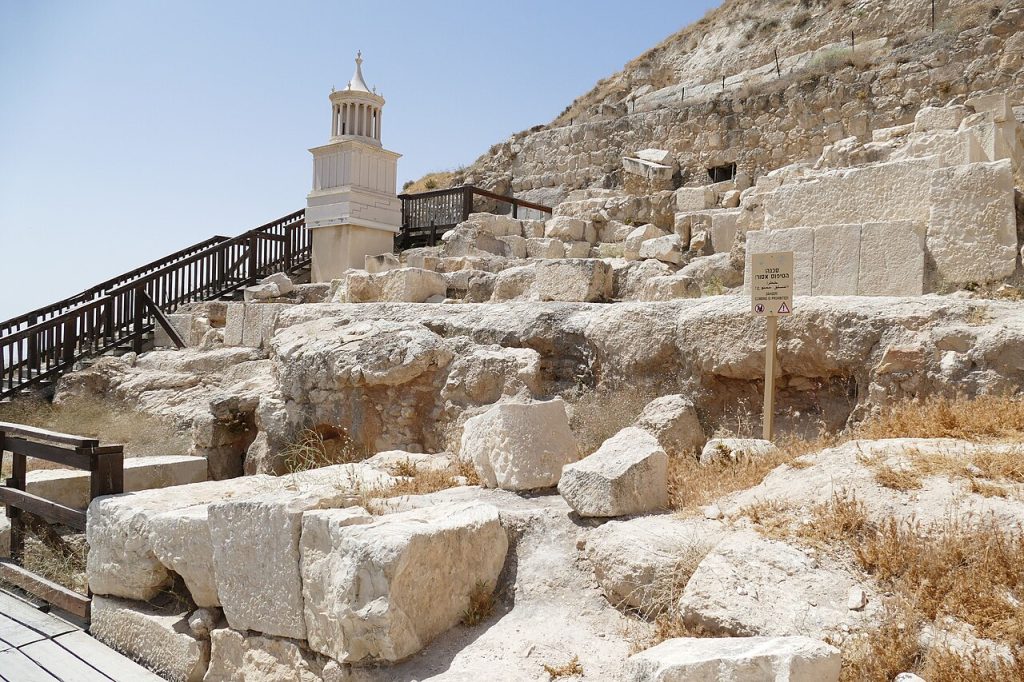
A podium is a raised base. Its footprint tells the investigator a great deal about how much ground the building took up and gives a place to begin reconstructing the parts above it. Among the architectural fragments found nearby were elements that could be compared with monuments of the same general period. Their size and form help establish possible positions for them. The reconstruction in the on-site model takes that process several steps farther. It lets a visitor envision a complete tomb above a rough collection of blocks. The underlying photographs, drawings, and excavation record give researchers a way to ask which parts of that finished picture depend on interpretation. Architectural pieces and proposed reconstruction.
The slope had already served other purposes. Netzer’s report describes a small theatre nearby, with tiered seating and an upper room richly decorated with wall paintings and stucco. It also describes the theatre being covered with fill during major work on the hill. The excavators read this as part of the process that gave the hill its distinctive conical form. Their visit to the same stretch of ground therefore brought them to an entertainment building, a burial monument, and evidence of earthmoving. Proximity makes a comparison possible. Dating and tracing the architectural relationships lets researchers decide what part each structure played. Netzer and colleagues on the theatre and later work on the slope, pp. 98–103.
Notice what an excavated fragment can contribute. A decorated block can retain the pattern of carving made on its original face and sometimes the joint where it met another stone. A pile of fragments can also have a history after the building collapsed. Some pieces may have moved downhill or been carried in fill. The team recorded the positions of the fragments and compared them with the foundation that remained in place. Reassembling a decorative program is one result of that work. Understanding what happened around the building before and after it was damaged calls for another reading of those same finds.
Three coffins and one proposed royal burial
The dig team recovered fragments of two white limestone sarcophagi and one reddish limestone sarcophagus. A sarcophagus is a stone coffin. The excavators described differences in the way the pieces had been left. The white fragments occurred mainly in one group at the base of the monument. Small pieces of the reddish coffin were dispersed in the fill that covered it. The researchers inferred that the reddish one had undergone especially thorough breaking. They also drew attention to the care devoted to carving and polishing its stone and the ornament made of rosettes. Sarcophagus fragments, their location, and the excavators’ discussion.
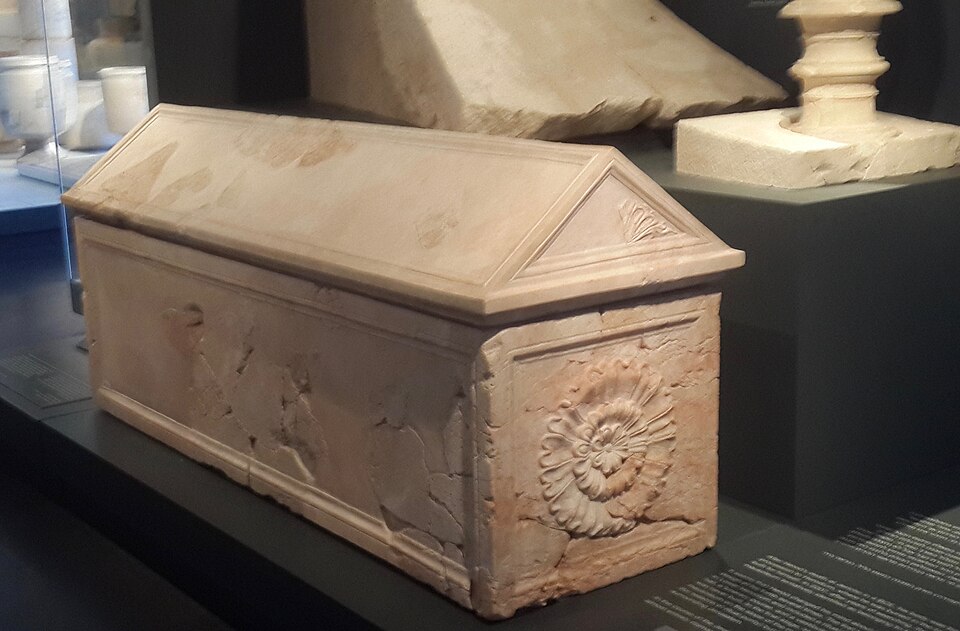
Netzer’s team used the scale and workmanship of the monument, the distribution of fragments, and the setting named by Josephus to support the proposal that the reddish coffin was Herod’s. They suggested that the damage could reflect deliberate destruction in the time of the First Jewish Revolt. Deliberate breaking is a claim about the physical record. The identification of the people who broke the pieces and their motives is a historical argument. One can find the excavation persuasive on how fragments accumulated and still ask whether their distribution is strong enough to help establish a royal name. The pieces carry no inscription naming an occupant. Excavators’ attribution of the reddish sarcophagus.
Josephus gives the research a place to look. The surviving stones have to carry the identification from the hill to one building.
Why the identification is debated
Joseph Patrich and Benjamin Arubas examined the proposed monument and asked what kind of burial setting would suit the royal procession described by Josephus. They found the dimensions modest for Herod, questioned the lack of a suitably formal entrance and space for an assembly, and examined the position of the mausoleum relative to the stairway and the larger complex. In their view, the larger works and the tomb are not aligned as components of the same plan. Their objections matter because they look at the monument’s intended role in a place full of other buildings. The same structure can be read differently depending on whether its relationships support one large design or several distinct projects. Patrich and Arubas’s archaeological reassessment.
Consider the stairway objection more closely. Patrich and Arubas note that the route to the summit overlies a water installation that they associate with a garden around the tomb. A stair above part of an earlier feature can help establish order. It also raises a question of design intent. Someone could build over an earlier garden while changing how visitors approach the palace, and the relationship would still have to be interpreted. The archaeological sequence gives the writers a reason to challenge the idea of a single coordinated burial complex. Their proposed locations for the actual grave remain alternatives supported by argument and comparison. Patrich and Arubas on the stairway, garden, and alternative locations.
The debate gives us a chance to separate observations from attributions. An excavator can measure a foundation and document ancient carving. A researcher comparing those remains with Josephus can infer that it was constructed for a high-status burial. Naming one person depends on fitting the evidence together more tightly. Those discussing Herodium agree about the significance of the 2007 discovery and differ about the weight of the setting, the damage and the architectural expectations. A comparison of the two reports makes it possible to see where each scholar moves from an observed feature to a conclusion about the identity or intentions of the builder. Herodium Expedition account · Patrich and Arubas’s alternative proposals.
Put Herod’s building world beside Matthew
Matthew 2 begins with travelers asking about someone born king of the Jews. Herod hears the question and consults people who know the Scriptures. He then asks the visitors for information. What follows is a story of fear, danger, and escape from someone whose power affects the lives of people in Bethlehem and beyond. Herodium and the harbor at Caesarea give a vivid view of what the historical Herod could build. Matthew directs our attention to what he fears and to the child whose identity makes that fear intelligible. Matthew 2:1–19.
In Matthew’s account the death of Herod changes the circumstances for Joseph, Mary, and Jesus. They are directed to return after the danger from Herod himself has ended, and the name of his successor Archelaus helps explain a later decision about where to settle. Josephus recounts the king’s funeral. The excavation gives readers a possible piece of the setting for that last part of his life. Matthew follows the family through the transition and stays with the consequences of his rule. Reading both requires attending to the dates, the people being described, and the questions that each author puts before his readers. Matthew 2:19–23 · Josephus, Jewish Antiquities 17.
When you look back at the platform on the slope, try to identify the strongest piece of the excavation argument. Is it the carved fragments, the monument’s position, or the coherence of the reconstruction? The pieces point to an ancient burial complex whose occupants matter to our understanding of the site. Associating it with Herod makes sense to the excavation team, and the competing architectural reading leaves room for a different answer. The scale of the project remains visible even where the last identification stays open. It gives the reader of Matthew one more way to see what a king’s power looked like in the country through which the family traveled.
Sources and further reading
- Ehud Netzer, Yaakov Kalman, Roi Porat and Rachel Chachy-Laureys, Preliminary report on Herod’s mausoleum and theatre with a royal box at Herodium — Primary Journal of Roman Archaeology report. Search history, base, architectural fragments, sarcophagi and tentative reconstruction.
- Herodium Expedition, Herod’s Tomb — Excavation team’s account of the discovery and reasons for the identification.
- Joseph Patrich and Benjamin Arubas, Revisiting the Mausoleum at Herodium: Is It Herod’s Tomb? — Primary published counterargument regarding dimensions, access, stratigraphy and orientation.
- Josephus, Jewish Antiquities, book 17 — Ancient account of Herod’s funeral and burial at Herodium, especially sections 196–199.
- The Israel Museum, Herod the Great exhibition — Curatorial context for presentation of finds and reconstruction.
- Matthew 2 — The birth of Jesus during Herod’s reign, the king’s response, and the movements of the family after his death.