A visitor approaching a royal doorway at Nimrud would have seen a creature standing squarely in the stone. Viewed from the side, it looked as if it were walking. The sculptors gave the giant guardians five legs so that they could create a convincing body for both points of view. That small surprise explains more about the palace than a photograph of an isolated statue might suggest. The images were designed for a person moving through the building. At ancient Calah, the approach to the Assyrian king passed through spaces carefully arranged to display the power and protection his court claimed.
What you’ll learn
- Why the guardians have five legs, and how their placement changed what visitors saw.
- How nineteenth-century excavation, museum displays, and work in Iraq shaped what survives of the Northwest Palace.
- Where Calah appears in Genesis, and how Assyrian guardian figures give context for reading biblical images of heavenly beings.
A doorway meant to be seen from two directions
Nimrud stands in northern Iraq near the Tigris, south of modern Mosul. Ancient inscriptions call it Kalḫu, the name usually rendered Calah in English Bibles. In the ninth century BC, Ashurnasirpal II turned the city into a center of Assyrian rule. His large building project included the complex now called the Northwest Palace. The building contained open courts and enclosed rooms, with doorways of different sizes and functions. The broad areas could receive groups of people, while the entrances directed movement in smaller numbers. An impressive creature at one of those points helped announce the kind of space a visitor was about to enter. Metropolitan Museum’s account of the palace and gallery.
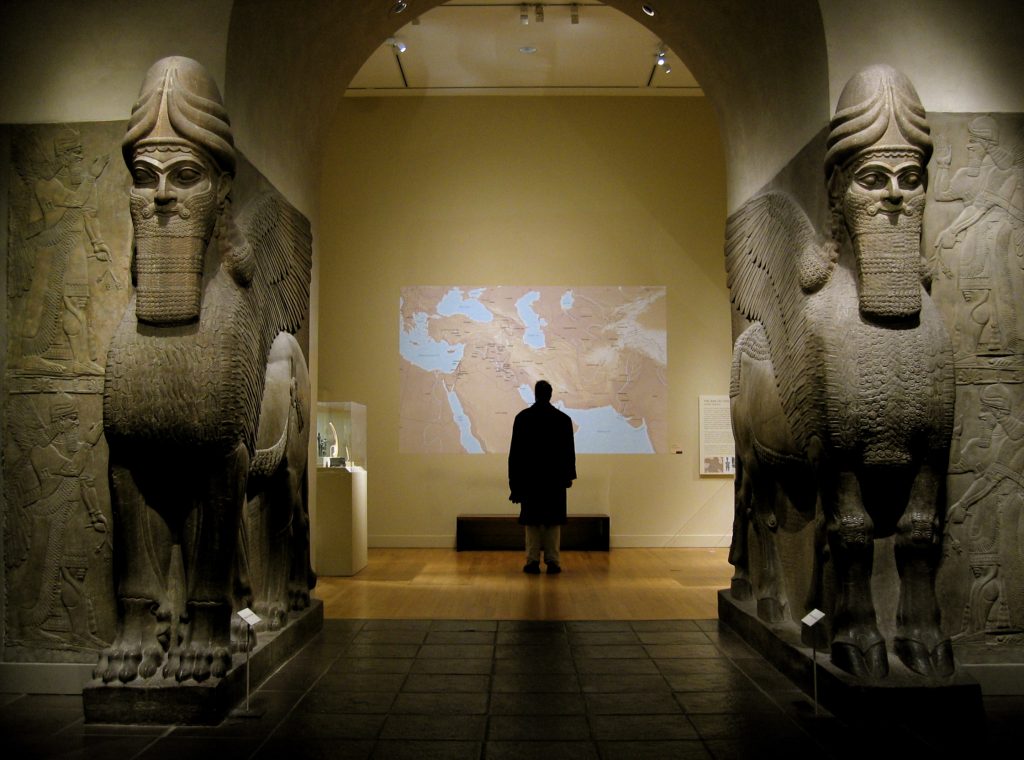
The Met’s winged bull, 32.143.1, is carved from gypsum alabaster. Its human face and beard join a bull’s body with birdlike wings. Sculptors worked part of the block deeply to form the projecting face and legs. Other features sit closer to the stone surface, where they are legible as a visitor walks beside it. The mass of the stone made it capable of defining a doorway as part of the architecture. The protective appearance depended just as much on the details, including the composed face, animal body, and carefully repeated feathers. Surviving examples from Nimrud show that sculptors could change the body from a bull to a lion while retaining the basic arrangement. Met object record for the bull.
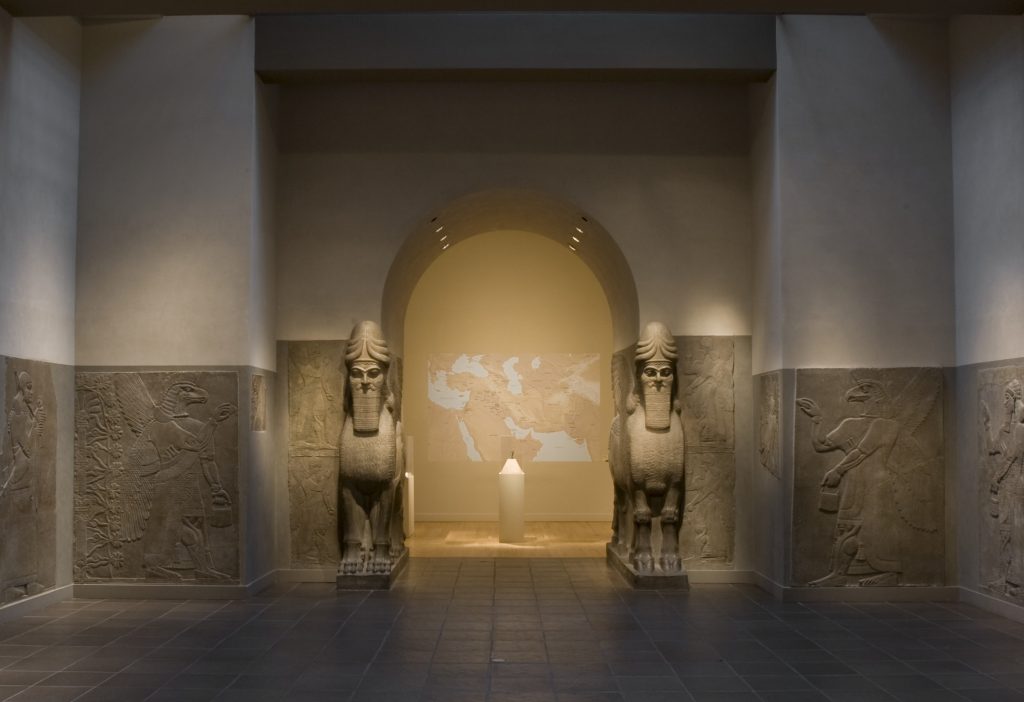
The lion in the photograph is a separate object of the same century. Stand mentally at its head and two feet face you. Follow the profile and four feet make sense as a walking animal. Since the two views share a leg, a count from an angle yields five. This is evidence about where ancient artisans expected viewers to stand, as well as evidence of their skill. The profile preserves the width of the large wing and the animal’s stride. The front emphasizes the encounter with the face and the weight of two feet firmly on the ground. Met object record for the lion.
The fifth leg belongs to an approach through a doorway. The ancient sculptor planned what visitors would see as they moved.
The message set into the palace walls
The guardians were one part of a building in which architecture, images, and words worked together. Many stone panels carry a repeated royal text known today as the Standard Inscription. Its title is a modern convenience for a recurring composition. It names Ashurnasirpal, gives his royal ancestry and titles, enumerates victories and spheres of control, and describes building at Kalḫu. Copies run across figures carved on the slabs. One could encounter traces of this description of the king in more than one room even without pausing to read out each line. The placement makes it possible for modern archaeologists to study what the royal house wanted to make visible. Nimrud project’s account of the Standard Inscription.
A different text, the Banquet Stele, records a large celebration at the palace and includes long lists of provisions. The monument claims that the king fed thousands of guests for multiple days, including people from the surrounding lands and inhabitants of Kalḫu. Such figures express the lavish scale the royal inscriptions wanted to advertise. They also open a window onto what the palace consumed and displayed, from meat, birds, and fish to wine, fruit, and bread. The words and the big stone door figures belong to one court that had the labor and materials to impress visitors in several ways. Edition of the Banquet Stele in Royal Inscriptions of Assyria online.
A protective image offered a further claim. Neo-Assyrian kings commissioned guardians and used ritual objects to defend important spaces. A doorway was especially suitable because it joined zones with different access. An image of great strength at the threshold could make protection visible to any visitor who crossed it. The palace materials give us part of this religious setting. They survive much better than most wooden furnishing, fabric, and applied decoration. A room of pale stone in a museum therefore preserves real ancient carving along with the effects of material loss. The ancient palace could have presented a much wider range of color, depth, and texture.
How the stones reached modern collections
Before looking at a plan or a museum doorway, try to work out which individual stones it represents. A photograph can put two sculptures side by side even if they arrived from different positions. One architectural reconstruction can draw on several doorways of a single building. The Met uses both a lion and a bull to evoke its ancient setting. The British Museum displays the remains of a separate pair of bulls that belonged to the Northwest Palace. The evidence for a particular doorway comes from excavated positions and related architectural records. Modern displays are an opportunity to walk among full-size figures and test how the viewing angle changes. Their labels can provide the object numbers necessary to follow the stones back to the excavation.
Austen Henry Layard began work at Nimrud in 1845. Hormuzd Rassam and local workers were central to the excavation enterprise and the identification and removal of monumental stonework. Later campaigns recorded more of the city, its palaces, and other parts of the mound. Early publications sometimes put the name Nineveh on their title pages as they brought discoveries at several Assyrian sites to a reading public. Calah and Nineveh were separate cities. The provenance in a museum catalogue or a field drawing matters when two sculptures have comparable wings, beards, and long bodies. Assyrian kings put related figures at more than one site and in more than one building. Project timeline of excavations at Nimrud.
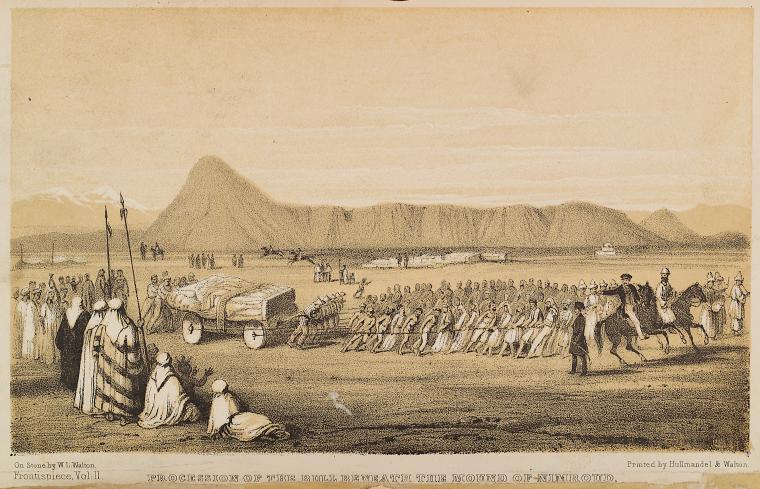
The big sculptures involved many kinds of labor after excavation as well. They had to be exposed, recorded, and prepared for transport. Period prints presented that process to a European public fascinated by the new finds. A drawing gives an artist’s view and can help date the modern history of a sculpture. The finds reached collections in several countries, while other sculptures remained in Iraq. Severe damage at the site in 2015 made records and photographs important for understanding what had stood there. Modern conservation and documentation rely on the work of Iraqi heritage specialists and on records held in many collections. UNESCO’s report on damage and heritage protection at Nimrud.
Calah and the Assyria of Scripture
Genesis 10:8–12 names Calah among the cities associated with the early spread of kingdoms in Mesopotamia. The passage introduces a group of places rather than giving us an excavation history of each one. The palace now known at Nimrud comes from the much later time of Ashurnasirpal II. Finding the later capital helps put Calah back on the map of a Bible reader’s imagination. It gives the place scale and geographical reality without assigning the excavated palace to the period of Nimrod. Over a long urban life a city can retain an old name while undergoing major changes in its rulers, buildings, and role in surrounding lands.
The court at Nimrud is also part of the political world behind the books of Kings and the prophets. The palace of Ashurnasirpal predates the episode in which Menahem of Israel paid tribute to Pul, known from Assyrian sources as Tiglath-pileser III. Assyrian kings after Ashurnasirpal used the city and its palaces as they maintained and expanded their rule. For a reader of Isaiah 10, Assyrian royal texts help bring the ruler’s claims of strength and conquest into focus. Isaiah treats imperial power as accountable to the Lord and condemns the arrogance of a ruler who acts as though his own hand deserves all the credit. Compare the Assyrian record of Menahem’s tribute.
Reading the biblical images with care
Scripture speaks of winged beings associated with holy places and with the presence of God. Exodus describes cherubim over the cover of the ark. Ezekiel sees living creatures in a vision of God’s glory and subsequently identifies them as cherubim. The specific combinations and movements in his vision have to be followed in the text itself. At Nimrud, a stone creature is placed to mark a human king’s doorway. At the ark, the cherubim belong to the place where the Lord says he will meet with Moses. In Ezekiel, the movement of the living beings accompanies a vision of the living God who can make himself known even to exiles far from Jerusalem.
These are useful comparisons of placement and visual language. Ancient Near Eastern artisans and writers could express more than one idea through wings and combined forms. The Assyrian sculpture helps modern readers imagine why such images might communicate power, a guarded approach, and an encounter with something beyond ordinary experience. Neither the number of the bull’s legs nor the role of its stone doorway settles what Ezekiel saw. For Christian readers, the vision makes its own claim about the Lord’s glory. The relief gives us an opportunity to see a real ancient object and to notice how different settings and purposes give meaning to the images we encounter.
Sources and further reading
- Met bull 32.143.1 — Artifact record, material, scale, and original setting.
- Met lion 32.143.2 — Artifact record and sculptural treatment.
- The Assyrian Sculpture Court — Met gallery context and archaeological interpretation.
- The Standard Inscription — Nimrud project’s contextual study.
- Palace inscription text — Edition and English translation of an Ashurnasirpal inscription.
- The Banquet Stele — Primary record of the dedication feast.
- Nimrud excavation chronology — Institutional chronology of modern fieldwork.
- Nimrud statue in collecting history — British Museum on the context and excavation of their winged bull.
- The Monuments of Nineveh — Met object account of nineteenth-century archaeological publication.
- Heritage at Nimrud — UNESCO report on 2015 destruction and ongoing protection.