In 1898 Bernard Grenfell and Arthur Hunt put a damaged page of Matthew at the front of their first book on the papyri of Oxyrhynchus. You can still see why they gave it that position. The Gospel opens by naming Jesus Christ before it traces his ancestry. Farther down, holes and splits make some letters vanish in the middle of words. Turn the leaf and the Gospel moves from generations of names through Mary’s pregnancy to the angel’s words to Joseph. The book that once held this leaf is gone, but what survives lets us examine how an early Christian copyist began Matthew. Grenfell and Hunt’s first publication, plate I and item II.
Key takeaways
- Grenfell and Hunt found the fragment in the first excavation season at Oxyrhynchus, Egypt, in the winter of 1896–97. The Penn Museum holds it as E2746.
- The portion of Matthew is generally dated to the third century AD by comparison of handwriting.
- Two numbered pages preserve Matthew 1:1–9, wording in verse 12, and portions of verses 14–20.
- The fibers, fold and small traces of writing on a neighboring leaf help researchers reconstruct how the codex might have been assembled.
How a Gospel leaf left the rubbish mounds
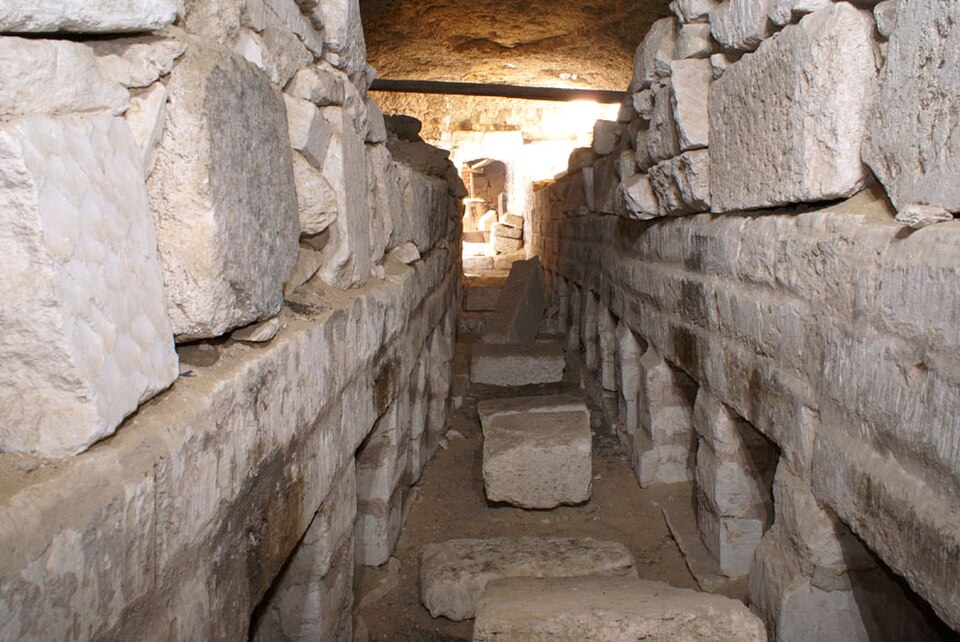
Oxyrhynchus stood in Middle Egypt at the site of what is now el-Bahnasa. Grenfell and Hunt began excavating its mounds in the winter of 1896–97 for the Egypt Exploration Fund. The first volume of their edition puts Matthew’s fragment close to the findspot of another early papyrus, a collection of sayings of Jesus. They reported finding Matthew there a day or two after the sayings. In the years that followed the excavations recovered literary works, contracts, letters and many other scraps of writing. The documents give different kinds of access to the people who lived there, even though many have come down in pieces. Oxford’s history of the Oxyrhynchus excavations.
P1 reached us through the old city’s deposits of discarded material. Once a papyrus book had come apart, a sheet could be separated from the rest. Dry deposits make the survival of ancient papyrus possible, but preservation is uneven. Ink can fade from a surface that otherwise appears intact, and a torn edge can take several words at once. For a manuscript found in these deposits the findspot is a secure part of its modern history. The same evidence leaves open where the book was produced, who read it and how long it circulated before some of its pages made their way into the mound. Luijendijk and Nongbri on the excavated books and their context.
Look for three names when following the fragment between institutions. P.Oxy. I 2 is the number of the item in the first volume of The Oxyrhynchus Papyri. E2746 is the accession number used by the Penn Museum in Philadelphia. P1 is its identifying number in the Gregory–Aland register of New Testament manuscripts, where P marks a papyrus witness. Each number tells you which catalogue you are consulting. One can take you to the nineteenth-century publication, another to the artifact, and the third to its place among copies of New Testament books. Penn Museum E2746 catalogue record.
What you can read on the two pages
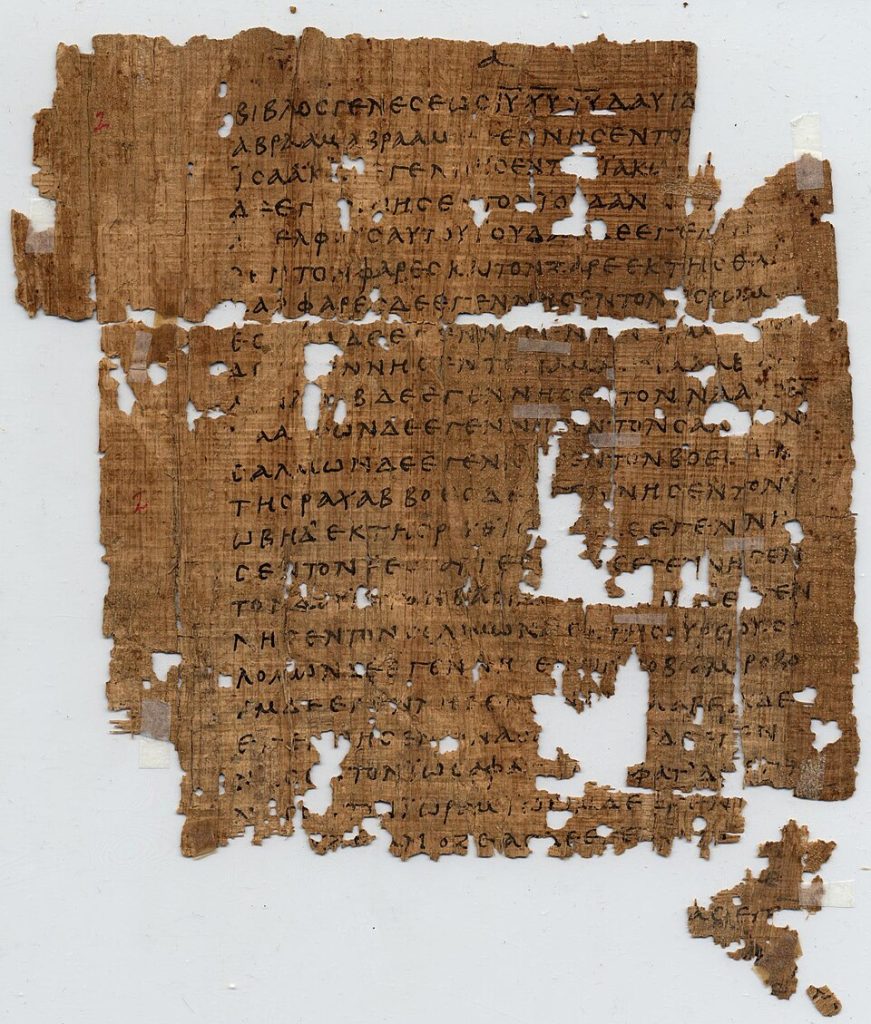
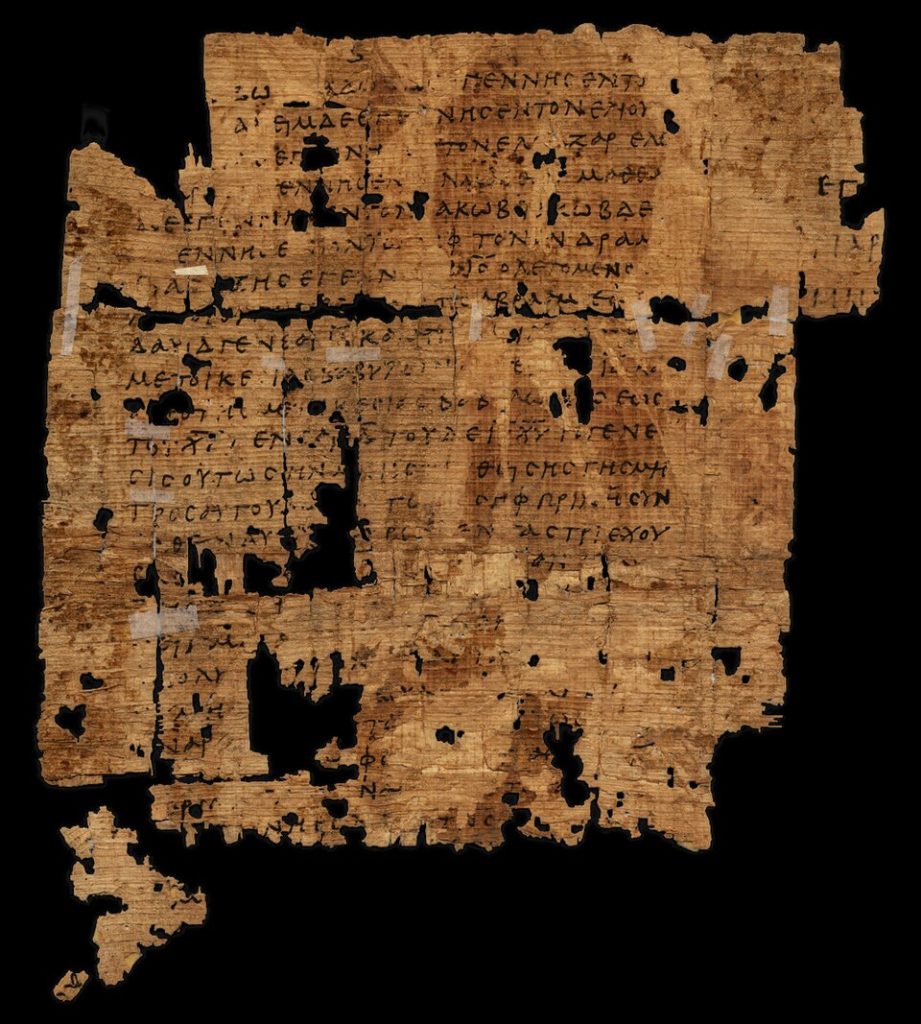
Matthew’s first sentences run across the side of the papyrus on which the exposed fibers lie vertically. The Greek letter alpha near the top functions as the number one. The other side, where the fibers follow the direction of the lines of text, is marked beta for page two. Modern editors list portions of Matthew 1:1–9, 12 and 14–20. That description gives the limits of what remains legible, with holes and interrupted lines within those limits. The scribe copied words across a continuous surface. Our verse numbers provide a way to put the surviving portions alongside a modern Bible. Penn Museum’s description of the numbered pages.
The first publication reproduces one side as its frontispiece and supplies a transcription of both sides. The printed Greek edition helps because it distinguishes what Grenfell and Hunt could read from what they supplied where part of a line had perished. For the same reason, a transcription is worth setting beside the photograph. You can see the gaps by eye and then ask how much a word depends on surviving strokes or on text known from other manuscripts. The early editors found variations mainly in the spelling of personal names. They also noted familiar abbreviations for sacred words such as Jesus and Christ, conventions that make a few letters do the work of a longer name. The original edition and discussion of the hand and readings.
A change as small as a letter can be worth following. In the line that our Bibles number Matthew 1:8, the early editors transcribed the name as Asaph. The Textus Receptus, the early printed Greek text to which they compared it, gives Asa. Readers may recognize Asa as the name used for the king in 1 Kings 15. The names in Matthew’s surviving manuscripts can therefore send an editor back to the photographs and the parallel records in Scripture. A note about the spelling concerns what was copied at one point in the line. The rest of the line still gives the succession from Abijah to the next king and then to Jehoshaphat. Original edition, page 6 and first-side line 20.
Why a folded sheet matters
In a papyrus book, a maker could fold a sheet into two leaves that remained joined along a spine. Book historians call that unit a bifolium, meaning a pair of leaves. The P1 fragment retains the leaf containing Matthew’s opening and a small amount of its partner. That partner has the starts of three lines in larger handwriting on one face. The other surviving face carries no writing. Grenfell and Hunt had already noticed that the lines could belong to another hand. A short written heading is one possibility, but there is too little text to identify it confidently. Its position matters because it affects how the book could have been put together. The 2025 codicological study, section 3.1.
A reader looking only at the preserved piece might picture a nearly square page. In a 2025 study AnneMarie Luijendijk and Brent Nongbri examined the line of the fold, the margins, small holes and the amount of missing text. One estimate they use puts the old page at roughly twelve centimeters wide and twenty-five centimeters high. That would make it a tall, narrow book. The height is partly reconstructed from missing writing between the preserved bottom of page one and the start of page two. The picture we can form of the book takes shape from the parts that survive and the space that the lost parts would have occupied. Codicological reconstruction, sections 3.2–3.3 and figure 4.
The authors also ask what would happen if the sheet had been folded the other way. Their reconstruction allows it to have been the outer sheet of a single gathering containing Matthew. On that scenario the stray writing could belong near the end of the book, for instance in a concluding title. They compare the reconstructed shape and potential thickness with other surviving papyrus codices. Their case shows that a particular construction fits the evidence, while several other arrangements are still possible. A single surviving opening can support a well-reasoned model of a book even when its covers, further gatherings and last page are all missing. Luijendijk and Nongbri’s alternatives and comparative examples.
The distinction between a leaf and a page makes the reconstruction easier to picture. A leaf has two faces. A sheet folded once provides two leaves and four faces. In a gathering, other sheets can sit between those two leaves. This is why the three stray lines physically attached to the leaf with pages one and two could have come from a very different place in the reading order. A study of the format therefore asks different questions from a study of the letters. It looks at the sequence in which a physical book could turn and the minimum amount of space required for the text that once filled it. 2025 study of position within the gathering.
A third-century copy and a first-century story
Grenfell and Hunt favored a third-century date from the style of the hand. The 2025 study and the Center for the Study of New Testament Manuscripts still give the third century as the usual assignment. A paleographic date is a comparison with other writing, often over several generations. It estimates when an individual hand could have produced the letters. P1 supplies no dated dedication or signature of its copyist. The original act of composing Matthew and the later act of setting those words on this particular papyrus are separate events. The time estimate belongs to the leaf and tells us when one copy was probably already in circulation. Digital manuscript record and dating.
A broken page can show the moment when a scribe turned the Gospel into a book someone could hold and read.
The book opens with Jesus Christ named as son of David and son of Abraham, a deliberate orientation to the history of Israel. The promise to Abraham reaches outward to the families of the earth, and the promise to David looks toward a lasting kingdom. In Matthew’s genealogy the sequence moves through the Davidic kings and then through the exile. The surviving copy retains names on both sides of that historical divide. Its physical scale can make the genealogy easier to appreciate. A story reaching across centuries had to be written one name at a time in a short column. Matthew 1:1–17; Genesis 12:1–3; 2 Samuel 7:8–16.
Matthew then tells how Mary came to be pregnant by the Holy Spirit and how an angel told Joseph to take her as his wife. Parts of that account are visible on P1’s second page. The Gospel continues beyond the preserved portion into the command to name the child Jesus and Matthew’s reading of Isaiah’s Immanuel promise. Christians receive Matthew as true Scripture, including what it says about Jesus’ birth. The excitement of this small witness is that some of the same words passed through the hands of a Greek copyist, into a book, and into a community generations before the first surviving great parchment Bibles. Matthew 1:18–25; Isaiah 7:10–17.
If you read the chapter beside the manuscript, stop at the line about the removal to Babylon. Part of that line is visible on P1’s first page, where it introduces Jeconiah and his descendants. The sequence puts the exile inside the family history Jesus inherits. The final part of the genealogy then changes its wording around Joseph and Mary. It calls Joseph Mary’s husband and identifies her as the one from whom Jesus was born. This change leads directly into the account of Joseph, Mary and the Holy Spirit. The two faces of the leaf let a reader see how closely Matthew has placed the public history of Israel and the events in this family. Matthew 1:11–20.
Frequently asked questions
Was it the first papyrus the excavators found?
P1 is its number in a modern register of New Testament manuscripts. The first excavation publication placed it second in its catalogue. The original catalogue and item numbers.
Does P1 preserve all of the Christmas story in Matthew?
The fragment reaches into Joseph’s dream in Matthew 1. Verse 20 is the last substantial passage still visible. The original editors tentatively assigned a two-letter trace farther down to verse 23. Matthew continues with the naming of Jesus, the quotation from Isaiah, and the later events of chapter 2. The surviving passages listed by the Penn Museum.
Can I see how much of the original writing is left?
Look at the two sides in the digital manuscript record, then compare the first edition’s transcription and the Penn Museum’s photographs. The difference between a legible letter, a partly legible line and an editorial restoration becomes clearer when you have both in front of you. P1’s two numbered pages on the CSNTM viewer.
Sources and further reading
- Penn Museum, Manuscript E2746 — Holding institution catalogue and photographs.
- Bernard P. Grenfell and Arthur S. Hunt, The Oxyrhynchus Papyri, part I — 1898 first edition with plate I and item II on printed pages 4–7.
- AnneMarie Luijendijk and Brent Nongbri, The Codicology of Early Christian Books from Oxyrhynchus — 2025 study of P1, its fold, page measurements, surviving texts and possible original arrangement.
- University of Oxford, The Oxyrhynchus Papyri — History of the early excavations and the first edition.
- Center for the Study of New Testament Manuscripts, P1 — Digital manuscript record and image viewer.





