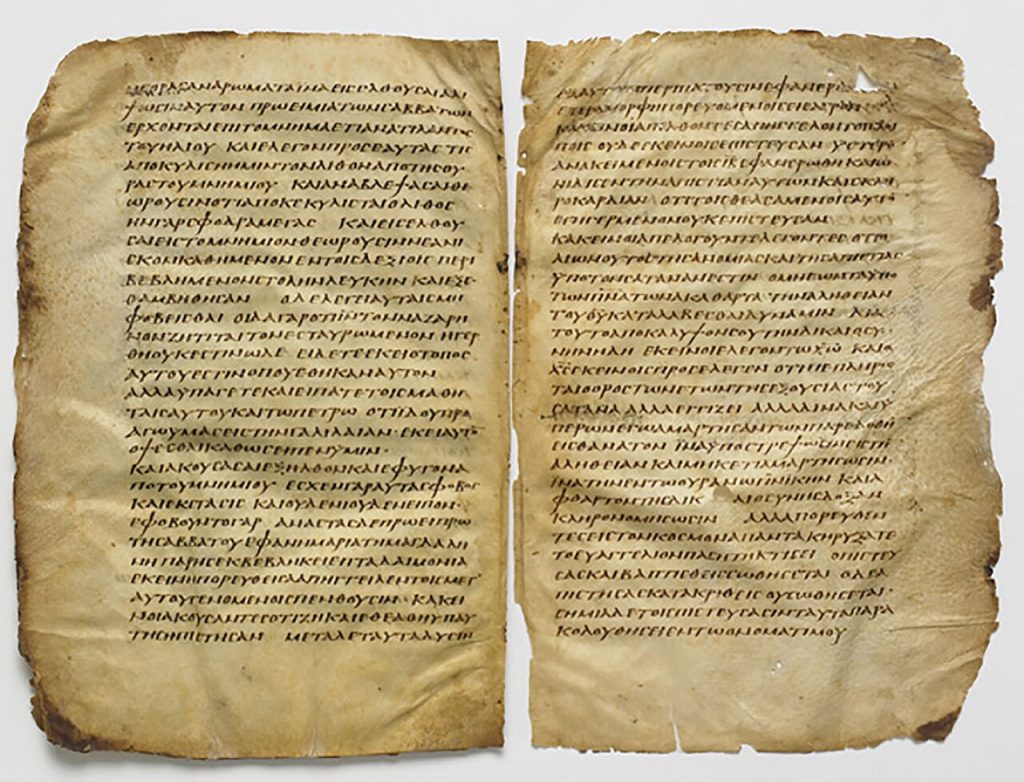
A reader who opened this book in late antiquity would come to Matthew first, then John, Luke and Mark. All four Gospels were there, in dark ink on parchment. The last book contains something that has made the manuscript especially famous. After Mark 16:14, the scribe copied an exchange between the risen Jesus and the eleven disciples that readers will rarely see in a printed Bible. The manuscript preserves the exchange in place, surrounded by the rest of the chapter. This is a chance to examine how a particular community received and copied the Gospels, alongside an extraordinary example of how an ancient book was made and kept. Smithsonian catalogue and digital photographs of the Freer Gospels.
Key takeaways
- Charles Lang Freer purchased the codex at Giza, Egypt, in December 1906. The Smithsonian holds it as F1906.274.
- The National Museum of Asian Art dates the parchment manuscript to the late fourth or early fifth century. Its associated painted covers are later.
- The Gospels occur in the order Matthew, John, Luke and Mark.
- An additional exchange after Mark 16:14 is known as the Freer Logion. Jerome discussed related wording centuries before the manuscript reached Washington.
The manuscript before Washington
The names for the book reflect different parts of its history. The National Museum of Asian Art often calls it Washington Manuscript III or Codex Washingtonensis. Codex Washingtonianus is another form of the name. Freer Gospels recalls the collector who acquired it, and W or 032 identifies it in New Testament scholarship. If you encounter those names beside a passage in a commentary or edition, the museum accession number will take you back to the very same manuscript. The substantial leaf count also helps distinguish it from the small fragments often associated with early Gospel manuscripts. The Smithsonian describes 187 leaves with writing on both sides. Smithsonian catalogue, accession and physical description.
The firmest date in the modern story is December 19, 1906. Freer bought the manuscript in Giza from the dealer whom the Smithsonian record calls Ali Arabi. The museum lists a possible earlier association with the Monastery of the Vinedresser near Giza. The word possible matters because the codex reached Freer through a dealer. A purchase record gives us strong evidence for when the object changed hands, while an excavated findspot would have provided different evidence about where it had been kept. Even an established place of use could be a long way from the workshop that produced the book. Smithsonian provenance entries and associated records.
The later journey is unusually well documented. The 1906 deed by which Freer offered his collection to the United States covered later acquisitions as well as objects he already had. The archival papers include shipping instructions for cases sent from Cairo to Detroit. The manuscript entered the Freer Gallery’s collection as a gift received in 1920. An archival photograph shows Freer with the dealer and others in Egypt. Those papers and images help date the acquisition, show who was involved and place the purchase in the history of collecting. The older ownership history is still a separate question that those records can only partly answer. Smithsonian archival documents discussed by Chase F. Robinson and Beth Harris.
Henry A. Sanders began studying the manuscript soon after the purchase. In 1912 he published an edition and also produced a facsimile with the University of Michigan. Readers across the world could then compare the printed transcription with photographs of the actual writing. The drawings, corrections and placement of text on the page could enter the discussion in addition to the reconstructed Greek words. The same distinction is easy to apply today by checking a page image beside a printed Bible. The photograph invites questions about the object itself. A transcription answers another question by representing the writing in readable text. Sanders’s 1912 edition of the Washington manuscript.
What the book looks like
The parchment is laid out mostly in a single, narrow column of roughly thirty lines per page. The letters belong to a kind of Greek majuscule, a form of writing with letter shapes comparable to capitals. The Smithsonian describes them as small and sloping. There are many decisions behind that restrained appearance. A maker had to prepare animal skins for ink, assemble the leaves, and lay out a repeated writing area. The single column gives the book a consistent rhythm even where its surface has worn with handling. Compare it with the narrow Greek column on a page of Papyrus P75, and you can see how a change of material could still accommodate a familiar form of page. Museum record and manuscript images.
The Gospels come in a different sequence from the one most readers know. Matthew and John lead, followed by Luke and Mark. Scholars often call this the Western order. The label describes a sequence attested in manuscripts and is separate from an argument about where this particular book was written. The four works are distinguishable even as a single physical volume gives them a shared home. P75 made two Gospels consecutive, while Washingtonianus lets us follow a whole four-Gospel sequence. Together such objects make it possible to discuss the ordering and grouping of the Gospels as things readers experienced with their hands. Smithsonian description of the Gospel order.
There is another way to read the arrangement. Find the end of one Gospel in the image sequence, then turn through to the opening of the next. The catalogue displays the book page by page. You can follow the boundary even though your own Bible probably places John elsewhere and gives you chapter and verse numbers to locate any passage. Liturgical use is suggested in the Smithsonian catalogue, partly because of the layout. A photograph can show the consistency that makes a text suitable for reading aloud. The occasion on which an individual reader actually used the book would require another kind of evidence. Museum image sequence and interpretive description.
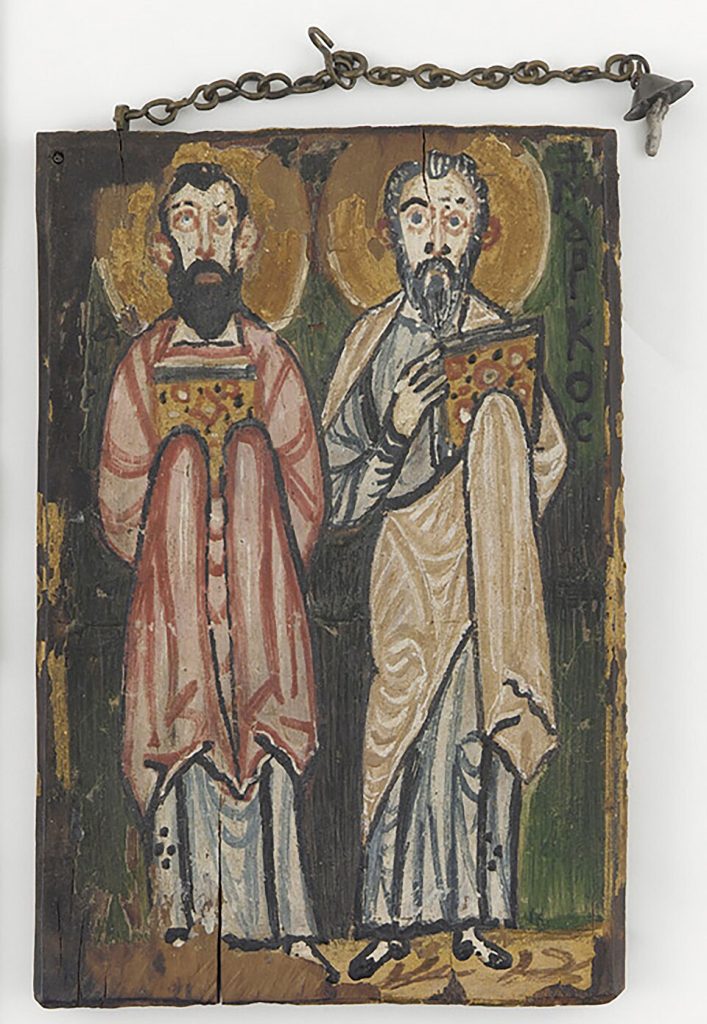
The painted boards helped attract Freer to the book. The surviving right panel shows Mark and Luke, and its companion shows Matthew and John. The Smithsonian dates the right panel to the seventh century and calls its medium encaustic painting on wood, a technique that uses wax as a medium for pigment. These boards add a separate stage to the book’s history. Dating the painting tells us when a cover for the book may have been made. Dating the hand and construction of the parchment leaves tells us when the text on those leaves was likely copied. Both dates belong in an account of the manuscript. Smithsonian record for the right painted board.
The current museum range for the main manuscript is late fourth to early fifth century. Within that range the precise date of the copying remains open. In a 2023 study, Régis Burnet and Claire Clivaz pointed to the decorative sign at the very end of Mark as additional evidence for assigning the copy of that Gospel to the fifth century. The sign is called a coronis. It marks a boundary in the text and has a history of its own that can be studied alongside letter forms. A date proposed for Mark needs to be understood in relation to the other parts of the volume, including the later boards. Burnet and Clivaz on the closing sign and dating of Mark.
The Freer Logion and the end of Mark
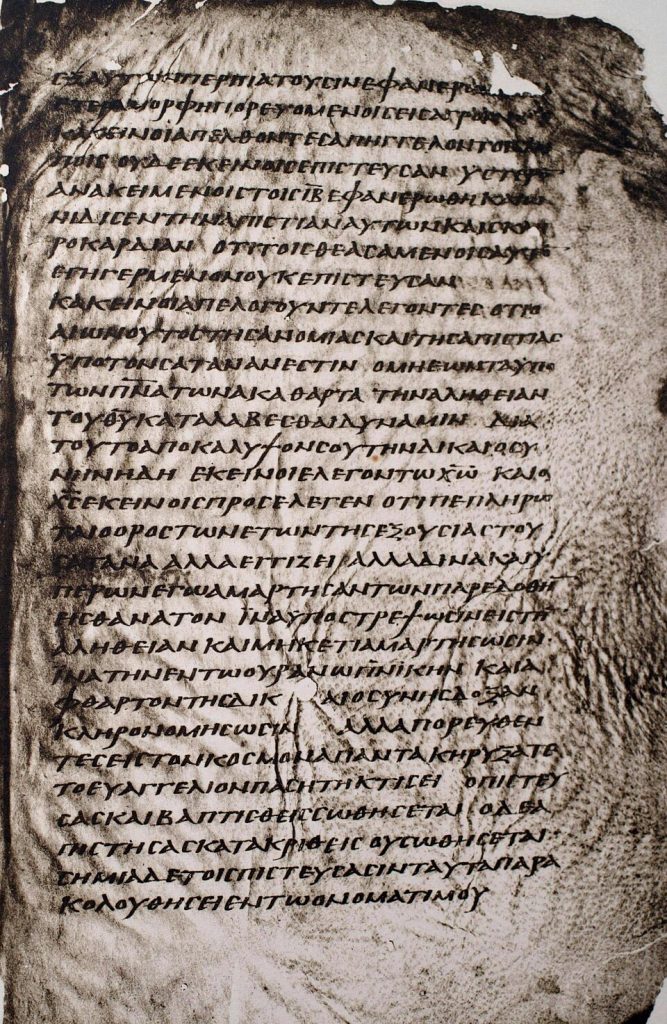
At the beginning of Mark 16, the first witnesses already have something vital to report. The women arrive and find the stone moved. At the tomb they are told that Jesus has risen. Later, in the long ending read in many Bibles as Mark 16:9–20, Jesus appears to the eleven and rebukes their unbelief. Washingtonianus contains that ending, and within it, after verse 14, the manuscript pauses for an extended reply. The disciples attribute the prevailing unbelief and lawlessness to Satan’s authority. Jesus responds that the term of Satan’s authority has been fulfilled and speaks of his death and its purpose for sinners. The text then resumes the surrounding longer ending. Smithsonian description of the inserted exchange.
Two distinct comparisons help when reading a Bible footnote about this chapter. The first concerns the transmission of the longer ending as a whole, and the second concerns the few additional lines found inside it in Washingtonianus. It is possible for a manuscript to contain the longer ending without containing the exchange. Codex Sinaiticus, on the other hand, ends its text of Mark at verse 8. Comparing the editions therefore means following the precise location and amount of text in each witness. The Freer Logion is an expansion within one form of the ending and is usually called a logion because it contains a saying. Study of the terms, placement and manuscript evidence.
The remarkable thing is that the exchange had been heard of before Freer’s codex was available. In a work directed against the Pelagians, Jerome reported wording related to this exchange and said he knew it from some copies. Burnet and Clivaz show how the early modern editor Erasmus discussed Jerome’s reference long before the Greek witness in Washington was available. The ancient quotation, the annotations in an early printed edition and the manuscript page are three different sources. Their relationship makes it possible to study the passage’s circulation even though this codex is the surviving continuous Greek Gospel manuscript that preserves the exchange in place. The documentary trail through Jerome, Erasmus and W.
A small addition is easier to understand when you can see exactly where it sits in the book and how the surrounding Gospel continues.
Reading the Gospel and the manuscript together
For Christians, the resurrection is the true event at the heart of the Gospels. Mark’s proclamation at the empty tomb, Matthew’s account of the risen Jesus commissioning his disciples, Luke’s account of his appearance and teaching, and John’s account of his encounters with Mary Magdalene and Thomas all belong to that testimony. The Freer Logion has a narrower place in the history of the text. Its survival shows that some early readers and copyists encountered an expanded exchange in Mark. Comparing it to other witnesses is one way to honor the words of Scripture by attending closely to what each book actually transmits. Mark 16:1–8; Matthew 28:16–20; Luke 24:36–49; John 20:11–31.
Think back to the four Gospels on the parchment leaves. The book’s extraordinary value comes from the amount we can examine at once. The sequence of the Gospels, the older parchment and later painted covers, and the unusually preserved words near the end of Mark tell related stories. One concerns the making and use of a book. Another concerns the readings that scribes copied for a community. Their intersection brings this codex closer to a reader than its catalogue number ever could. We can visit one of its pages and see how a person left space, chose a title or continued a line. Full digital manuscript and museum commentary.
Watch how the manuscript reached the Smithsonian
Frequently asked questions
Was the codex excavated in Giza?
Giza is the documented place of purchase in 1906. The Smithsonian describes a possible association with a monastery in the area. An exact ancient findspot remains undocumented. Provenance record.
Why does it have a seventh-century cover if the manuscript is earlier?
The cover and the parchment book can date from different acts of production. The painted boards preserve a later stage in how the Gospels were stored and presented. Smithsonian cover record.
Where can I examine the relevant Gospel leaf?
The Smithsonian has photographs of the manuscript. The 1912 facsimile reproduced here shows the text across Mark 16:12–17. Sanders’s edition supplies the transcription. Sanders’s edition.
Sources and further reading
- Smithsonian National Museum of Asian Art, Washington Manuscript III — CC0 holder record, complete digital photographs, purchase history and scholarly bibliography.
- Smithsonian National Museum of Asian Art, Right Cover of the Washington Manuscript — CC0 holder record documenting the painted wooden panel, subjects, materials and date.
- Henry A. Sanders, The Washington Manuscript of the Four Gospels — The 1912 critical edition, with physical description and transcription.
- Régis Burnet and Claire Clivaz, The Freer-Logion (Mark 16:14) — Study of the Greek witness, Jerome, Erasmus and the sign at the end of Mark.
- Center for the Study of New Testament Manuscripts, GA 032 — Catalogue of the manuscript under the Gregory–Aland number.
- Smarthistory and the Smithsonian, A Young Country, an Ancient Manuscript — Museum staff and art historians discuss the acquisition with original documents.



