Two modest limestone altars spent decades on display in Jerusalem before researchers identified what remained on their tops. Both came from a small shrine excavated inside the fortress at Tel Arad, on the northern edge of the Negev. One held evidence of frankincense. The other held evidence of cannabis. Together with the rooms in which they were found, they offer a rare glimpse of worship at a fortress in the kingdom of Judah. The shrine also raises a question familiar from reading Kings. What happened to local places of worship when rulers called Judah back to the worship of the Lord?
Scripture is true and accurate, and part of its truthfulness is its record of how often God’s people departed from what he commanded. The remains at Arad give us something tangible to put beside that record. We can follow the plan of the sanctuary, see how the altars reached the museum, and examine a proposal that the shrine was closed during Hezekiah’s reign. The physical evidence is clearest about the buildings and the objects. The historical argument about why use stopped takes more work.
What you’ll learn
- How the upper fortress relates to the much earlier city below it.
- What the courtyard, inner room, and paired limestone altars reveal about the sanctuary.
- How independent chemical analyses identified materials on the two altars.
- Why the shrine’s closure may belong to Hezekiah’s reign and why the attribution remains debated.
A shrine inside a southern fortress
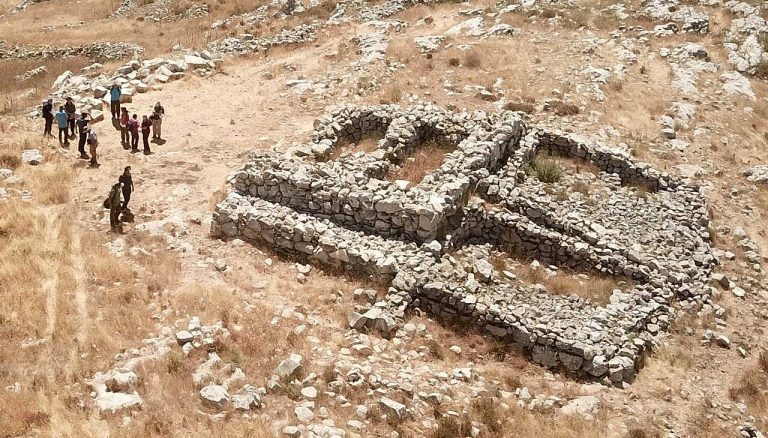
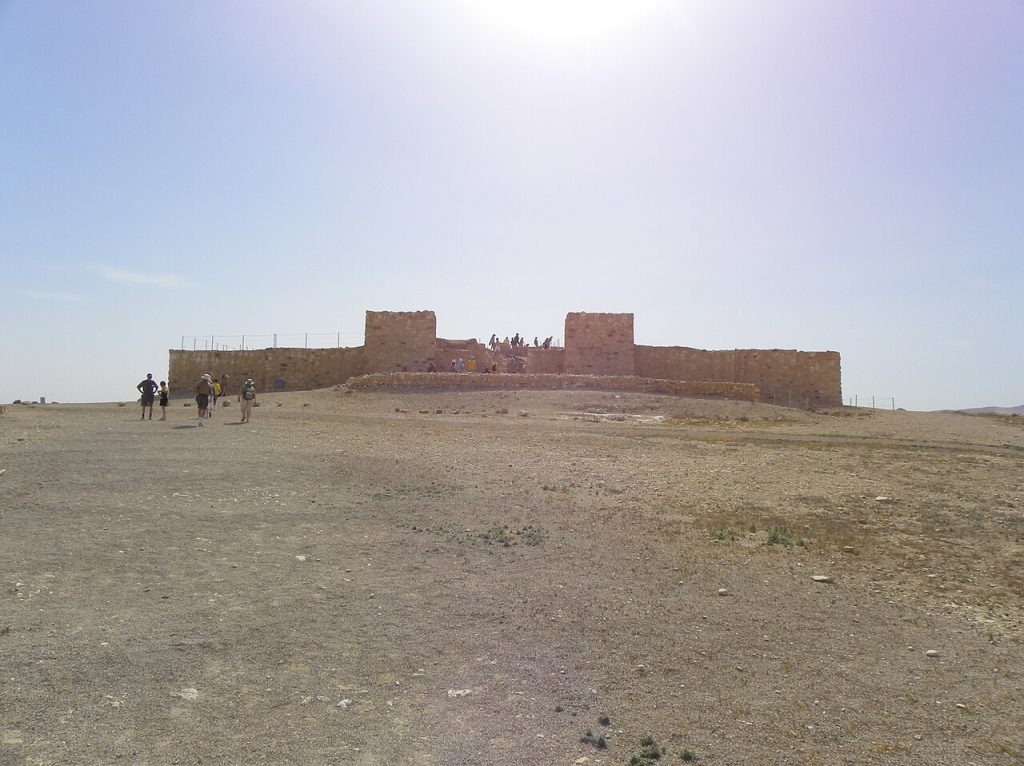
Tel Arad overlooks the Beersheba–Arad Valley. The walled Early Bronze Age town occupied the lower part of the site. Long afterward, Judahite builders used the upper mound for a fortress, and successive buildings occupied much of the same ground. This distinction matters when reading a map or looking at a photograph. The sprawling foundations below the hilltop belong to a different stage of Arad’s history from the worship installation inside the fort. Ruth Amiran’s excavations investigated the earlier city, while Yohanan Aharoni’s team worked on the fortress mound from 1962 to 1967. Fortress excavation and publication project
Aharoni’s second season, in 1963, brought to light the small inner chamber and some of its furnishings. Further digging in 1964 and 1965 revealed the larger arrangement. The sanctuary sat in the northwest part of the fortress. From its courtyard, a visitor could enter a long hall and go up steps to a smaller space at the west, commonly called the debir or innermost chamber. A roughly square installation made of fieldstones stood in the courtyard. The excavators drew attention to its use as an altar and distinguished it from the pair of much smaller limestone altars near the inner chamber. Aharoni’s report of the 1963 season and Arie, Rosen, and Namdar’s description of the shrine
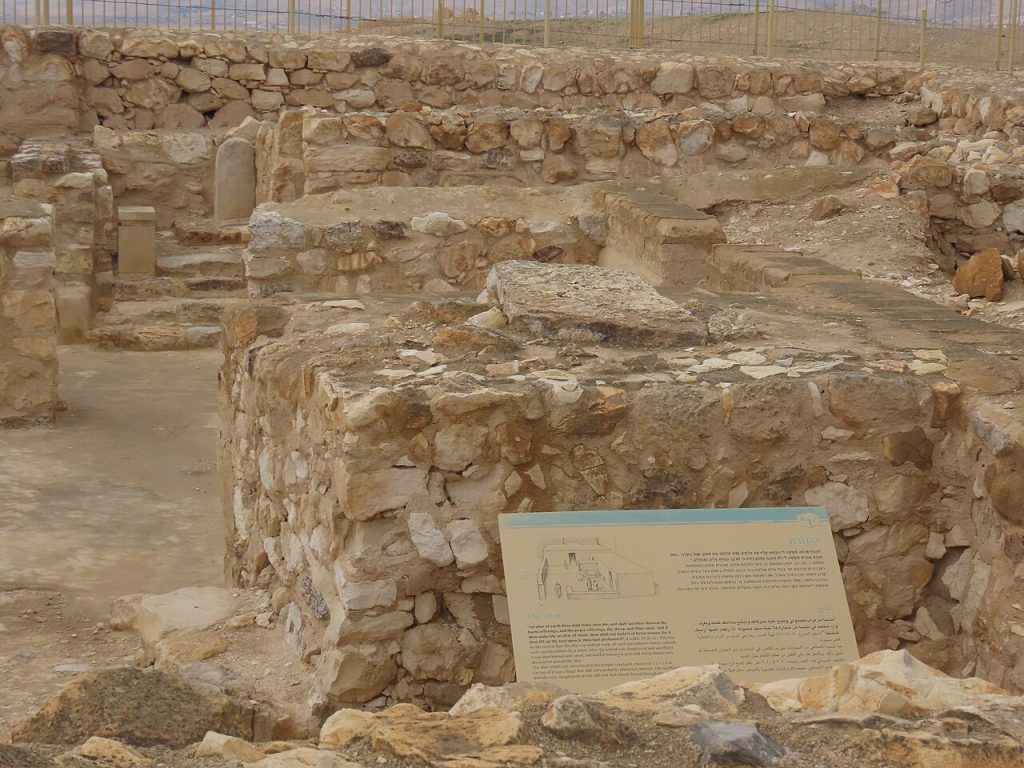
The different sizes make it possible to appreciate how worship involved several spaces and kinds of furniture. The courtyard altar occupied an open area and was built into the architecture. The paired objects had small depressions on top and could be moved. The steps concentrated attention on the inner room. In a photograph the upright stone naturally attracts the eye, but the archaeologists found a limestone slab fallen flat, with traces of red pigment. The placement visible today is a reconstruction. Aharoni thought a separate flint slab also belonged in the display. Its original function and position are less certain, and the stones carry no secure labels identifying whom they represented. Find positions and discussion of the museum display in the residue study
There were also two stone pavements at different heights in the small chamber. The earlier floor extended through much of the room, and a shallow basin was set into it toward the back. The later arrangement changed how this space was used or presented. An excavation can show one floor resting over another and establish which came first. Putting a date on each change usually takes evidence elsewhere in the building. The overlapping pavements also explain why a reconstruction can be helpful even when it combines materials from more than one moment in the room’s history. It lets us see the furniture and the steps together while the excavation record tells us where the pieces came from. Residue study, description of the pavements and original museum installation
The broad sequence from court to hall to inner room brings the language of 1 Kings 6 to mind, where the account of Solomon’s temple gives special attention to its innermost sanctuary. The size, proportions, and furniture at Arad belong to its own building. The comparison makes the idea of an inner chamber more concrete and shows why archaeologists compare plans across sites. It can help them identify a kind of room. It cannot supply the names of the people who entered it, their rites, or the dedication of the building.
What survived on two limestone altars
Excavation photographs recorded the two altars lying on the same stair, with their tops oriented in the same direction. That is an unusual detail. The museum display stands them upright so a visitor can see their intended form. In the original context, their placement suggested to the researchers that someone had laid them down carefully. The dark material adhered to the shallow depressions on top. An early scientific examination did not settle what the material was. The preservation of the stones and their recorded findspots left something that later researchers could sample and interpret together. Excavation photographs and early sampling history, pp. 7–10
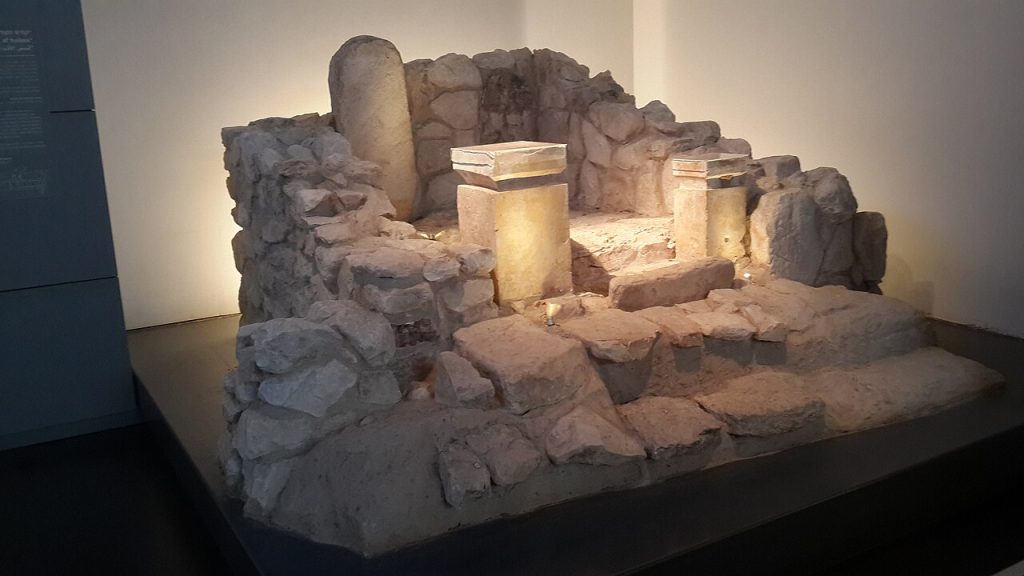
In 2020 Eran Arie, Baruch Rosen, and Dvory Namdar published the results of work using gas chromatography and mass spectrometry. In simple terms, the researchers separated compounds in the samples and used their characteristic chemical signals to identify them. They sampled the altars on separate occasions and used two laboratories. The larger altar yielded compounds characteristic of frankincense resin. On the smaller one they detected several compounds associated with cannabis. Those findings address what was present in the residue. They give substance to an aspect of ancient worship that does not often survive in an archaeological record dominated by stone and pottery. Published residue analysis and discussion
Frankincense appears in the biblical instructions for sacred incense in Exodus 30:34–38. Its presence on a Judahite altar makes the material behind that passage easier to imagine. A chemical trace of frankincense by itself gives no indication that the full biblical mixture was used here. The separate cannabis residue is evidence of a practice at this place. It gives no basis to read that substance into the Exodus instructions, or to assume that it was a feature of public worship in Jerusalem. Both lines of evidence gain value when we keep their scale in view. Exodus gives an instruction for worship. The altars preserve traces of what people set on them at one stage in their use.
The shrine gives us a rare chance to see where Judahites worshiped and recover something they used there. Scripture gives us the measure by which their worship was judged.
Did Hezekiah close the sanctuary?
Archaeologists working at Arad give a different Roman numeral to each major stage of occupation on the mound. Aharoni initially interpreted the sanctuary as a much longer-lived building. Ze’ev Herzog revisited the excavation records and reassigned it to Strata X and IX. With the pottery sequence studied by Lily Singer-Avitz, this reconstruction puts the shrine’s use roughly between 760 or 750 BC and 715 BC. In that reading, walls and floors belonging to the next fortress phase covered parts of the former worship area. The dates are scholarly estimates tied to pottery and architecture. Neither the altars nor the walls carry a date fixing the year the sanctuary closed. Herzog’s interim report and revised fortress sequence and Herzog’s summary of the reform argument
The case for deliberate retirement brings together several clues. The altars seem to have been set aside carefully. The inner chamber and parts of the complex were covered by later work. The fort remained a place of activity and its subsequent occupants did not restore the shrine in the same spot. On Herzog’s reconstruction the change precedes the horizon commonly associated with Sennacherib’s 701 BC campaign. Those clues make a planned closure worth considering. They also explain why some scholars bring Arad into the same discussion as the dismantled horned altar at Beersheba. Israel Nature and Parks Authority on the preserved shrine and closure and Herzog’s comparison with Beersheba
Nadav Na’aman disputes the assignment of some of the relevant remains to the earlier phase. On his reading, laying aside the paired altars and the end of activity in the sanctuary could belong to different moments. The resulting disagreement is about which walls and floors were in use at the same time, and how to account for the end of that use. 2 Kings 18:4 records that Hezekiah removed high places and broke standing stones. Arad is a plausible case to consider alongside that passage. Its archaeology gives us no written order naming the king who closed the shrine. 2 Kings 23 records another reform under Josiah many decades later, a reminder that the chronology of a particular site matters. Na’aman’s statement of the stratigraphic disagreement, note 3
Reading Arad alongside Scripture
Deuteronomy 12 tells Israel to seek the place the Lord would choose and bring its sacrifices there. In 2 Kings 18 the Assyrian spokesman brings Hezekiah’s reforms into his taunt to Jerusalem. He treats removing local places of worship as though it offended the very God in whom the king trusted. The narrator has already praised Hezekiah for trusting and obeying the Lord. The contrast within the chapter shows how differently the same decisions could be understood. For a person accustomed to worshiping near a garrison or a town, a demand to turn to Jerusalem would carry immediate consequences. Arad helps make that possibility tangible. We can see how the removal of arrangements people had used could change the life of a community.
In 2 Chronicles 29–31, the reforms also involve opening and repairing the doors of the Jerusalem temple, restoring its service, and inviting people to celebrate Passover. The record includes what was put back in order as well as what was removed. That fuller picture is worth keeping in mind when viewing an excavated place of worship whose installations were left behind. The remains at a site such as Arad can help us imagine the local change a reform might bring. Chronicles directs attention to the worship to which Hezekiah was calling the people.
The fortress preserves other kinds of evidence as well. Its military ostraca give readers a view of life through inked orders and accounts, several of them from a later phase. The shrine gives a view through floors, stairs, and objects whose uses have to be inferred. Our guide to why an artifact’s findspot matters explains why an altar in the museum and its excavated position on a stair each contribute something different. Put those records together and the surroundings of biblical Judah come into sharper focus. A small sanctuary and the remains of what people burned there bring an otherwise little-known place into view. Scripture explains why it mattered where and how the people worshiped.
Sources and further reading
- Yohanan Aharoni, Excavations at Tel Arad: Preliminary Report on the Second Season, 1963 (1967) — Primary discovery report for the inner chamber and its furnishings, especially pp. 247–249.
- Ze’ev Herzog, The Fortress Mound at Tel Arad: An Interim Report (2002) — Revised fortress stratum sequence and the architectural context and end of use of the shrine.
- Eran Arie, Baruch Rosen, and Dvory Namdar, Cannabis and Frankincense at the Judahite Shrine of Arad (2020) — Original chemical study, with find photographs, display history, and full discussion of sampling and results.
- Nadav Na’aman, New Light on Six Inscriptions from Arad (2021) — See note 3 for his disagreement with Herzog’s attribution of the shrine’s closure to Stratum IX.
- Ze’ev Herzog, The Cult Reform in the Kingdom of Judah — Researcher’s overview of Arad and Beersheba, citing the evidence both for and against an eighth-century BC reform connection.
- The Shelby White and Leon Levy Program, The Fortress Mound at Tel Arad — Excavation and final-publication project record.
- Israel Nature and Parks Authority, Tel Arad National Park — Site orientation, preserved shrine, and distinction from the lower Early Bronze Age remains.