Someone pressed a line of letters into the shoulder of a storage jar while the clay was still soft. The jar broke, much of the writing fell into pieces, and the fragments lay on a floor at Khirbet Qeiyafa for roughly three thousand years. When archaeologists reassembled them, one name was clear enough to read beside his father’s. Their edition gives the words as Eshbaal son of Beda. The first name was already familiar from Scripture. The father’s name distinguishes this Eshbaal from Saul’s son. The find gives us something unusual in its own right, a legible name from this period on a container that someone had to make, fire and put to use. Garfinkel, Golub, Misgav and Ganor’s edition of the inscription.
Key takeaways
- Archaeologists found the jar in 2012 in Building C11 at Khirbet Qeiyafa, a fortified site overlooking the Elah Valley region.
- The inscription was cut into the clay before firing. It names Eshbaal son of Beda, following an opening word that is too damaged to complete.
- The excavators date the relevant occupation around the turn of the first millennium BC using radiocarbon and the site’s archaeological sequence.
- Chronicles names another Eshbaal, the son of Saul. The jar preserves the same personal name for a different individual living in the broader period of the early monarchy.
Where the pieces came from
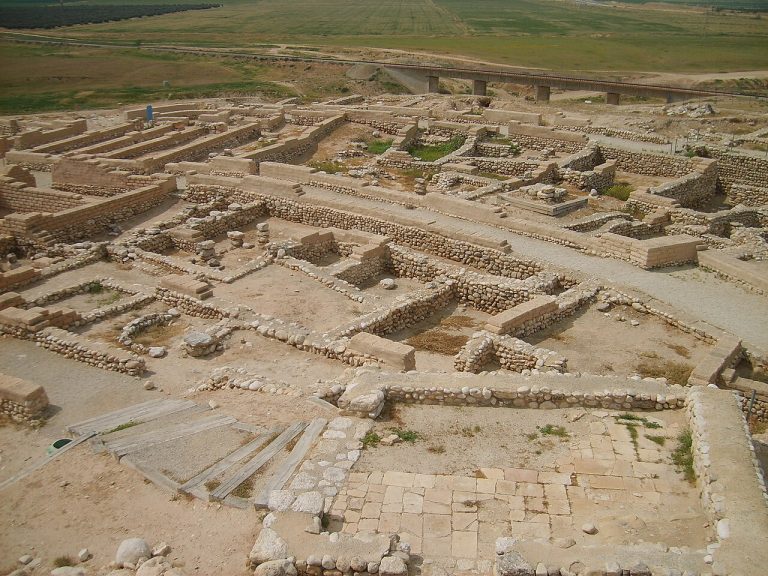
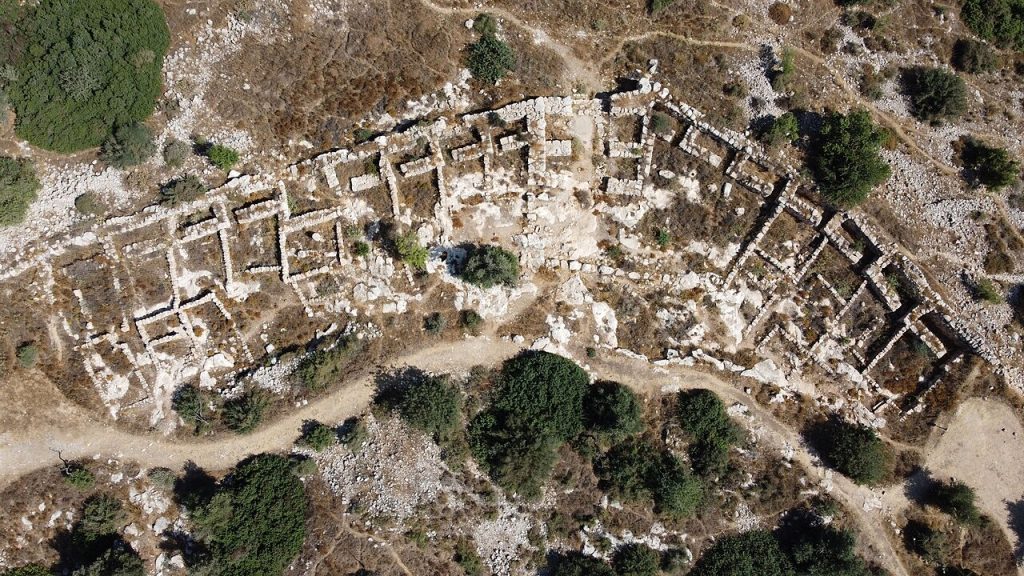
Khirbet Qeiyafa lies in the foothills southwest of Jerusalem, near the Elah Valley. A system of excavated buildings, gates and fortifications makes the Iron Age occupation unusually visible on a hill that saw activity in much later periods too. The authors can say where this jar lay because the fragments were excavated in place in Area C. They came from the northeastern corner of a room in Building C11. The same room had other pottery and installations. The published plan and photographs distinguish the find’s location from the name of the site as a whole. That is valuable evidence for a vessel with a short, personal inscription. Excavation context, maps and figures 2–5.
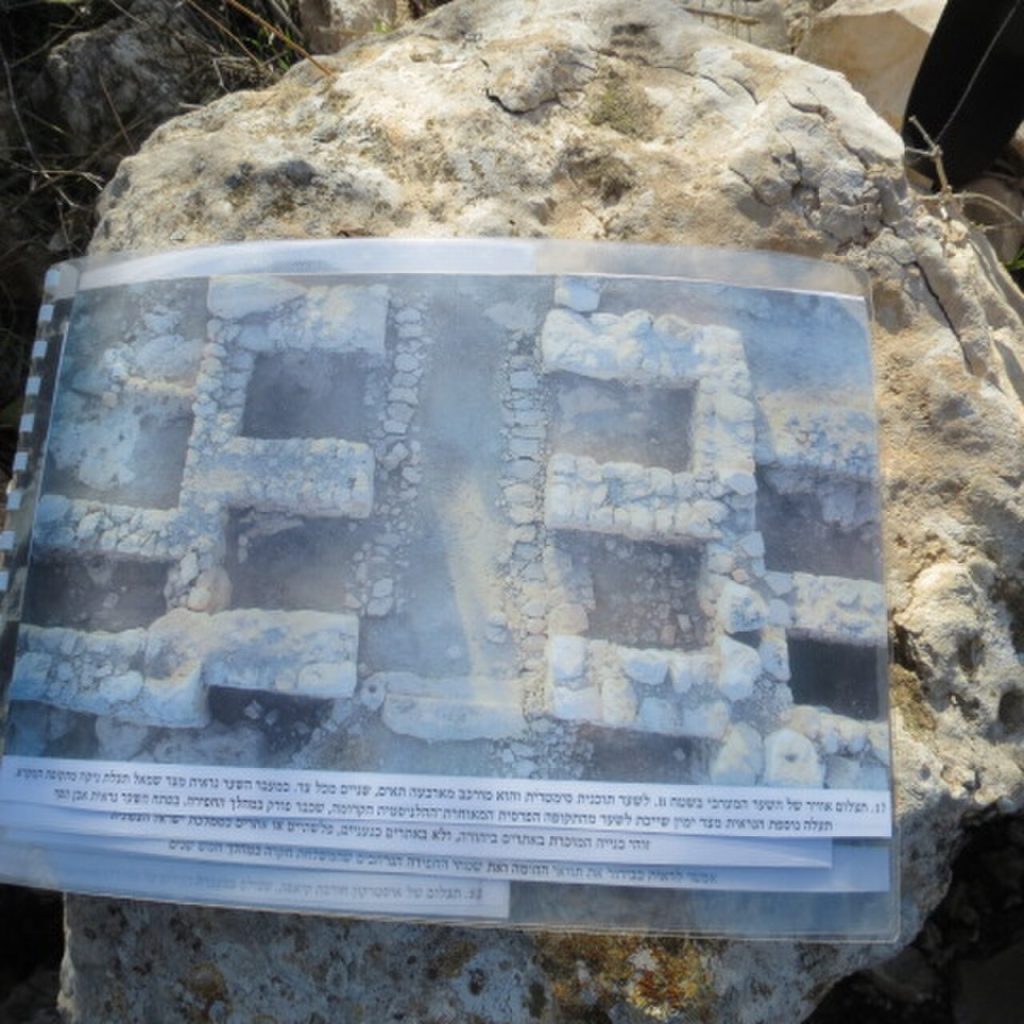
The finds in Building C11 can be read against its ground plan. The jar fragments lay in the part the excavators called Room B, a space about six by five meters. There was a hearth near its center, and the team found no pillar bases. Those observations led the excavators to consider whether the space had been an open courtyard. It contained several vessels that could be restored, and a heavy stone collapse covered the floor. This is more informative than finding a name loose in the soil. The broken jar lay within an arrangement of walls and other objects that helps reconstruct where storage and domestic work took place. Room B, the floor deposits and related finds.
The team recognized writing on some of the pottery in the field and sifted the sediment from the room to recover even small pieces. Later, researchers could spread the pieces out and look for joins. The result is a reassembled vessel with some original areas and some losses. The published account includes a photograph of restoration in progress, a restored view, a three-dimensional record, and drawings that make letter shapes and dividers easier to follow. Each representation tells the reader something. A view of the full jar shows where the marks sit relative to the handle and neck. A close photograph lets you look across a join and decide how much of a stroke survives. Figures 8–17 in the first detailed publication.
The recovery method matters because a few missing pieces can change how much a label says. A sherd with two letters on it might be impossible to understand in isolation. Three pieces fitted together can reveal the length of a word and its relation to the next name. A join also shows whether marks that might look random belong to the same curved surface. The Eshbaal reading is built from a part of the jar that could be reconstructed in this way. Broken or missing clay still limits the reading of the opening word, even though the personal name and its patronymic are recognizable. Hebrew University excavation project photographs and drawings.
How to read the inscription
The editors transliterate the surviving name phrase as ʾšbʿl bn bdʿ. The middle word, bn, is the familiar Semitic expression for “son of.” The surrounding letters name Eshbaal and his father Beda. The line reads from right to left, and short vertical marks divide its words. The report describes letters of comparatively even size and spacing. An ordinary storage vessel thus preserves a distinctive example of someone preparing a readable text for use on an object. The style is described as Canaanite alphabetic script in the excavation report. That describes the writing system and leaves other historical questions to the context. Epigraphic reading and letter-by-letter discussion.
- Find the shoulder of the jar. That is where the line runs in the project’s close photographs.
- Look for vertical dividers. They separate the personal name, the words for the father’s name, and the damaged material to one side.
- Notice the incomplete opening. The surviving marks prompted suggestions about a place name or the contents, with too little preserved for a secure restoration.
The damaged word is one reason the jar’s purpose is still open. The excavators compare later jars that give a place before a name, which could suggest a place or estate connected with Eshbaal. They also consider a description of the vessel’s contents or use. Each interpretation needs letters the fragments no longer supply. We can say that someone intended a name to be readable on a storage container, and that the act of labeling took place before the firing made the letters permanent. The inscription gives no certain crop, occupation or administrative office for Eshbaal. The proposed readings of the incomplete opening.
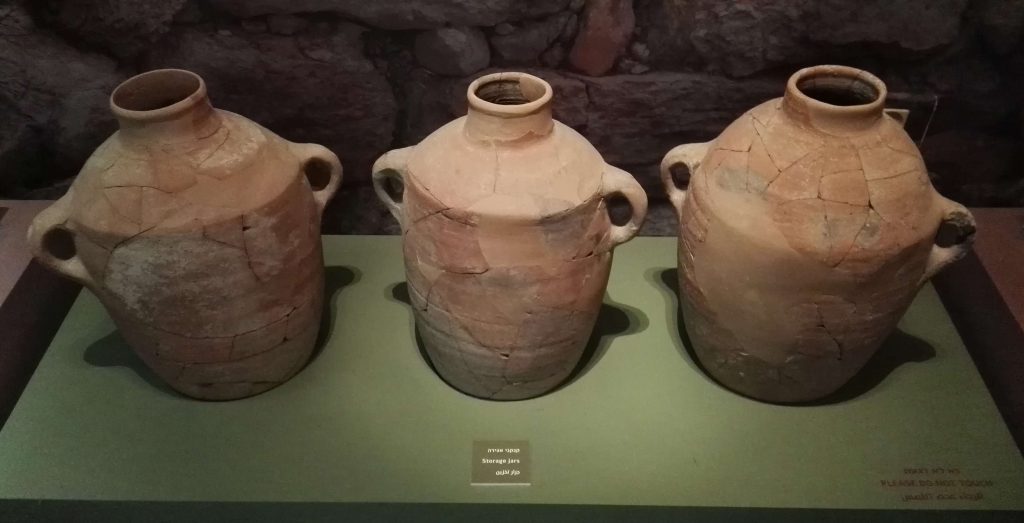
The other well-known Qeiyafa text is a different discovery. The Khirbet Qeiyafa ostracon was found in 2008 in Area B and carries traces of letters in ink. The Eshbaal name appears on a storage jar from Area C, written before firing. The methods for seeing and reading the two objects therefore differ. The ink on the ostracon can be hard to recover where it has faded. The incision on the jar is easier to see where original clay survives, while the broken beginning remains difficult. Taken together, the two finds attest to more than one way people used the alphabet at the settlement. Comparison with the 2008 ostracon.
A familiar biblical name survived here because someone needed to write it on the shoulder of a jar.
When the jar was made and used
The date assigned to the inscription starts with its archaeological setting. The excavation team’s first radiocarbon program used burned olive pits from the occupation and gave a range of roughly 1020–980 BC for the end of the Iron Age city. A second study tested material from another jar and gave a somewhat later estimate, with the first half of the tenth century important to its interpretation. In either case the organic material and the jar inscription are different evidence. The radiocarbon tests help place the history of the settlement and its final use. The incised letters were already on the jar by the time it was fired and used there. The excavation team’s second radiocarbon study.
The date ranges can be made more explicit. The first radiocarbon program used ten determinations, while the second investigated olive pits from a single vessel in the settlement. In their discussion of the jar the authors report that an estimate using both datasets placed the end of the occupation at 1006–970 BC at a stated 68.2 percent probability. This range is the result of calibration and modeling for the end of an archaeological phase. The computation uses material from a particular context and assumptions about how that context relates to the settlement’s sequence. A date for the vessel is inferred from its relationship to the relevant occupation and the floor on which the pieces lay. Primary radiocarbon study and calibration methods.
Israel Finkelstein and Eli Piasetzky asked how the site should be dated within a longer regional sequence. Their model used nearby sites as well and favored a date farther into the tenth century than the excavators’ initial estimate. Scholars also disagree about which political community controlled the settlement, with the excavators favoring Judah and other studies pointing to northern material connections. A date range is more defensible than assigning a year or a king’s reign to an individual object. The jar has special value because its physical context is known regardless of how the site’s wider political affiliation is resolved. Finkelstein and Piasetzky’s regional radiocarbon model. Fantalkin and Finkelstein’s study of territorial affiliation.
The biblical geography is firmer at the level of the valley. First Samuel 17 locates the armies of Saul and the Philistines in the region around Socoh and Azekah and describes the Israelites in the Elah Valley. Qeiyafa helps readers picture the foothill landscape in which the account is set. It is an excavated site with a remarkable position in that landscape. Identifying any individual wall or artifact with an episode of the narrative would require a separate argument. The topography, the settlement and the personal name on the jar all contribute different kinds of historical context for reading the Bible. 1 Samuel 17:1–11.
Eshbaal in Chronicles and Samuel
The genealogy in 1 Chronicles 8 lists Eshbaal among the sons of Saul, and the next chapter repeats the family list. In 2 Samuel 2, Abner installs a son of Saul named Ish-bosheth as king over much of Israel, while David is reigning in Judah. The books give two forms of the royal son’s name. One explanation is that the element baal was replaced in one form by bosheth, a word meaning shame. The report discusses this alongside comparable pairs of biblical names. The jar’s father’s name is Beda, whereas the king’s father in these accounts is Saul. That detail is precisely what makes the archaeological comparison possible without confusing the two people. 1 Chronicles 8:29–34; 1 Chronicles 9:35–40; 2 Samuel 2:8–11.
Second Samuel follows Ish-bosheth’s story through the conflict between Abner and the house of Saul and then to Ish-bosheth’s murder. David refuses to treat the murder as an acceptable way to advance his own reign and condemns the men who bring him the news. This is the narrative in which readers encounter the alternate name. Chronicles puts it to another use by recording Saul’s family line and continuing with Jonathan’s descendants. The different settings explain why a person reading only one book might remember only one form of the name. With the jar beside them, the biblical passages become part of a wider comparison of how names were used and transmitted. 2 Samuel 3–4 and 1 Chronicles 8.
Names can outlast changes in the way people understand the words inside them. The edition of the inscription discusses both the use of Baal for a deity and the broader sense of lord or master. It also considers more than one possible way of vocalizing and interpreting the name, since the old inscription gives consonants. A personal name can tell us what vocabulary was available to a community. By itself it leaves the worship, convictions and life of the man on the jar unknown. For Christians who trust the biblical account, the excitement of the find lies in seeing a name Scripture records repeated in the physical life of the period. Discussion of the name and its possible meanings.
Frequently asked questions
Is this the jar of Saul’s son?
The inscription names Eshbaal son of Beda. Chronicles names Eshbaal son of Saul. The patronymic, or father’s name, distinguishes the two. Published inscription.
Was the lettering painted on the jar?
The archaeological study describes an inscription incised on the shoulder before firing. The other, earlier inscription from the site was written in ink on an ostracon. Technical descriptions of the two finds.
Where can I see the reconstruction and read the letters?
The excavation project displays photographs and drawings. Compare the reconstructed jar with the close photograph, then look for the dividers and the damaged first word. Hebrew University images of the Eshbaal jar.
Sources and further reading
- Garfinkel, Golub, Misgav and Ganor, The ʾIšbaʿal Inscription from Khirbet Qeiyafa — Primary publication in BASOR 373 with analysis of the context, writing, dates and names.
- Primary publication, full illustrated text — Excavation plans, restoration photographs, readings and discussion.
- Hebrew University, The Eshbaal Inscription — Excavation project photographs and drawings of the actual artifact.
- Hebrew University, Eshbaal Inscription — Excavation project summary and bibliography.
- Garfinkel and colleagues, Results of the Second Radiocarbon Dating Project — Primary laboratory and archaeological study of samples from Khirbet Qeiyafa.
- Finkelstein and Piasetzky, Radiocarbon Dating Khirbet Qeiyafa — Alternative regional treatment of the chronometric evidence.
- Fantalkin and Finkelstein, Date of Abandonment and Territorial Affiliation — Study of disputed chronology and territorial affiliation.