A piece of a shallow bowl at Tell es-Safi has a line of letters scratched into its outer surface. The sherd was recovered in 2005, during excavations at the mound widely identified as Gath. The letters are an early form of the alphabet shared among communities in the region. But the people who published the inscription proposed that the two names it preserves came from a different linguistic tradition. That combination drew attention because the Bible calls Goliath a man of Gath. The sherd deserves a close look for what it tells us about names in a Philistine city and for the difference between a linguistic comparison and identifying a person. Primary publication of the Gath inscription
Key takeaways
- An expedition directed by Aren Maeir excavated the inscribed bowl fragment at Tell es-Safi in 2005. Its archaeological setting is near the transition from Iron Age I to Iron Age II.
- The authors propose two personal names in a local alphabetic script. The second reaches a broken edge and may be incomplete.
- Names from Gath can illuminate the setting of the Goliath account. The spelling on the sherd differs from Goliath’s biblical name, and the proposed linguistic relationship remains uncertain.
The site and the layer that held the sherd
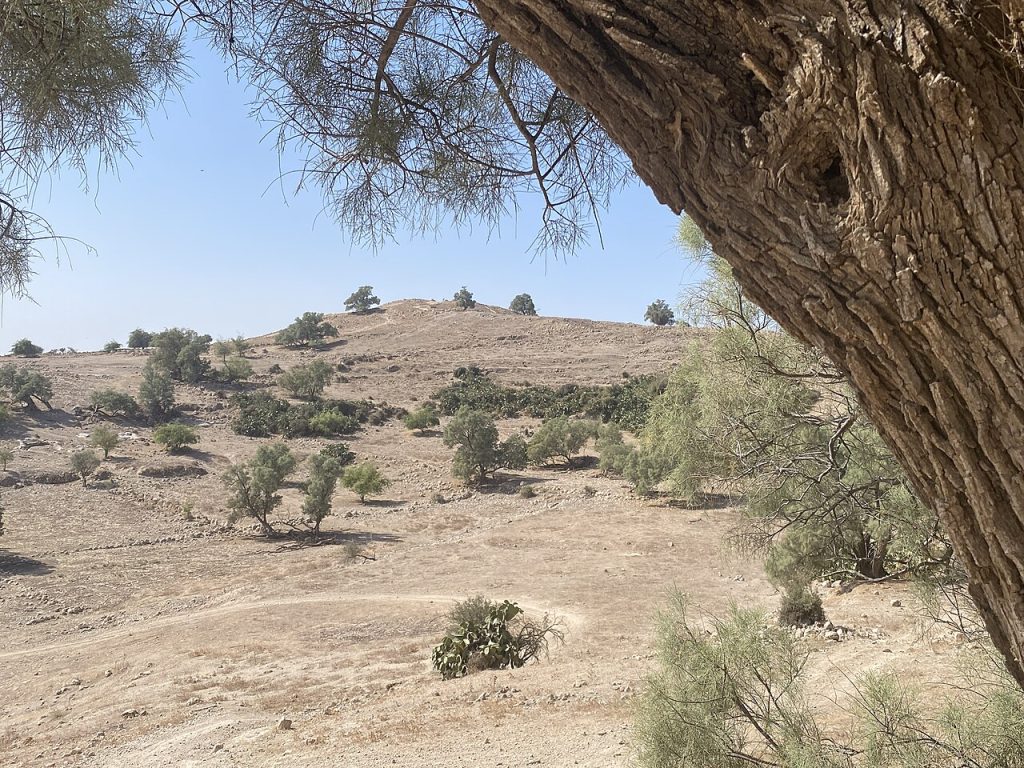
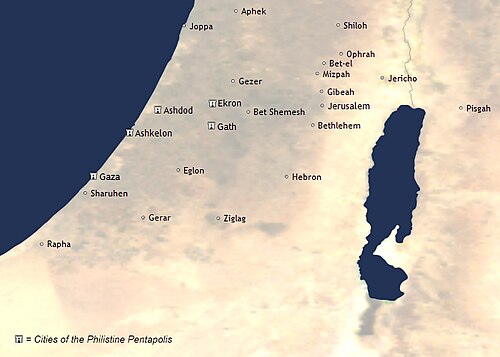
Tell es-Safi rises near the point where the hills of the Shephelah descend toward the coastal plain. It has deposits from many periods and a long history after its occupation by the Philistines. Identifying Gath with the site gives readers a place to put the city they find in Joshua and Samuel. Joshua 13 groups Gath with Gaza, Ashdod, Ashkelon, and Ekron. The cluster helps orient us. Gath was an inland center compared with several of the other cities. People moving from it toward the hill country or toward the coast would have been moving through very different landscapes. The expedition’s overview of Tell es-Safi · Joshua 13:1–3
The particular sherd came from Area A, on the eastern part of the site, in an excavated layer with other pottery. That helps establish its time and place more securely than if it had surfaced without any record of where it came from. A field team can identify the pieces found nearby, plot their relationship to buildings or surfaces, and compare the pottery as a group. This fragment was recovered from occupation debris, so its findspot is the last place the bowl fragment came to rest. It could have been made, used, broken, and moved before it reached that position. Primary study, Area A context and plans
The site plan helps us follow the report in greater detail. The team ties the fragment to a numbered excavation square and to a layer that contained other pieces of bowls and vessels. On the ground those details look like a small patch of loose material among walls and floors. On paper, the numbered units allow another researcher to check which finds the excavators compared. They also help distinguish this evidence from later buildings elsewhere on the mound. There were many generations of people at Gath, so a broad description of the site would give us far too much material to date a single fragment. Primary report, figure 2 and excavation account
The excavators place it around the late Iron Age I and early Iron Age IIA. Their study discussed more than one calendar range because researchers align regional ceramic sequences with absolute years in different ways. The expedition’s announcement gave a broad tenth- to early ninth-century range. The full study compares the pottery of the layer with other assemblages, and it allows a somewhat wider range when different dating systems are used. A description at the level of an archaeological phase is stronger here than an attempt to put the inscription in a particular year or to date it a precise number of years after David. Expedition discussion of the date · Dating analysis in the primary study
The date of a sherd involves more than the day its letters were cut. Pottery types change over time, and the range for the type of bowl belongs to its manufacture and use. Excavated debris belongs to the period in which it accumulated. The people who published this find saw that the letters cut through the bowl’s red coating, so they were added after firing. They also considered whether someone wrote on a complete bowl or used a broken piece as a writing surface. The fragment alone leaves that question open. For readers studying the process, the close-up photograph and profile drawings show the few details on which those possibilities rest. Figures 7–9, original sherd and proposed drawing
Two names in a local alphabet
The scratches are faint. The authors study the strokes at different angles and compare their shapes with other early letters from the region. They read a first group of consonants usually represented in English transliteration as ʾlwt. They read the beginning of the second as wl, with a possible further letter near the break. Early reports offered a longer second form and later discussion distinguished more clearly between the readable letters and the uncertainty at the edge. Many of the sounds that speakers might have heard have no direct vowel markings on this piece. Renderings that present full vowels already involve interpretation. Letter-by-letter reading in the primary study
An unusual mark can complicate even the first step in reading such a short text. The authors describe initially entertaining an additional letter near the beginning. When they examined the fragment under magnification, they judged the apparent stroke to be a trace of dirt. They also considered how to orient the piece and what would count as a plausible letter in the surrounding alphabet. Those small judgments tell us what kind of evidence a published transcription represents. The letters proposed by an editor are a record of observations and comparisons. A clean drawing is useful precisely because readers can consult the artifact photograph and see which marks led to the drawing. Primary report, identification of the signs
The authors interpret the groups as personal names. That is a reading of the surviving letters rather than a complete sentence about the people who bore them. They consider various possibilities for the names’ linguistic background, including comparisons with names attested in the Aegean and Anatolia. The local alphabet does not require that those names have originated in a local Semitic language. A person in Gath could use signs learned in the region to write a name brought into use through other cultural ties. This is one reason the find matters even before the Bible enters the discussion. The sherd preserves an early practice of writing in a Philistine setting. The authors’ discussion of script and naming
This literacy also puts a local object into the history of contact across the southern Levant. A bowl that was made and used in one place can reflect choices quite different from those conveyed by a royal dedication or a list of imports. Here someone used an everyday object and a script increasingly at home in the region. If the names reached Gath through wider Mediterranean ties, the scratches offer a glimpse of how such a tradition could persist alongside a local way of writing. It is an observation about the use of script and names, with no need to make a claim about any one person’s ancestry. The study’s conclusions on naming and script
How strong is the comparison with Goliath?
The first announcement drew attention to the broad resemblance between the forms and names previously compared with Goliath. The full study asks readers to distinguish those steps. One of the suggested comparisons for the first name is the Anatolian name usually represented as Alyattes. That comparison can be considered without assuming that Alyattes and Goliath have the same origin. The authors of the study caution against making the derivation on the available phonetic evidence. Goliath’s biblical spelling has different consonants. Others may still consider possibilities for names changing across languages. The historical value here is what the sherd gives directly, examples of names in use in the city where Samuel places Goliath’s home. Primary study, section on Anatolian parallels and conclusion
A name can help us hear the language of a place even when the person who wrote it has left us no story.
What Samuel tells us about Gath
First Samuel 17 gives Goliath’s home as Gath and places the confrontation with David in the Valley of Elah. Keeping the places straight helps us read the archaeology honestly. The sherd speaks to what was written at Gath, while Samuel narrates what happened at the assembly of the two armies. Samuel returns to Gath later, when David flees to Achish and when he seeks refuge there with his men. Those passages give the city a life beyond the birthplace of one champion. It was a place where Israel’s future king could be recognized, encounter a local ruler, and seek protection on a later occasion. Gath in 1 Samuel
The archaeological and biblical records can be read together with three details in view.
- The place is the point of contact. Tell es-Safi offers physical evidence from the city widely identified with Gath.
- The script gives examples of local alphabetic writing, which could be used to record names from different linguistic traditions.
- The person is named and described in Samuel. The sherd preserves different names and does not describe the encounter with David.
As Christians, we trust the history Scripture gives. David’s words in 1 Samuel 17 are important because they explain how he faced a threat other men were trained to assess in military terms. David recognized that Israel’s safety and God’s honor were at stake, and he credited the Lord with the outcome before the encounter began. This is a public claim set within a real conflict between people in real places. The archaeology of Gath makes it easier to picture the world beyond the single confrontation. Scripture tells us how to understand what David did and whom he trusted. 1 Samuel 17:31–50
The small bowl fragment also gives a way into the wider history of writing. The Gezer Calendar is another early example of the alphabet in the same broad region, with a very different text and use. The Ekron royal inscription comes from another Philistine city centuries later and gives the names of a king and his ancestors within a much fuller dedication. Set beside those finds, the Gath sherd shows how different writing could look depending on who needed it, the object they were using, and the words they meant to preserve.
We have only a little of the bowl and a short run of letters. Yet the material is enough to tell us about handling written names in an Iron Age city, and the excavated context allows that information to enter a larger history. Who made the scratches and what purpose they served remain fair questions. The strongest connection to Scripture is in the setting and the naming practices. Those practices help a reader approach the history of Gath as a history of people whose names, movements, and relationships mattered, as they also do in the books of Samuel.
Sources and further reading
- Aren M. Maeir, Stefan J. Wimmer, Avraham Zukerman, and Aaron Demsky, A Late Iron Age I/Early Iron Age II Old Canaanite Inscription — Primary publication of the sherd, BASOR 351 (2008), pp. 39–71. Figures 7–9 show the bowl profile, close-up photo, and proposed reading.
- Maeir et al., author’s copy of the Gath inscription study — Full research text, including the excavation context and comments on the name Goliath in the conclusion.
- The Tell es-Safi/Gath Archaeological Project, field notice and comments — The excavation director’s discussion of the initial announcement and its limitations.
- Aren M. Maeir, Tell es-Safi/Gath Archaeological Project overview — The expedition’s introduction to the mound and its long archaeology.
- 1 Samuel 17 — Goliath’s origin at Gath and David’s account of whom he trusts in the battle.
- Joshua 13 and 1 Samuel 21 — Gath as one of five Philistine centers and as the city of Achish.





