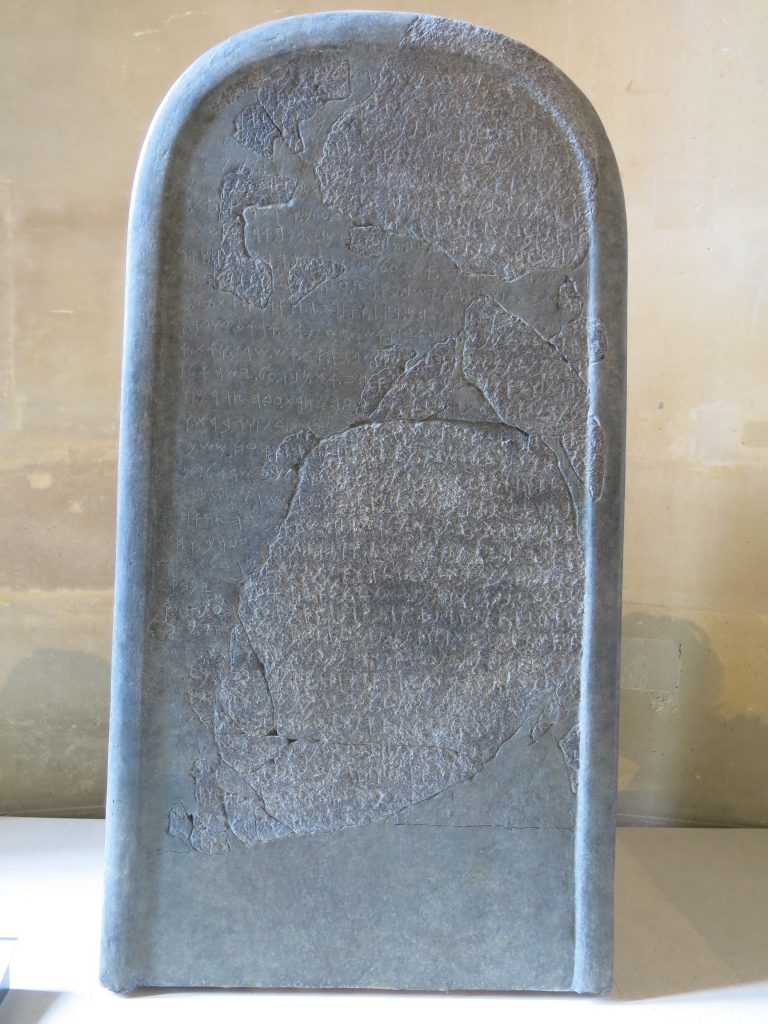
The king of Moab had his own account of breaking away from Israel. Across the face of a black basalt monument, Mesha described how Israel had occupied territory his people claimed and how he recovered it. The names Mesha, Moab, Israel and Omri give the account a point of contact with the Bible. Mesha appears in 2 Kings 3, where his revolt draws the armies of Israel, Judah and Edom into Moab. How much of that encounter can we recognize in the inscription? The answer begins with its names and towns, and it takes some care over events the two ancient authors chose to describe. Louvre collection record · 2 Kings 3.
What you’ll learn
- Why a paper impression became essential to reading a broken basalt monument.
- What Mesha tells us about Israel’s power, Moab’s recovery and the towns they contested.
- How the two ancient records illuminate the revolt and the difficult ending of 2 Kings 3.
The paper that helped save a stone text
In 1868 a missionary, Frederick Augustus Klein, saw the monument at Dhiban, the site of ancient Dibon east of the Dead Sea in present-day Jordan. Negotiations over the stone followed. During the following year Yaqoub Karakava, working in connection with the French scholar and diplomat Charles Clermont-Ganneau, made a paper impression. The stone subsequently broke into pieces. Recovery of many fragments and the survival of the impression made it possible to assemble and read much of the inscription. The Louvre keeps the assembled monument and records additional fragments and the impression as related objects. The pieces have their own separate histories in the collection. Collège de France, Mesha exhibition and original impression · Louvre, related objects.
A paper impression is often called a squeeze. Pressed into the carved surface and allowed to take its shape, the paper retains relief from some of the marks it contacted. A modern researcher can use raking light or digital imaging to study how that relief varies across the surface. An impression made before breakage sometimes preserves the right shape in the right place where the original rock now has a gap. It can also be damaged or hard to read in its own right. A persuasive restoration therefore says whether the proposed letter survives on the rock, on the impression, in both places or chiefly as an inference from the sentence. Michael Langlois on imaging the stone and its squeeze.
At first glance the monument looks like one upright slab with straight lines of lettering. On a closer look, different areas of surface meet at jagged edges. Restored material sits between fragments. A printed translation can appear as continuous as the mounted stele. An edition’s brackets are part of the evidence because they tell you where a particular reading depends on reconstruction. The most useful first pass is to read the least damaged passages. They introduce the cast, place the war on the map and show why the king went to the trouble of having his account cut in stone. The disputed letters become easier to evaluate once we know the story in which they appear.
A line can be almost complete in a modern translation while several of its ancient letters remain uncertain.
The king who writes his own victory
The opening introduces Mesha as king of Moab and associates him with Dibon. He puts his accomplishments in a religious setting, crediting his god Chemosh with deliverance. To explain why a Moabite king needed deliverance, he goes back to Omri of Israel. Omri had dominated Moab, Mesha says, and Israel’s grip had continued after him. That starting point helps explain why the revolt in Kings could matter so much to both parties. Israel had an existing relationship to defend. From Dibon, the same relationship could be remembered as foreign control that now had to be broken. Lemaire’s line-numbered translation, lines 1–9.
The account also gives a glimpse of an older political order than the immediate crisis in 2 Kings 3. In 1 Kings 16, Omri buys the hill of Samaria and makes it his capital. His own reign occupies relatively little space in the biblical history. The Moabite text remembers his reach east of the Jordan in far more detail. Compare the Black Obelisk, which shows that the Assyrians also continued to associate Omri’s name with Israel. Kings gives the reader the standards by which it judges Omri, and these records give us two further perspectives on how neighboring rulers remembered the kingdom he led. 1 Kings 16:21–28.
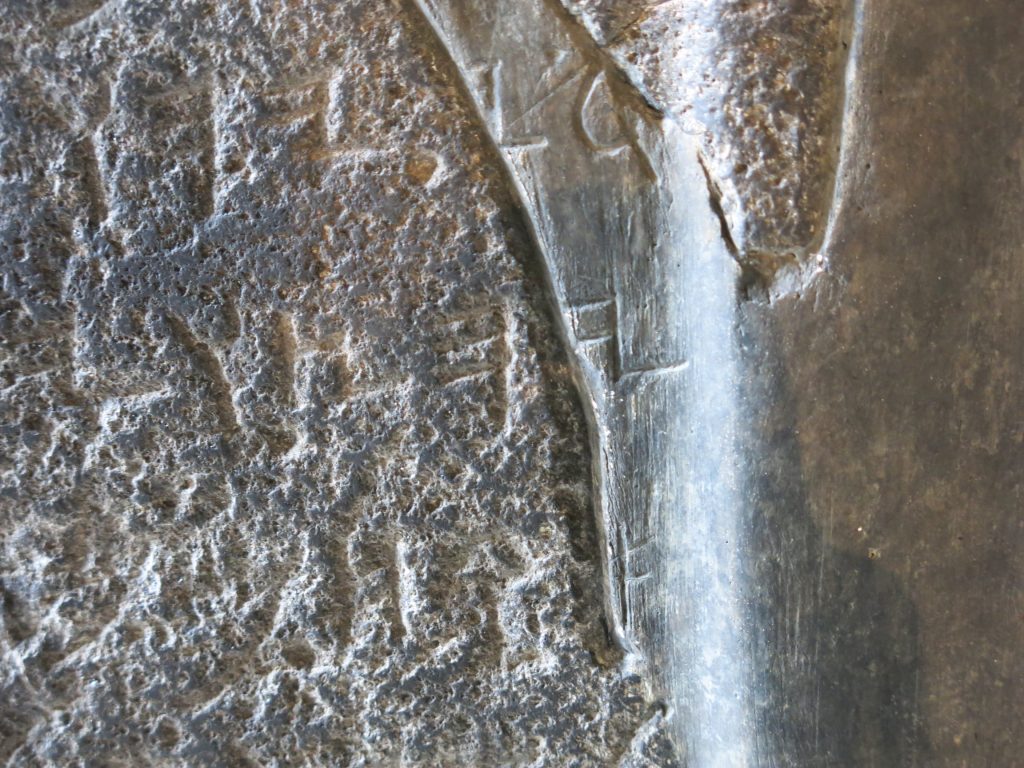
Mesha names Ataroth and Nebo. He links Ataroth to the people of Gad and says the king of Israel had built up the town. He claims to have seized it. He also reports taking Nebo and bringing objects associated with the Lord before Chemosh. These details give substance to the rebellion described in Kings. The contest was about towns people knew, and the appropriation of objects used in worship formed part of the monument’s account of conquest. Look at the photograph below after reading the name in the translation. It connects the translator’s reading with a surviving physical mark, where a modern reader can still see the incisions in the basalt. Translation, lines 10–18.
The later lines give civic works almost as much attention as victories. Mesha credits himself with construction and restoration in several places. Look for gates and walls, and notices about reservoirs or cisterns for holding water. A king explaining what he has achieved expects his audience to care about the condition of towns and the supply of water. After a battle, settlement still has to be made defensible and inhabitable. Many readers encounter Moab first from the perspective of Israel or Judah. Here a Moabite ruler gives us his own list of matters of lasting importance to his kingdom. Translation, lines 21–30.
Read the campaign in 2 Kings 3
The biblical chapter opens with Jehoram, also called Joram, on Israel’s throne. An enormous tribute of lambs and rams’ wool shows what Mesha’s allegiance was worth to Israel. After Ahab’s death, Mesha rebels. Jehoram calls on Jehoshaphat of Judah and leads a joint expedition by way of Edom. On the way they find themselves without water. The story pauses on their dependence before it tells how the army advances. Jehoshaphat asks for a prophet of the Lord, and Elisha is brought into the account. When water arrives, the Moabites mistake its appearance for blood and assume that their enemies have fought each other. Their approach to the camp gives Israel an advantage. 2 Kings 3:1–25.
The offensive reaches Kir-hareseth, and the chapter ends with a horror. Mesha takes the heir to his throne and offers him on the wall, after which there is great wrath against Israel and the coalition withdraws. The narrator leaves the source or mechanism of that wrath open to interpretation. The monument honors Chemosh as Mesha’s patron. Kings frames the campaign through the appeal to the Lord and Elisha’s word, and tells the reader about a costly ending rather than leaving them with an uncomplicated victory recital. The two records differ in the places they emphasize and the course of events each includes. 2 Kings 3:25–27 · Frevel on the geography and the comparison.
A map explains why some popular retellings become confusing. The inscription’s best-known recovery accounts include Ataroth and Nebo in the northern territory Mesha contested with Israel. In Kings the allied army approaches through Edom, from the south. The shared struggle can include different theaters, dates and episodes. Mesha’s monument ranges across his reign and celebrates a series of achievements. Kings follows a particular expedition, giving the actions of Jehoram, Jehoshaphat, Elisha and Mesha space in the narrative. Recognizing that difference in scale lets us compare the sources without asking either to narrate an episode it passes over. Frevel’s comparison of the accounts and regions.
The first and easiest association is personal. Both works know a king named Mesha who ruled Moab, and both remember Israel holding power there before he rebelled. The specific cities and sequence of battles take more work. There is also a difference in the way victory is measured. A coalition can defeat troops and damage towns during a campaign, and a local ruler can claim to have restored his kingdom over a longer period. Kings itself ends with the allies going home. That ending gives the long-term claim of Moabite recovery historical room while leaving open which particular campaigns Mesha selected for his monument. 2 Kings 3 · Mesha’s account.
A disputed line and a well-attested king
Line 31 has drawn attention because André Lemaire proposed a reference to the house of David. Langlois sees new imaging evidence favoring that reading. Finkelstein, Na’aman and Römer challenge it and cautiously propose reading the name Balak in the damaged space. The dispute rests on small marks and how to reconstruct the words around them. Even a persuasive photograph has to be considered alongside the surviving stroke patterns, the paper impression and the length of the proposed expression. The Tel Dan Stele is worth looking at alongside this discussion because its royal-house wording survives in another context and can be assessed on its own evidence. Langlois on line 31 · Finkelstein, Na’aman and Römer’s alternative.
There is ample reason to read the monument even if one sets the debated letters aside. Those who know the Bible will recognize the landscape behind the names and see what some of its stories look like from the opposite bank of the Dead Sea. Numbers 32:37–38 names Nebo among the towns the Reubenites built east of the Jordan. Joshua 13:15–23 includes nearby Dibon in Reuben’s allotment. The passages concern different periods. Read together, they remind us why a short list of names on a page is worth looking up. One familiar name can lead to a community inhabited, fortified and contested over successive generations. Joshua 13:15–23.
As Christians we trust that Scripture tells the truth about the people it names, and placing the story beside Mesha’s words lets us see that he was a ruler with ambitions and territory, a court and a political memory of his own. Next time you read that the king of Moab rebelled, picture Dibon and the neighboring towns. Imagine the difference between a king remembering lost towns, a prophet addressing desperate soldiers and families still needing a place to store water when the armies have gone. The name that opens the stone gives all those perspectives a location and a man to reckon with. The passage in Kings asks us to consider what the king of Moab did at the end of the campaign. The monument, with its pride in war and its concern for water, makes the human setting of that difficult episode easier to picture.
Sources and further reading
- Musée du Louvre, Stèle de Mesha — Collection record AO 5066, material, Diban provenance, ninth-century dating, and associated fragment/squeeze records.
- Collège de France, Mésha et la Bible — Modern discovery, Yaqoub Karakava and the original 1869 impression.
- André Lemaire, Translation of the Mesha Stela — Line-numbered primary text translation. Compare lines 1–9 for Omri, 10–18 for Ataroth and Nebo, 21–30 for civic works and 31 for a proposed restoration.
- Michael Langlois, The Kings, the City and the House of David on the Mesha Stele in Light of New Imaging Techniques — Semitica 61 (2019), pp. 23–47. Imaging and proposal for line 31.
- Israel Finkelstein, Nadav Na’aman and Thomas Römer, Restoring Line 31 in the Mesha Stele — Competing assessment proposing Balak very tentatively.
- Christian Frevel, The Mesha Inscription and Relations with Moab and Edom — Geography, political relationships and comparison with 2 Kings 3.
- 2 Kings 3 — Mesha’s tribute, the southern coalition campaign, Elisha and the withdrawal. Paraphrase used.
- Numbers 32:37–38 — Nebo is named among the towns built by the Reubenites east of the Jordan.




