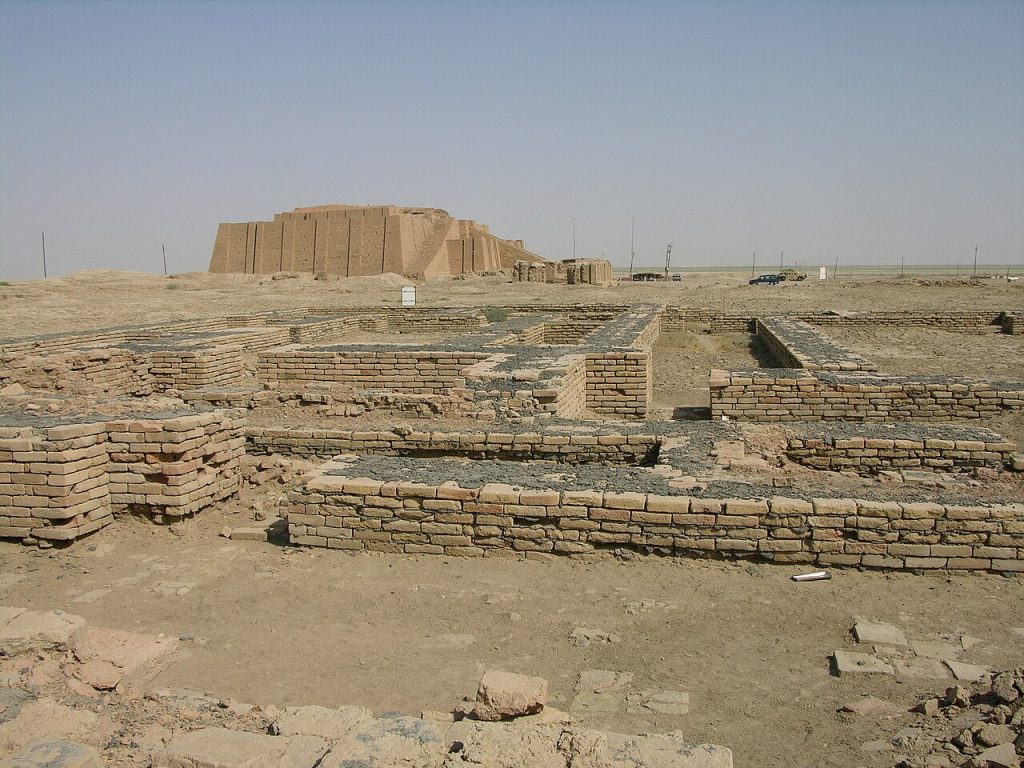
While examining the ruins of Ur in southern Iraq in 1854, J. E. Taylor found inscribed clay cylinders concealed in the masonry of a great stepped temple tower. The writing carried him back to Nabonidus, the last king of independent Babylon, who had repaired the tower some twenty-four centuries earlier. Near the end of his account, Nabonidus prayed for his eldest son. The name is familiar to anyone who has read the story of the handwriting on the wall. It was Belshazzar. Daniel introduces him holding a feast on the night his rule came to an end. In the ruins of Ur, he appears in his father’s own words. Taylor’s excavation report · Translation of the cylinder
Key takeaways
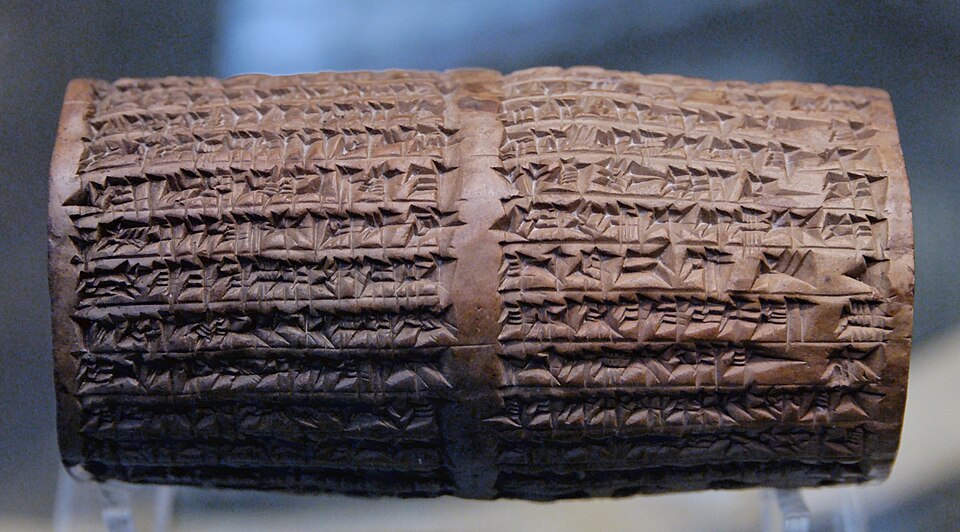
- Taylor uncovered four inscribed cylinders in the masonry of the ziggurat at Ur during his 1854 work. The photograph below shows one of the surviving originals.
- Nabonidus’s inscription identifies Belshazzar as his firstborn son. The Nabonidus Chronicle and the Verse Account help explain how that son came to exercise royal power.
- Daniel calls Belshazzar a king and calls Nebuchadnezzar his father. The documents illuminate Belshazzar’s position, while the exact kinship implied in Daniel remains a question of interpretation.
A document built into a tower
The older spelling Muqeyer in Taylor’s excavation report refers to Tell el-Muqayyar, the site of ancient Ur. At its center stands the ziggurat, a temple tower built in stages that once rose over a major religious precinct. Construction and repair left records as well as walls. The workers in Nabonidus’s time could place written objects inside masonry, beyond the reach of anyone who was simply walking through the complex. Taylor reported finding two cylinders in solid brickwork at two corners. He then sank shafts at the remaining corners and found two more in comparable positions. The depth varied with the uneven state of the ruin. Taylor, pp. 263–265
The clay barrel in the photograph is covered with tightly packed cuneiform, signs impressed into clay with a wedge-shaped stylus. Writing across a curved surface gives a scribe room for a long account that can be held in the hand. Such an object differs from a cylinder seal, whose carved design leaves a repeating impression when rolled over soft clay. The text here is meant to be read from the clay itself. The catalog number, British Museum 91128, ties this photograph to one particular example. The ancient text is also known from other copies, which scholars collate when they prepare modern editions. Object record for BM 91128 · George’s edition
The first part of the inscription looks farther back from Nabonidus to Ur-Nammu and his son Shulgi, rulers from the end of the third millennium BC. Nabonidus says he read earlier inscriptions that showed how the father began the ziggurat and the son completed it. He describes repairing the old structure with bitumen and baked bricks on the earlier foundations. The account reflects the royal claim to have honored the past while renewing a sacred building. Taylor’s own account brings that claim full circle. Nabonidus says he read documents left by former builders. Centuries later Taylor chanced on the documents left by Nabonidus’s builders. Foundation inscription, opening section
The name in the prayer
Nabonidus introduces himself with the title king of Babylon, then recounts his work and addresses Sîn, the moon god worshiped at Ur. He asks for protection from offending the god and for a long life. The prayer for his firstborn follows. Nabonidus asks that Belshazzar revere the god, avoid wrongdoing, and enjoy life. There is no ambiguity about which family the son belongs to in this passage. His father names him as his own offspring. His name occurs because a king preserving the memory of a building project also wanted to preserve the memory of a prayer for his household. Beaulieu’s translation of the closing prayer
It matters where the name occurs. A prayer made in the name of a reigning king is direct evidence that the court recognized Belshazzar as the firstborn son. The prayer never needs to explain the son’s office or how authority was shared at the capital. Its task is to commend him to the deity to whom the works were dedicated. That gives the archaeologist an unusually firm answer to a narrow question. Belshazzar belonged to the last Babylonian royal household, and the very king who commissioned the works identifies their relationship. To follow the son from the household into government, we have to turn to records written for other purposes.
The prince who stayed in Babylonia
The Nabonidus Chronicle gives a year-by-year record of parts of the reign. Its entries place Nabonidus at Tayma, an oasis in northwestern Arabia, while the crown prince, officials, and army were in Akkad, here referring to Babylonia. Compare the entries for the seventh and ninth years. The king did not come to Babylon for the major New Year rites, and the festival was interrupted. Other temple offerings continued. In those lines, the tablet still calls the man at Tayma the king. It gives the man responsible for the officials and troops at home the title of prince. Those terms and duties are both important. Chronicle, column ii
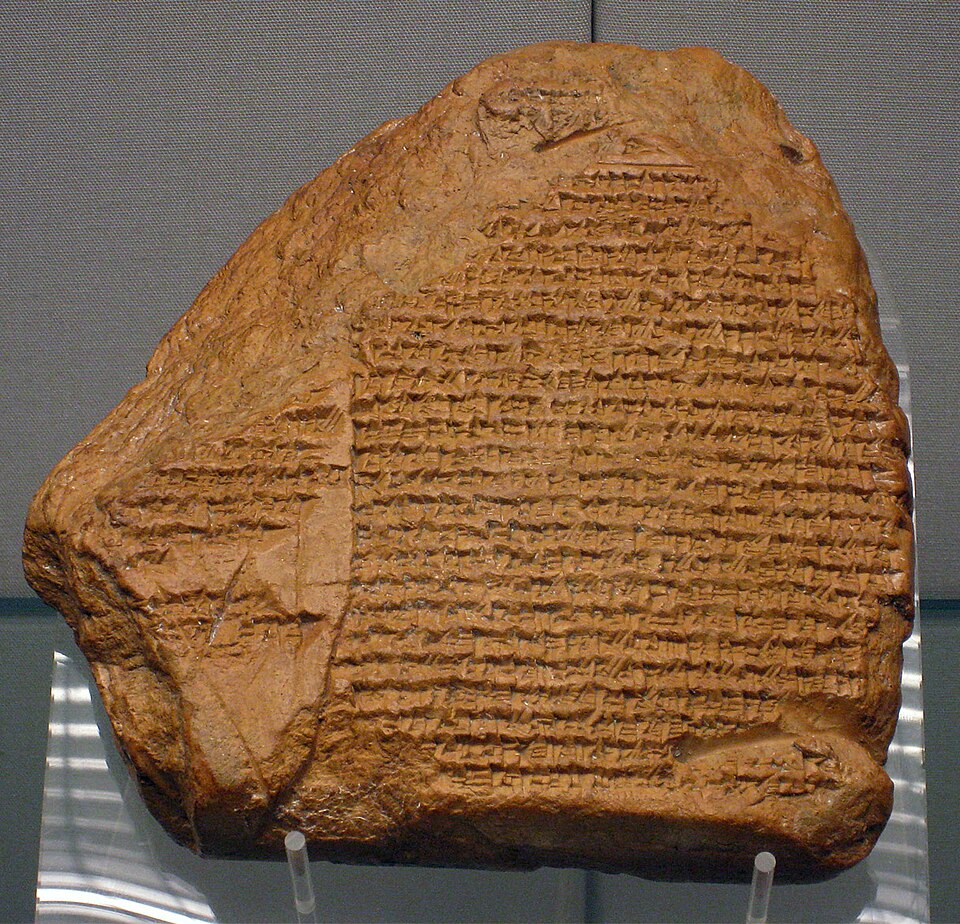
The Verse Account of Nabonidus also describes the delegation. In A. Leo Oppenheim’s translation, the author says that Nabonidus placed troops under his firstborn son’s command and entrusted him with kingship before departing. The poem goes out of its way to discredit Nabonidus. Its account of the handover nevertheless converges with the chronicle’s distinction between the king abroad and the prince at home. In turn, the cylinder supplies the personal name of the firstborn whom the poem leaves unnamed in that passage. The word regent is a useful way to describe the arrangement. The powers could be extensive while Nabonidus retained the formal kingship. Verse Account, column ii
The cylinder gives the prince a name. The other records give us a sense of the authority he carried when his father was away.
Belshazzar at the feast in Daniel 5
Daniel begins the chapter with Belshazzar hosting a banquet on a grand scale. He commands that vessels taken from God’s temple in Jerusalem be brought out so that the company can drink from them. The spoil connects the evening in Babylon with the conquest and exile that the book describes from its first chapter. The king and his guests then praise images made of precious metals, wood, and stone. As fingers appear and write on the palace wall, the feast collapses into fear. The king calls for his experts and can only get an answer when Daniel, a captive from Judah, is brought in. Daniel 5:1–16
Daniel describes Belshazzar as king and dates visions by years of his rule in chapters 7 and 8. Readers have long asked why the royal list and the biblical account describe his standing differently. A reader can take the title in Daniel as describing the authority Belshazzar exercised in Babylon. The court scene depicts him commanding servants, summoning officials, and awarding public honors. Those actions are intelligible in light of the power the Babylonian documents describe. The evidence for that power is stronger than the evidence for a formal coronation or an official second kingship alongside Nabonidus. Shea on the sources for Belshazzar’s rule
Three times in the chapter the promised reward for interpreting the writing is described in terms of being third in the kingdom. One plausible reading sees an opening below Nabonidus and Belshazzar. The prince could confer a high place while the senior king still occupied a rank above him. That makes good sense of a court in which two men held different kinds of royal authority. The story leaves the places above Daniel unspecified, however, and the foundation document supplies no list of ranks. The proposal helps explain the wording and depends on a reconstruction of how those places worked. Daniel 5:7, 16, 29 and translation notes
Why does Daniel call Nebuchadnezzar his father?
Daniel 5 repeatedly connects Belshazzar to Nebuchadnezzar using the Aramaic language of father and son. The cylinder shows that Nabonidus was his biological father. Nebuchadnezzar had ruled Babylon earlier, with several kings intervening before Nabonidus, and Daniel presents Belshazzar as having inherited the royal power and lessons associated with him. Some interpreters understand the kinship language broadly, as referring to an ancestor or royal predecessor. An ancestor reading would require a family connection that the surviving evidence has yet to establish. A broader predecessor reading accounts for the emphasis in the speech on the continuity of royal responsibility. The exact intended relationship is still debated. Daniel 5:2, 11, 13, 18 and translation notes
The comparison within Daniel clarifies what the king ought to have learned. In chapter 4 Nebuchadnezzar had to acknowledge that his kingship depended on God, and he finally blessed the One who rules forever. Daniel reminds Belshazzar of this humiliation and says he knew what had happened. The night’s offense is deliberate. Belshazzar treats the vessels from God’s house as trophies, exalts himself, and gives praise to things that can neither see nor hear. As Christians, we trust the Bible to tell the truth about these rulers and to tell us who gives them their power. Daniel’s confrontation calls us to pay attention to both the man and the warning. Daniel 4:28–37 and 5:18–23
The end of a kingdom
Daniel explains the words on the wall as an announcement that God has numbered the days of Belshazzar’s rule, found him wanting, and divided his kingdom. That same chapter records his death that night. The Babylonian Chronicle describes the Persian advance in 539 BC from a different vantage. It follows the fighting at Opis, the capture of Sippar, and the entry into Babylon by the troops of Cyrus, and it records the capture of Nabonidus. Its surviving lines provide dates and movements. Daniel lets us hear what the end of empire sounded like inside the palace. For the conqueror’s own account of his arrival, continue with the Cyrus Cylinder. Chronicle, column iii · Daniel 5:24–31
Three ancient texts and what to look for
- The cylinder from Ur names Belshazzar and states his relationship to Nabonidus, within a prayer for the royal family.
- The Nabonidus Chronicle places the prince and army in Babylonia while the king stays in Arabia, and gives a sequence for Babylon’s fall.
- The Verse Account describes the prince taking charge of royal responsibilities, in a poem hostile to Nabonidus.
The clay left in the walls at Ur gives us one of the most human details in this story. A father asked on his son’s behalf for a long and worthy life. The son later stands in Daniel as someone who knew the reach of his earthly inheritance and forgot whose hand held his life. We can admire the skill of the scribes, be grateful the ancient builders preserved their writing, and follow the evidence patiently where it leads. The more clearly we see the world Belshazzar ruled, the more pointed Daniel’s address to him becomes. Great responsibility did not make the king beyond judgment. It gave him more reason to humble himself.
Sources and further reading
- Daniel 5 — Biblical account of Belshazzar’s feast, Daniel’s interpretation, and the king’s death.
- CDLI, RINBE 2, Nabonidus 32, example 04 — Catalog record for the Ur cylinder photographed here, British Museum 91128.
- Paul-Alain Beaulieu, Nabonidus Cylinder from Ur — English translation of the foundation inscription.
- Andrew R. George, Other Neo-Babylonian Royal Inscriptions — Edition with cuneiform transliteration and English translation of the Ur text, pp. 185–186.
- J. E. Taylor, Notes on the Ruins of Muqeyer — Original report of the excavation and the four cylinders found in the masonry.
- A. Kirk Grayson, ABC 7 (Nabonidus Chronicle) — Translation of the chronicle for Nabonidus’s years away and the Persian conquest.
- A. Leo Oppenheim, Verse Account of Nabonidus — Translation of the hostile ancient account that describes the delegation of power to the crown prince.
- William H. Shea, Nabonidus, Belshazzar, and the Book of Daniel: An Update — Historical discussion of delegated rule and the title used in Daniel.





