
A small scrap of papyrus preserves a few lines from both sides of a page in the Gospel of John. Turn it over and the scene advances. On one side the surviving letters belong to the passage where Jesus is brought before the Roman governor. On the other, a few lines survive from Pilate’s exchange with Jesus about kingship and truth. The scrap is kept in Manchester as Greek P 457 and is widely called P52. It is among the earliest surviving manuscript witnesses to a New Testament book. Its fame makes one question especially worth asking. How can specialists tell the age of a piece of handwriting with no date attached? University of Manchester Digital Collections, Greek P 457.
Key takeaways
- The surviving fragment measures about nine by six centimeters and preserves portions of John 18:31–33 and 18:37–38 in Greek.
- It was acquired in Egypt in 1920 for the John Rylands Library. C. H. Roberts identified the passage and published it in 1935.
- Roberts favored the first half of the second century. One later study proposes around AD 125–175, while other specialists allow a wider range that extends into the third century.
- The age of this copy bears on how early John was circulating. The date of the Gospel’s composition and the date of its surviving copy are separate questions.
The photographs are enlarged enough to see the writing clearly. It is worth looking at the actual dimensions first, because the size of the piece helps explain both the excitement of its identification and the limits of its evidence. The object would fit in a person’s hand. Anything we say about the rest of the page involves comparing how much text must have fitted between the visible lines. The catalog gives the fragment’s dimensions, while the transcription identifies parts of verses. Those are two ways of describing the same evidence. The inches or centimeters belong to an object. The verse numbers tell a modern reader where to turn in the Gospel. Manchester’s catalog and images.
The two faces of a torn page
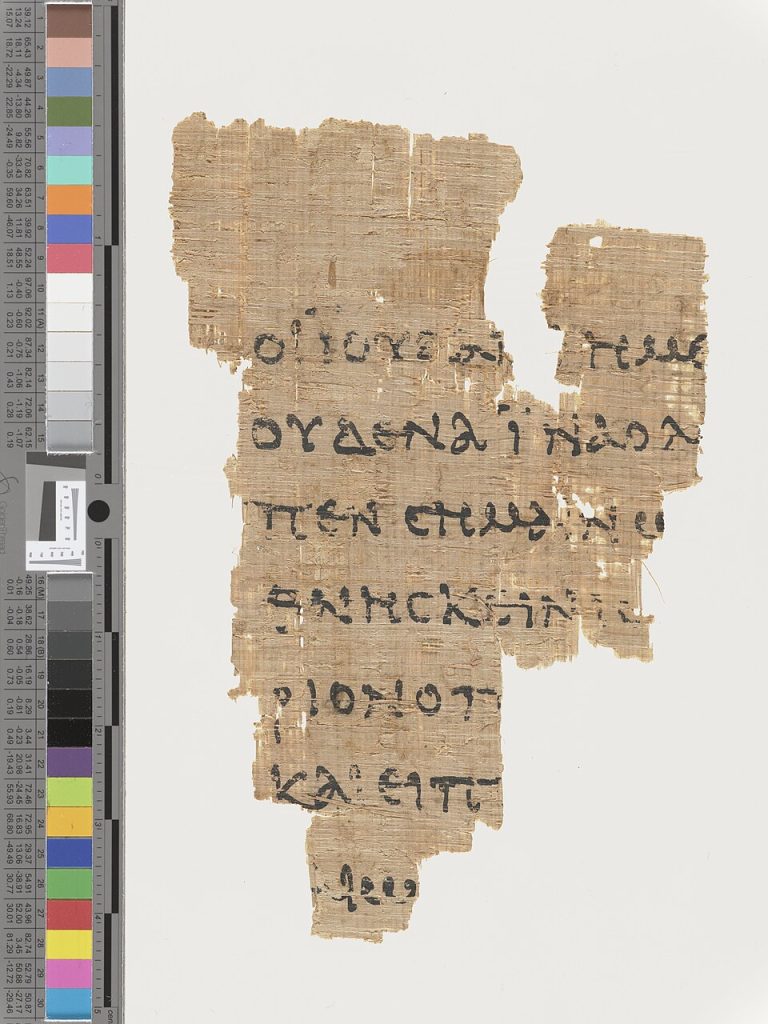
The term recto identifies one face of the fragment in the catalog. The other is labeled verso. The positions and interruptions of the letters matter just as much as the familiar biblical words. On each side, pieces of about seven lines survive. Some lines consist of only a handful of characters. An editor can locate those letters within John by comparing where they fit in the known succession of words and lines. Matching fragments on two sides, in the order John gives them, is far more informative than finding an isolated letter or a single familiar word on a scrap. C. H. Roberts’s published transcription and analysis.
When you look at a photo of the recto, try following the horizontal rows of writing before looking up a transcription. Irregular edges interrupt most of the lines. A transcription can show those gaps or supply likely words in brackets. Both approaches are useful, since readers may want to see the surviving letters at one moment and compare the whole story at another. The part supplied in brackets comes from comparing the visible writing with other copies and the expected space on the page. The photograph gives readers a chance to see where that reconstruction begins. Original images of both faces in the Manchester viewer.
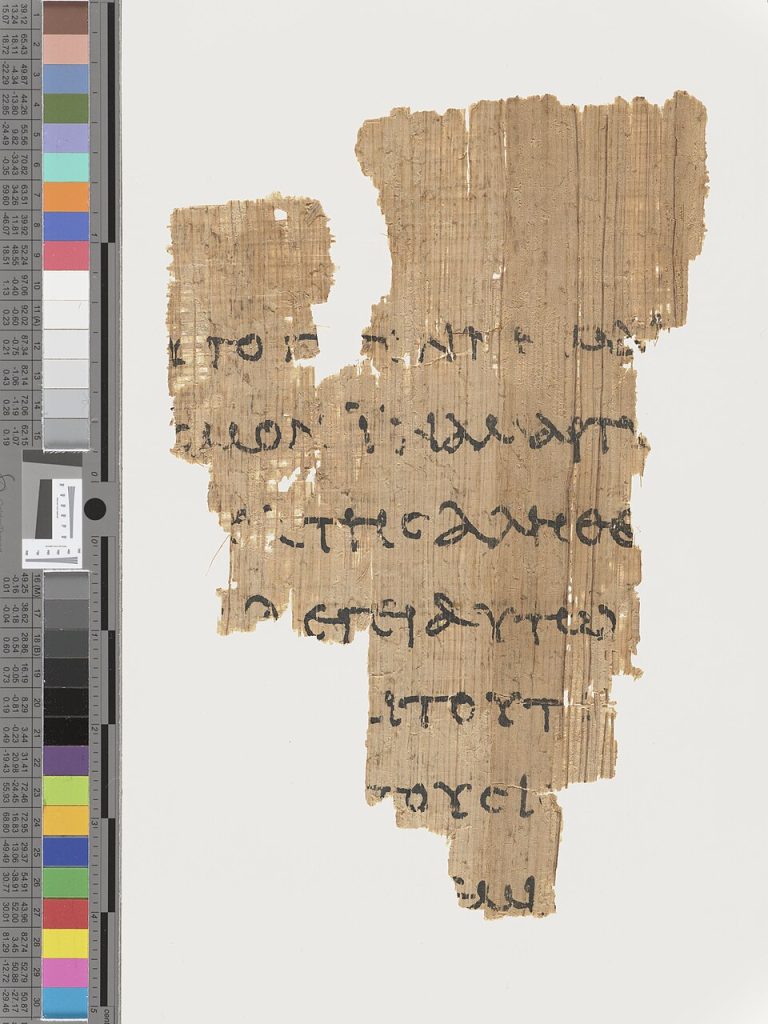
Both faces carry the same narrative in sequence. That is a strong reason to identify it as part of a codex, a book with leaves written on both sides. Ancient people also wrote on the backs of reused scrolls, so writing on two faces by itself would be a limited clue. Here the two sides contain successive parts of the same work. Their placement and the surviving margins help specialists estimate the size and layout of the original page. There was much more writing on either face, and the visible fragment only gives us one small area in which to recognize the scribe’s work. Roberts’s analysis of the codex and page layout.
From Egypt to Manchester
The Egypt connection comes from modern acquisition history. Bernard Grenfell obtained papyri in Egypt on behalf of the John Rylands Library in 1920. This fragment eventually came to Roberts’s attention among material in the collection, and his publication appeared in 1935. The two events explain why accounts of the discovery can give different dates. One marks the library acquisition, and the other marks the publication identifying the writing. Surviving documentation supports the acquisition in Egypt. The original place of recovery and the archaeological layer that held the piece cannot be specified as they could be for an object excavated and recorded in place. Brent Nongbri’s study of the acquisition and publication archives.
The library name and the manuscript number tell us where to find the object today. Greek P 457 is the Rylands shelf mark. P52 is the number assigned in a wider system used by New Testament scholars for Greek papyrus witnesses. The number gives readers a shared way to refer to the witness even when they are using different catalogs. It is especially handy because the same object can appear under the name of the biblical book, its library number, and the abbreviation of an edition. When comparing the age of manuscripts, look for the date discussion in the catalog or article, alongside the number. Institute for New Testament Textual Research, manuscript 10052.
What handwriting can tell us about date
Palaeography is the study of older writing, including the ways forms and habits changed across time. P52 gives palaeographers a limited sample of one scribe. Roberts compared the shapes and construction of individual letters, the proportions of the writing, and the little strokes that finish some letters with comparable Greek hands. Dated documents can be particularly useful because they anchor at least one surviving example of a style. A letter dated by its writer or a petition tied to a particular year gives a point of reference. The other piece of writing still has to be compared with it as a whole. Roberts’s original argument for the first half of the second century.
Consider the letter alpha. The papyrus has more than one way of writing it. A comparable, securely dated document may display the same variety, which can help scholars see how a particular kind of hand worked. That resembles a family of habits more than a single date stamp. In studying P52, Don Barker notes that the forms compared in one early document can also be observed in a much later document. He weighs such examples alongside broader writing habits, the nature of the documents, and the possibility that someone writing a book might use a different pace and degree of formality from someone writing a business document. Barker’s comparison of dated parallels.
The small sample makes a difference for another reason. A page from a long text might give a palaeographer distinctive letter pairs, abbreviations, and habits repeated across many lines. Here several useful letters occur only a few times, so a single shape cannot carry the same weight it would in a larger sample. An independently dated context could strengthen the case for any one interval. In its absence, asking which comparisons hold up matters more than accumulating similarities. That explains how scholars can agree on the identification of John’s text and disagree on the range best supported by the same photographs. Nongbri on the limits of fine palaeographical dating.
The proposed dates therefore differ. Roberts favored the first half of the second century. Pasquale Orsini and Willy Clarysse proposed approximately AD 125–175 after comparing early Greek scripts across a wider group of New Testament manuscripts. Barker considered either the second or third century possible. Nongbri’s later work also explicitly argues that plausible dates extend into the third century and traces how the approximate year 125 became so widely repeated. An early copy remains important even when the physical evidence supports a wider interval than an exhibit label can easily express. Orsini and Clarysse’s table of manuscript dates. Nongbri on palaeography and the spread of the AD 125 claim.
The fragment carries part of John’s Gospel. The precise year in which the scribe wrote those lines has to be judged from the handwriting.
A date assigned to this surviving piece concerns an act of copying. The Gospel had to be in existence by the time the scribe prepared this page. There is an interval between those acts whose length the papyrus cannot measure. Even if the findspot in Egypt were better known, the place where a copy was deposited and the place where the Gospel was first written would still need independent arguments. The strongest historical observation is that a Greek text recognizable as John 18 had been copied in the period suggested by the handwriting. The route this particular book traveled before it was acquired is less well documented. Nongbri’s discussion of the scope of the dating evidence.
What the fragment preserves in John’s account
Read John 18:28–38 before returning to the photos. John takes the reader with Pilate between the people bringing the accusations and the man before him. Pilate wants to know what case has been brought and asks Jesus about being king of the Jews. The surviving recto intersects that sequence. On the verso, John moves to Jesus’ testimony to the truth and to Pilate’s question about truth. In the larger narrative, the title that Pilate asks about here reappears in John 19:19–22, above the cross. The connection is part of what John’s Gospel does with the trial and its outcome.
The surviving lines belong to that account, and the boundaries of the fragment are worth keeping in view. For example, the statement about Jesus’ kingdom in verse 36 is read between the portions represented on the two faces. It belongs to the surrounding conversation in the Gospel, in the stretch of text that has been lost from this piece. A modern edition of John lets us read the complete movement of the dialogue. The ancient fragment gives evidence for just the parts a particular scribe set down where the papyrus survived. This is what makes it rewarding to use the complete version and the individual manuscript together. Compare the two photographed faces with John 18.
We receive the Gospel of John as true and accurate testimony about Jesus. John 20:30–31 explains why its author wrote the account, inviting readers to believe that Jesus is the Christ and to have life in his name. It is worth turning from the technical questions about a scribe’s hand to ask what the book was trying to communicate. In this case the two questions meet in an unusually small place. Someone copied the trial account in Greek, and just enough of that copy survives for readers today to recognize a moment in John’s testimony. The most remarkable thing about that recognition is how much of the book it leads us back to.
Look at the evidence in this order
- Open the two images. Identify an edge of the fragment and look for where the remaining letters stop on each side.
- Read the complete passage. Keep John 18:31–33 and 18:37–38 alongside the photographs, with verse 36 in the wider conversation between them.
- Compare date ranges. Notice what each specialist uses as a point of comparison before using any date in an argument about the Gospel.
There is a useful comparison in the Codex Sinaiticus. Its surviving pages preserve a much larger stretch of the history of the Bible as a book, and its fourth-century Greek text includes the whole New Testament. P52 sits much closer to the fragmentary end of the evidence. Both can be read as made objects with a particular script, page, and transmission history. The small Rylands scrap gives few words to work with. The fact that they come from two sides of a single leaf makes it possible to recover more about that leaf than its size would suggest.
Questions readers ask
Is AD 125 the date of the fragment?
It is a shorthand associated with the early dating of the handwriting. Published estimates include approximately AD 125–175 as well as wider ranges extending into the third century.
Did P52 contain all of John?
The preserved text is part of John 18 from a codex leaf. The lost extent of the book and what else was bound with it remain questions the fragment cannot answer.
Sources and further reading
- University of Manchester Digital Collections, Greek P 457 — Custodian’s images of the papyrus and official collection record.
- C. H. Roberts, An Unpublished Fragment of the Fourth Gospel — 1936 Bulletin of the John Rylands Library article based on Roberts’s 1935 publication.
- Brent Nongbri, Palaeography, Precision and Publicity — Reassesses the acquisition records, scholarly dating, comparative hands, and public presentation.
- Pasquale Orsini and Willy Clarysse, Early New Testament Manuscripts and Their Dates — Systematic comparison placing P52 at approximately AD 125–175.
- Don Barker, The Dating of New Testament Papyri — Wider-handwriting comparison, including close discussion of P52 and dated documentary parallels.





