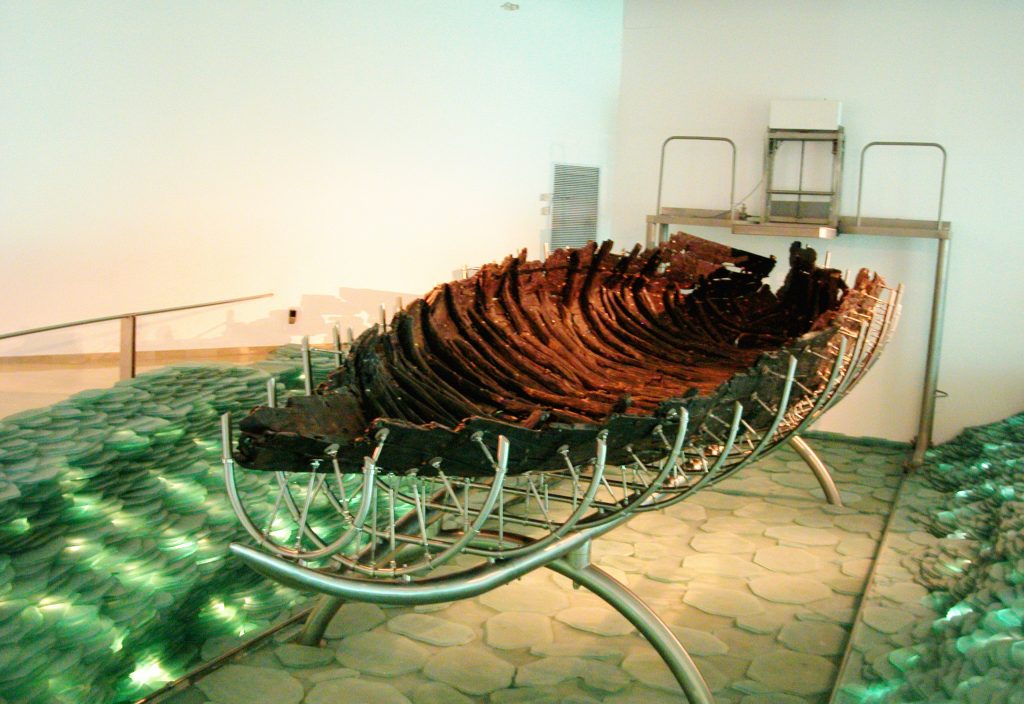
A stretch of mud on the northwest shore of the Sea of Galilee gave up something that usually disappears from the archaeological record. In 1986 two brothers from nearby Ginosar, Moshe and Yuval Lufan, recognized traces of an ancient boat where water had receded. What survived was much of the lower hull, still shaped by the work of the people who built and repaired it. The timbers now stand inside the Yigal Allon Centre. They give us a rare opportunity to see a working boat from the broad period in which Jesus walked the shores of Galilee. Yigal Allon Centre museum record.
For Christians who receive the Bible as true and accurate, a discovery like this draws our attention to the ordinary materials of an extraordinary history. The Gospel writers knew where Jesus taught, where the disciples worked, and what happened when they crossed the lake. The boat belongs to that inhabited world. Its planks, seams, and repairs bring the fishermen’s working days into focus. We can also ask precise questions about its discovery, date, and preservation, and let those answers guide how closely we connect it with the events Scripture records.
What you'll learn
- How a falling lake exposed an ancient hull, and how excavators rescued wood too fragile to lift on its own.
- What the boat’s dimensions, fastenings, and repairs tell us about work on the Sea of Galilee.
- How an authentic boat from the Gospel period helps us picture the accounts in Mark, Luke, and John.
A boat hidden in the mud
The Sea of Galilee also goes by its modern Hebrew name, the Kinneret. During the dry period that preceded the discovery, the falling water level exposed an area below the usual shoreline. The find lay between the vicinity of ancient Magdala and modern Ginosar. That setting helps explain both its survival and its vulnerability. Wet sediment had covered the lower timbers and limited their exposure to oxygen. As the lake fell, the same material that preserved them began to lose its protective conditions. From the moment the wooden outline was recognized, conservation was part of the excavation.
The mud was worth studying in its own right. An excavation documents where material sits in relation to other finds, and that relationship determines how much weight to give a date. A vessel resting on a lakebed can acquire sediment and objects after its last voyage. Pottery found in association with the hull can help place the boat in an ancient period, particularly alongside an independent assessment of the wood. The sediment preserved part of the vessel’s final resting place. Its earlier moorings, trips, and changing owners remain matters for historical imagination. Wachsmann’s technical report on excavation and conservation.
Getting the hull to a conservation tank
Waterlogged wood can retain its shape long after the material giving it strength has deteriorated. Water occupies spaces inside the weakened wood. When evaporation takes place in the open air, the timber can shrink, warp, or collapse. Excavator Shelley Wachsmann and his colleagues therefore worked to keep the boat wet as they exposed and recorded it. They cleared the mud in stages and fashioned a protective support around the hull. The support distributed pressure over a much larger area than ropes or lifting points could have done.
The protected boat was floated out from the excavation and moved into care on shore. Treatment at Ginosar took years. Conservation replaced water in the timbers with polyethylene glycol, a waxlike material that supports weakened wood as it dries. The Yigal Allon Centre put the boat on public display in 2000. From the first exposure to its mounting in the gallery, each stage depended on recognizing what the wood could bear. The shape we can see now is a record of ancient construction, lakebed preservation, and the decisions of the modern team that saved it. The museum’s account of the rescue and display.
Reading the work of the boatbuilders
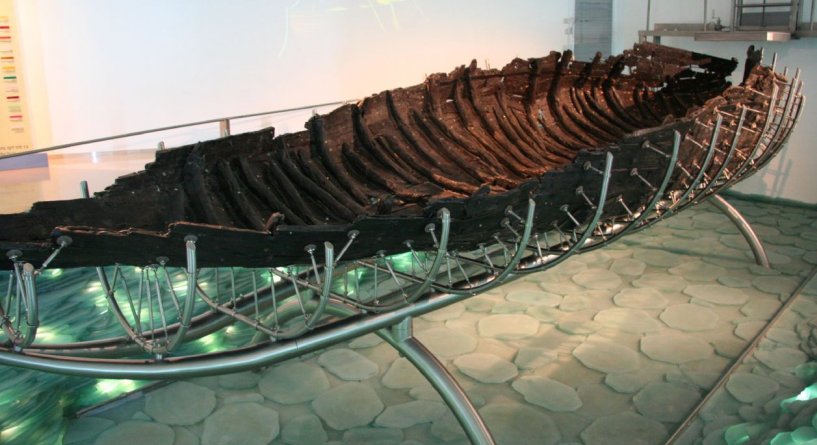
The surviving hull measures a little over eight metres long and about two metres across. It was long enough to carry several people and their equipment, narrow enough to give a small crew useful control on the lake, and shaped to move through water with a shallow draft. The upper parts were lost, and a complete reconstruction requires interpretation. The gallery view lets us start with the surface of the ancient material itself. Follow the runs of wood lengthwise, then look for the structure crossing them. Each direction served a different role in holding the hull together against the pressure of the water.
Boatbuilding specialist J. Richard Steffy documented the way the planks fitted together. Builders could join the edges of planks by cutting matching slots, fitting wooden tongues between them, and securing the pieces. The boat also preserves evidence of repairs. The condition of a finished working hull is the accumulated result of decisions made over time. A replacement plank might call for different material or a new fastening. The resulting patchwork gives us a glimpse of labor and maintenance that the Gospels could take for granted when they tell us that fishermen were washing or mending their nets. Steffy’s technical study of the hull.
What can researchers say about the date? Excavators considered associated pottery, the form and construction of the boat, and radiocarbon evidence. Together these place it around the turn of the era, with room for dates on either side. A radiocarbon sample measures when the tree incorporated carbon into the wood being tested. A board could come from a part of the tree that grew many years before the hull was built, or could have had an earlier use. The ranges are enough to make the boat a genuine witness to the material world of first-century Galilee. Excavation report and dating evidence.
The surviving planks bring us close to the working lives of the disciples, a world where a boat meant wages, weather, and the skill of a crew.
Into the boats of the Gospels
In Mark 1:16–20, Simon and Andrew are casting a net into the lake when Jesus calls them. Further along the shore, James and John are in a boat with their father Zebedee, mending nets. Mark adds that Zebedee remains with the hired servants. It is a brief glimpse of a family enterprise with equipment to maintain and hands to pay. The call of Jesus came during a day of work. The disciples’ decision had consequences they could see immediately in the faces of their family and coworkers and in the gear they left behind.
Luke 5:1–11 gives a different view of fishing gear and teamwork. Fishermen have left their boats and begun washing their nets. Jesus asks Simon to put out a little way from land and teaches from the boat. When Simon lets down his nets after Jesus speaks, the catch forces him to signal the other crew. The mass of fish, the condition of the nets, and the weight in the boats all have a place in the account. At the center is Simon’s response. The man who knows the trade confesses his own sinfulness when he sees what Jesus has done, and Jesus calls him into a life of gathering people.
The Ginosar boat makes those brief details easier to picture. A crew needs space to shift weight and move around its gear. A boat can get a teacher away from a pressing crowd while keeping him within earshot. Two crews can come to each other’s aid when a catch exceeds what the first expected. None of those observations assigns the surviving hull to a named fisherman. They help explain why the Gospel writers could use a few words to take their earliest readers directly into such scenes.
A boat ride across the lake
Mark 4:35–41 takes place after a day of teaching. Jesus asks the disciples to go to the other side. Mark mentions other boats accompanying him and remembers Jesus asleep on a cushion in the stern. The water rises inside their vessel while they struggle. A hull of modest size gives readers a sense of how closely the disciples would have experienced the wind, waves, and each other’s alarm. By the time Jesus commands the storm to be still, Mark has already supplied the details that put us aboard with the men who saw it.
Jesus’ authority is the reason the disciples ask who he is. Christians hear in that question a theme from the Scriptures Israel already knew. Psalm 107:23–30 describes people who go down to the sea in ships, cry out to the Lord, and see him still the storm. Mark tells us what the disciples saw Jesus do on the lake. The archaeological evidence gives us a tangible sense of their vulnerability in a boat. The biblical account tells us whose presence mattered when their own experience and effort could carry them only so far.
John 21:1–14 speaks of the same body of water as the Sea of Tiberias and brings us to the shore after the resurrection. The disciples work through the night. Jesus speaks from land, directs them to a catch, and has a fire and food waiting when they reach him. Work, hunger, and fatigue belong in a true account of life on the lake, and the risen Lord meets the disciples there. As readers follow the story from darkness toward breakfast, the physical details and the recognition of Jesus unfold together.
Galilee on shore and on the water
The Magdala Stone, found in a synagogue near the same northwestern stretch of the lake, offers another view into this region. The building and its carved stone speak to Jewish worship and community. The boat speaks to the work that helped sustain such settlements. One discovery asks us to look at the stone a community carved for a setting where people assembled. The other asks us to trace joints and repairs in something people depended on for movement and livelihood. The Gospels bring both kinds of places into the same historical setting.
Begin with the hull when you look at the photographs. Its irregular boards draw the eye toward the practical choices of real workers. Then read one of the lake passages slowly and notice the people who ready the boat, handle the nets, or remain on shore. Across those accounts, Jesus teaches, provides, calms the wind, or calls disciples in the places where they had expected to carry out another day’s work. The preserved vessel helps us see those places and tasks with a little more of the clarity that Mark, Luke, and John give their readers.
Sources and further reading
- Shelley Wachsmann, excavation and conservation of the Kinneret boat — Original technical excavation report on the discovery, rescue and date.
- J. Richard Steffy, notes on the construction of the Kinneret boat — Original nautical-archaeological study of structure and construction.
- Yigal Allon Centre, The Ancient Boat — Museum record of the discovery, conservation and current display.
- Shelley Wachsmann lecture, University of Chicago — The excavation director describes the discovery, recovery and study of the hull.




