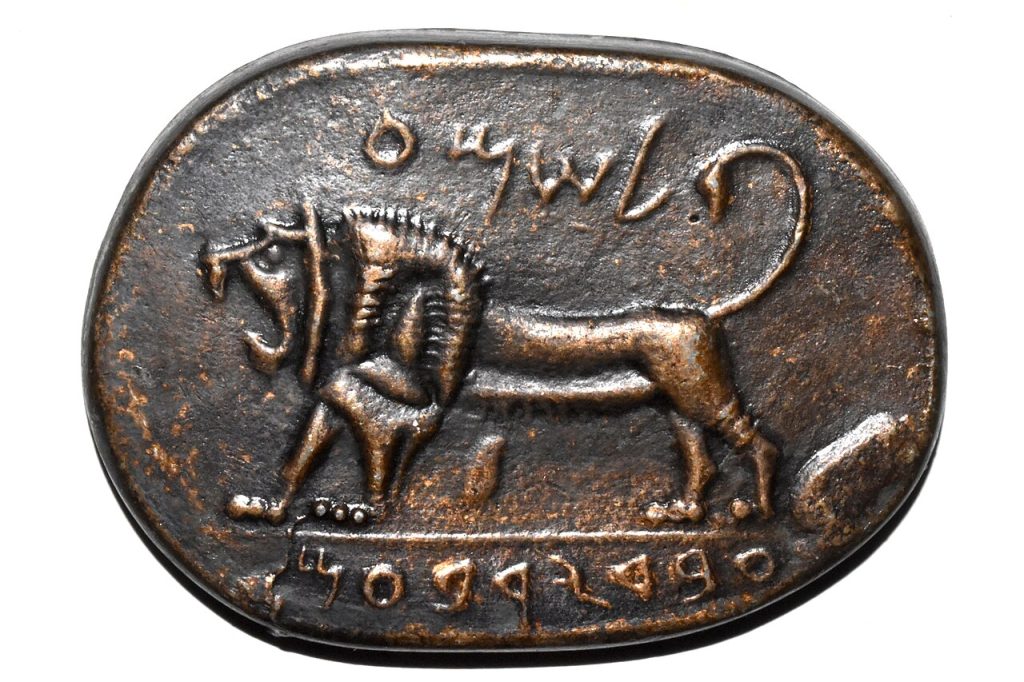
Look closely at the lion on the seal of Shema. Its mouth is open, its tail curls over its back, and letters fit into the narrow space above and below its body. The whole design occupied the face of a piece of green jasper only 37 millimeters long. An engraver working at that scale made a durable instrument for a man whose name the writing preserves. In English it reads, “Belonging to Shema, servant of Jeroboam.”
The object is usually connected with the eighth-century king of Israel described in 2 Kings 14:23–29. Gottlieb Schumacher’s excavation found it at Megiddo in 1904. The original is missing, and casts and early documentation allow the design to be studied today. The seal brings us close to the administration of the northern kingdom at a time when its borders and its influence expanded. As Christians, we receive the biblical account of that kingdom as true and accurate. The letters on the seal help us appreciate the real kingdom and real people about whom Scripture speaks. They also invite us to look closely at the limits of a very small source. Cline’s study of the excavation.
Key takeaways
- Schumacher’s team excavated the original green jasper seal at Megiddo in March 1904. Its whereabouts are now unknown. Casts and published drawings preserve the design.
- The inscription identifies Shema and names Jeroboam. The eighth-century Jeroboam II is the usual identification, while the wording alone could also fit the earlier king by that name.
- The lion and the title point to the social world of a royal official. Neither the official’s exact duties nor the object’s original place of use can be pinned down.
- A separate clay seal impression bought on the antiquities market is disputed. The excavated stone and its early documentation stand on their own evidence.
The March discovery and the missing original
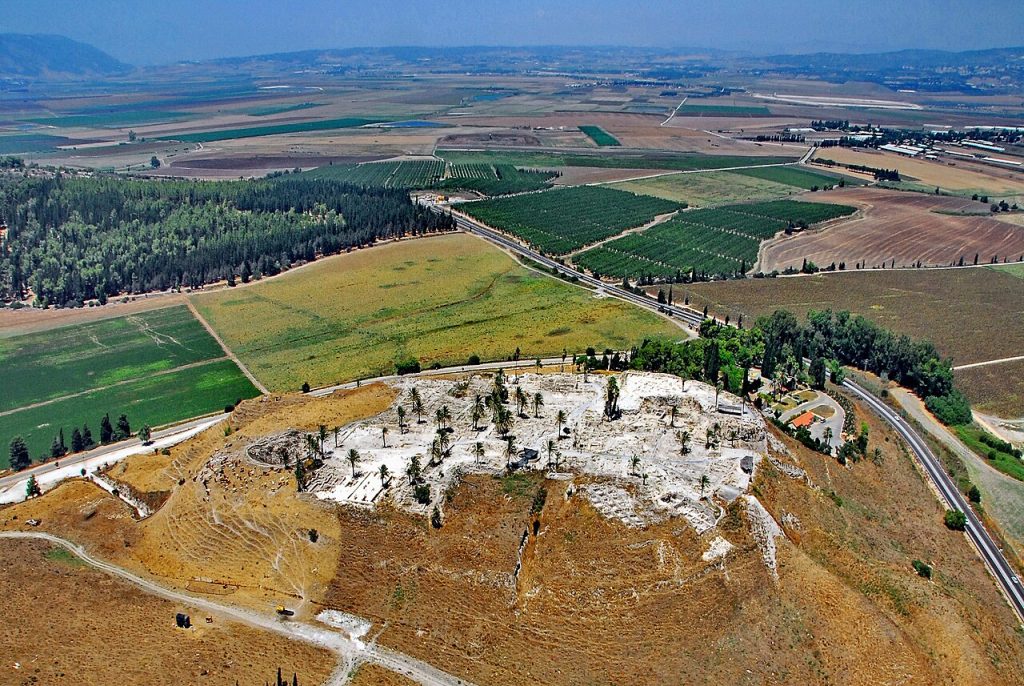
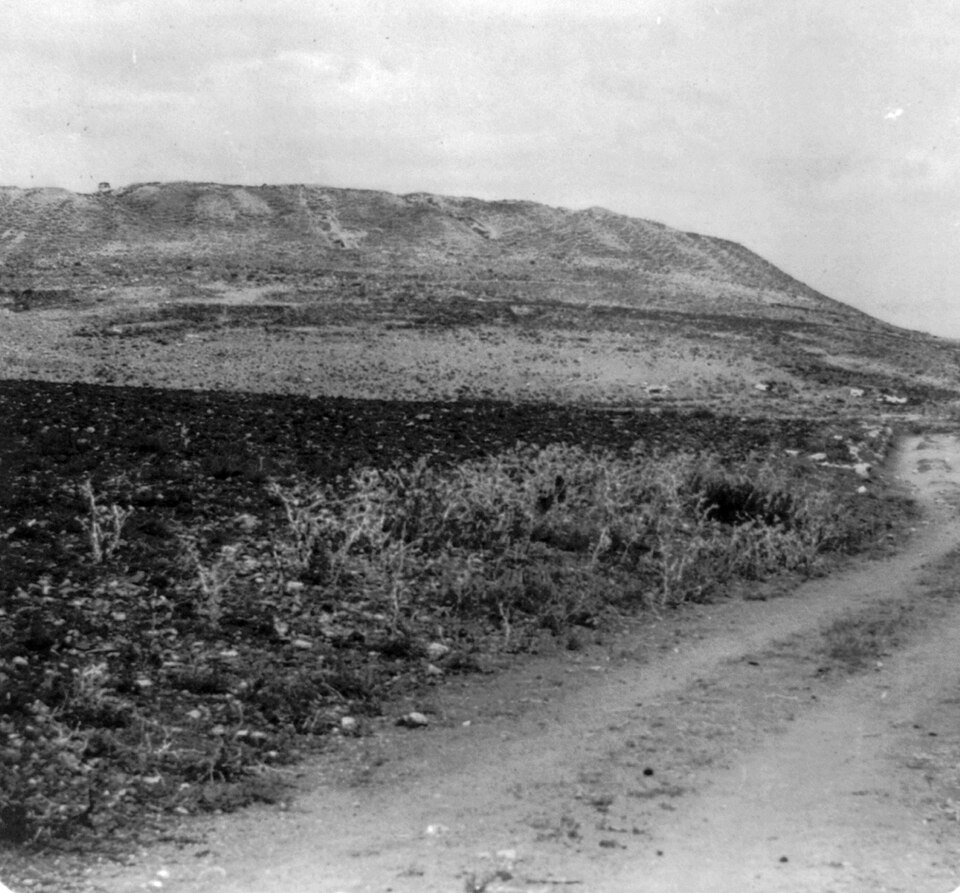
Megiddo lay beside a passage between the coastal plain and the Jezreel Valley. It gave people authority over movement through one of the north’s busiest corridors. The mound that excavators called Tell el-Mutesellim retained the stacked remains of many centuries of settlement. Schumacher’s expedition dug there from 1903 to 1905. Eric Cline’s study identifies March 22, 1904, as the day the seal came to light, drawing on the journal of the visiting scholar Emil Kautzsch. The excavators placed the object in the vicinity of an interior gate or enclosure. Later scholars who compared the early records noted that the seal lay above the gate floor and that its stratigraphic relationship to the building is ambiguous. The excavation journal and contemporary correspondence. Catalogue no. 2 on the find context.
That setting tells us much about the seal and leaves important details open. An object recovered in an early excavation has a documented site of discovery. Its exact association with an architectural phase is a more specific claim. Even inside an enclosure a small seal can move through time as people rebuild, level ground, replace floors, or fill an abandoned space. The field records establish Megiddo as the findspot and give later readers something to test. The recovered position alone cannot supply the year of carving or establish where Shema usually worked. For a fuller look at how the site’s architecture can be dated, see Megiddo’s six-chambered gate and the city beneath it.
Kautzsch hoped to help get the seal to Constantinople, where it was intended for the Ottoman sultan. The records Cline examined document the excavation commissioner taking the seal to Beirut. A contemporary Palestine Exploration Fund report places it with the governor of Beirut for presentation to Sultan Abdul Hamid II. That is the last documented point in the account Cline reconstructs. The original’s present location is unknown. Fortunately, people had already recorded its appearance. Schumacher’s published excavation report includes the design, and surviving copies give us the lion and letters that would otherwise only be known from a description. Schumacher’s 1908 report, pp. 99–101.
The difference between a carving and an impression matters when you examine letters. A seal face cut in reverse can produce a readable inscription after being pressed into a soft surface. Casts and drawings may be made to reproduce either the face or the readable impression, depending on what the maker sets out to document. So if two illustrations look reversed, check their labels and the drawing conventions before trying to judge the letters. An enlarged cast also helps a modern viewer see the mane, the position of the paws, and the border that the engraver fitted around them. The catalogue measurements take us back to the scale at which the engraver and the owner would actually have handled the stone.
What the seal tells us about Shema
The letters name the owner as Shema and give his relationship to Jeroboam. The Hebrew word often translated “servant” can carry the weight of official service when someone names a king in that formula. Think of it as a claim about whose authority the owner served. A stamp seal could authenticate an impression in clay, often used to close a package or document. A piece of clay carrying such an impression is called a bulla. The jasper seal gives us a name and title, and its type helps scholars reconstruct uses for such objects. Whether this particular seal was used for a letter, a delivery, or several kinds of business remains open. Ancient Hebrew Inscriptions, figure 16 and discussion of official titles.
Unlike a long narrative text, a personal seal had to communicate quickly. Its owner’s name occupies one field. The lion’s silhouette and its careful detailing fill much of the center. The official title appears on the other side of the animal. That compact combination was useful even in a world where an ordinary observer might identify a familiar design faster than they could read its letters. The lion was a widespread figure in the ancient Near East, so the image alone could not identify a particular kingdom or a royal office. The accompanying words make this lion belong to a specific person’s seal. Together they show us the work of an engraver and the status an official wanted to make legible.
The title is worth comparing with another inscription in the Bible’s world. In 2 Kings 18:18, the Judean officials sent out to meet an Assyrian delegation include a royal household official, a secretary, and a recorder. Kings can distinguish particular duties when they are relevant to its story. The formula on Shema’s seal supplies a more general description of service. A reader who sees the word “servant” and imagines chiefly household labor should allow for the rank of a trusted officer. The seal’s material, skilled workmanship, and reference to a named king all make sense in that reading while leaving the precise post open.
Which Jeroboam?
The Bible gives us two kings named Jeroboam. The first, son of Nebat, ruled after the kingdom divided following Solomon’s reign (1 Kings 12). The second, son of Jehoash, ruled in the eighth century BC (2 Kings 14:23–29). The seal gives the personal name only. Scholars usually identify Jeroboam II because the lettering fits the established corpus of Hebrew seals around his period. Specialists have also proposed Jeroboam I, partly because the original stratigraphy leaves room for discussion and the surviving comparative record of earlier Hebrew writing is thinner. The prevailing identification is a judgment about the combined evidence. In a drawing, the letters are as readable as ever, but neither the name of the king’s father nor a regnal year appears alongside them. Avigad and Sass on the royal attribution.
In 2 Kings 14, Jeroboam II reigns from Samaria and restores territory from Lebo-hamath to the Sea of the Arabah, in keeping with the word of the Lord spoken through Jonah son of Amittai. Megiddo was a different city within the northern kingdom. Objects such as this seal, and the records on pottery from Samaria, make tangible the affairs of officials working where the kingdom’s business was conducted. The Samaria ostraca give examples of consignments, people, and places recorded on sherds. A stamp seal serves a different purpose and has a different findspot. Together the two kinds of evidence show why archaeology is well suited to the administrative details that a biblical narrative can pass over in a few verses.
The seal preserves a royal servant’s name. Scripture tells us what the kingdom he served owed to the God who showed it mercy.
There is a tension worth sitting with in Kings. Jeroboam restored territory and ruled for decades, yet the biblical account also says that he continued in the sins of Jeroboam son of Nebat. God saw Israel’s severe affliction and rescued Israel through this king. The author gives full weight to a political achievement and assigns its outcome to the Lord’s compassion despite the king’s conduct. Amos, whose opening verse names Jeroboam II and Judah’s Uzziah, takes us further into the same age. He condemns people who exploit the poor in disputes at the city gate and speaks of those resting on ivory beds while others suffer. A fine seal helps us picture Israel’s skilled craftsmanship and official standing. Amos reminds us to ask how the prosperity of such a kingdom was used.
Amos makes this contrast concrete in another way. His demands for justice at the gate in Amos 5 concern a public place where grievances could be heard and decisions made. The historical question of exactly which gateway or enclosure was near the Shema find belongs to a different inquiry. Still, either reading brings us into a world where access, judgment, and official authority had visible settings. The luxury Amos describes and the durable objects excavated at Israelite towns make that world easier to picture. His charge against people whose religious observance coexisted with injustice remains a claim Scripture makes on us as readers today.
Three objects and their histories
- The excavated seal: Schumacher’s team found the small green jasper artifact at Megiddo in 1904. Its present location is unknown.
- The casts and images: Early documentation records the lion and lettering, and the bronze replica shown here is a later representation of the design.
- The disputed clay bulla: A separately acquired object, said by some researchers to carry a smaller version of the seal design, has no documented archaeological findspot.
The clay bulla is a useful lesson in weighing a claim. Shmuel Aḥituv and colleagues published tests in 2023 which they understood to support authenticity. Their object had reportedly been bought at a market in Beersheba years earlier. Critics led by Robert Deutsch argued that the letter forms and details of the lion were inconsistent with a secure Iron Age identification and challenged what the laboratory analysis could establish. Their exchange concerns this market object. For the older Megiddo discovery, we have the excavation records and early reproductions regardless of how the debate over the bulla turns out. The laboratory study. The published critique.
Is Shema mentioned in the Bible?
The seal gives us the name of an official called Shema. The historical connection concerns Jeroboam, usually identified as the king in 2 Kings 14:23–29. The inscription gives no family name or other detail that securely identifies the official with any biblical namesake.
Sources and further reading
- Gottlieb Schumacher, Tell el Mutesellim (1908), pp. 99–101, fig. 147 — Original excavation volume with the early published illustration. The catalogue links digitized copies.
- Eric H. Cline, study of Gottlieb Schumacher at Megiddo — Draws on the excavation notes, Kautzsch’s journal, and Ottoman records to reconstruct the find and the documented transfer to Beirut.
- Nahman Avigad and Benjamin Sass, Corpus of West Semitic Stamp Seals, no. 2 — Object description, script, dimensions, and the difficulty of dating the seal from its stratigraphy.
- Ancient Hebrew Inscriptions, Cambridge University Press, figure 16 — Modern drawing of the seal and discussion of the title and attribution to Jeroboam II.
- Shmuel Aḥituv and colleagues, “A Seal Impression of ‘ShemaꜤ Servant of Jeroboam’” (2023) — Study arguing that a separate, unprovenanced clay impression is ancient. The university record links the journal article.
- Robert Deutsch and colleagues, “The Bulla of ‘Shema, Servant of Jeroboam’ An Embarrassing Forgery” — Published critique of the separate bulla’s letter forms, design and proposed authentication.




