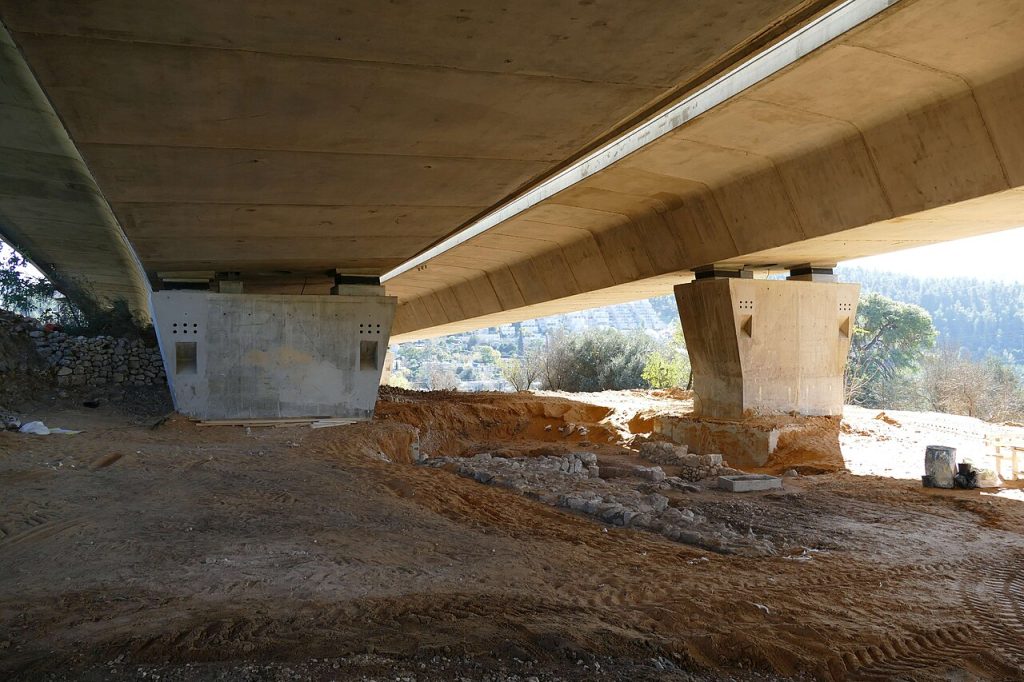
West of Jerusalem, at Tel Moẓa, archaeologists uncovered the remains of an Iron Age temple. Its courtyard contained a stone altar and broken figurines. It stood near facilities for storing agricultural goods, just a few kilometers from the city where the Bible locates Solomon’s temple. The find puts a physical place behind a historical question. What forms of worship took place in Judah alongside the worship at Jerusalem? As Christians, we trust the Bible’s account of the Lord’s commands and of the people who did not always obey them. The remains at Moẓa give us a place to study how worship actually took shape in one community in Judah. Kisilevitz’s first publication of the temple
Key takeaways
- Rescue excavations in 2012 uncovered a temple complex at Tel Moẓa. Continued excavations found evidence of a smaller temple beneath a larger one.
- The courtyard’s altar, ash and bone deposit, fragments of figurines, and vessels identify a place of ritual activity beside an important agricultural center.
- The evidence of local worship illuminates Deuteronomy’s commands and the reforms in Kings. The remains leave open whom people worshiped at the site and when particular rituals ended.
What excavation revealed west of Jerusalem
The site lies on a slope overlooking a fertile basin where valleys converge. Springs made the area attractive to people who worked the land. Routes from the lowlands toward the central hills gave goods and people ways to travel to and from Jerusalem. The archaeological team identifies it with Mozah, which appears among the towns of Benjamin in Joshua 18. The biblical list ties the name to a landscape. Archaeology then follows the history of the settlement through evidence from many different periods. The temple belongs to the Iron Age, while many of the buildings and stones around it reflect other stages of use. Expedition site and setting · Joshua 18:25–28
Before the temple came to light, excavations had already brought attention to groups of silos and buildings used to store produce. The numbers of storage facilities and the position near Jerusalem led the excavators to understand the site as an important agricultural collection center. The plan below shows what it means to speak of a temple and storage areas in the same compound. A plan records the excavated parts and may also show proposed outlines for the rest. That makes it useful for seeing the relation of features across the site, and the accompanying report explains which relationships are observed directly. Garfinkel and Mumcuoglu on the compound
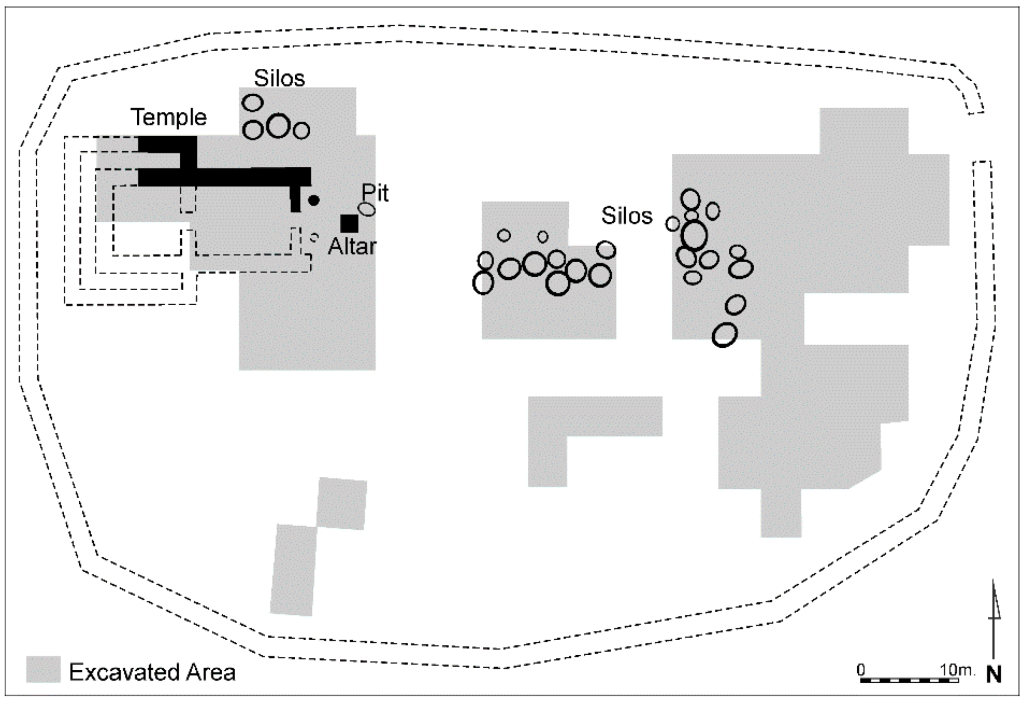
It is understandable that a place near fields and springs also became a place for collecting grain. The presence of silos changes how we picture the temple. People could arrive in this part of the settlement with work to do that had little directly to do with the altar, while those who maintained the sanctuary depended on a settled community. The published interpretation of a royal collection center accounts for the size of the storage facilities. It leaves questions about who managed the courtyard and whether the institution that controlled some of the grain also sponsored the sanctuary. That relationship matters because temple and storage stood close enough to shape the use of the same part of town. Expedition discussion of the silos and settlement
The 2012 excavations took place in advance of road work. They exposed part of a substantial building and the courtyard containing the ritual finds. In 2019 a research excavation directed by Shua Kisilevitz and Oded Lipschits returned to examine the construction and what lay beneath it. Excavators widened earlier areas and opened targeted probes. Details such as a floor continuing beneath the edge of later construction can distinguish two stages that first looked like one. The early reports and the more recent results show why a single headline about a newly found temple seldom tells the whole story of a complex site. The rescue excavation report · Report of the 2019 season
A useful way to read the 2012 and 2019 reports together is to look for which structures they can follow across the site. At some points only the base of a wall or a stretch of paving survives. In other places a floor belonging to the earlier use was preserved beneath the later building. A flat area can also owe its present shape to much later terracing. Excavation records let the team remove those stages in reverse order and connect remains from several seasons. Some details such as the complete dimensions of a courtyard or the appearance of a roof then have to be inferred from the parts that remain. The targeted probes and architectural notes
Two temples and a courtyard
The excavation project dates the start of the complex to the late tenth or early ninth century BC, around the earlier part of Iron Age IIA. A 2025 study distinguishes a smaller Early Iron IIA temple and a larger Late Iron IIA temple built over it. The complex contains further changes that belong to the later Iron Age. A courtyard retained or renewed over several building phases is evidence for a place that mattered for generations. It gives historians cause to look for continuity and change in practice over time, rather than imagining that every wall, floor and object on the plan stood together on a particular day. Expedition overview of the phases · Kisilevitz and colleagues on the two temples
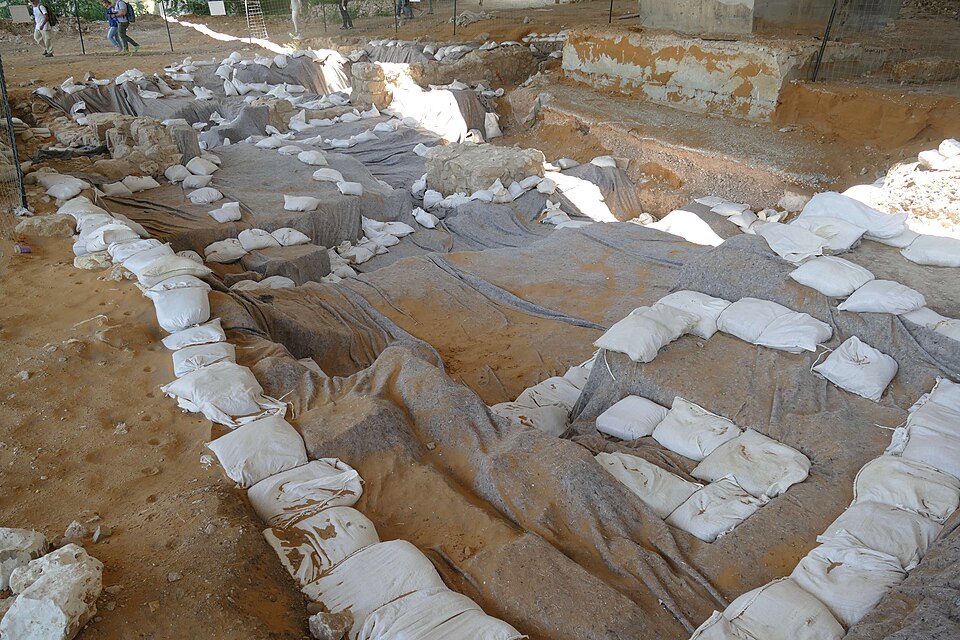
The earlier courtyard finds include a square altar built of fieldstones. Nearby the field team recorded a flat feature interpreted as an offering table and a pit containing bone and ash. On the floor lay fragments of ritual vessels and figurines, including human heads and animal forms. No one of these objects would tell the whole story on its own. Taken together and studied where they were found, they establish that the courtyard was used for ritual activities. The animal remains and traces of burning add a dimension that room outlines alone cannot supply. The Israel Antiquities Authority’s report includes photographs of both the altar and figurines. Original altar and figurine photographs, figures 5 and 6
The objects raise a familiar problem in the study of worship. A human likeness might represent a worshiper, a ruler, or a deity. The form and its placement offer clues, but they do not amount to a label. A stone relief studied in 2025 was found broken in the foundations of the larger temple. The authors propose that it once belonged to the earlier temple and may have depicted a ruler or a divine figure. They also consider whether its burial marked continuity between the temples. That proposal is an interpretation of how a particular object was treated. The recovered pieces establish the context in which the fragments were actually found. Study of the stone relief and its context
An architectural comparison with Jerusalem
The temple’s plan fits within a wider Levantine tradition. Researchers compare its approach through a courtyard and entry area toward a long building with temples in northern Syria, and with the layout described for Solomon’s temple in 1 Kings 6. A surviving column base is one feature that can be compared with descriptions of temple entrances elsewhere. The points of contact make it possible to picture the kind of architecture described in Kings against excavated buildings of the Iron Age. The temple at Moẓa also has its own history, scale, and location. We can learn from the comparison without transferring every room or ornament in Kings onto the excavated plan. Architectural plans and discussion · 1 Kings 6:1–22
What the evidence lets us distinguish
- Where the activity took place. The excavated remains locate an altar and temple courtyard a few kilometers from Jerusalem.
- How the buildings changed. Walls, foundations, and deposits show successive construction and changes to the compound.
- What can be said of the worship. The objects point to ritual activity. Identifying the deity, the sponsors, or the exact meaning of the figurines requires other evidence.
The altar gives Judah’s local worship a physical setting. The covenant tells us how Israel was called to worship.
The discovery alongside Deuteronomy and Kings
In Deuteronomy 12 Moses commands Israel to seek the place the Lord will choose for his name. In that passage the place of offering belongs to the terms of the covenant. The books of Kings recount what rulers and people did in practice. The writer can approve a king’s conduct in some matters and still call attention to high places that remained in use. A physical temple outside Jerusalem can therefore be considered alongside both kinds of biblical evidence. The law shows the authority of God’s command. The history shows how far the people lived from it and how much work was involved whenever a ruler took it seriously. Deuteronomy 12 and Hezekiah’s reform in 2 Kings 18
Hezekiah’s reform in 2 Kings 18 supplies a useful point of comparison. The account describes acts involving high places, pillars, and an object that once had a different place in Israel’s history but which people had begun to treat as a focus of worship. Those are specific things, and Kings makes a judgment about what people were doing with them. Archaeologists approach a high place or a temple through the buildings and materials that survive. The terms in a biblical narrative and the labels in an excavation report only partly overlap. It makes sense to compare them carefully while keeping full attention on what each passage or artifact records. 2 Kings 18:1–6
Second Kings 23 makes the scope of Josiah’s reform unusually concrete. The king orders the removal of objects used in the worship of other gods, takes action at places beyond the city, and backs the change with public reading and covenant renewal. Moẓa does not appear by name in this account. Dating a temple floor or the end of a particular local practice tightly enough to link it to an order from Josiah would require its own evidence. The excavation helps us picture the kind of religious landscape a royal reform would have had to address. It leaves the specific history of this sanctuary open for study. 2 Kings 23:1–15
Another comparison comes from the Kuntillet ‘Ajrud inscriptions, which preserve the wording of blessings and related imagery from another part of the southern Levant. At Moẓa, much of the evidence comes from architecture, material in a ritual courtyard, and traces of activity instead of a blessing that names its recipient. Each site adds something to the study of everyday and public worship. The find at Moẓa is particularly important because of its scale and position close to Jerusalem. It shows that some form of worship with a substantial building could have an established place within Judah’s settled and agricultural life.
Our Christian reading starts from confidence in the truth of Scripture and listens to its account of real, persistent disobedience. It is worth the slow work of recovering the surfaces, broken objects, and changes that local worship left behind, even when they raise questions we cannot answer. The ancient people who made an offering, built an altar, or stored grain near a temple belonged to the same history in which the Lord called Judah to faithfulness. At Moẓa we can see part of the world that gave that call its urgency.
Sources and further reading
- Israel Antiquities Authority, Moẓa, Tel Moẓa — Original report of rescue excavations, with plans, photographs of the altar, and a photograph of figurines from the courtyard.
- Shua Kisilevitz, The Iron IIA Judahite Temple at Tel Moza — Primary publication of the initial discovery, Tel Aviv 42 (2015), pp. 147–164.
- Israel Antiquities Authority, Tel Moẕa, 2019 excavations — Report on the first non-salvage season, earlier structure and probes around the temple complex.
- Shua Kisilevitz and Oded Lipschits, Tel Moẓa archaeological expedition — Project overview, geography, the silos and the temples’ archaeological phases.
- Kisilevitz et al., In his image: God or ruler? — 2025 study on the two superimposed temples and a broken relief recovered in the foundation of the later one.
- Yosef Garfinkel and Madeleine Mumcuoglu, The Temple of Solomon in Iron Age Context — Architectural comparison of Moẓa and other Iron Age temples with 1 Kings. Figure 4 is the schematic used here.
- Deuteronomy 12 and 2 Kings 23 — The covenant command about worship and the narrative of Josiah’s reform.




