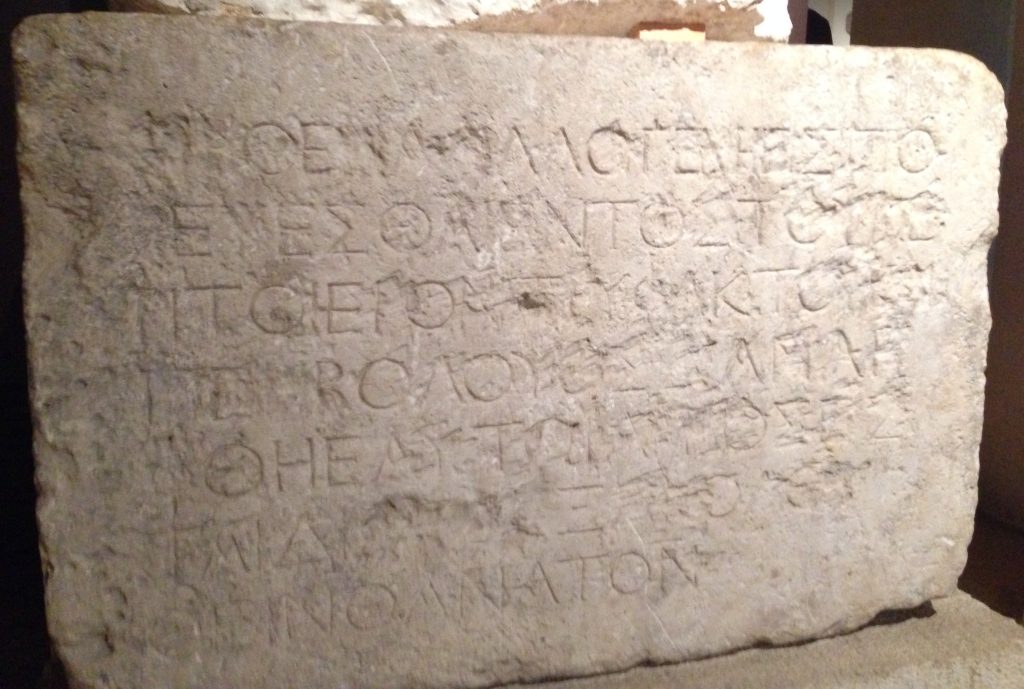
A visitor to Herod’s Temple in Jerusalem could read this warning before deciding where to walk. Cut across seven lines of limestone in Greek, the notice prohibited foreigners from crossing a boundary around the sanctuary. It warned that whoever was caught inside would bear responsibility for the death that followed. In 1871 Charles Simon Clermont-Ganneau identified this stone in Jerusalem, where it had been reused near the northern side of the Temple Mount. The slab now belongs to the Istanbul Archaeology Museums. Another partial copy came to light in Jerusalem in the 1930s.
The warning helps explain the urgency of a story Acts tells about Paul. As he visited the Temple, a public accusation brought a crowd down upon him and drew Roman soldiers into the dispute. Luke is precise about who saw what, who drew an inference, and who acted. We receive that history as true and accurate. With one of the ancient Temple notices in view, we can understand why the allegation carried such force. The inscription also gives concrete historical weight to the kind of dividing wall Paul evokes when he describes the peace Christ made.
What you'll learn
- What foreigners visiting the Second Temple were told in Greek, and where the warning applied.
- How the two surviving inscriptions and the writings of Josephus illuminate the Temple boundary.
- Why a mistaken inference about Trophimus mattered in Acts 21, and how Ephesians uses the image of a dividing wall.
The first stone and the surviving fragment
Clermont-Ganneau recognized the text on a limestone block used as building material near the Temple Mount. Its reuse explains why the nineteenth-century findspot and the original place of display are two different questions. A stone can move when one structure is dismantled and another is built. It can become valuable as a block of the right size long after people cease to read what is written on it. The reused slab preserves nearly the full warning. Its original purpose becomes clear once its words are read alongside the accounts of the ancient Temple. Clermont-Ganneau’s 1871 report.
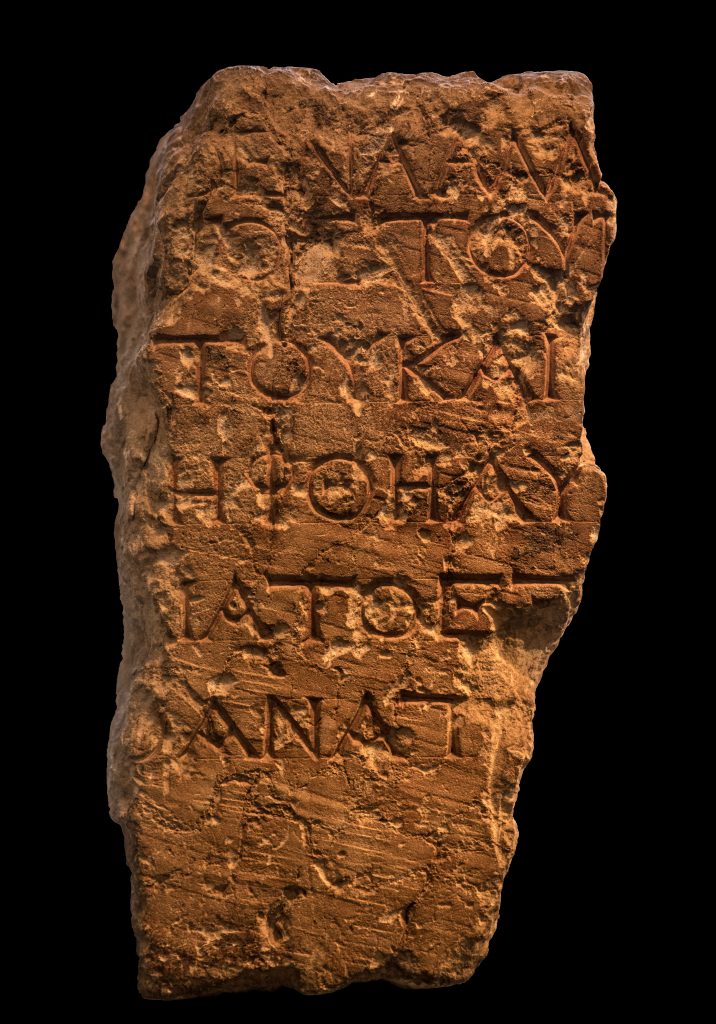
A second, broken stone supplies an independent piece of the same story. Found in the 1930s, it preserves portions of lines recognizable from the first notice. Its lettering, spacing, and remaining words let scholars compare the two copies. Archaeologists who encounter only a short run of letters can sometimes identify the sort of document it came from by comparing it with a fuller example. Here the result also goes the other way. The smaller find helps us understand the large slab as one example of a sign that could be displayed at multiple points.
Where the warning applied
The rule addressed a boundary inside the larger Temple complex. A non-Jewish visitor could come into the outer area. Passage farther in subjected a foreigner to the warning. Josephus, a first-century Jewish historian familiar with Jerusalem, describes a stone barrier separating the outer part of the complex from the sanctuary beyond it. In The Jewish War 5.193–194 he says notices along it communicated the restriction in Greek and Latin. Both surviving pieces are Greek. That language made the prohibition immediately understandable to the many visitors who could read Greek across the eastern Roman world. Josephus, The Jewish War, Book 5.
Josephus gives us the scope of the enclosure and the recurrence of the notices. The slabs give us words intended for people who were physically approaching it. In paraphrase, the sign says a foreigner must stay outside the barrier and enclosure around the sanctuary, and someone seized within bears responsibility for the death that follows. The wording addresses the visitor and states the danger. The actual procedures by which the penalty might be investigated or imposed have to be studied through other evidence. A carved public rule and a record of its enforcement answer different kinds of historical questions.
Modern scholarship can go farther into the question of how a Greek reader would recognize the message. Stephen Llewelyn and Dionysia Van Beek study the sign as a visitor might have read it, together with ancient inscriptions that governed access to sacred spaces. Its carefully cut public lettering and its statement of consequence belong to a world where people were expected to recognize the rules of the sanctuary they entered. The script is a feature of the archaeology in its own right. A visitor coming toward the boundary was being made responsible for a choice before he took another step. Llewelyn and Van Beek’s study of the Greek warning.
A second view of Jewish sacred space in the same period comes from the Magdala Stone. It stood in a synagogue on the Sea of Galilee and carries reliefs many scholars connect with Jerusalem’s Temple. In Jerusalem, some ancient stonework communicated where a visitor could go. At Magdala, the carved menorah and other imagery brought Temple associations into the life of a Jewish community living at a distance from the city. Each discovery preserves a different way the Temple shaped the lives and movements of people in the first century.
What Luke says happened to Paul
Acts 21 begins the Jerusalem episode with a meeting between Paul, James, and the elders. Paul gives an account of what God has done among the Gentiles through his ministry. The elders praise God, then draw his attention to rumors circulating about his teaching among Jewish believers. Paul joins men engaged in purification and enters the Temple in connection with their observance. His decision matters when reading what follows. Luke depicts him going into a sacred place in connection with an observance to which he had agreed, even as suspicion persisted about his attitude to the law.
Near the end of the period of purification, some Jews from Asia see Paul in the Temple and raise an alarm. Among their allegations is the charge of bringing Greeks into the Temple and defiling it. Luke supplies the source of the misunderstanding in Acts 21:29. They had seen Trophimus the Ephesian with Paul in the city and supposed that Paul had brought him into the Temple. The wording preserves the distinction between the place where the men were seen together and the place into which the crowd imagined Paul had taken him. Acts 21:26–36.
That distinction goes to the heart of why the inscription matters. Its presence makes the allegation intelligible in the Temple setting. The crowd thought a forbidden crossing had happened. Luke traces the allegation to people who saw a Gentile in Paul’s company elsewhere, then assumed a further event. The threatening language of the rule about foreigners helps explain the intensity of that charge. The people seize Paul and drag him out, and the doors close. People seeking to kill him have already begun beating him by the time the Roman commander and his soldiers get to him.
The carving tells us what was at stake at the boundary, and Luke tells us how a rumor about crossing it nearly cost Paul his life.
It is worth distinguishing the person the warning addresses from the person the crowd grabs. The notice speaks to a foreign visitor. In Acts the accusation takes in a Jewish apostle said to have brought a Gentile across. Paul is the one beaten and taken into custody. The officers initially struggle to learn what happened because people shout different things. The scene ends with the Roman commander giving Paul permission to address the people. The next chapter carries the drama forward when Paul says the Lord sent him to the Gentiles and the crowd again cries for his death.
The dividing wall in Ephesians
Ephesians 2:11–22 asks Gentile believers to remember their former distance from Israel’s covenants and promises. Paul tells them that those who were far off have been brought near by the blood of Christ. Paul describes Christ as our peace, speaks of the middle wall of partition, and says both peoples have access to the Father through one Spirit. Then he develops the image of a holy temple. In Christ, believers are being built together into a dwelling place of God. The passage moves from former estrangement to shared membership in God’s household. Ephesians 2:11–22.
Did Paul have this particular barrier in mind? The local architecture offers a vivid possible association. A real line between the places where a Gentile visitor might stand and where he might not stand was part of the landscape of the Jerusalem of Paul’s lifetime. Paul’s argument in Ephesians centers on Christ’s death, the end of hostility, and reconciliation to God. Its scope reaches the place of Jew and Gentile in God’s household. Readers can see the force of the comparison while letting the terms of Ephesians establish what Paul means by peace and access.
Jesus’ words about the Temple also belong in the conversation. In Mark 11:17 he cites Isaiah’s promise that God’s house would be a house of prayer for all nations. Isaiah 56 speaks of foreigners who join themselves to the Lord and are welcomed to worship. The Old Testament already gives Christians words for God’s concern for people beyond Israel. The Temple warning makes a specific historical arrangement visible. Reading Isaiah, Mark, Acts, and Ephesians places that arrangement beside a biblical story in which the Lord calls people from the nations to himself.
Where to begin when you look at either stone
Study the first photograph for the uninterrupted lines of a public notice. In the second, the surviving letters stop at a break that passes through their lines. Those two views illustrate how much can turn on each preserved piece. They also give us an opportunity to read Acts carefully. Watch how Luke shifts from the crowd’s allegation to its cause, then to the commander’s attempt to find out what happened. When you turn to Ephesians, watch how the image of the barrier gives way to people built into the same household in Christ. Each source repays attention to its particular words.
Sources and further reading
- Charles Clermont-Ganneau, Discovery of a Tablet from Herod's Temple — The discoverer’s 1871 report in the Palestine Exploration Quarterly.
- Musée du Louvre, register entry for its cast of the warning — Museum catalogue documenting the original limestone and Clermont-Ganneau’s discovery.
- Stephen Llewelyn and Dionysia Van Beek, Reading the Temple Warning as a Greek Visitor — Study of the Greek text and of the sign’s communication in its ancient setting.
- Josephus, The Jewish War, Book 5 — First-century description of the Temple precinct, boundary, and Greek and Latin notices at 5.193–194.




