Lesson 4 of 5 · About 20 minutes · Course outline
Set aside about 20 minutes and keep a piece of paper or a notes app handy. You’ll examine two photographs of the Mesha Stele, try a missing-letter exercise in English, and compare readings of a damaged line. The stele is a basalt monument set up by Mesha, king of Moab. Its familiar name can tempt us to rush to the history. Begin instead with something you can check for yourself. Where did the ancient cutter make a mark, and where did the stone later break? By the end you’ll be able to take one archaeological claim back to a particular line and explain how much of it survives.
What you’ll learn
- Use the surface of an inscription to tell deliberate cuts from possible breaks and damage.
- Separate a transliteration, a proposed restoration, a translation, and a claim about history.
- Explain why two readers can examine the same damaged line and reach different conclusions.
- Compare a well-supported statement on the Mesha Stele with 2 Kings 3.
What can you see on the stone?
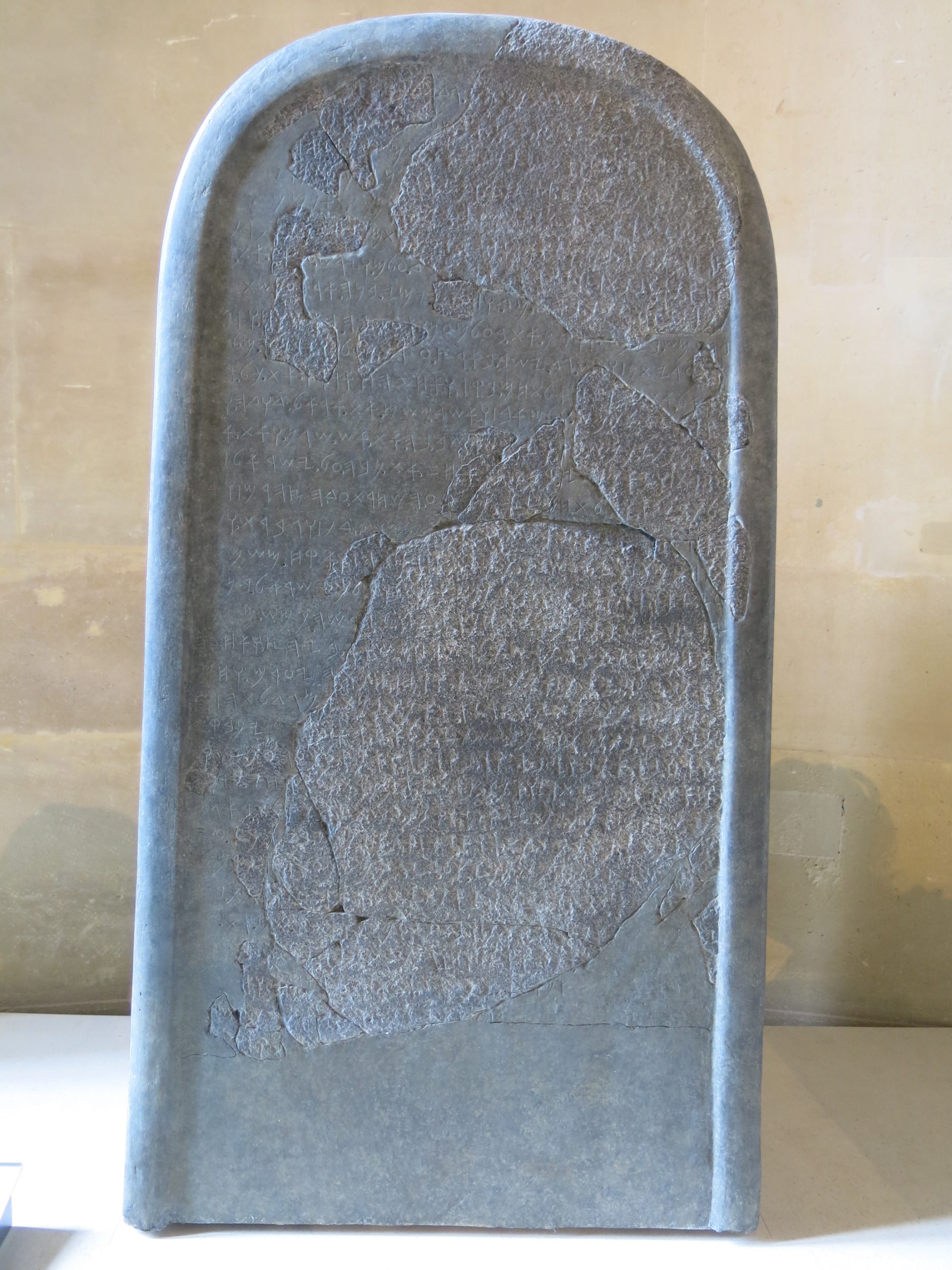
Look at the monument from top to bottom. Some lines of signs hold a fairly steady height. The seams wander and cut across more than one line. Anybody can make that initial observation. It will help even when you cannot name a single character. Follow a reasonably clear row with your eyes, then follow one edge where two sections meet. Try tracing each on paper. The first trace shows where a cutter kept the writing in a band. The second shows where the physical surface interrupts what the cutter did. Keep both traces in view as you read any edition. Louvre catalogue and additional views of AO 5066.
For your first entry, draw two columns labeled What I see and What could explain it. Pick one short mark in a row and one mark that crosses rows. Write down their positions before deciding what made them. If you are using the image description, start with the continuous rows and the jagged joins it identifies. A letter can also have a diagonal stroke, so direction alone cannot settle the question. A useful test is to ask whether the mark stays within the writing band and whether it has a width and depth similar to cuts nearby. A single photograph may leave the depth difficult to judge.
Reveal a sample observation
“This narrow mark lies in the same band as several other incisions” is an observation. “It is part of one letter” is an explanation to test. “This long jagged line crosses several rows” is another observation. “It is a break or a join” fits the object’s documented reconstruction. The explanations have different levels of support.
The story of the stele gives you another way to check a mark. A paper impression, called a squeeze, was made in 1869 before the monument broke apart. Dampened paper could take the shape of the incisions it touched, and the dried impression then carried those shapes separately. A cut may be hard to read on today’s stone but easier to trace on the old impression. The squeeze has its own creases and damage too. If a mark appears along a tear, look at nearby parts of the paper for similar accidental traces and check the stone where that portion survives. Having two surfaces makes this a comparison you can reason about. Collège de France on the impression and its recovery.
Try a restoration in English
Imagine that you are reading a classroom copy of a decree in English. Its middle has broken away. The exercise line reads THE KING OF [····] SET UP THIS STONE. Four letter spaces look plausible. Try putting MOAB and EDOM in the gap. Both fit the space and the English grammar. Now suppose you find an older impression of the same line and the first two letters are clearly MO. Write a version that records which letters you would supply. There is still a judgment to make about what follows those two letters, and you can show your reader exactly where it begins.
Reveal the completed practice line
THE KING OF MO[AB] SET UP THIS STONE gives one well-supported restoration. MO is documented by the impression in this invented exercise. Brackets show that AB is supplied. Before you had the impression, both kingdoms were possible. The extra evidence changed how much of the proposal you could defend.
The exact notation varies between editions. A reader-friendly rule is to look for the publisher’s explanation before assuming what a dot or bracket means. Square brackets can mark missing material and can contain suggested letters or signs for an open gap. Dots or other signs can also mark visible damage when an editor thinks a particular letter uncertain. For a beginner, these distinctions are useful because they let uncertainty stay where it belongs. Two missing letters in a familiar name may be easy to restore. Several missing words at the end of a line can leave competing possibilities. The marks in an edition are the start of an explanation for each decision. Inscriptions of Aphrodisias project guide to epigraphic notation.
Read a name in four steps
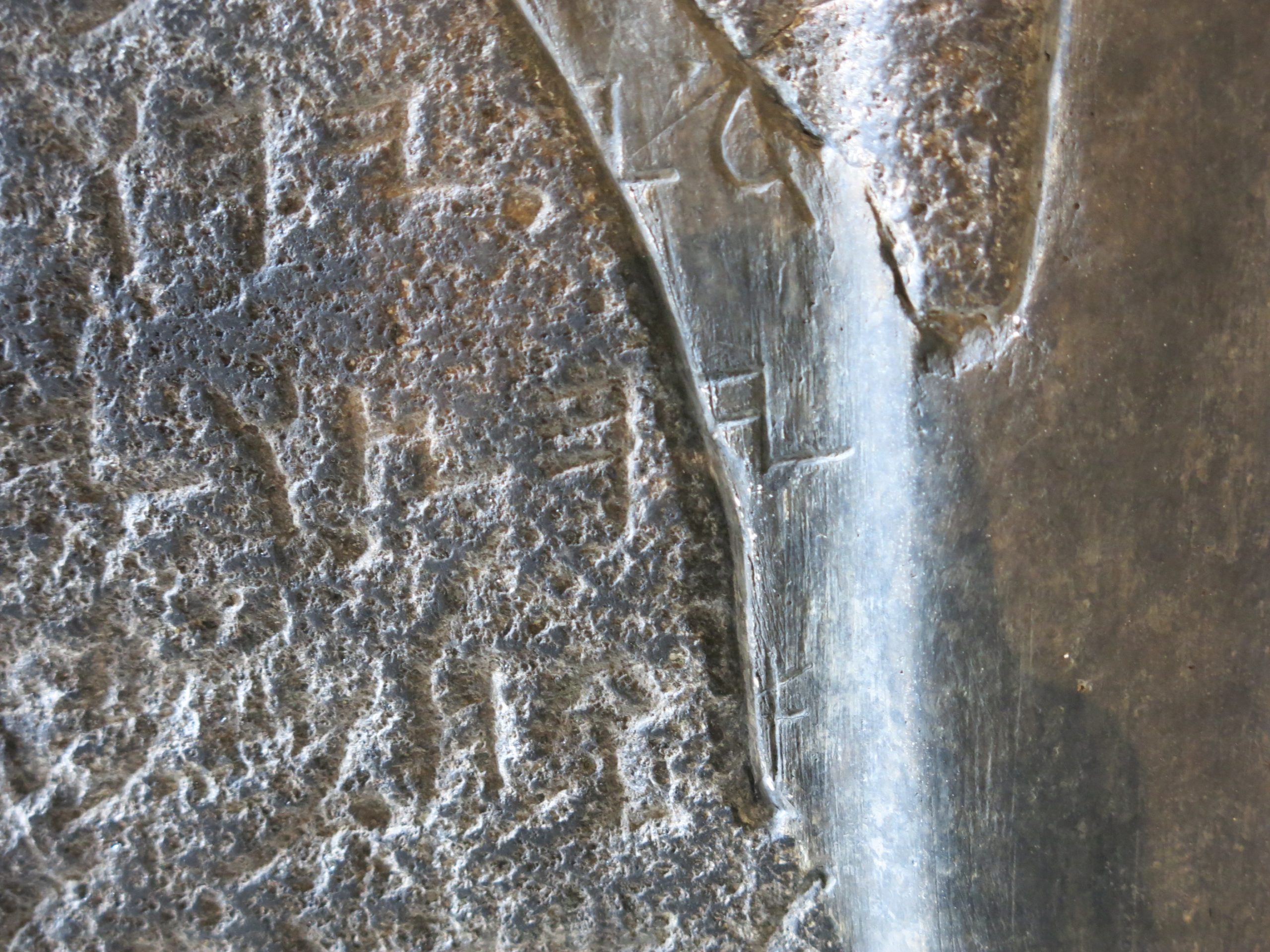
For a real example, move to the close photograph and open the line-numbered edition. In line 18 the letters YHWH occur in a passage about Nebo. The copy of the ancient letters in Latin characters is a transliteration. It gives the signs names that can be printed on an English keyboard. An English Bible generally represents this divine name as LORD in small capitals. That convention helps English readers read the passage in their own language. As you compare the photograph and the edition, remember that old Moabite was written from right to left. The physical order along the row may feel unfamiliar before you see it written in Latin letters from left to right. André Lemaire’s numbered English translation, lines 17–18.
- Surface. Record the material, regular incisions and any damage you can locate.
- Edited letters. Copy the four-letter sequence YHWH and mark any restorations shown for the particular words you are using.
- Translation. Write one English sentence about the reference to the Lord and what Mesha says he took from Nebo.
- Historical claim. State what the text says about the event and identify the person commissioning this account.
If your sentence says that Mesha claimed to have taken objects connected with the Lord, it assigns the claim to the source that makes it. Mesha was telling the story of his own victories. That helps explain why a short report of the episode can give the words a fair hearing without turning the king’s monument into a record of everyone’s experience. An editor who has made a sound reading of the letters can stop there. Deciding how much of the event happened as the king presents it requires attention to the purpose of the monument and to accounts from other sources.
Keep that sentence next to the four Latin letters in your notes. There is a useful difference between seeing four signs in a short, well-preserved group and knowing the exact English noun a translator will put beside them. Lemaire’s translation places the English word “hearths” near the beginning of line 18. For the exercise you can write “objects associated with the Lord” and carry the distinction forward. The four-letter name gives you enough to make that observation. Questions about the objects’ precise form would lead you to a different part of the text. Lemaire’s translation, lines 17–18.
Put brackets around a restoration. Put a source around a historical claim.
Compare two readings of a damaged line
Move down to line 31 and compare two proposals. André Lemaire and Jean-Philippe Delorme read btdwd, commonly rendered “House of David.” They point to traces on both the stone and the squeeze, including marks they identify with an X-shaped letter and with a small word divider. Michael Langlois also used imaging to reassess the line and found the Davidic reading plausible. Israel Finkelstein, Nadav Na’aman and Thomas Römer interpreted the boundary of the damaged group differently. They proposed a three-letter personal name beginning with b and tentatively suggested Balak. Both readings depend on identifying particular marks and deciding where the group ends. Lemaire and Delorme’s photographs and argument. Finkelstein, Na’aman and Römer’s abstract at Tel Aviv University.
You can follow one part of the argument with your eyes. Find the enlargement in the first study and look for the mark its authors take as part of an X. In their own examination Matthieu Richelle and Andrew Burlingame ask whether the supposed strokes have the width and depth expected from the cutter. They compare some of those marks with tiny spots found elsewhere on the squeeze where nobody expects a letter. That gives you a concrete point to write in your first column. The question is whether the mark has the physical properties of an intentional cut. A proposed word gives you a place to look. Comparison tells you how persuasive the identification is. Richelle and Burlingame’s article in the BAS Library. Langlois’s analysis of line 31.
On your page, draw two rows of five boxes. Put a B in the first box of each row. For the longer proposal, draw a boundary after box five and fill the row with BTDWD. For the shorter proposal, draw the boundary after box three and try BLQ, the consonants of Balak. Underline W and D in the first row. Could marks in those last two positions help complete the name if it ends after box three? The sketch shows which positions each proposal allows you to use. Tel Aviv University abstract on the three-letter proposal.
Reveal a defensible assessment of line 31
If the group ends after box three, marks in positions four and five fall beyond the proposed name. The five-position reading allows those marks to contribute to “House of David.” The three-position reading has room for Balak, with two letters supplied after the surviving B. In your own notes, present both names as proposed readings of a damaged line.
Test a sentence against Scripture
Now read 2 Kings 3:1–7. The narrator identifies Mesha as king of Moab, describes the tribute he paid to Israel, and says he rebelled after Ahab’s death. The upper lines of the monument independently identify Mesha with Moab and recall Israelite control and Moab’s recovery. Write one sentence about that overlap. Then read the end of the biblical chapter and choose a single detail, such as the withdrawal in verse 27. Ask where the monument records that particular part of the expedition. You can say something definite about the shared people and political setting while continuing to examine the episodes each source selects. 2 Kings 3, including the campaign’s ending. Mesha’s account, opening lines.
Reveal a sample comparison with 2 Kings
“Both sources identify Mesha with Moab and describe a period of Israelite control followed by Moab’s break with Israel.” The shared account of that political change does not depend on how anyone reads line 31. The coalition’s withdrawal is part of the Bible’s account of a particular campaign, which needs its own evidence if you want to locate it on the monument.
Christians receive the Bible as true and accurate. That confidence gives us a reason to read Scripture closely enough to see the specific claims it makes. It also gives us a reason to notice what a Moabite ruler chose to write about people and places we meet in Scripture. Finish by circling the strongest word in your own sentence. If it is “proves,” check whether “names,” “describes,” or “supports” expresses the relation more precisely. You now have a way to read a claim about any damaged inscription. Trace the words to a line, the line to a surface, and the surface back to the evidence that has actually survived.
Sources and further reading
- Musée du Louvre, Mesha Stele Primary collection record, AO 5066, photographed object, its discovery and related pieces.
- Collège de France, Mesha and the Bible Institutional account of the 1869 paper impression and the named participants.
- Inscriptions of Aphrodisias, epigraphic conventions Project edition’s examples of signs and conventions.
- André Lemaire, Translation of the Mesha Stela Line-numbered edition. Lines 1–9 and 17–18 support the historical and reading exercises.
- André Lemaire and Jean-Philippe Delorme, Mesha’s Stele and the House of David The researchers’ account of line 31 with images and discussion of three disputed letters and the word dividers.
- Michael Langlois, The Kings, the City and the House of David on the Mesha Stele Primary imaging and epigraphic study, Semitica 61, 2019.
- Israel Finkelstein, Nadav Na’aman and Thomas Römer, Restoring Line 31 in the Mesha Stele Institutional abstract and publication record for the 2019 three-letter proposal and tentative identification with Balak.
- Matthieu Richelle and Andrew Burlingame, Set in Stone? Publisher’s record and public notes for the authors’ re-examination of the proposed X, triangle and dot. The full article is available to BAS Library members.
- How Scholars Read a Broken Inscription A deeper guide to reading inscriptions, with another worked example.
Previous lesson: Dating Sites with Pottery and Radiocarbon · Next lesson: Investigating the Siege of Lachish · Return to the course outline