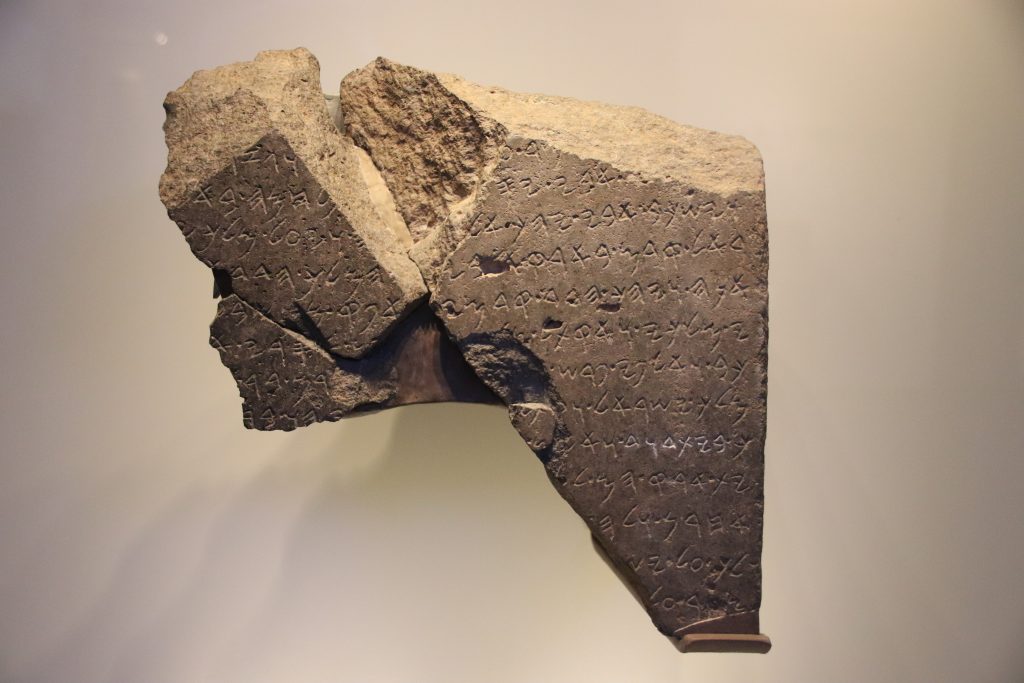
A city wall at Tel Dan held a piece of someone else’s history. One of its stones had once belonged to an inscribed monument. In 1993, during work near the ancient city gate, surveyor Gila Cook recognized that there was writing on the exposed basalt. Two smaller pieces were found the next summer. The stone had been broken and reused, and the text was incomplete. Yet its surviving lines contained a name biblical readers recognize immediately, the House of David. An Aramaic-speaking ruler, celebrating his military successes, had used the name of Judah’s royal family. The Jewish Museum’s exhibition account.
What you’ll learn
- How an inscribed victory monument survived as building material.
- Why the Aramaic letters bytdwd are generally understood to name David’s dynasty.
- How the find illuminates the conflict in 2 Kings without turning a damaged victory text into an eyewitness transcript.
A stone in a second life
Ancient Dan stood in the north, close to the sources of the Jordan and to routes between the Israelite kingdom and its northern neighbors. The Bible uses Dan as one endpoint in its familiar expression for the breadth of Israel, and 1 Kings 12 makes it one of the places where Jeroboam established a royal sanctuary after the kingdom divided. Here, a traveler approaching the city passed through a substantial gate complex. The broken lettered stone was found in the remains of a wall bordering an open paved area by the outer gate. That location is important for the find’s archaeological history. The object was already broken when builders used it there. Biran and Naveh’s excavation account, pp. 81–84.
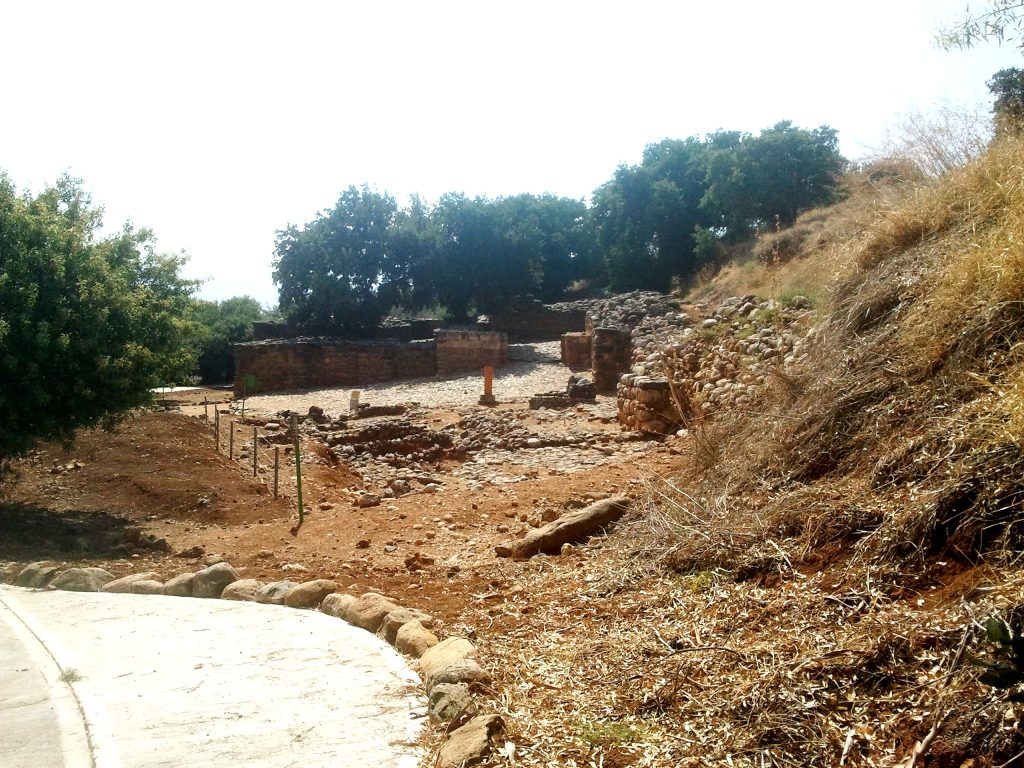
Archaeologists call this secondary use. A builder can take a carved or dressed block from an older structure and use it in a new one. The context where archaeologists find that block tells them about its later use. An inscribed fragment may have been carved a generation earlier or have come from another place altogether. With the Tel Dan pieces, the excavators assessed the dated remains associated with the paving and walls and compared the shapes of the Aramaic letters. The inscription had to exist before its fragments went into the later fabric. The setting gives the investigators a sequence even where the date of carving needs to be inferred. Biran and Naveh’s report on the smaller pieces.
The smaller pieces make that sequence tangible. The excavators found them separately in June 1994. In their report they describe Cook spotting the third piece while measuring at the base of the wall. In its second life it served as an ordinary flat building stone. The remarkable fact is how little material was needed for that later discovery to matter. The smaller pieces contain incomplete lines, yet they give researchers connections that the larger fragment by itself could never have supplied. The largest piece and the joined smaller pair can be compared for letter size, spacing, line alignment and their surviving grammar. Each comparison matters when an apparent continuation has to cross a gap. Primary report, find contexts and figures 7–9.
What the Aramaic letters say
Look at a transcription and you will find the phrase represented as bytdwd. That is a way of writing the surviving Aramaic consonants with Latin letters. The conventional analysis divides them into byt, meaning house, and dwd, David. House in royal usage can mean a dynasty. Near the phrase is a reference to a king of Israel, and the usual reconstruction sets a ruler connected with David’s house alongside Israel’s king. The pattern makes historical sense of the wording. The speaker can distinguish the two kingdoms by naming one as Israel and referring to the royal line associated with the other. Biran and Naveh, discussion and reconstructed lines.
For a reader accustomed to printed words separated by spaces, it is tempting to look for modern sentence formatting on an ancient object. Some words on the fragments are separated by dots. The string usually read House of David has no separator between its parts, a detail early critics raised. A composite dynastic expression can be written together, and the neighboring royal language favors that interpretation. A scholar still has to show why the division makes sense in its sentence. The standard reading draws strength from the full context of the line and from the way dynastic names function in other ancient inscriptions. This is one of the reasons sources print both a transcription and a translation. Ehud Ben Zvi’s early assessment of the alternatives · Michael Langlois’s later reassessment.
A different uncertainty concerns the fragment placement. Clear letters, broken letters and editorial restorations deserve different degrees of confidence. For example, a run of surviving consonants at the end of a name, together with a patronymic and the historical context, can suggest a particular king. Full names in printed translations may contain letters supplied by the editor. Readers who compare the facsimile, transcription and translation can see exactly where the inference comes in. The dynastic expression on the larger fragment can be evaluated even while scholars investigate how the smaller pair belongs with it. Those are related questions with different kinds of evidence. Langlois on the fragments and text.
The broken stone is strongest where a few surviving letters carry a claim the surrounding words can sustain.
Dan, Damascus and the deaths of two kings
Biran and Naveh attributed the monument to the period of Hazael, king of Aram-Damascus, in the ninth century BC. Their reconstruction sees possible references to Jehoram, also called Joram, king of Israel, and Ahaziah, king of Judah. In the same reconstructed text the speaker takes credit for victories involving these rulers. The connection with Hazael is a historical inference. A signature naming him as the speaker has not survived. The known wars, the divine name Hadad within the surviving text and the proposed royal identifications together make that Aramean setting a serious explanation of the monument. Primary report, reconstruction and historical context.
Read 2 Kings 8–9 and the rapid sequence of events becomes easier to follow. Elisha goes to Damascus, speaks with Hazael about Ben-hadad’s illness and foresees the harm Hazael will bring to Israel. Hazael takes the throne of Aram. Later Israel and Judah fight against him at Ramoth-gilead. Jehoram is wounded and retreats to Jezreel, where Ahaziah visits him. Then comes the internal revolt. Jehu leads the coup, kills Jehoram and orders the attack on Ahaziah, who is wounded while fleeing and dies. Hazael’s war and Jehu’s revolt are both part of the biblical account, and the events are close enough together that a foreign king writing a victory account might put his own role at the center. 2 Kings 8–9.
The proposed reading raises a serious question about the language of responsibility. The biblical narrator tells the reader who acted at Jezreel and how Ahaziah died. A royal monument is written from the victor’s perspective, and its claims may compress the sequence, claim credit for wider political results or portray an enemy’s fall as an achievement of the ruler who brought pressure to bear. Scholars have also discussed possible cooperation between the actors. The surviving fragments leave the details of any such relationship uncertain. We can keep the literary character of the inscription in view while hearing the narrative of Kings on its own terms. William M. Schniedewind’s reconstruction and historical proposal.
The neighboring powers saw the same succession from still other vantage points. On the Black Obelisk, Shalmaneser III records tribute associated with Jehu and uses a name tied to Omri’s house for Israel. Jehu had overthrown that royal family. The designation survived because Assyria used it for the realm it knew. This gives us a concrete point of comparison for the dynastic language at Dan. An outside official or king could identify a political house with the founder whose name had become useful in diplomacy. Putting the objects beside each other helps show how a royal family might be known across a border.
Why the name David matters
In 2 Samuel 5, the tribes recognize David as king. In 2 Samuel 7, David proposes building a house for the Lord, and the promise turns to the house the Lord will establish for David. The chapter can use the same ordinary word for a building and for a continuing family. The Tel Dan inscription uses royal-house language in the practical world of kings and conflict. In the Bible, the term carries the history of a royal family and the promise that gives that family its place in the story of God’s people. We can read the stone’s memorable wording without treating all those biblical meanings as claims made by an Aramean royal author. 2 Samuel 5 and 7.
The inscription belongs to the age of David’s successors, well after David’s own lifetime. That timing defines the value of the evidence. An outside royal text speaks as though David’s name can identify a dynasty. A reader should still turn to Samuel for the narrative of David’s life and to other evidence for particular questions about the size and organization of his kingdom. The Mesha Stele provides a useful further exercise. Its possible reference to David’s house depends on a more damaged passage, while its naming of Omri and Israel is much clearer. Ancient witnesses can support particular conclusions at different strengths.
As Christians we receive Scripture as true, and David’s place in the story matters because the promise continues beyond the political fortunes of any one successor. Luke 1 presents Jesus as the heir of David’s throne. The line from a broken victory monument and the angel’s promise to Mary belong to very different settings. One attests an ancient dynasty in the ordinary language of international politics. The other announces a king whose reign endures. Taking the ancient ruler’s wording seriously makes the human setting of that story easier to see. When you next encounter the house of David in Kings or in the opening chapters of the Gospels, remember that the name once meant something intelligible even to Judah’s enemies. Luke 1:26–33.
Sources and further reading
- Avraham Biran and Joseph Naveh, An Aramaic Stele Fragment from Tel Dan — Israel Exploration Journal 43 (1993), pp. 81–98. Primary find report, context, letter forms and original reading.
- Avraham Biran and Joseph Naveh, The Tel Dan Inscription: A New Fragment — Israel Exploration Journal 45 (1995), pp. 1–18. Discovery of B1/B2, proposed association with A, text and historical reconstruction.
- The Jewish Museum, Tel Dan Stele — Museum exhibition, basalt, loan, historical context and date of first discovery.
- Michael Langlois, The Tel Dan Inscription after 30 Years — Israel Exploration Journal 74(2), recent discussion of fragment arrangement and damaged text.
- Ehud Ben Zvi, On the Reading BYTDWD in the Aramaic Stele From Tel Dan — Early dissenting assessment of the confidence possible in the reading.
- 2 Kings 8–9 — Aram’s succession, the war at Ramoth-gilead and Jehu’s coup. Paraphrase used.




