A man bows low at the feet of a king under a parasol. Behind him, others approach with goods for the royal court. The scene belongs to the Black Obelisk of Shalmaneser III, discovered in northern Iraq in 1846. Above the figures are cuneiform signs identifying the tribute with Jehu of Israel, the king whose rise to power fills much of 2 Kings 9–10. The monument commemorates an episode that the Bible does not narrate. It lets us see the pressure of an empire on the northern kingdom just as Jehu was establishing his rule. British Museum collection entry ORACC, Scene 2
What you'll learn
- When the tribute was paid, when the monument was erected and where Austen Henry Layard found it.
- What the relief and its caption each tell us about Jehu’s tribute.
- Why Assyria associated Jehu with Omri, the founder of the royal house that Jehu overthrew.
- How the monument adds foreign policy context to the history of Jehu and Hazael in 2 Kings.
From Kalhu to the British Museum
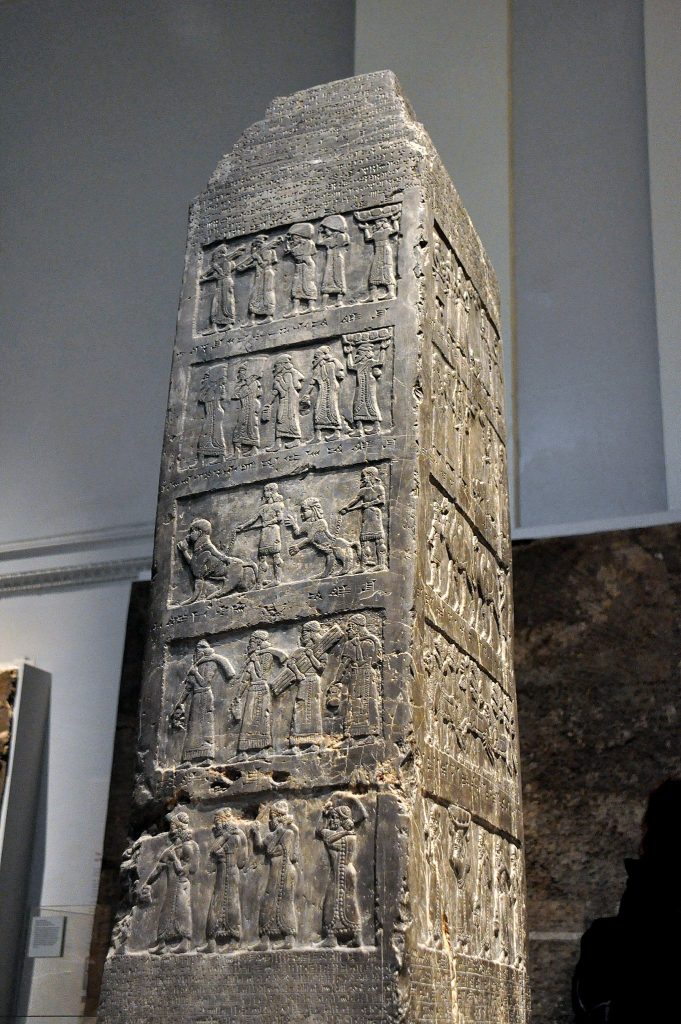
Layard was excavating at Nimrud, the site of ancient Kalhu in present-day Iraq, when he uncovered the monument in 1846. Kalhu was a center of the Neo-Assyrian Empire. The object Layard found was a tall block of dark limestone, nearly two metres high, engraved on four faces. The British Museum acquired it in 1848 and catalogues it under BM 118885. The discovery date belongs to the modern excavation. The carving belongs to the end of Shalmaneser’s reign, around 825 BC, when the monument presented a retrospective view of his achievements. British Museum, discovery and ancient date Cuneiform Digital Library Initiative, BM 118885
Those two dates leave a third to locate. The tribute connected to Jehu occurred around 841 BC, roughly sixteen years before the obelisk was erected. Assyrian annals describe a campaign against Hazael of Damascus during Shalmaneser’s eighteenth regnal year and record payments from Tyre and Jehu. The monument draws on events from different years and puts them beside one another as examples of lasting Assyrian power. The scenes can make multiple delegations feel like a single ceremony to someone viewing the stone as a whole. Reading the dates restores the separate campaigns behind the sculptor’s arrangement. Shalmaneser’s parallel account, columns iii–iv ORACC, arrangement of the tribute scenes
How to read Jehu's tribute band
Start at the second band from the top. On one face the Assyrian king receives homage. Follow that same register around the corners and the procession continues, with men carrying offerings in the presence of Assyrian officials. The other registers repeat the pattern with delegations from different places. The sculptor gives the ruler the most prominent position and uses the lowered body of the foreign representative to display the relationship Assyria claimed. In a museum photo you see whatever surfaces the photographer could capture from one position. The published panel diagram can help you follow the action across all four sides. ORACC, four panels of the Jehu scene
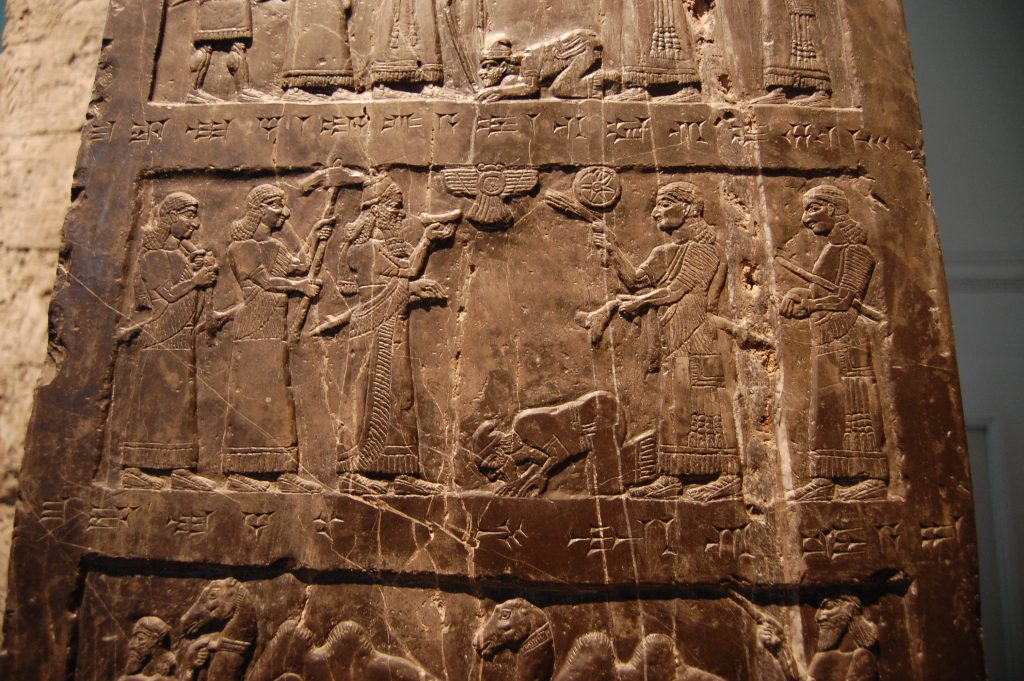
The writing above the scene gives the ruler’s name in an Assyrian form, Iaua, conventionally identified with Jehu. The caption lists valuable gifts, including silver, gold, gold vessels and tin, along with items of royal equipment. The list makes an impression of wealth while the relief shows the act of submission. A carved vessel is easier to recognize than the exact material or ancient name of a particular object, which is one reason to read the caption alongside the picture. The tribute publicly acknowledges Assyrian power. We learn little from the picture about the terms under which it was sent. ORACC, translation and commentary on Scene 2
The bowing figure is traditionally described as Jehu. The caption establishes that this tribute is Jehu’s and the artist represents it as an act of personal submission. Whether the ruler himself knelt before Shalmaneser or the scene stands for what his representative did is harder to establish. The sculptor has given us a stylized image intended to communicate hierarchy. If this is a depiction of the king himself, it gives us a rare ancient image of a ruler named in Scripture. Even if a representative made the journey, the strongest archaeological link remains the caption’s attribution of the tribute to Jehu of Israel. British Museum identification of the scene ORACC, interpretation of the bowing figure
Why the Assyrians used Omri's name
An English translation of the label may call Jehu “son of Omri” or describe him as being “of the House of Omri.” That is striking if you have just read 2 Kings 9. Jehu is introduced there as the son of Jehoshaphat, son of Nimshi. He takes power from Joram, a son of Ahab and grandson of Omri. In the new king’s own country, the overthrow marked the end of Omri’s line as the ruling dynasty. In Assyrian political language, Omri’s name had become attached to the kingdom founded around the capital he established at Samaria. The name was still intelligible when a different family occupied the throne. State Archives of Assyria, Israel as the House of Omri
There is a useful comparison across the Jordan. The Mesha Stele remembers Omri as the Israelite king who ruled over Moab, while 1 Kings 16:21–28 places him within the history of Israel and reports his establishment of Samaria. Omri’s prominence mattered to neighboring rulers as well as to Assyria. Even so, the Moabite and Assyrian uses of his name belong to different stories. Mesha is recounting a conflict over land that his country sought to recover. The Assyrian court is identifying the source of a payment. Care with the sort of claim each inscription is making helps us avoid turning the tribute caption into a genealogy.
The caption carries two stories at once. Jehu had taken the throne from Omri’s house, and Omri’s name still told the Assyrians which kingdom was paying.
Jehu's commission and the pressure from Damascus
Second Kings situates the revolt in a region already at war. In 2 Kings 8:7–15, Elisha foresees Hazael’s rise to rule in Damascus and weeps over the harm he will bring on Israel. At the beginning of chapter 9, a messenger from Elisha anoints Jehu at Ramoth-gilead, where Israelite officers are gathered. The wounded Joram is recovering at Jezreel. The author follows Jehu’s progress from the field to the royal household and recounts his attacks on the house of Ahab. By the time the tribute went to Assyria, Israel’s political leadership had changed in the midst of an existing struggle with its neighbor.
Shalmaneser’s other account of the same campaign offers a view from the northeast. In his eighteenth year, he boasts of defeating Hazael’s forces, pursuing him toward Damascus and devastating areas around the city. The inscription then records payments from the ruler of Tyre and from Jehu. It’s easy to see why a king under pressure from Damascus might seek accommodation with Assyria. That is an inference from the regional situation and the sequence of the account. Jehu’s diplomatic instructions and reasons are unrecorded. The independent notices establish the named rulers and a moment when their interests ran across the same corridor of land. Shalmaneser’s eighteenth-year campaign record
A companion view comes from the Kurkh Monolith. Twelve years earlier, in 853 BC, Shalmaneser had listed Ahab of Israel among the rulers whose forces faced him at Qarqar. Jehu’s later payment shows the change in how the two kings appeared in Assyria’s records. Ahab was represented as an opponent alongside the ruler of Damascus. Jehu was represented as a source of tribute in a campaign in which Damascus was the Assyrian target. The contrast helps explain how quickly regional alignments could shift. It also reminds us to read each inscription under its own date, even when both celebrate the same Assyrian ruler.
The inscriptions also differ in what they record about the rival king. The Black Obelisk’s interest in foreign relations includes the display of goods an empire could collect. The parallel annals linger on Hazael’s resistance and the Assyrian march around Damascus. In the Bible, the Lord reveals Hazael’s coming rule to Elisha before he takes the throne, and Elisha grieves for the people who will suffer. Placing those accounts beside one another helps us ask who bears the cost in a campaign. An Assyrian scribe counts what passed to his king. Elisha is concerned with families and fortified towns that a powerful neighbor could harm.
What the carving preserves
Cuneiform specialists have an advantage here because the image and its label survive in close company. An anonymous procession might have left interpreters weighing costumes, objects and artistic conventions without being able to name the ruler who sent it. An isolated tribute list could tell us about wealth and diplomacy while leaving the ceremony entirely to our imagination. Here we can compare both kinds of evidence on the same ancient object. The monument supplies a name and a carefully chosen way of representing the transaction, making the record unusually direct evidence for Israel’s place in an Assyrian ruler’s public account. CDLI, catalogue and text
What Scripture asks about Jehu's reign
Second Kings records Jehu’s destruction of the temple of Baal and the continuation of the golden calves at Bethel and Dan. It says God commended Jehu for carrying out judgment on Ahab’s house, then gives a judgment of its own about the direction of Jehu’s heart. He failed to follow the Lord’s instruction wholeheartedly. Later in 2 Kings 10, the focus turns to losses inflicted by Hazael across the Jordan. Scripture connects the fortunes of the kingdom to God’s dealings with his people. The depth of that account comes in part from its willingness to report Jehu’s obedience and failure within the same reign.
As Christians we trust the truth of that history. The Black Obelisk brings us closer to Jehu’s circumstances and lets us examine the posture, objects and vocabulary through which another court portrayed him. The pairing is especially telling at the end of the article. One source celebrates what came into Shalmaneser’s hands and engraves the goods above the procession. In the other, an Israelite king’s legacy turns on whether his deeds flowed from a heart devoted to the Lord. Both prompts send us back to 2 Kings to read Jehu’s story with greater attention to the choices he faced and how Scripture evaluates them.
Sources and further reading
- British Museum, The Black Obelisk of Shalmaneser III — Museum record for the monument’s discovery, date, material and five tribute scenes.
- Cuneiform Digital Library Initiative, BM 118885 — Catalogue record, dimensions, provenance and transcription of the main inscription.
- Jonathan Taylor, The Black Obelisk of Shalmaneser III (ORACC) — Specialist guide to the monument, the four panels in Jehu’s register and the listed tribute.
- Royal Inscriptions of Assyria online, Shalmaneser III 010 — Parallel annalistic account of the eighteenth-year campaign against Hazael and payments from Tyre and Israel, columns iii–iv.
- State Archives of Assyria online, Israel, the ‘House of Omri’ — Assyrian territorial usage of Omri’s name and context for the northern kingdom’s relations with Assyria.




