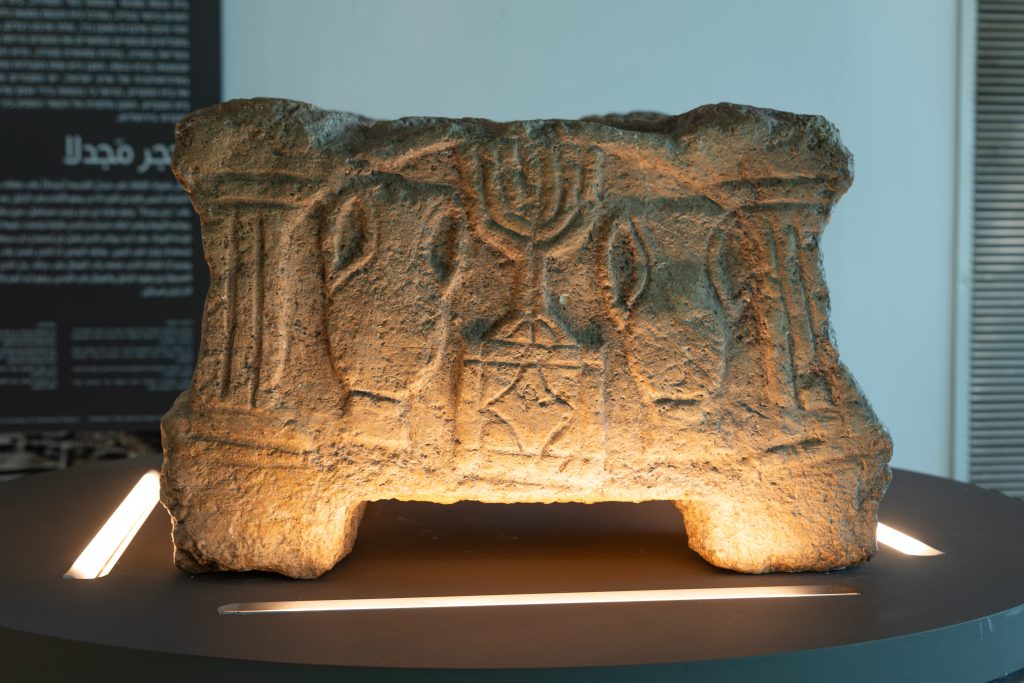
On one face of the Magdala Stone, a seven-branched lampstand rises between two vessels. It is small enough to take in at a glance. Once you know where the stone was found, though, the carving opens up a much larger question. Why did a Jewish community beside the Sea of Galilee put imagery associated with the Jerusalem Temple on a low stone in its synagogue? The lampstand is visible. The building context is documented. The way they fit together has kept archaeologists, historians of art, and readers of the Gospels asking good questions. Excavation report for Migdal
What you’ll learn
- Where excavators found the stone and how the surrounding room helps explain its purpose.
- Why a menorah carved in Galilee draws attention to Jerusalem.
- How the synagogue illuminates the setting of Jesus’ teaching in the Gospels.
The room beneath the modern site
In 2009 an Israel Antiquities Authority salvage excavation began in the northern part of ancient Migdal ahead of hotel construction. Dina Avshalom-Gorni and Arfan Najar directed work that continued through several seasons. A salvage excavation records remains before development or another disturbance can obscure or destroy them. At Magdala, the work exposed portions of a settlement on the northwestern shore of the lake. The synagogue appeared beside a road in the excavated quarter, among the traces of a place whose inhabitants had been building and rebuilding for generations. Avshalom-Gorni and Najar, introduction and Area C
A visitor looking down into the excavated space sees the lines of rooms most easily. In its report, the excavation team describes an entrance area leading into a more substantial room with benches and column bases. Portions of a mosaic floor survived, including a rosette in the margin. Painted decoration survived in fragments. The report records panels of several colors with contrasting framing. Together these finds help us imagine how different the room once felt from exposed stones in daylight. People invested care in the space that held their gatherings, with worked stone, color, and ornament visible to those who met there. Excavation report, figures 7–11
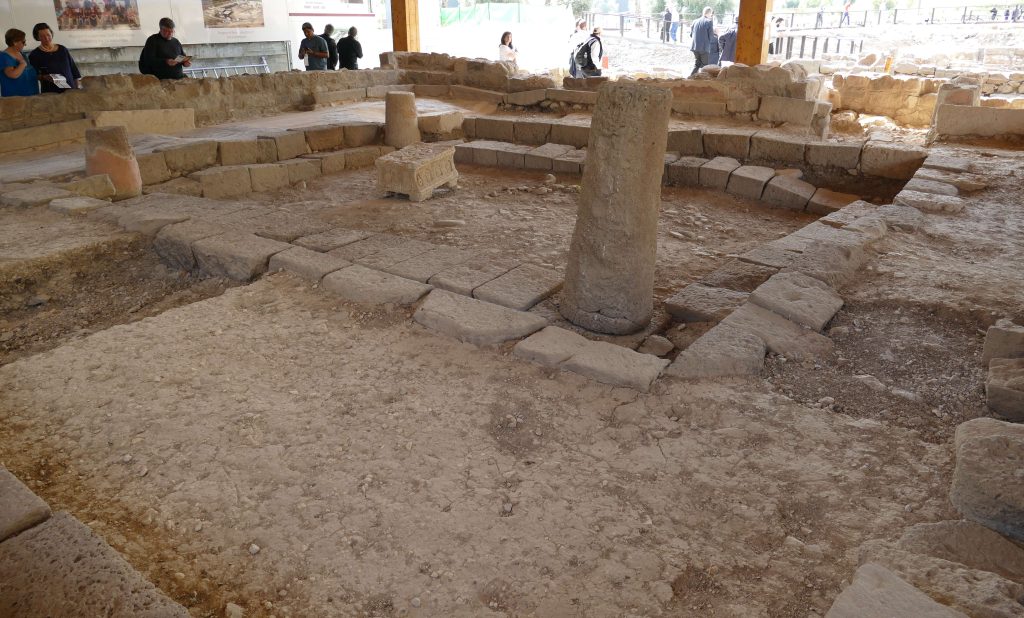
The report distinguishes phases of construction. An earlier structure stood on the spot, and the excavators identify the later phases as synagogue use. A coin dated to AD 43 was recovered from the foundation of a mosaic in the reading room. It helps date work connected with that floor because material incorporated beneath a mosaic had to be there when the floor was put down. It cannot tell us the exact year the room first served the community or the date the carved stone was made. The building’s history unfolds at a different resolution from the date on one coin. Matching the date to the particular feature is a good habit to take from this excavation. Excavation report on the phases and coins
The menorah within reach
In the main room the excavators found a low rectangular stone with four feet. Its top and sides were carefully decorated. The face most often photographed shows a seven-branched menorah, with a vessel and an architectural element on either side. On other surfaces are rosettes and architectural designs. Look at the published photographs face by face if you can. A single angle shows why the lampstand is famous. Several angles help you see why researchers have asked whether a series of images on different surfaces was meant to be read together. Metropolitan Museum exhibition catalogue, object 54
The seven branches draw us back to the lampstand prescribed in Exodus 25 for the tabernacle. By the first century the menorah also belonged to the remembered and visible worship of the Temple in Jerusalem. The stone at Magdala is especially valuable because of its local setting and date. The excavators identify it among the earliest surviving menorah images from a Jewish religious building. The carving gives us evidence that people in a lakeside community chose imagery associated with worship in Jerusalem while the Second Temple still stood. That choice helps us see the relationship between a meeting place in Galilee and a sanctuary farther south. Read Exodus 25:31–40 Excavators’ description of the carving
A community on the lakeshore carried the image of Jerusalem’s worship into the room where it gathered.
Scholars have suggested that other designs on the stone also refer to features or objects in the Temple. An image can summon the memory of a place without serving as a measured plan of it. Columns and arches, for example, belong to a visual language familiar in the period. The menorah gives a strong reason to consider the Temple when reading the rest of the carving. The identification of every motif involves further judgment about ancient art, the way the designs were arranged, and the role the furniture played. The Met catalogue is a useful point of comparison because it discusses both the imagery and the range of proposals for the stone’s use. Metropolitan Museum catalogue, object 54
What was the stone used for?
Its location in the main room suggests that it belonged to activities there. Its height invites a closer examination of what those activities could have been. Imagine the differences between setting a scroll down, standing to read from it, and putting it away after use. Furniture suited to one step might be inconvenient for another. The initial excavation report proposed a prayer table. Others have suggested the stone was a base for something made of wood, such as a raised reading platform. An ordinary piece of furniture can leave an archaeological problem when it was assembled from materials that survive at different rates. Excavation report on the stone’s position
Zeev Weiss proposed that this stone and comparable low stone tables served as stands on which to place the Torah scroll before, during pauses in, and after the public reading. He examines the Magdala example alongside related synagogue furniture elsewhere. That proposal accounts for the low height without asking the reader to read at that height. It also gives the object a specific role in a sequence of actions. The debate is a good example of what archaeologists and historians are trying to recover when they study a room. Arrangement, height, wear, comparison, and the place where an object was found can suggest what people did there. Weiss, Journal of Roman Archaeology
Setting the proposals beside one another makes their consequences easier to picture. A base for a taller wooden stand would have placed the scroll higher where it was read. A low rest for the scroll assigns the stone a job during other moments in the gathering. The decoration could carry meaning in either arrangement. That is why the imagery alone cannot resolve the question of furniture. The alternatives ask us to look at the stone both as a work of art and as something people used in a particular place. Those two kinds of attention reward different clues, even though both begin with the same object.
The findspot makes such questions possible. An elaborately carved block from an antiquities collection might invite a study of what the designs resemble. Here the excavators could describe the room, the prepared surface beneath the stone, and the benches nearby. That relationship gives the discussion a context beyond artistic resemblance. When you compare the synagogue photograph with the image of the stone, pay attention to how a small piece of furnished space can carry so much information about the activities that took place around it.
Reading Luke with the room in mind
Luke 4 takes us to a synagogue in Nazareth. Jesus stands to read, receives the scroll of Isaiah, and gives it back before sitting to speak. The Gospel locates the event, supplies the passage, and records the response of those who heard him. Magdala is a different Galilean town. Its excavated meeting room gives us a way to understand the physical world in which Luke’s account belongs. People could assemble around a reading space, hear someone handle and read a scroll, and sit together as they listened to an explanation of Scripture. The room and its furniture make those movements easier to imagine. Read Luke 4:14–30
Matthew describes Jesus teaching in the synagogues of Galilee as part of a wider ministry of preaching and healing. The Magdala find belongs to this regional setting. Christian tradition also associates the town with Mary Magdalene, whose importance is already clear from the Gospels. Luke includes her among the women who supported Jesus’ ministry. John tells of her encounter with the risen Lord. The stone names neither Jesus nor Mary. To ask what it reveals, look at the worship and material culture of the place, then let the biblical text tell the events it actually records. Read the Gospel passages
We believe Scripture is true and accurate. Reading it alongside archaeology gives its ordinary settings more substance. Before a congregation could hear a passage, someone had to bring the scroll to the reader. Before a gathering could listen, it needed a place to assemble. At Magdala, we can look at a room where such matters were worth planning for. In Luke, the room at Nazareth becomes the setting for Jesus’ declaration that the Scripture he has read is fulfilled in the hearing of those assembled. The examples fit together at the level of daily practice, and the meaning of Jesus’ words comes from the Gospel.
When you look at the stone again, begin by counting the branches, then walk your eye toward the other carved forms. Read the excavation team’s description of the room and think about who would have been able to see that face while sitting on the benches. The object rewards an interest both in the Scripture being read and in the people who built a place to hear it. The Sea of Galilee boat, found farther along the same shore, brings a different part of that world within reach. Its boards are a reminder of the work that supported communities with gathering places like this one.
Does the excavation establish that Jesus taught at Magdala?
Matthew describes Jesus teaching across Galilee. The stone and synagogue show a setting of the right region and broad period for his ministry, and neither identifies a particular visit.
Sources and further reading
- Dina Avshalom-Gorni and Arfan Najar, Migdal excavation report — Introduction and Area C document the salvage excavation, phases, stone, room, surviving decoration and coins.
- The Magdala Stone, Metropolitan Museum of Art — Catalogue object 54 with images, Second Temple iconography, and discussion of possible functions.
- Zeev Weiss, The Magdala Stone Table — Journal of Roman Archaeology 34, 2021, pp. 608–631. Compares low stands and discusses the stages of scroll reading.
- Luke 4:14–30 — Narrative of Jesus reading the Isaiah scroll in Nazareth.




