Somewhere inside a ridge below ancient Jerusalem, two crews cutting through limestone heard one another. A few cubits of rock still separated them. When the work was finished, water could flow through the passage from a spring to a pool. Six lines of ancient Hebrew carved into the wall near the lower end remember the breakthrough. Whoever wrote them thought the moment the workers heard one another was worth preserving. More than twenty-seven centuries later, the words remain legible enough for us to follow the last moments of the dig.
What you’ll learn
- How a water tunnel made a spring on the eastern slope accessible from the south end of Jerusalem’s ridge.
- What was noticed in 1880 and what the six lines of Hebrew actually tell us.
- How the tunnel’s rock, plaster and archaeological context inform the association with King Hezekiah.
Where the water was going
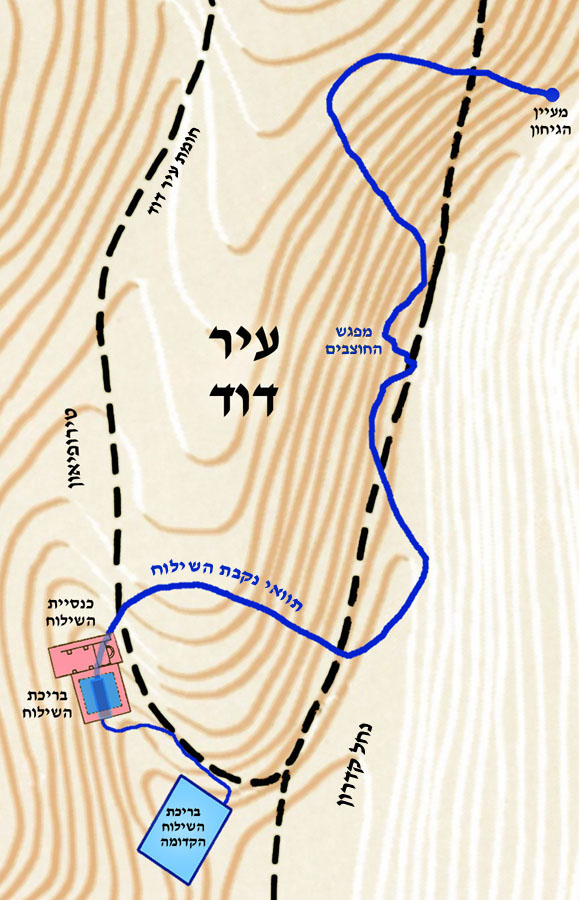
Start on the eastern slope of the ridge south of Jerusalem’s Temple Mount, above the Kidron Valley. The Gihon Spring rises there. Its location offered ancient Jerusalem a major advantage, and it posed a recurring problem for a city under threat. A spring is only as valuable as your ability to reach its water. A defended point of access can give you a way to reach the source. A conduit can carry the flow elsewhere. The remains around Gihon show that Jerusalem’s builders addressed these problems in several periods. Study of Jerusalem’s waterworks and their phases.
The Siloam Tunnel runs from the spring southward through the ridge to a lower outlet near its southern end. The passage itself repeatedly bends. Following the channel through the rock is not the same as drawing a straight line between the two ends on a map. It runs for roughly 530 meters, about a third of a mile. The long, low slope allows gravity to move water through the channel. There are points where the ceiling can crowd a walker and others where the rock opens high above one’s head. The experience of those shifts helps explain why the engineering attracts attention even before anyone begins to read the text.
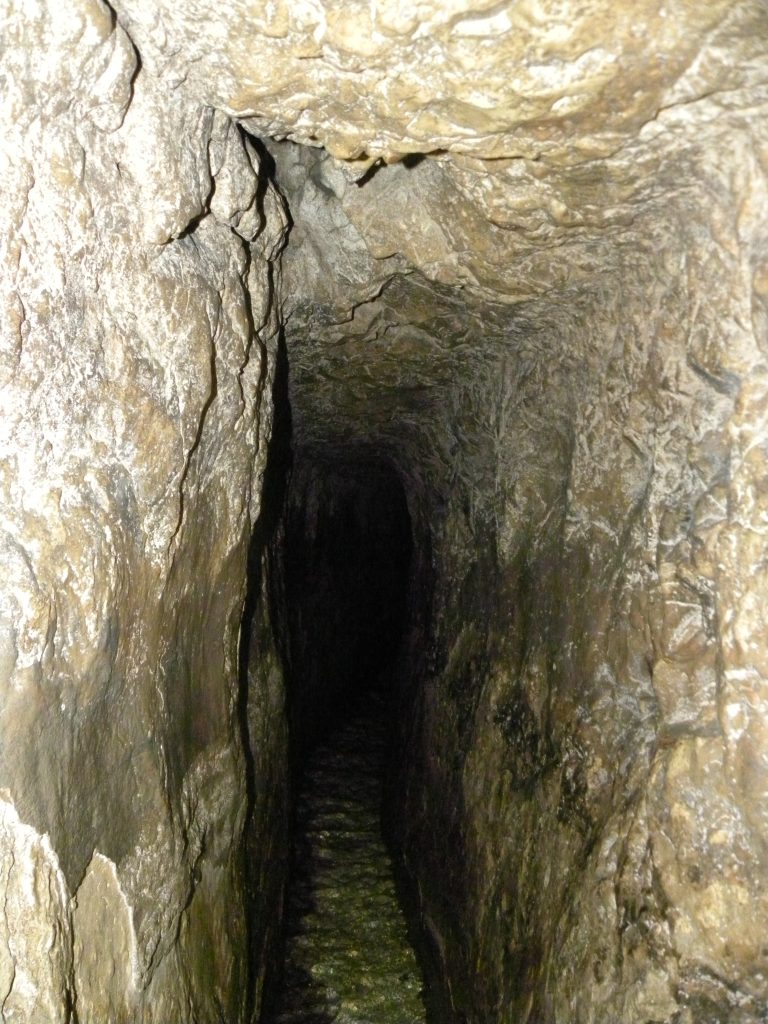
The first engineering challenge was intersecting the work coming from the other direction. The second was maintaining a workable grade while following a route far longer than the direct distance. In a tunnel that passes through bedrock without intermediate construction shafts, the workers could not repeatedly step out to check their position against a marker above them. The text records the crossing of the final gap, and geological study asks how the teams got close enough for that moment. Frumkin and Shimron argue for an intentionally cut passage and discuss changes in digging direction and the leveling required to move water. Researchers have debated the role natural fractures or acoustic cues may have played in the tunneling. Frumkin and Shimron’s geoarchaeological study.
What was found in 1880
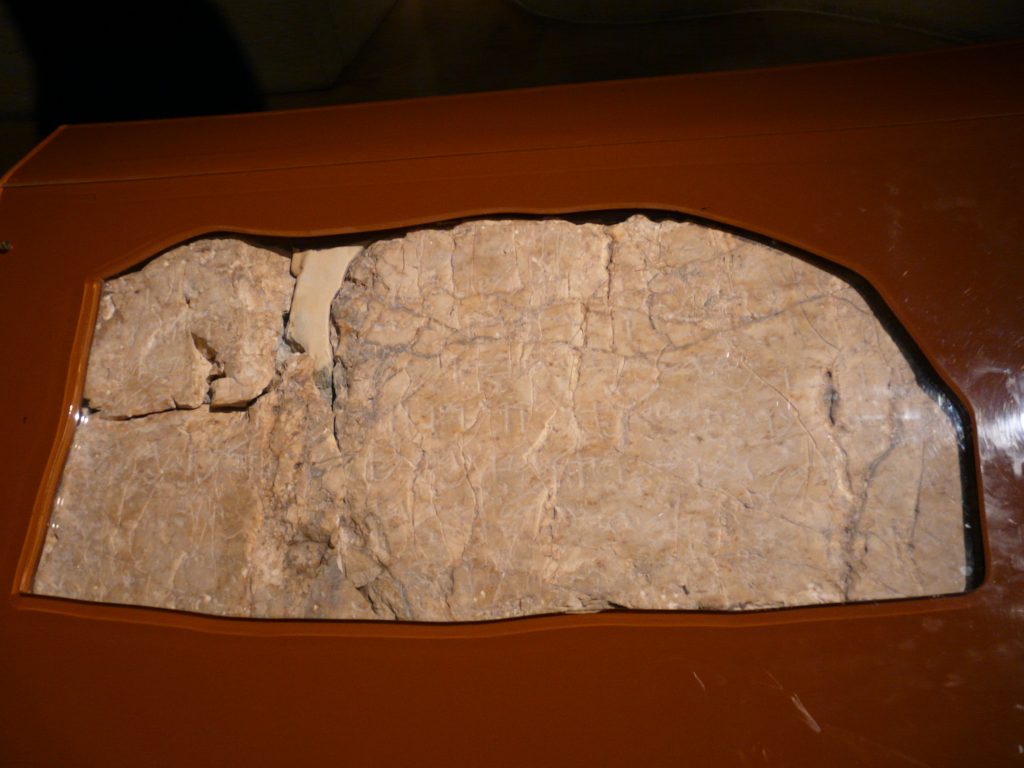
The tunnel was already known when its inscription drew the attention of modern researchers. The writing was noticed in 1880 near the pool end, cut shallowly into a prepared portion of the tunnel wall. Conrad Schick reported the find in the Palestine Exploration Fund’s Quarterly Statement. Early copies and impressions created records of the text. By 1891 the inscription had been cut out of the wall. It subsequently entered the collection now known as the Istanbul Archaeology Museums. The excavation context at the point of discovery, as preserved by early observers, is important because the writing itself describes the completion of the very kind of tunnel in which it was found. T. C. Mitchell, discovery and early documentation.
A photographic display makes the words easy to regard as an independent museum artifact. Imagine them back on the wall with water nearby. This was a place a person could stand or crouch and look deliberately at the text. The carving was part of the waterworks. The stone’s subsequent history explains why studying the object now means consulting both the museum panel and evidence gathered back in Jerusalem. The building project left two witnesses with different locations and different kinds of information.
Read the inscription in three steps
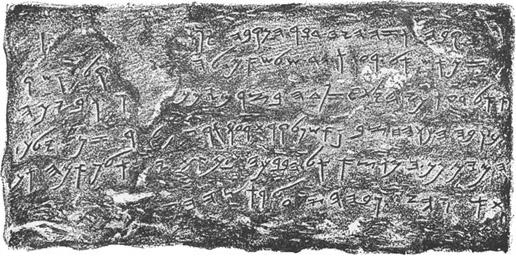
The writing runs right to left in an older form of the Hebrew alphabet. Its signs look different from the square Hebrew letters familiar from most printed Bibles. The language is recognizable to scholars even though damage obscures part of the opening. The following is a paraphrase of the surviving account. University of Michigan image record and translation.
- Men work toward one another. Near the last three cubits, one hears the voice of another on the far side.
- The crews meet, striking toward one another. The brief description turns the engineering problem into an audible and physical moment.
- Water runs from the spring to the pool over 1,200 cubits. The ending also gives a measure of the rock above the workers.
A cubit conventionally represents a forearm-based length, with several standards attested in antiquity. The figure of 1,200 cubits is in keeping with a long tunnel, but it should not be presented as an exact modern survey. The description gives us the focus of the ancient writer. It draws attention to the convergence and to the accomplishment of bringing water through. One word in the passage near the men’s voices remains difficult to translate. Some readings bring in a fissure in the rock. That reading and the mention of voices do not independently tell us the full procedure the crews used to guide the project.
The biblical books remember what the king made possible. The inscription remembers the moment the workers heard one another.
How the tunnel was dated
Letter forms and the style of the inscription point to the Iron Age, and the commonly given date is around the end of the eighth century BC. Physical dating came from a different set of clues. In 2003, Amos Frumkin, Aryeh Shimron and Jeff Rosenbaum reported radiocarbon and uranium-series results from materials associated with the tunnel. Organic remains within plaster and mineral deposits that formed in the passage offered ways to bound when it was made and in use. The researchers treated the combined results as evidence for an Iron Age II date and found the biblical association historically credible. Frumkin, Shimron and Rosenbaum, Nature 425.
It is easy to hear that a tunnel has been radiocarbon dated and imagine that the limestone gives the age of the excavation. The rock was already there. Dating an organic fragment tells you when that material ceased exchanging carbon, even if it was reused later. A mineral growth that formed inside the passage comes after the surface it formed on. Archaeologists and geologists therefore have to explain how their particular samples relate to the first work, subsequent plastering, repair or use. That sequence is part of the argument that gives the dates meaning.
Ronny Reich and Eli Shukron proposed an earlier date in the eighth century BC based on their excavations at the spring end. They interpreted the stratigraphic relationship around that end of the tunnel as evidence for construction before Hezekiah. That argument shifts the question to the physical sequence between the tunnel and the surrounding installations. It illustrates the difference between showing that a work belongs to Iron Age Jerusalem and pinning its construction to one ruler’s reign. The wider identification with Hezekiah remains a well-grounded, traditional reading of the combined evidence. Reich and Shukron, The Date of the Siloam Tunnel Reconsidered.
A 2025 study led by Johanna Regev helps put this work into a longer sequence. Its authors dated straw and other samples from the mortar of the Siloam Dam to around 800 BC. They argue that an earlier conduit, called Channel II, initially brought surplus water to the reservoir and that the Siloam Tunnel replaced it later. The dam’s date belongs to a different structure. For the tunnel, the authors caution that the earlier wood sample can precede its use in plaster, and the short-lived plant sample has a broad calibrated date range. The combined picture is of a city that returned to its water problems over generations. Regev and colleagues’ study of the Siloam Dam.
What Hezekiah did in Scripture
Second Kings 20:20 comes at the close of Hezekiah’s reign. Along with his other acts the writer recalls how he made a pool and conduit and brought water into the city. Second Chronicles 32 gives further particulars. The verses describing preparations against Assyria include blocking waters outside the city. Verse 30 connects Hezekiah with diverting the upper outlet of the Gihon and directing the water down toward the west side of the City of David. The two biblical texts refer to work on Jerusalem’s water supply, and Chronicles gives it a named spring. Put them next to the physical route and the Siloam Inscription and the association makes sense.
Keep the three claims distinct as you read them. The biblical authors name the king and explain what he accomplished. The Siloam Inscription names neither Hezekiah nor Sennacherib and does not mention a siege. It describes the cutting and flow of water. The tunnel connects a known spring and lower outlet and preserves evidence about the work and its age. Seeing where those witnesses overlap gives the Hezekiah association substance. Their independent details also leave room for questions about dates and stages of construction that a short carved account could never have been expected to answer.
The name Siloam occurs in the New Testament too. John 9 sends the man born blind to wash at the Pool of Siloam. The pool and water system remained part of Jerusalem’s geography long after the Iron Age, through later building and remodeling. The ancient Hebrew inscription belongs to the tunnel’s Iron Age story. Readers comparing it to John will want to keep the tunnel’s construction separate from the pool structures in use centuries later.
Preparation and trust in the life of Jerusalem
The biblical chapters set the waterworks within a larger account of human decisions and dependence on God. In 2 Chronicles 32, Hezekiah prepares for the Assyrian attack with repairs, weapons and water measures. He also calls the people to courage because the Lord is with them. We read that testimony as true, and for us the care put into the city’s defense is a particular detail worth dwelling on. Jerusalem needed water with or without enemy soldiers in sight. Digging and maintaining a channel was slow, hard work whose effect would reach households the builders would never meet.
Read the Taylor Prism for the other side of the danger Judah faced at the end of the eighth century. Assyria’s official account makes victory the measure of a king’s power. The Siloam text brings you down to people shouting through rock so that a city will have water. Both are part of the world Scripture asks us to enter. Hearing the voices of those workers puts human strength, foresight and labor beside Hezekiah’s recorded trust in God. The work under the ridge has a scale and a sound of its own now, and the biblical account is easier to picture.
Sources and further reading
- University of Michigan, Siloam Tunnel Inscription — Image record with an English rendering of the six-line text.
- T. C. Mitchell, New Light on the Siloam Tunnel Inscription — Discovery and nineteenth-century documentation, text and technical vocabulary.
- Frumkin, Shimron and Rosenbaum, Radiometric Dating of the Siloam Tunnel, Jerusalem — Original analysis of plaster inclusions and mineral deposits, Nature 425, pp. 169–171.
- Frumkin and Shimron, Tunnel Engineering in the Iron Age — Approach to routing, limestone, water deposits, slope and direction of excavation.
- Reich and Shukron, The Date of the Siloam Tunnel Reconsidered — Alternative earlier construction date based on archaeological relationships at the spring end.
- Palestine Exploration Fund, Survey of Western Palestine, Jerusalem (1884) — Early surveys, historical observations, and the length reported in the inscription.
- Regev and colleagues, Radiocarbon Dating of Jerusalem’s Siloam Dam — 2025 radiocarbon analysis of the dam and discussion of how an earlier channel and the later tunnel fit together.
- Israel Antiquities Authority, The Largest Dam in Ancient Israel — Official film about the excavation and dating of the dam near the Pool of Siloam.





