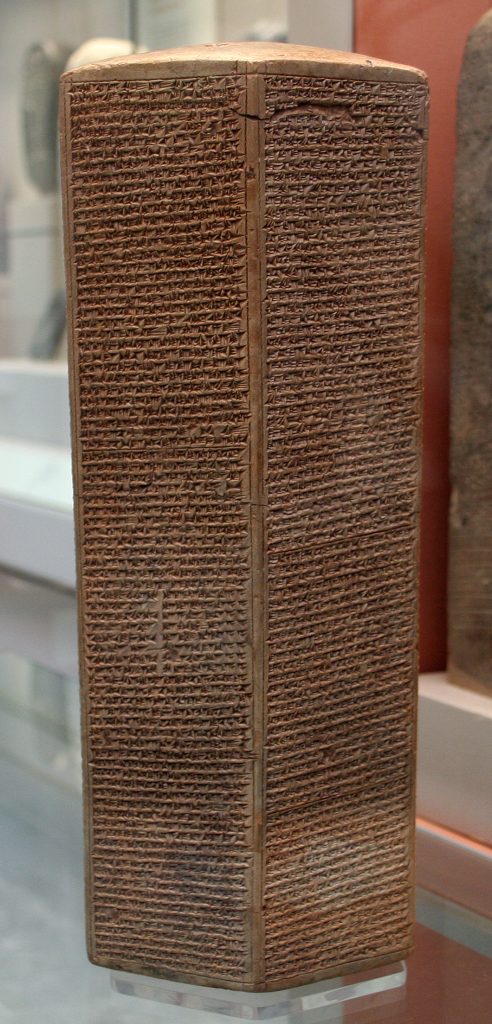
Among the closely packed lines on a six-sided clay prism, King Sennacherib of Assyria describes shutting up Hezekiah in Jerusalem like a bird in a cage. The image is memorable in part because of what happens to the bird. The king remains within the city the Assyrians have surrounded. The account lists towns taken away from Judah and treasure sent to Nineveh. Its author has every reason to boast of a victory and supplies a long catalog of successes, yet the conquest of Jerusalem itself never appears in that catalog.
What you’ll learn
- When the campaign happened and how its account reached the British Museum.
- What the prism says about Jerusalem, the towns of Judah, and Hezekiah’s tribute.
- How to read the shared details and the different silver totals in 2 Kings and the Assyrian annals.
A campaign recorded a decade later
Sennacherib came to the Assyrian throne after Sargon II died in 705 BC. His third campaign took him west in 701 BC. The Taylor Prism itself dates to 691 BC, around ten years after the events in Judah. Its manufactured shape and densely ruled columns speak to a court with trained scribes, established writing conventions, and the resources to preserve its preferred account of military history. Read down a column and the writing resembles a pattern until you learn to see the signs. Each sign is made of wedges pressed into clay. The regularity of those wedges is part of the work of producing an official record. British Museum object account.
A foundation record accompanies royal construction and preserves an account of the ruler’s deeds. That setting helps explain why the annals combine military campaigns with an account of building at Nineveh. Campaigns show what the king says he accomplished abroad. The building account shows what he invested in his capital. The two belong together as statements about how Sennacherib wanted his reign remembered. A victory account in this setting can preserve real names and events while arranging them to heighten the king’s glory.
The prism takes its modern name from Colonel Robert Taylor, the British political resident at Baghdad. It is conventionally associated with his acquisition around 1830 and with ancient Nineveh, often specifically Nebi Yunus. Its exact find circumstances are uncertain. The British Museum acquired it in 1855. That distinction matters if you want to understand what archaeology can recover from an object. The ancient text can be located and compared with other clay copies even when the early collecting history lacks the details of a modern excavation. Grayson and Novotny, text 22, provenance discussion.
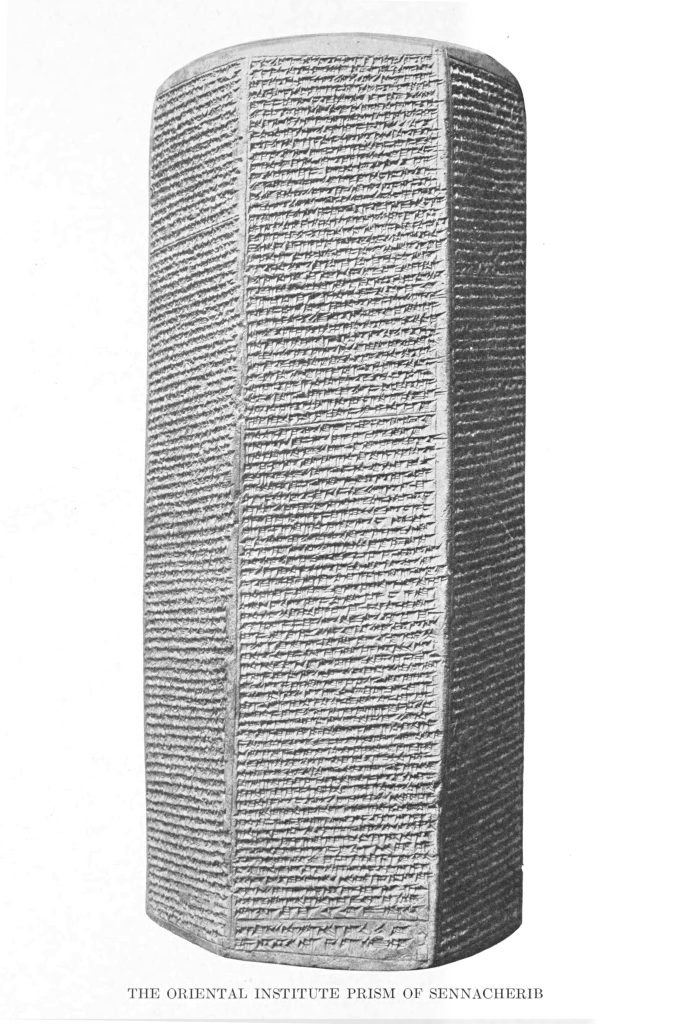
The Chicago Prism, in the University of Chicago’s Institute for the Study of Ancient Cultures, is a separate copy dated 689 BC. In their edition of the annals, A. Kirk Grayson and Jamie Novotny follow the Chicago copy as the principal witness for text 22 and identify the Taylor Prism as another exemplar. When a translation on the web calls itself the text of the Taylor Prism, it may actually follow the shared scholarly edition. The distinction is useful if you want to match translated words to a particular photograph or compare how versions preserve a line. Chicago Prism collection record.
How Assyria came to Judah
Judah is one part of the third campaign, as a glance at the surrounding lines shows. Sennacherib claims to have put down resistance along the coast and reasserted control over rulers and cities that had challenged Assyria. Ekron supplies an example of the local choices at stake. Its leadership had removed Padi, a ruler loyal to Assyria, and delivered him to Hezekiah. The Assyrian account describes a battle involving an Egyptian and Kushite force before it presents the punishment of Ekron and the restoration of Padi. Judah was embroiled in the political affairs of its neighbors as well as defending its own territory.
It is worth returning to 2 Kings 17 before reading the encounter. Samaria, the capital of the northern kingdom of Israel, had already fallen to Assyria. Judah now faced a power with a history of taking fortified capitals and moving people from their homes. Second Kings 18 portrays Hezekiah as a king who trusted the Lord and rebelled against Assyrian rule. In the absence of a modern map, that small pair of details supplies the scale of his decision. Hezekiah governed a kingdom that could see what had happened to its neighbor and had little reason to assume it would enjoy an easier campaign.
Jerusalem’s survival is one of the striking facts of the campaign. Judah paid a terrible price around it.
What the court says it accomplished
In the Judah section, Sennacherib credits himself with taking forty-six fortified settlements and smaller towns beyond that count. He lists siege works, prisoners and animals, and says he handed some of Hezekiah’s territory over to rulers of Ashdod, Ekron and Gaza. These are claims made by the Assyrian court. Because the account does not provide a list of all forty-six sites, the precise figure cannot be checked town by town. The wider pattern of devastation, by contrast, is consistent with the sweep of 2 Kings 18:13 and with direct evidence for the capture of Lachish. Royal annals, text 22, column iii, Judah section.
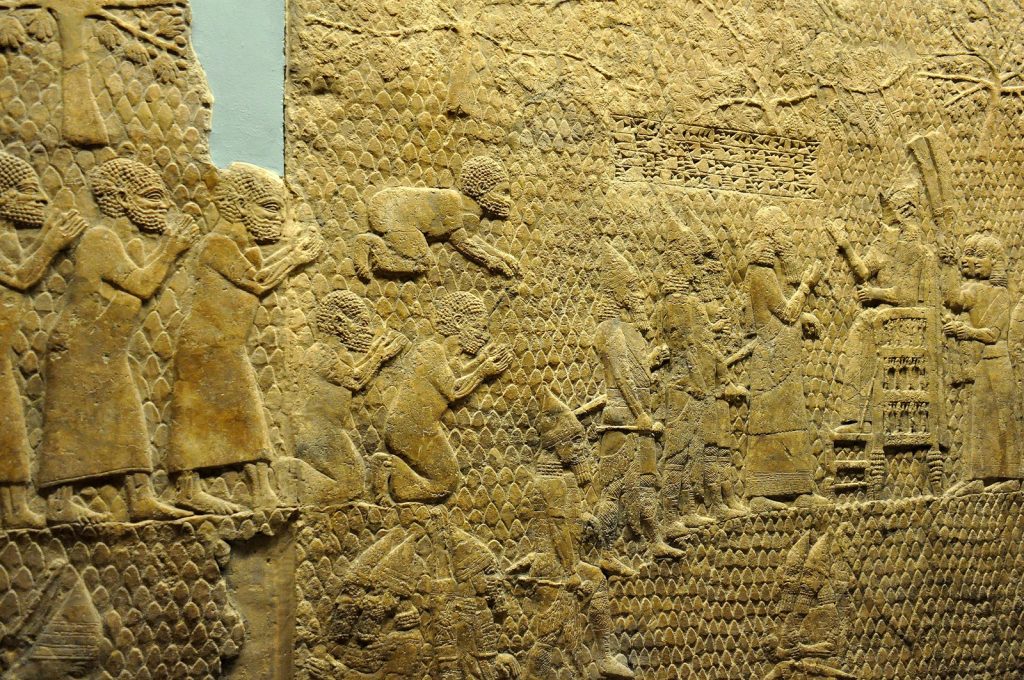
The Lachish reliefs preserve the difference between the city that fell and the capital that remained. One panel gives the name of Lachish next to the scene of Sennacherib reviewing prisoners. The reliefs cover the siege and deportation at a named town. The prism offers a broad campaign record and names Jerusalem as the place where Hezekiah was confined. As royal productions, both display the king’s power. Their claims have different geographical reach. The panel underlines why it matters to ask which town a source describes before treating a picture of captives as a picture of Jerusalem’s fate. British Museum, Lachish relief and its label.
Hezekiah appears in the text as the ruler of Judah. Jerusalem is his royal city. The Assyrian scribe uses a simile traditionally rendered as putting him in the city “like a bird in a cage.” The picture conveys a trapped ruler and a constrained capital. It offers no report that the Assyrians marched through Jerusalem’s gates, deposed its king or installed a replacement there. That omission is especially worth noticing next to the explicit accounts of taking cities and replacing rulers elsewhere in the campaign. Kings does not depict Jerusalem as escaping the danger unscathed. It shows a capital placed under threat after other towns were attacked.
A visitor might ask what would count as an archaeology of a siege ending. A destruction layer can indicate a city burned. A captured city may appear in the annals, in imagery, or in records of people moved elsewhere. A city surviving can leave a much less conspicuous record. We can weigh the convergence of the two narratives and the conspicuous absence of a claim to have captured the city. The Assyrian text can bear that historical weight. It supplies no diagnosis of the deaths that 2 Kings 19 describes or an admission by the king of Assyria that Jerusalem’s God had delivered it.
The tribute that both witnesses remember
Read 2 Kings 18:13–17 with a finger on the verses. First the author describes the seizure of fortified towns. Hezekiah sends word to the Assyrian king at Lachish and agrees to pay whatever is imposed. The author then explains where Hezekiah gets the money, from the temple and palace treasuries and even the gold he had put on the temple’s doors and doorposts. In the following verse an Assyrian delegation comes from Lachish to Jerusalem. The payment in the text supplies no guarantee that the danger has passed.
- In 2 Kings 18:14, the amount imposed at Lachish is thirty talents of gold and three hundred talents of silver.
- In the Assyrian annals, thirty talents of gold and eight hundred talents of silver appear in the account of what was sent after Sennacherib to Nineveh.
- The Assyrian account includes additional valuable goods and people. The biblical narrator focuses on what Hezekiah paid and on its cost to the temple and palace.
A talent was a unit of weight, and ancient economies did not all use identical standards. A difference in standards is one possible question to investigate. It would take evidence for the particular systems used by each recorder and a conversion that fits the surviving figures to establish that explanation. The texts could also count different components or describe different stages of payment. The Assyrian setting in Nineveh and the biblical setting of the demand at Lachish allow that possibility, while neither of these surviving descriptions supplies an itemized record of two separate payments. The figures remain a genuine point of difference to keep on the page.
The gold amount and the names belong on the page too. A careful comparison gives each detail its appropriate weight. The two texts agree that Sennacherib’s campaign overran Judahite fortifications, reached Hezekiah and his capital, and extracted an expensive payment. They remain distinct witnesses with different interests. Their accounts give us more to work with together, and a closer look at one number directs our attention to what historians need in order to explain it. Royal annals, text 22, tribute and editorial note comparing 2 Kings 18:14.
Hezekiah’s prayer and the question of power
Isaiah 36–37 tells the same crisis around Jerusalem in close parallel with 2 Kings. The Assyrian spokesman challenges the choices Judah has made, mocks its reliance on Egypt, and then speaks as if the Lord must suffer the fate of the gods of every city Assyria has conquered. Hezekiah takes the threat into the temple and asks that the kingdoms of the earth may know the Lord is God. For Christians reading Scripture as true and trustworthy, this is the center of the story. Jerusalem’s people are afraid for their own lives, yet the prayer opens out to the question of who the nations will recognize as God.
Second Chronicles 32 adds the work of preparing the city, including managing the water supply and strengthening defenses. Those details make it possible to picture Jerusalem as a vulnerable place where inhabitants have to make decisions about food, water and walls. The contemporary Siloam waterworks and its ancient inscription give us a different kind of evidence for the skills Judah could put into such a project. A water conduit answers a material problem. Hezekiah’s prayer brings the city’s existence before the God who had made promises to his people. Both kinds of attention belong in an honest reading of the crisis.
Return once more to the clay prism. Sennacherib invested substantial care in the way his court told his victories. As one of its readers twenty-seven centuries later, you can see Judah from his court’s side for a moment. Then read 2 Kings 18–19 again and listen for all the people its perspective brings into view: frightened people on a wall, messengers, a king who knows the limits of money and force, and the prophet who carries God’s answer. Archaeology helps us hear how plausible Assyria’s threats would have sounded. Scripture tells us why they did not have the last word.
Sources and further reading
- Grayson and Novotny, The Royal Inscriptions of Sennacherib, Part 1 — Text 22, p. 167 and following, provides the principal edition, prism witnesses, campaign account and tribute notes.
- British Museum, Taylor Prism object presentation — Object BM 91032, dating and campaign context, physical form and description of the attack on Judah.
- Institute for the Study of Ancient Cultures, Chicago Prism A2793 — Separate version of the annals, dated 689 BC.
- Iraq, study of the British Museum’s Sennacherib prism acquisitions — Collecting history and the Taylor Prism’s 1855 acquisition.





