A photograph of a broken inscription can leave you wondering how anyone reads it. The jagged edge runs through the words, and a published translation may still look like an ordinary paragraph. Between those two views is the work of an epigrapher, a scholar who studies inscriptions. One skill can make that work easier to follow. Read the photograph, the edited text, and the translation as three related pieces of evidence. See which letters emerge from the surface and where an editor has supplied a possible reading.
We can try this with two discoveries that illuminate biblical history. Broken Aramaic fragments at Tel Dan preserve a group of letters generally understood as “House of David.” A broken Greek letter from Delphi names Gallio, the Roman official before whom Paul appears in Acts. Christians receive Scripture as true and accurate, so we have good reason to pay close attention to ancient documents from its world. Studying what survives lets us value the details they actually give us and understand why a reader can have more confidence in one part of the same text than another.
What you’ll learn
- How the photograph, edited lines, and translation work together.
- How to recognize restored letters, uncertain readings, and unresolved gaps.
- Why the name of David’s dynasty and the name of a Roman official can be clearer than the lines around them.
Start with the surface
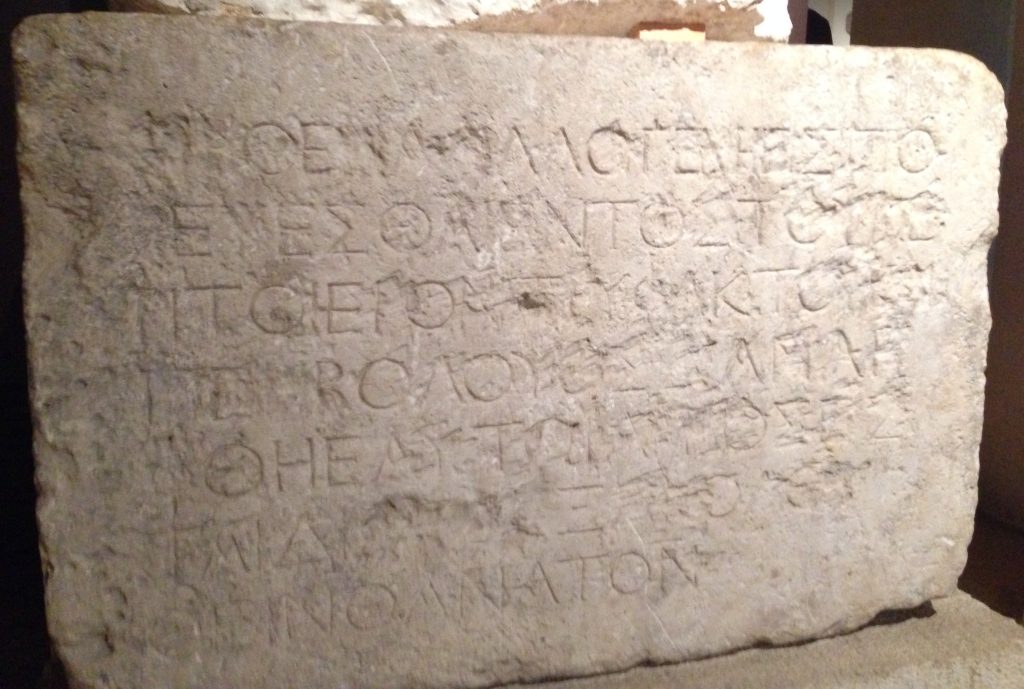
The Jerusalem Temple Warning Inscription survives as a comparatively complete example. Its lines fit within the width of a dressed stone. Even if you have never read Greek, you can see that the characters were cut at fairly regular intervals and that the beginning or the end of a line can be a design feature. Compare that orderly boundary with an edge that breaks through a letter. Different kinds of edges lead to different questions. A complete margin helps identify where the cutter set limits. A broken edge may be where a translator turns to a proposed restoration.
On fragments, the first step is to distinguish letters from irregularities of the material. An angled light can make shallow marks easier to see. A photograph taken from another direction can help distinguish a surface crack from an intentional stroke. Researchers can also compare several photographs or consult an impression taken from the surface. Even then an apparently promising mark might be the remains of several possible characters. An editor asks how much of a stroke appears and how it lines up with the rest of the inscription. Looking at the surface is a systematic task before it becomes a reading task.
The relationship between fragments deserves the same attention. If two broken edges physically fit, the fit gives a reason to align the writing on either side. If the fragments cannot be joined edge to edge, other clues come into play. A common height for writing, matching material, a related line of argument, and similar letter forms can support the idea that they came from one monument. A display mount might put the fragments in a proposed arrangement. An edition that explains how the arrangement was reached gives you a way to ask whether another placement is possible.
Learn three signs used by editors
Exact conventions vary with the publication. A Greek edition may make it easy to follow the visible words even when an English version runs smoothly through its gaps. Start with the edition’s own note on notation. Readers often encounter a set of conventions associated with the Leiden system, used in various forms across epigraphy and papyrology. They make visible choices that a translator would otherwise have to describe repeatedly. King’s College London, conventions for Inscriptions of Aphrodisias.
- Square brackets can enclose letters the editor restores where the original is lost. Think of a hypothetical phrase like “the [gover]nor.” In that example, the first part is supplied and the ending survives.
- A dot underneath a letter can mark a damaged sign whose identification is uncertain. A visible mark supports the reading, with some room for another identification.
- Dashes or dots in brackets can signal a gap that remains open. Editions differ in how they indicate whether the number of missing characters can be estimated.
A bracket gives you another piece of information. It shows where the editor’s reasoning enters the line.
The same marks can appear in quite different circumstances. A missing letter can be clear from a particular spelling or formula. Several missing words may depend on a more speculative reconstruction. The bracket marks both as supplied. The evidence for the choice tells you how much confidence to place in it. Letter height, the space available, grammar, and wording from other inscriptions can all constrain a restoration. When an edition supplies two alternatives or leaves a gap, it is making space for any reader who wants to follow the evidence to that point.
Try it at Tel Dan
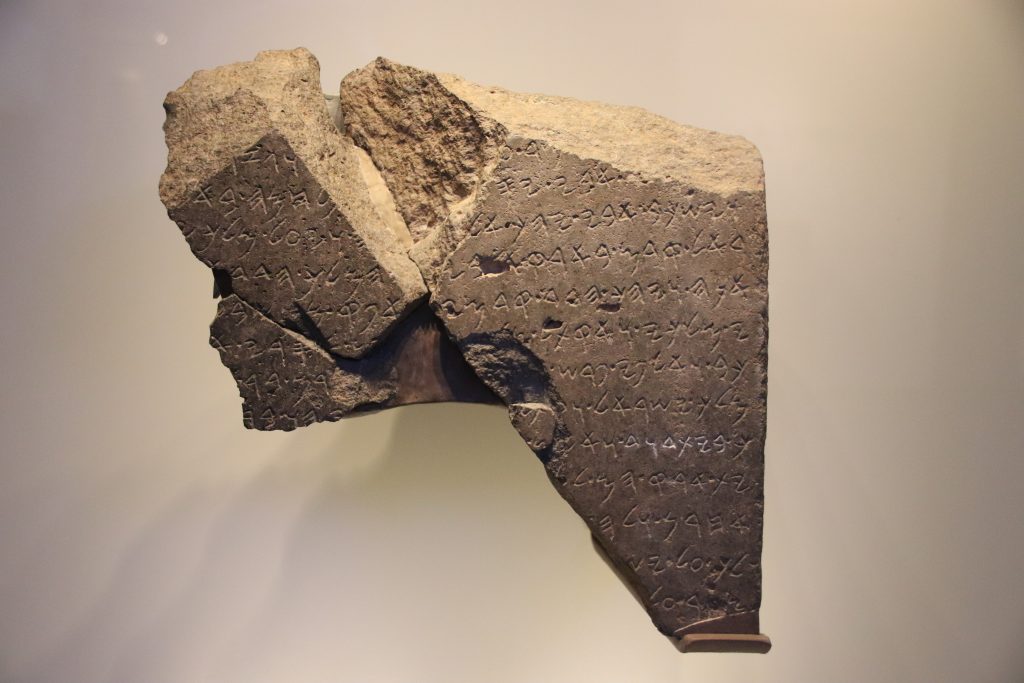
The Tel Dan Stele comes from a northern city whose remains include a major gateway. Excavators recovered the largest basalt fragment in 1993 and two smaller fragments the next year. The stone had been broken and reused. The writing belongs to an Aramaic royal text, and scholars have proposed connections with the wars of the ninth century BC. On the larger piece, six letters are commonly transcribed bytdwd. Epigraphers compare the group with ancient expressions for a ruling house or dynasty. “House of David” is the widely accepted interpretation of those letters. Biran and Naveh, primary report.
The notation bytdwd transfers the letters from the ancient script to familiar Latin characters. That is transliteration. English words such as “House of David” supply the meaning and the spaces a modern reader expects. That is translation. These are two separate decisions worth recognizing, especially when a few letters carry much of the historical interest. A reader may accept the six characters and ask how they should be understood together. In both cases the photographed stone remains the point of contact. A printed word can look as complete as any other on the page, and transliteration lets you ask what visible sequence the word represents.
A careful reading can move outward from those six letters to consider the surrounding damage. Where does a line break? Where are the other royal names partly lost? What arrangement of fragments does the edition propose? The argument for reading the dynastic name is distinct from an argument that assigns every nearby name or identifies the king who commissioned the monument. A reader encountering a smooth translation can look back to see where these judgments enter. Michael Langlois’s study compares fragment arrangements and shows how a proposal about placement can affect which neighboring letters and words can be reconstructed. Langlois, reassessment of fragments and readings.
In 2 Samuel 7, God promises to establish David’s house. The promise reaches through David’s descendants and beyond the lifespan of a single king. The broken stele attests how a foreign royal text could recognize Judah’s ruling house by David’s name. Samuel tells the story of the promise, and Luke 1 presents Jesus as the heir to David’s throne. A Christian reader can appreciate the weight each source carries. The stone preserves an ancient dynastic expression in a setting of political rivalry. The scope of the biblical promise comes from reading the biblical passages. 2 Samuel 7 and Luke 1.
Try it again at Delphi
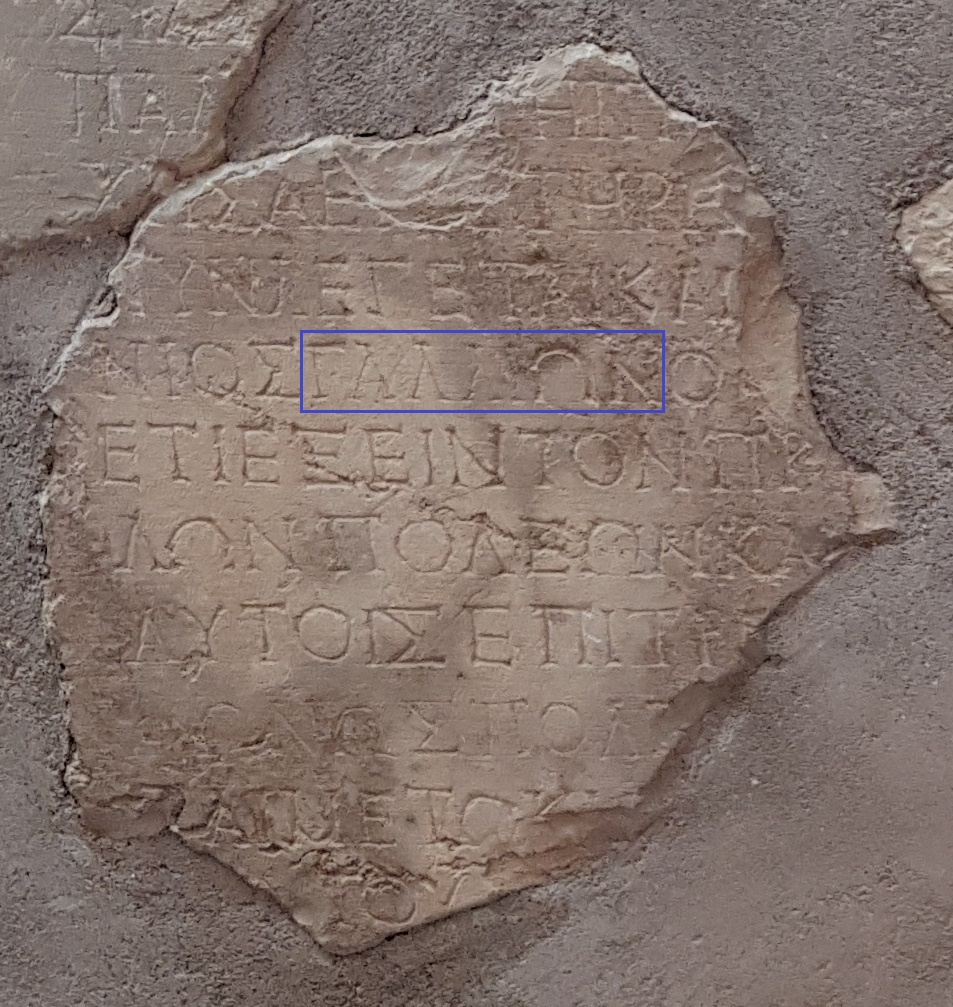
The Delphi Inscription preserves parts of a Greek letter from the emperor Claudius. The communication concerns a decline in the city’s population. Its connection with Scripture comes from the way Claudius identifies the official who had informed him. Open the Packard Humanities Institute edition and look at lines 5 and 6. You can spot Gallio as Γαλλίων. Nearby, the editor prints the word for proconsul with part of it in brackets. The line makes a useful exercise because the name, the partly restored words, and the title belong to the same sentence. Greek text of the Delphi letter, lines 5–6.
Take the sequence printed as κα̣[ὶ ἀνθύ]πατος. A letter before the bracket is dotted because it is uncertain. The bracket contains supplied letters. The ending after the bracket is printed without those marks. The surrounding sentence and an official term that ends this way help explain why an edition can plausibly read “and proconsul.” A line with missing parts can give a convincing reading when the readable part, the grammar, and the type of document point together. That is a different situation from a gap long enough to fit several unrelated phrases. James H. Oliver on the letter and its wording.
Acts 18 places Paul before Gallio while he is proconsul of Achaia. The independent letter places the official in recognizable Roman administration. Other parts of its opening help constrain when the emperor sent it, which is why this damaged text matters for dating Paul’s ministry in Corinth. Because that line of reasoning depends on multiple details in the document, the edition retains the visible evidence and the restorations. You can trace what survives for yourself before following the broader connection with Luke’s account. Acts 18:12–17.
Try a quick reading of a new discovery
When you encounter a claim about an inscription, try writing down one line about each layer of evidence.
- Locate one phrase in the edition and identify which letters are shown as surviving.
- Explain the proposed reading and name the type of evidence that supports it, such as grammar, another official formula, or a physical join.
- Identify the historical claim that reading supports and the other evidence you would need to go further.
Start with a short phrase. If several readings compete, the layout and notation can help you identify the point where they diverge. Disagreement sometimes centers on whether a scratch is intentional, whether a fragment joins another, or whether a proposed word fits the space. Those are concrete questions. The best test of a wide claim may begin with one surviving stroke or with a word an editor has placed in brackets. The Mesha Stele, where an early paper impression and a surviving stone both matter, provides a useful next case.
Ancient inscriptions are thrilling to read because someone chose these particular words for a public purpose. The cutters at Tel Dan and Delphi left us surfaces that preserve part of their world. Time and human action took away other parts. The Bible gives us a reason to learn the names of a dynasty and an official, and the inscriptions give us something we can work through in their own settings. Read the photograph and the printed lines together. You will see how much a small number of letters can tell and how carefully an honest translation can preserve the reach of that evidence.
Sources and further reading
- Inscriptions of Aphrodisias, epigraphic conventions — King’s College London hosted edition and description of notation.
- Avraham Biran and Joseph Naveh, An Aramaic Stele Fragment from Tel Dan — Israel Exploration Journal 43 (1993). Primary report and early edition, including the reading of the royal-house expression.
- Michael Langlois, The Tel Dan Inscription after 30 Years — Israel Exploration Journal 74(2). Compares fragment arrangement, surviving strokes, and readings.
- Packard Humanities Institute, Fouilles de Delphes III.4, no. 286 — Greek scholarly edition, lines 5–6 for the example with partially restored wording.
- James H. Oliver, The Epistle of Claudius Which Mentions the Proconsul Junius Gallio — Study of the Delphi inscription and its civil context.