At a ruined Philistine sanctuary, excavators recovered a stone whose inscription names the city where it stood. The five lines identify the builder as Achish, son of Padi, ruler of Ekron. They also name four generations of his family and ask his patron goddess for blessing. This is a rare chance to read how a ruler of a city familiar from Scripture spoke of his own work and his dependence on the divine. For archaeologists, the inscribed name and the place where it was found make an especially strong case that the mound called Tel Miqne is biblical Ekron. Gitin, Dothan and Naveh, first publication
What you'll learn
- How a stone built for a temple helped identify the mound with Ekron.
- Why an Assyrian court called this ruler Ikausu, and where his father appears in Sennacherib’s records.
- How to read the temple inscription beside Scripture’s accounts of the Philistines across different centuries.
A royal dedication in the sanctuary
Seymour Gitin and Trude Dothan led excavations at Tel Miqne, near modern Revadim in Israel. In 1996 their team recovered the inscribed block in the inner sanctuary of the building designated Temple Complex 650. Excavators published the inscription the following year. A field number identifies the find within the excavation records, and the final reports describe it alongside other written finds from the complex. Its recovery in a documented building associated with the late Iron Age town makes its context unusually informative. Here the mention of Ekron comes from a dedication to a building excavators could identify and study. Gitin, Dothan and Naveh, pp. 1–16 Tel Miqne–Ekron final field report, object 7310
The block is limestone, wide enough for several short lines. The sign shapes and the city’s archaeological phase place the dedication in the seventh century BC. The kings named in the text give researchers an additional point of comparison with documents kept under Assyrian rulers. Those different kinds of evidence sharpen the date and strengthen the site identification for different reasons. The findspot links the stone to its sanctuary. The carved words link the sanctuary and its royal builder to the city of Ekron. The Assyrian records put individuals named on the stone into the history of the late eighth and seventh centuries. Gitin and Dothan, site synthesis
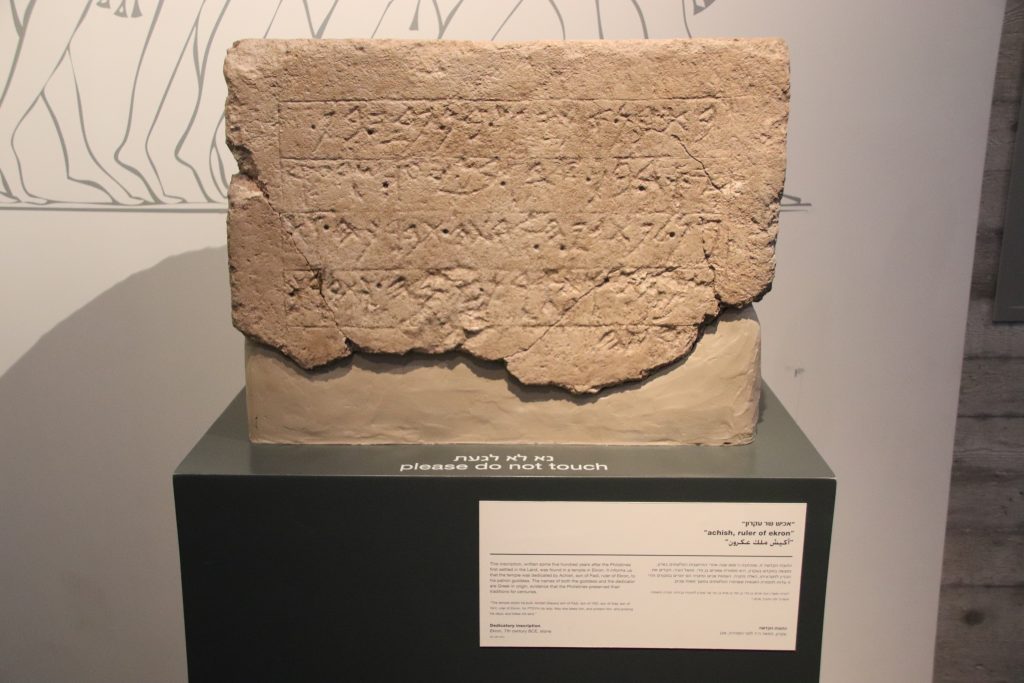
One reason the name matters so much is that buildings and broken vessels can be excavated long before anyone knows how their inhabitants referred to the town. Archaeologists can compare a mound’s position with written routes and notices about nearby places, and those comparisons had already led scholars to propose Ekron here. The dedication makes a direct connection. Its title identifies the temple builder as ruler of Ekron in the temple he built. A small object found without its excavation setting might have traveled any distance. The building context and the royal statement together give the place name much more force. The excavators’ discussion of identification and setting
The names and the blessing
The inscription identifies its builder and then works backward through his paternal line. Transliteration preserves the consonants, so English renderings vary in how they spell the names. The sequence usually appears as Achish, Padi, Yasid, Ada and Ya’ir. The title ruler of Ekron belongs to Achish. The family list gives the dedication a sense of continuity and helps the reader see what the rest of it is asking to preserve. Temple building had a place in the public presentation of power, and this particular text ties the new building to a man and his lineage. Excavators’ reading of the dedication
In the last lines Achish refers to a goddess as his lady and petitions her to bless and protect him, prolong his days and bless his land. The earliest edition represented her name as Ptgyh. The consonants and the identity behind them have prompted proposals, including comparisons with Aegean religious language. Some researchers have questioned the reading of an individual sign. The title and the shape of the petition are firmer than any proposed equation with a familiar goddess. Readers can trace the request itself and leave the question of her name and origin where the evidence places it. Schäfer-Lichtenberger, chapter 3
The language of the dedication is also instructive. Its alphabetic script and wording can be compared with other Northwest Semitic inscriptions, including Phoenician dedicatory writing. Its local royal names and practices belong to the life of an Iron Age Philistine city. Together these details let us see people who used a recognizable form of writing and gave it their own place in a sanctuary. There is room in that picture for contact among communities, for the preservation of names over generations, and for choices made by one ruler and his scribes. We should be wary of trying to assign a single origin to a community through one feature of one inscription. First edition, language and script discussion
A temple dedication gave a ruler the chance to name the past he had inherited and the future he wanted for his city.
Ekron between Judah and Assyria
The movement of the Philistine cities between alliances shows up in Sennacherib’s annals. In his account of the campaign of 701 BC, leaders of Ekron handed over their king, Padi, to Hezekiah of Judah. Sennacherib says Padi had been bound to Assyria by oath and later records restoring him to rule. He describes the participants in terms favorable to Assyrian authority. For our purposes the important link is that Padi is recorded as a king of Ekron outside the local dedication. In the seventh century, the later Assyrian royal texts also refer to the ruler Achish in the form Ikausu. Sennacherib’s annals, column iii Excavators’ synchronisms for Padi and Ikausu
Second Kings 18:7–8 records Hezekiah’s revolt against the king of Assyria and his action in Philistine territory as far as Gaza. The narrative then records Sennacherib’s attack on Judah’s fortified cities in Hezekiah’s fourteenth year. It provides reason to follow the concerns of more than one small kingdom in this period. To compare Judah’s account with the voice of the empire, see the Taylor Prism. Ekron’s dedication adds the voice of a city that the empire claimed as a vassal. Its ruler uses his own temple and family to announce his place, even under the wider reach of Assyria.
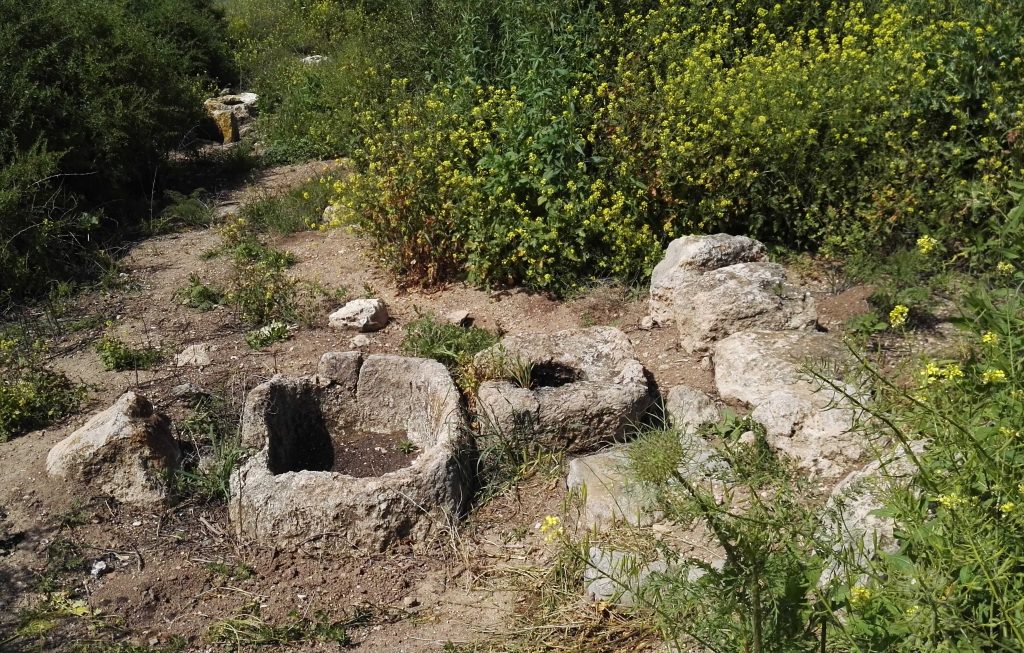
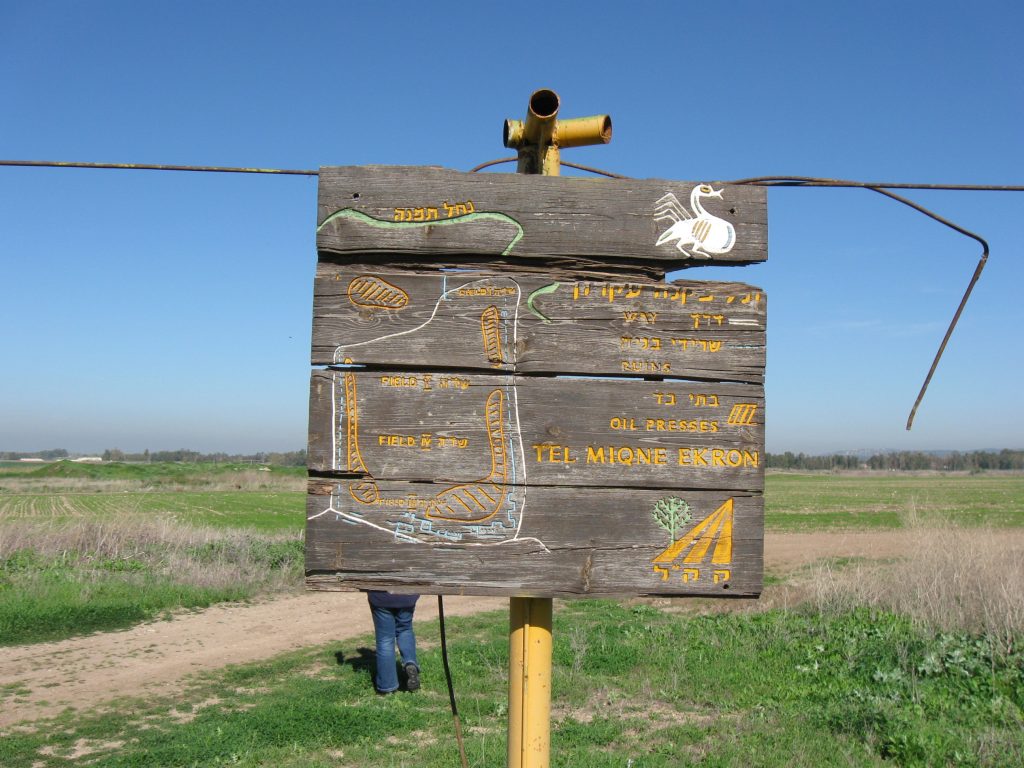
The excavated city behind the inscription was productive as well as politically exposed. Excavators documented a concentration of olive oil installations, including basins, presses and stone weights. The machinery requires no royal name to show that many people worked there. Exactly how local elites and the empire shared the profits or supervised production is a larger question. The industry helps explain why a major sanctuary and a ruler able to sponsor it belonged in the plain around the mound. Archaeology recovers the setting in which a leader had reason to pray for the prosperity of his land. Ben-Shlomo, oil production and cult at Ekron
Reading about Ekron in Scripture
Joshua 13:1–3 lists Ekron among the five Philistine centers as part of the land still remaining when Joshua is old. In 1 Samuel 5, the Philistines have captured the ark and move it from Ashdod through Gath to Ekron. When it reaches Ekron, the people fear what will happen and seek to have it sent away. First Samuel 6:16–18 names the five rulers again in the account of the return of the ark. These readings show why identifying Ekron matters. This town was a participant in the life of Philistia, with rulers capable of acting in concert alongside other cities.
Achish is also the name of the ruler of Gath who receives David in 1 Samuel 27. The temple at Ekron belongs centuries later, and its Achish rules a different city. Compare the recurrence of the name with what you see in a family or region today. A familiar name can recur across generations and among neighbors. The resemblance brings us closer to the vocabulary of a real community. A historical identification also needs a compatible date, place and role. The stone gives the city and father of the seventh-century ruler, which is why those details belong beside the name in every account. Schäfer-Lichtenberger on the name Achish
Zephaniah 2:4–7 takes us into another era of biblical writing. The prophet names Ekron with Gaza, Ashkelon and Ashdod in an oracle against the Philistine coast. He speaks of cities losing their inhabitants and of a remnant of Judah finding a place to pasture its flocks. The place name that appears as an address of royal power on the stone appears in the prophet’s announcement of judgment. Archaeologists can trace the end of the late Iron Age city through a destruction context. Assigning every element of a prophetic passage to one archaeological event would require more than the name and the presence of burned remains. Final excavation report, Stratum I and Sanctuary 650
A reader can use the entry for the stone to practice joining three records without making them interchangeable. Joshua supplies the geographic setting of one of the Philistine centers. Sennacherib’s annals describe an imperial conflict that included Ekron and Judah. The dedication identifies the ruler who built one sanctuary under a later stage of Assyrian power. Together they let the reader visit the same city from several dates and vantage points. The sharpest connection comes when a name such as Padi appears in two contemporary historical settings with a clear connection to Ekron. That is a different kind of link from the continued appearance of a city name over centuries.
As Christians we receive Scripture’s account of the ark and of the Lord’s dealings with Israel and its neighbors as true. The inscription brings a voice from Ekron itself into that historical world. It also gives us a glimpse of what people in a Philistine city wanted the gods to do for their ruler and their land. The request has an understandable human shape. Everyone who considers the future of a land has reason to desire protection. In Samuel, the Lord’s authority reaches into Philistine cities and cannot be treated as the possession of whichever army happens to carry his ark. That is a different account of who holds power, set in the same real world where Philistine rulers blessed their buildings and watched empires draw near.
Sources and further reading
- Seymour Gitin, Trude Dothan and Joseph Naveh, A Royal Dedicatory Inscription from Ekron (1997) — First scholarly publication of the 1996 find, its context, proposed reading and significance.
- Tel Miqne–Ekron Final Field Reports, volume 9/2 (Harvard Museum of the Ancient Near East) — Excavation record for the sanctuary find and related inscriptions, including excavation object 7310.
- Christa Schäfer-Lichtenberger, Achish and the Goddess of Ekron — Chapter 3 of the final reports addresses Achish, the debated divine name and linguistic proposals.
- Seymour Gitin and Trude Dothan, Miqne, Tel (Ekron) — Excavators’ site synthesis, including the olive oil industry and translation of the Royal Dedicatory Inscription.
- Royal Inscriptions of the Neo-Assyrian Period, Sennacherib 017 — Assyrian version of the events involving Padi and Hezekiah in Sennacherib's western campaign. See column iii, especially lines 8′ onward.
- David Ben-Shlomo, Industry and Cult in Philistia (2025) — Archaeological discussion of Ekron’s presses, sanctuary complex and local economy under Assyrian influence.





