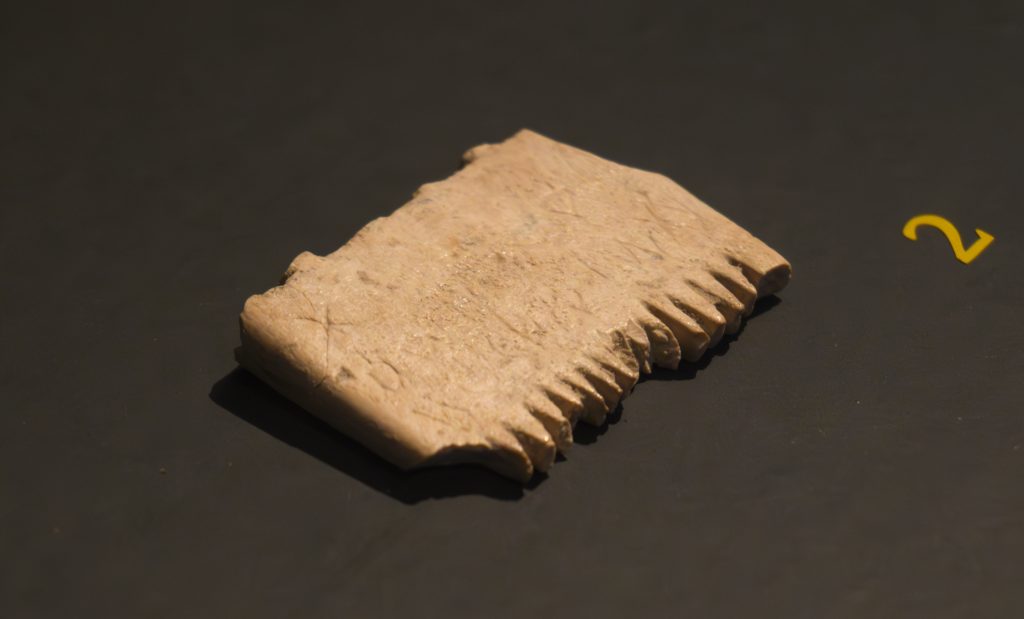
The earliest writing can sound surprisingly familiar. Someone cut tiny letters into an ivory comb less than four centimeters across, and the editors who studied it read a wish that the comb would get rid of lice in the hair and beard. The tool turned up in excavations at Lachish in 2016. Its marks were first recognized as writing in 2021, and the full study appeared in 2022. The object brings together three kinds of work seldom seen on the same find. Archaeologists traced the pit where it survived, specialists examined the ivory and traces of a louse, and an epigrapher read a sentence in an early form of the alphabet. Vainstub and colleagues, §§2–5
What you'll learn
- What the two sets of comb teeth did and how researchers recognized a trace of a head louse.
- Why an Iron Age pit could contain a much earlier object and what puts the engraving in the Bronze Age.
- How a grooming tool helps us understand the written world of Canaan long before the later Hebrew letters of Lachish.
A tool with two working edges
The comb is made of ivory from a tusk. Its surface shows structures characteristic of elephant or mammoth ivory, and the authors identify the material as elephant ivory without claiming a narrower species from the limited exposed surface. At about 3.66 by 2.51 centimeters, the object could rest easily in a person’s palm. Its teeth themselves broke long ago, leaving bases along the margins. Six thicker teeth on one side could help separate tangled hair. Fourteen finer teeth on the other side could pass close enough together to remove lice and eggs. The broken edges retain the pattern that shows how the craftsman made the two sides for different tasks. Primary study, §§3.1 and 4
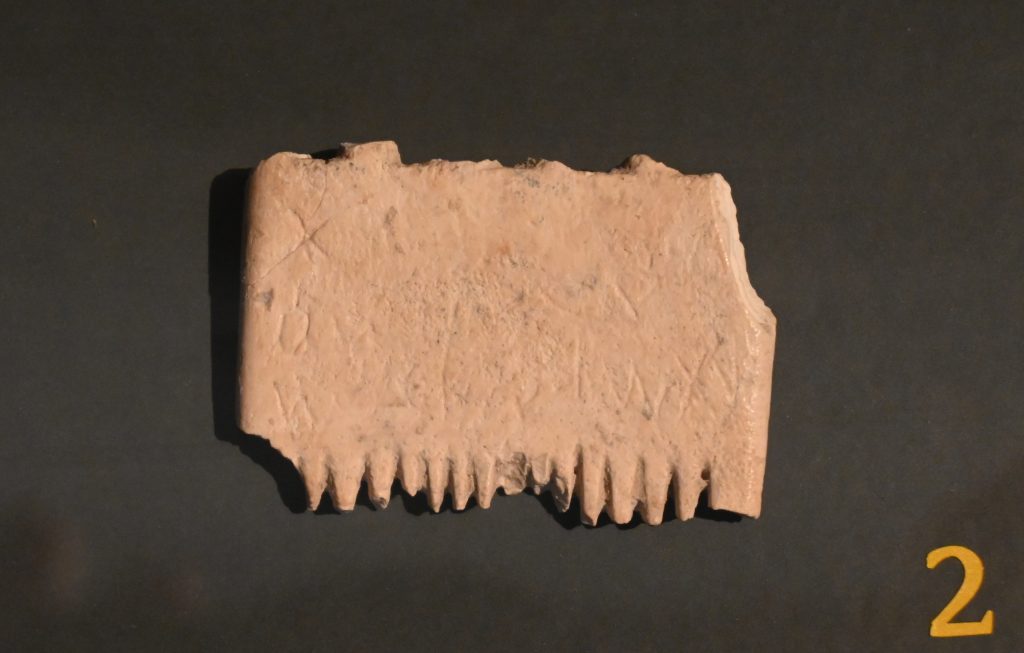
The most intimate evidence about its use is smaller than a millimeter. With a digital microscope, researchers identified part of the outer membrane of an immature head louse on one of the teeth. They report that it was about half a millimeter in size. Finding a trace of the parasite supports the use of the fine teeth for grooming and lice removal. That observation can stand alongside the translation because it comes from a different technique. The shapes of the tool give a first idea of its use, and the trace on the tooth gives the idea a physical connection to a living person’s hair. Primary study, §3.2 and fig. 4
The authors compared the object with another small comb from the excavation. One looked sufficiently similar to make the other a useful control. Close examination confirmed ivory for the inscribed example and bone for the comparator. What may look like the same pale color in a photograph can come from a different material and a different selection of raw stock. An ivory comb would have required access to a valued material. It is reasonable to ask whether the owner was well placed to acquire it. The place where the comb eventually landed and the little we can read of the inscription give no firm social identity for that owner. Primary study, §§2 and 4.3
The age of a comb and the age of a pit
The team recovered the comb in Area AA on June 20, 2016, during the Fourth Expedition to Lachish. It came from a pit dug from Level II, a seventh- to sixth-century BC occupation phase. The excavation report describes the pit cutting through older Iron Age layers. That gives the comb a documented findspot with an important complication. The period of the pit tells us about the circumstances in which the object survived at the site. Older objects can end up in later deposits when people cut through previous layers or move material. The researchers’ proposed date for the comb depends on evidence the inscription itself carries. Primary study, §2 and fig. 2
The authors compared the letters with other early alphabetic writing, including a fragmentary inscription from a Middle Bronze Age tomb at Lachish on a dagger. They caution that some signs changed little over time and have limited value for dating. Other shapes preserve more of the pictorial character visible in early inscriptions from sites such as Serabit el-Khadem in Sinai. The researchers proposed approximately 1700–1550 BC for the comb on this basis. The beginning and end of that range are estimates. Some of the material they compared also has a debated date, which limits the precision those comparisons can deliver. Primary study, §5.2
The researchers tried to obtain a date directly from the ivory. The laboratory was unable to recover suitable material from two submitted samples. That is an informative result for anyone learning how archaeological dating works. A promising material can fail to give a usable radiocarbon measurement if the necessary carbon has not survived in suitable condition. Compare the comb with a separately excavated alphabetic bowl fragment from Lachish published by Felix Höflmayer and colleagues in 2021. The pottery fragment’s associated deposits support a fifteenth-century BC date. The two objects tell us about early writing in the same town, but the reasoning behind their dates is different. Primary study, §5.2, laboratory attempts Höflmayer and colleagues, bowl fragment
The excavators could date the pit more closely than the comb. The letters carried a different and much older history into that later deposit.
What the writer put between the teeth
Madeleine Mumcuoglu noticed the shallow marks in December 2021. In the published reading, seventeen signs form seven words, although strokes in the worn central area survive poorly and some letters are reconstructed. The lines have an unusual relationship. The writer began a row running from right to left and then turned the comb to continue the second row. Their heads face toward the middle of the object. The letters vary in size, most only a few millimeters across. The published study includes views under altered illumination, so readers can compare what a proposed sign looks like when light brings out the incisions. Primary study, §5 and figs. 14–18
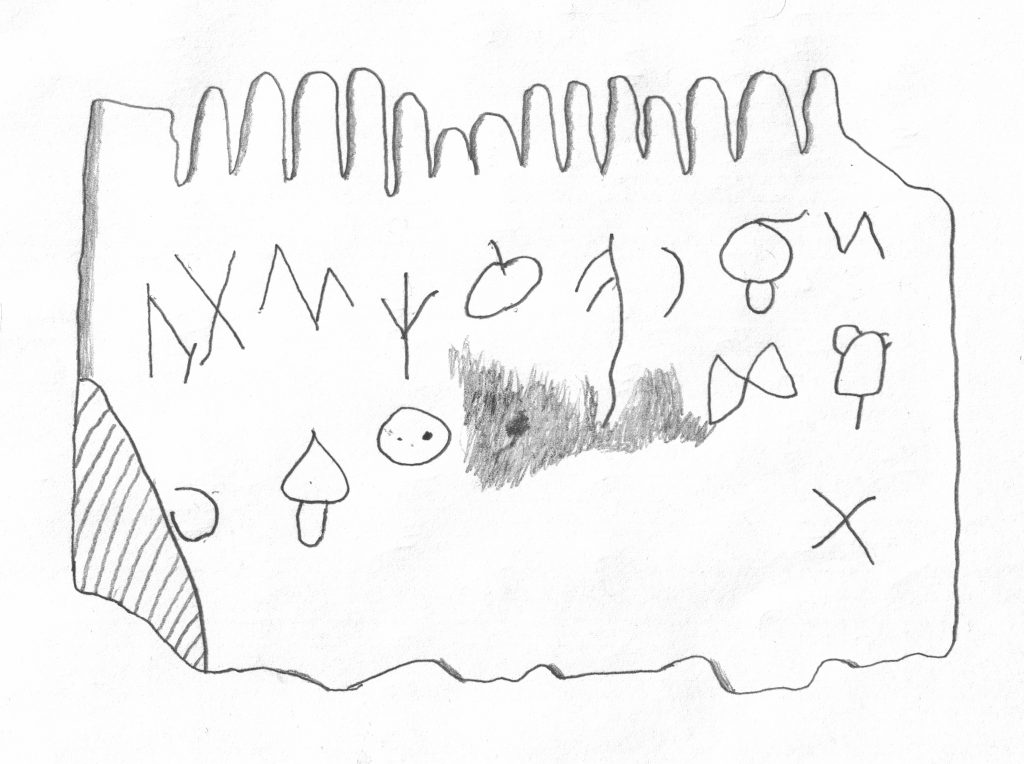
Daniel Vainstub and his colleagues read the message as a plea that this piece of tusk might root out lice from the hair and beard. Calling a finished object by its material has familiar counterparts in ancient languages. Bob Becking proposes that the disputed term refers to the inscription itself, giving the words a protective role in his interpretation. Both readings take the object and the setting of grooming seriously while assigning a different function to one small term. The surviving signs are the common evidence. The attempt to recover an entire alphabetic sentence from them is what makes this find especially important for the history of Canaanite writing. Primary study, §5.3 Becking, alternative reading
A short alphabetic name or label can establish that people used a certain form of the alphabet. A sentence carries information about word order and relationships among words as well. That is why this little inscription has attracted attention even though larger and more elaborate written records had already been recovered in the ancient Near East. Its type of writing uses a limited set of signs for sounds and belongs among early alphabetic traditions. Its medium happens to be an object used on the body. That combination gives language historians a rare example of early writing applied to an immediate concern of ordinary life. Primary study, §§5.4 and 6.1
It is tempting to make a find like this stand for all the literacy of a city. The comb provides evidence for a person who could compose or commission a short message and someone who could incise it. It also tells us that writing could belong on this kind of possession. Much of the range of writing done elsewhere in the city would have had a poorer chance of survival. Texts on materials that decay easily could disappear completely while a mark on pottery or ivory endured. The question of how many people could read and write asks more of the evidence than the existence of one carefully incised object can show.
There is also a difference between an early surviving sentence and the first sentence anyone wrote. Several early alphabetic inscriptions outside Lachish are brief, damaged or difficult to date. The comb’s special contribution is a proposed reading with a verb, an object and enough context to make sense of their relationship. If comparable finds are made or known fragments are read anew, the record may grow. The evidence already available is specific and unusually personal. It shows an alphabet in use for a small wish in the Canaanite world, in words that would have made sense to the owner of a fine-toothed comb. Höflmayer and colleagues on the early alphabetic record
The comb in the world of Scripture
Joshua 10 names Lachish among the Canaanite cities whose kings join the coalition against Gibeon. After the coalition’s defeat, the account follows Joshua and Israel to the city of Lachish. The excavation’s report shows how much history the same mound contains. Canaanite buildings and objects belong to its Bronze Age settlements. The city later served the kingdom of Judah, where people wrote the Lachish Letters in Hebrew near the end of the monarchy. These discoveries give us points of contact with different periods in the Bible. Nothing on the comb identifies its owner with one of the people named in Joshua. Fourth Expedition, occupation phases
First Kings 10 describes the ivory used on Solomon’s throne and the ivory that reached his kingdom through trade. Amos 6 mentions ivory-trimmed beds as he calls wealthy people to account for taking their ease while others suffer. The comb takes us to an earlier setting and a more personal use of valuable material. Those different uses give a sense of the value and versatility of ivory across the region. Scripture can follow a prized material into a royal building or the lives of people who could afford fine furniture. Archaeology can find the same material in an object just large enough to take care of someone’s hair.
As Christians we take the biblical history of Canaan and Israel seriously. It is rewarding to learn even things Scripture has little reason to mention, because they help us picture the people who inhabited that history. The comb invites us to notice vulnerable bodies and the ingenuity of their owners. The find tells us a person could enlist the art of writing to express a hope for something as small as finishing a grooming task. Later, in 2 Kings 22, the reading of a written book leads a king to repentance. The difference in scale makes the history of writing richer. People wrote brief wishes and preserved words that addressed a whole people with a claim on their lives.
Sources and further reading
- Daniel Vainstub, Madeleine Mumcuoglu and colleagues, A Canaanite’s Wish to Eradicate Lice on an Inscribed Ivory Comb from Lachish (2022) — Primary technical and inscription study. See §§2–3 for findspot and use, §4 for material, and §5 for script, reading and dating.
- Yosef Garfinkel, Michael G. Hasel and colleagues, Preliminary Report of the Fourth Expedition, 2013–2017 (2021) — Expedition report for the Canaanite and Judean occupation phases of Lachish.
- Bob Becking, The Power of an Inscription (2023) — An alternative proposal for the term translated as ‘tusk’ in the first edition.
- Felix Höflmayer, Haggai Misgav, Lyndelle Webster and Katharina Streit, Early Alphabetic Writing in the Ancient Near East (2021) — Report on a securely contextualized fifteenth-century BC alphabetic pottery fragment from a separate excavation at Lachish.





