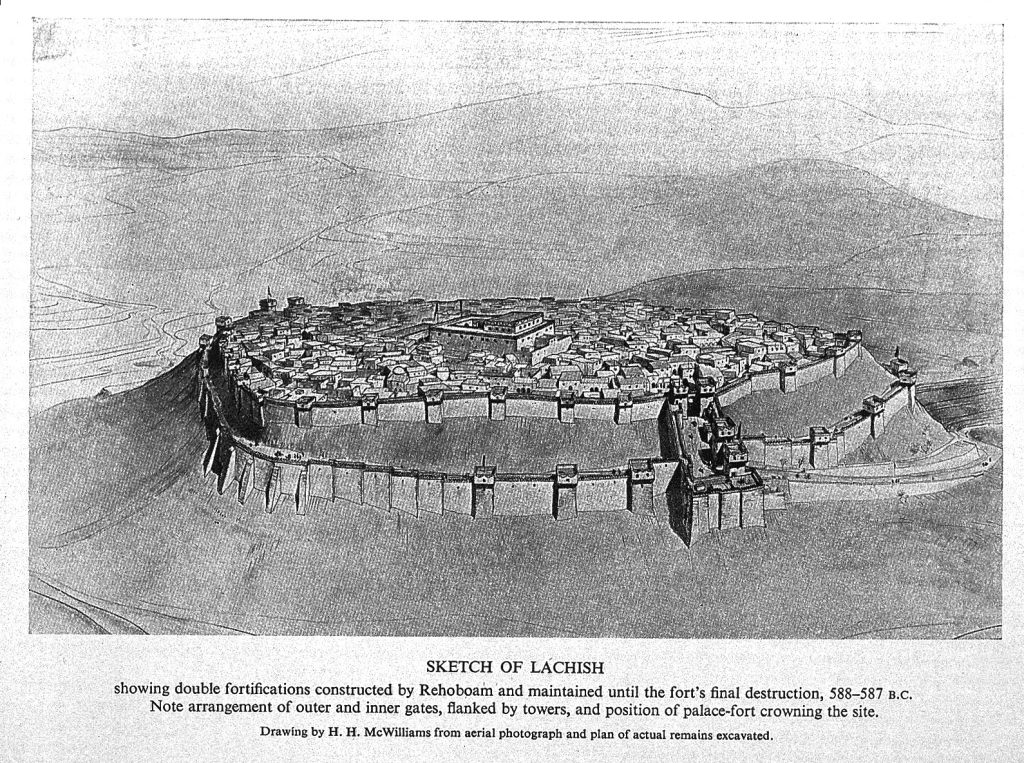
A writer serving Judah reported that his group was watching for signals from Lachish and could not see Azekah. He put the report in ink on a fragment of pottery, using both faces to fit the message. Excavators recovered the sherd, now called Lachish Letter 4, from ash near the city gate in 1935. Jeremiah names Lachish and Azekah as two fortified cities still standing during Babylon’s invasion. The letter and the biblical passage open different windows onto the same crisis. What someone saw from a watch post turns out to be easier to recover than what actually happened at the city outside his view. Zammit, Catalogue A, Lachish 4
What you'll learn
- What a group of small inscribed sherds was doing near a gate of Lachish.
- Where Letter 4 describes the signals and what it leaves open about Azekah.
- How letters from Judah help us read Jeremiah’s account of the last years of the kingdom.
Burned debris at a gate
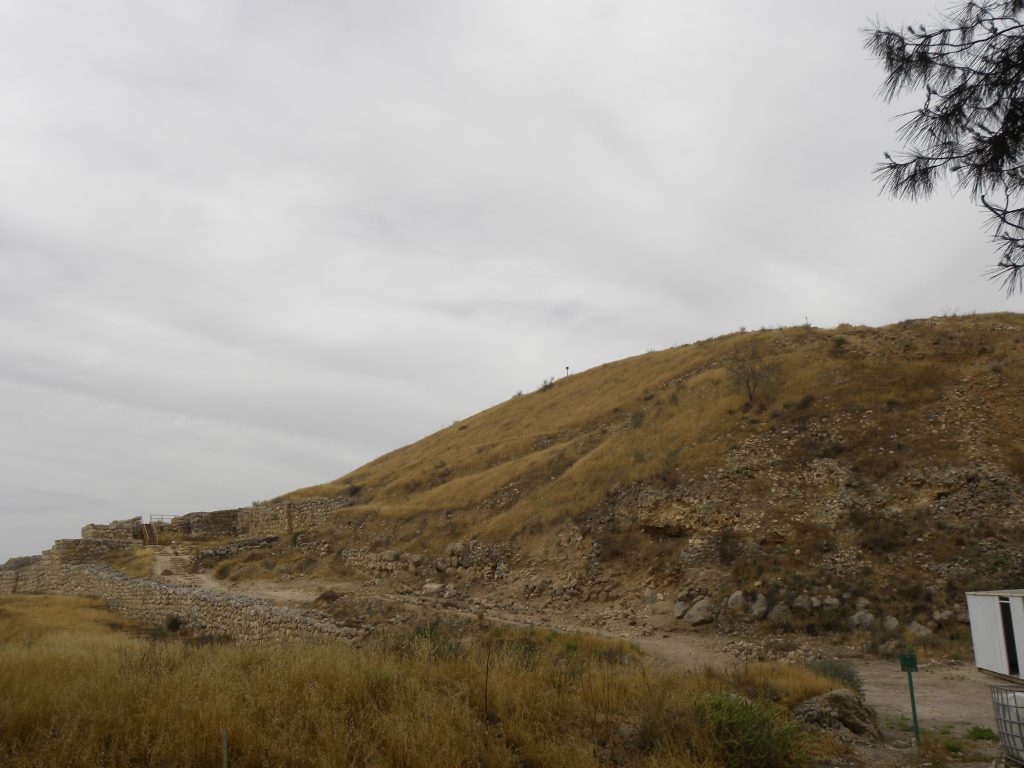
Tell ed-Duweir, the site of ancient Lachish, rises above the lowlands southwest of Jerusalem. The Wellcome–Marston expedition under James Leslie Starkey began excavating there in the 1930s. Its excavators found the principal group of inscribed sherds in 1935. More fragments were recovered in 1938. The name Lachish Letters applies to a group of writings with different states of preservation and different contents. Some survive well enough to follow the business behind an entire message. Others offer a few words or individual signs. The expedition began the formal publication of the material in 1938, assigning numbers still used to identify individual letters. Wellcome Collection excavation archive Zammit, Catalogue A
Archaeologists call one of these inscribed sherds an ostracon. A broken pot left pieces with surfaces firm enough to take ink and small enough to carry. The clay had already been fired to make the vessel before anyone wrote the message. Its color comes from that history as well as what happened to the fragment later. Letter 4 is about thirteen by eight centimeters and carries ink on the outer and inner surfaces. A copy in print lets you see how the irregular break defines the writing area. As you turn the object over, the other face gives the scribe extra space to finish. Zammit, Catalogue A, Lachish 4 and figs. 33–35
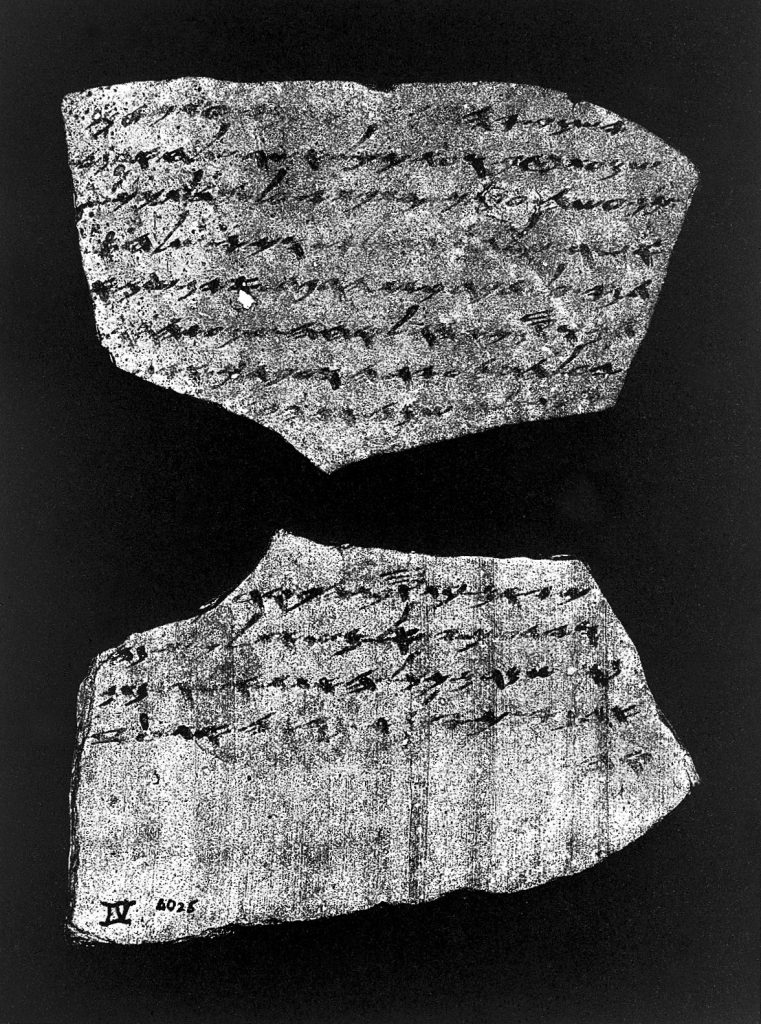
The excavators found Letter 4 in burnt ash in a room which they called a guardroom, near the gateway. The association puts the sherd in a meaningful sequence. A letter must be written before it enters the debris of a building’s destruction, and the local pottery and architecture help archaeologists assign that debris to a phase. The sherd’s cursive Hebrew provides a line of evidence about the period of writing. Taken together, they place the texts near the close of Judah’s monarchy, in the late seventh or early sixth century BC. The room’s familiar label is convenient. Its precise use and the reasons the messages were together are still subjects of study. Zammit, §§1.3–1.4 and 5.3
There were two famous destructions at this mound, and the numbers tell you which one you are reading about. Level III belongs to the city attacked by Sennacherib in 701 BC. The Assyrian annals and the palace reliefs belong to that earlier war. The pottery letters come from the later Level II, in the period ending with the Babylonian conquest of Judah. Jerusalem fell around 587 or 586 BC, well over a century after Sennacherib’s campaign. The older Assyrian images can help you picture how important a fortified gate was, but the people who penned the letters served a later government facing a different empire. Zammit, §1.3, Levels III and II
The report about Azekah
Read the opening of Letter 4 before you look for the famous place names. The writer first wishes that his superior will hear good news. He then reports carrying out instructions, a written notice and what had happened to particular people. Near the end he gives an update about the watch. In lines 10–13 his group is following the signals of Lachish according to the instructions received and says it cannot see Azekah. From the officer’s viewpoint, the visibility of one fortified place enters the same report as the movements of people and the handling of documents. Zammit, §3.1.4 and especially lines 10–13
Ancient observers could use a fire on a visible rise to communicate over intervening ground. A set of agreed signals could pass along a warning without waiting for a messenger on foot. A short remark about the system, however, leaves many specifics implicit. The writer may have expected his reader to know where to look, what appearance to expect and which watches were taking place. Modern readers have to reconstruct those conditions from geography and a very brief statement. The text supplies two known locations and a report from one observer’s position. It leaves the observer’s exact station unspecified. Ancient Hebrew Inscriptions, discussion of fire signals
An influential reading of the letter takes the report as evidence that Azekah’s lights had gone out because the city had fallen. If the group normally saw the signal and looked for it under the expected conditions, its absence could be alarming. That interpretation needs assumptions the sherd itself does not supply. The text gives the observation and leaves the cause open. With the watch post uncertain, terrain and position also deserve consideration. Jeremiah 34 adds evidence that the two towns faced the same crisis. It leaves the exact order in which they stopped resisting unstated. The correspondence is strong at the level of places and circumstances and much less precise about the last hours of one city. Zammit on the debated reading, §3.1.4
A writer could report the hill he could not see. The broken sherd gives us his view of the crisis, as far as that view reached.
The other voices near the gate
Letter 3 lets us hear a more personal exchange. Its sender, Hoshayahu, addresses Yaosh and takes issue with the suggestion that he cannot read a letter. He claims he can handle the messages that have come to him. Farther down the sherd, he reports an official going toward Egypt and mentions a written warning associated with an unnamed prophet. The notice gives us an idea of how much information could travel in one report. It also shows a person having to defend his competence to a superior. Naming that prophet would require evidence beyond what the letter preserves. Zammit, §3.1.3 and lines 19–21
Letter 6 is concerned with the effect of words sent by officials. Its writer regards the messages as demoralizing. That is a useful comparison with Jeremiah 38:1–13, where royal officials accuse Jeremiah of weakening the soldiers and the people by telling them how they can survive. The accusation in Jeremiah is part of a story that goes on to describe his confinement in a cistern and Ebed-melech’s appeal to rescue him. The two sources give us grounds to recognize that warnings and written words mattered in wartime. Identifying the unnamed individuals or equating the specific communications would take further evidence. Zammit, Catalogue A, Lachish 6
The documents let us distinguish several kinds of evidence on a single piece of clay. The first is a surface that someone chose for writing. The second is a particular person’s phrasing, with greetings and reports suited to the addressee. The third is the building debris that received the object. A person who reads only the translation misses how the broken edge and the ink affect the reading. A person who studies only the sherd misses the small group of people visible in the choice of words. When the archaeological and textual work meet, a provincial town looks inhabited again.
Reading Jeremiah with the letters in view
Earlier in Jeremiah, the prophet tells the people of Benjamin to flee from Jerusalem and calls for a signal to be raised at Beth-haccerem in the face of danger from the north. The signal in Jeremiah 6:1 belongs to a prophetic warning. The signals in Letter 4 belong to a report on an assigned watch. Read together, they give a picture of why a visible point on a hill mattered to people confronted by an approaching army. A warning was only as effective as the observers who could see it and knew what to do when it appeared.
In Jeremiah 34:1–7, Nebuchadnezzar’s forces are fighting against Jerusalem and against the remaining cities of Judah, including Lachish and Azekah. The Lord tells Jeremiah to speak to Zedekiah about what lies ahead for the king and the city. Read on and the chapter turns to a covenant to release enslaved Hebrew neighbors. The people reverse their decision and take back those they had freed, and Jeremiah calls the breach what it is. The same crisis that has brought soldiers to watch for signs also exposes what the people do with a promise they made before God.
As Christians we take the history and judgment in Scripture to be true. The sherd is precious because we can meet someone from that history through his written words. The biblical account takes us into those circumstances and asks us to attend to the Lord’s purposes amid them. Second Kings 25 recounts the siege and the burning of Jerusalem and describes some of the people carried away. Jeremiah 34 presses the reader to notice covenant faithfulness and the people most easily harmed by those with power. The little report from Lachish helps us feel the urgency of the days in which that demand was made.
Before leaving Letter 4, look once more at how small it is. Someone made room on a fragment of a vessel for several pieces of business and a line about places he expected his reader to know. He had reason to take what he could see seriously. We have reason to take the limits of his view seriously too. His report and Jeremiah’s account deserve close reading because both deal with a real, dangerous time in Judah. The letters give the watch its human scale. Scripture shows how the Lord addressed the people while they kept it.
Sources and further reading
- Abigail Zammit, The Lachish Letters: A Reappraisal (University of Oxford, 2016), volume 1 — See §§1.3–1.4 for excavation context and §§3.1.3–3.1.4 for Letters 3 and 4.
- Abigail Zammit, Catalogue A — Inscription records for Letters 3, 4 and 6, with physical dimensions, dating, findspot, museum records and readings.
- Harry Torczyner and colleagues, Lachish I: The Lachish Letters (1938) — Bibliographic record for the Wellcome–Marston expedition's original publication.
- Wellcome Collection, Lachish Letters archive — Excavation archive and publication series for the Wellcome–Marston expedition.
- Ancient Hebrew Inscriptions (Cambridge University Press), §4 — See Figure 21 and accompanying discussion of Lachish 4 for the signals and use of ostraca.
- Israel Museum, The Azeqah Ostracon — Museum footage of the original object. The presentation adopts the interpretation that Azekah had fallen, one proposal discussed in the article.





