A synagogue in Jerusalem had rooms ready for people who came from abroad and needed somewhere to stay. We know because a priest named Theodotos had the purpose of his building cut into limestone. The Greek lines speak of reading the Law, teaching the commandments, and making room for guests. They also identify Theodotos as the third generation of synagogue leaders in his family. The stone has survived far better than the plans of the building. It gives us an unusually direct account of what one Jewish community considered worth building and what it wanted people to know about the work. Greek text and translation, CIIP I.1 no. 9.
What you’ll learn
- Where the slab was recovered and why the spot does not identify the building that first held it.
- How the lettering and historical comparisons support a late Second Temple date.
- What this Jerusalem dedication adds to readings of Luke and Acts.
The slab in the cistern
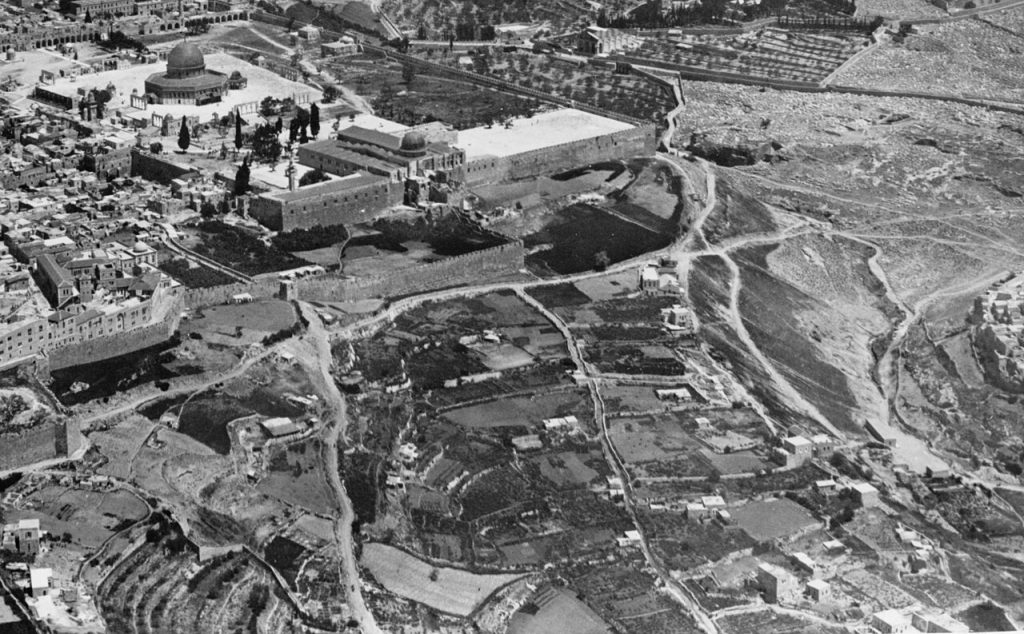
In the 1913–1914 excavation campaign on the southeastern ridge of Jerusalem, Raymond Weill’s team found the stone in debris inside a cistern. The ridge is commonly called the City of David and lies south of the Temple Mount. Publications sometimes give either year for the discovery. The excavation season is a safe way to describe when it came to light. Weill published the inscription and its context in his account of the excavations. The record matters because the cavity was filled with architectural material. The inscribed stone had been moved from the setting in which its carved message originally made sense. Weill’s 1920 report · University of Michigan, manuscript and find record.
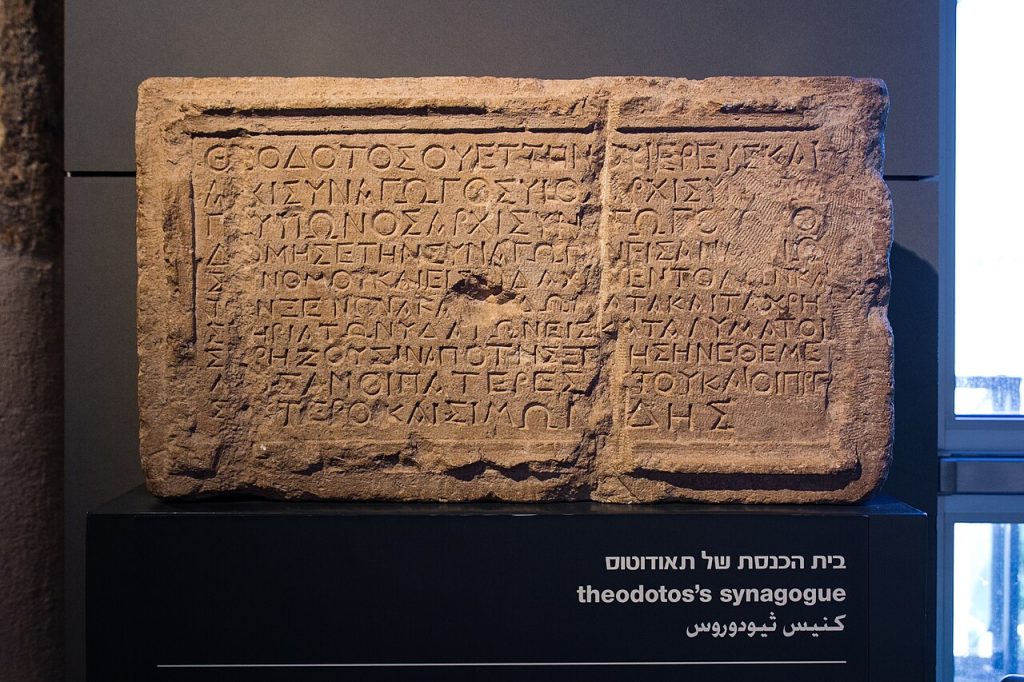
A stone found among discarded building materials poses a different problem from an inscription built into a doorway in its original position. The latter can tie a text directly to some of the walls that surrounded it. The former takes the historian through several events. A building was dedicated and the slab was carved, the object was removed or became debris, and someone deposited it in the cistern. Material in the fill may help date its deposition if its archaeological relationships are clear. It does not automatically date either the erection of the synagogue or the period when the stone was visible there. Kloppenborg, excavation setting and the cistern argument.
The scale of the panel suggests a deliberate public statement. The lines fit a prepared surface, with letters cut steadily enough to follow across most of the block. The visible text tells who took credit and for what. It cannot tell where people entered the house from the street or whether the sanctuary and rooms occupied one building or a small group of structures. The lost context prevents us from plotting a doorway onto the ground. The surviving dedication lets us recover something that a plan on its own might never tell us, the named purpose for which a group arranged and funded its space.
A date for the dedication
A late first-century BC or first-century AD date before Jerusalem’s destruction in AD 70 is widely accepted. The date is chiefly determined by comparing the Greek letter forms and inscriptional conventions with dated regional texts. John Kloppenborg compared the forms with material including the Greek Temple warning and the inscription of a Rhodian benefactor at Jerusalem dated 18 or 17 BC. A comparison of letter shapes gets stronger when other aspects of layout and language fit, and the range is generally more secure than a particular year. This is why the date is usually expressed as a period rather than as a date for the cutting of the individual letters. Kloppenborg, letter forms and contemporary parallels.
A much later date has also been argued. It depended in part on understanding the cistern as part of a later Roman bath and making that proposed context do much of the chronological work. Kloppenborg reexamined the find report and the assumptions behind that connection and made a detailed case for the earlier date. The debate is a reminder of how excavation notes and comparison with separate dated inscriptions work together. A cistern can function long after a nearby building has gone, just as a reused stone can be older than the rubbish around it. The archaeological task is to explain what each observation actually dates. Kloppenborg, history of the dating proposals and conclusions.
It helps to keep the sequence on one page. The group’s founding came first, Theodotos’s building work and dedication came later, and the stone arrived in the cistern after leaving its first setting. The order is clearer than the intervals between events.
The purposes set out on the stone
Theodotos is called son of Vettenos, priest, and archisynagōgos, meaning head or leader of the synagogue. The same title is applied to his father and grandfather. The ending credits predecessors, the elders and a man named Simonides with founding the synagogue. The present dedication thus refers to an existing institutional history. Theodotos commemorated his own building work while acknowledging people who were there before him. The lines give a relative chronology in a family and community. They do not tell us how long anyone held office or where the earlier gatherings took place. Text and commentary on Theodotos and the founders.
- Reading and teaching. The dedication says the synagogue served for reading the Torah and teaching the commandments.
- Hospitality. A guest facility and rooms are named in connection with people coming from elsewhere and in need of lodging.
- Water. The arrangements included water installations. Their exact form and purpose remain open.
In a city to which travelers came for religious reasons, shelter and water were concrete needs. A synagogue that provided them could be part of what made it possible for a visitor to remain and participate. The wording identifies the visitors as people from abroad who needed the accommodation, without listing which cities they came from or how they spent their time. The exact water installations are also unknown. They could have included arrangements for storage or for washing, and ritual use has been suggested. One part of interpreting the dedication is knowing when a public description has supplied the end a facility served without telling us everything about its design. Magness, the inscription and the archaeological evidence for ancient synagogues.
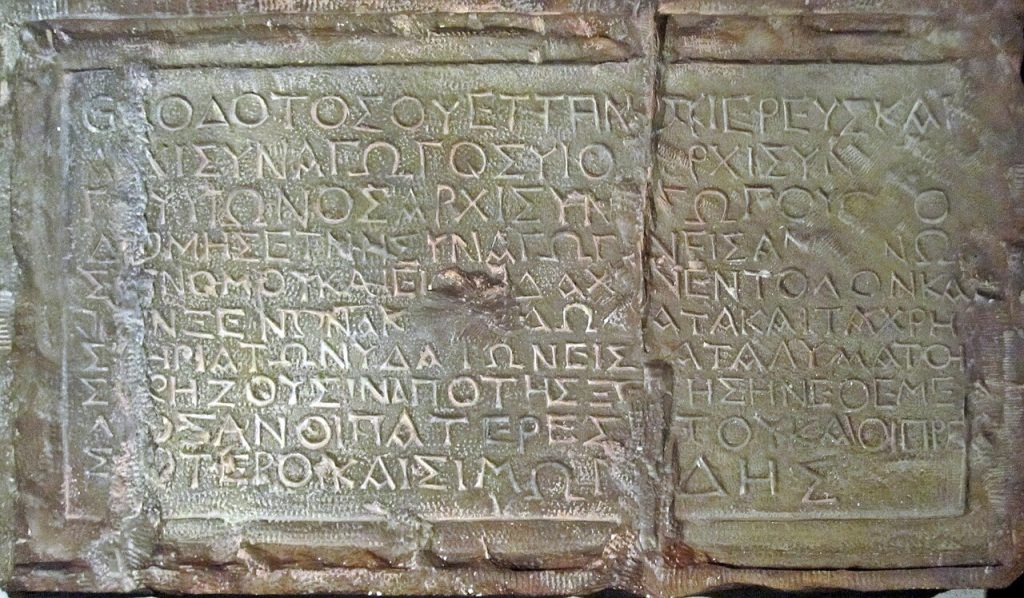
The same dedication makes space for people to hear the Law and for travelers to stay long enough to join them.
The public reading named in the first part of the dedication belongs alongside a less visible sort of work. A place for people to stay has to be maintained between arrivals. Water has to be brought in or collected, and rooms have to be made accessible. When a builder identifies those uses on the same panel as reading and teaching, we can see what the sponsor considered integral to the undertaking. The readers of the ancient inscription would know about the furnishings and arrangements that the modern reader can only infer. What survives is a direct clue to how one community described its priorities in its own words.
Greek in Jerusalem
The choice of Greek matters in a city whose religious life brought together people from many places. Greek could communicate with Jewish visitors whose ordinary language differed from that of some residents. The inscription gives us evidence that this community could make a public statement in Greek. It does not automatically tell us the language of every reading in the building. The leader’s family background has also been debated. The name Vettenos has prompted associations with the Roman world, but a name on its own cannot establish the family’s place of origin or the identity of the synagogue’s members. The strongest conclusion is that the community knew how to address Greek readers in Jerusalem. Harland, name forms and the dedication · Kloppenborg, historical comparisons.
Acts 2 presents Jerusalem as a place where Jews and proselytes from a wide range of countries could gather and hear speech they recognized. Acts 6:9 describes opponents of Stephen associated with the synagogue called that of the Freedmen and names places including Cyrene, Alexandria, Cilicia and Asia. That setting makes the kind of institution named on the stone intelligible. A proposed identification of Theodotos’s synagogue with one of the groups named by Acts has attracted interest, but the inscription has no name that securely matches the passage. It gives us a close contextual parallel. Acts provides the people and the events in Stephen’s story.
The term synagogue also does more than one job in ancient writing. It can refer to people who assemble, and it can come to name the place they use. Theodotos gives tangible evidence for the latter meaning because the builder claims responsibility for a synagogue together with spaces serving visitors. The spelling of the title names a role within the group as well. Those details can help a reader decide what a biblical or historical author means in a particular sentence. A narrative naming people affiliated with a synagogue does not have to supply an architectural description, just as a dedication naming a building leaves us with reasons to ask about its membership. Magness, ancient synagogue terminology and evidence.
The Scripture people heard together
Luke 4 depicts Jesus returning to Nazareth, entering the synagogue on the Sabbath and reading from Isaiah before addressing the people there. The location is Galilee, far from the cistern in Jerusalem. Yet the function of the gathering has a direct point of comparison with the dedication. A community made it possible for Scripture to be heard publicly and explained. For archaeological examples of other settings and dates, see our articles on the Magdala synagogue and its carved stone and the synagogue archaeology of Capernaum. Their buildings give spatial evidence, while the text from Jerusalem names the practices that mattered to the people who erected it.
Christians receive the Gospel account as true and recognize the importance of what happened when the words of Isaiah were read aloud and Jesus declared their fulfillment. The Theodotos inscription illuminates the ordinary work that stood behind opportunities to hear Scripture together. Someone arranged space, funded construction, and provided water and a room for people who needed one. Read Luke 4 for the moment a reading became a declaration, then Acts 6 for the disputes that arose among people whose lives were shaped by such gatherings. The Jerusalem slab makes the institution itself more concrete. Its closing lines let us remember the people who built a place for reading and for welcoming those who had traveled to the city.
Sources and further reading
- Raymond Weill, La Cité de David, 1913–1914 excavation report — Primary report on the inscription and cistern context, Revue des études juives 71 (1920).
- John S. Kloppenborg, Dating Theodotos (CIJ II 1404) — Detailed evaluation of excavation history, epigraphy and the pre-70 date, Journal of Jewish Studies 51 (2000), pp. 243–280.
- Philip A. Harland, Dedication of a Synagogue by Theodotos — Greek text, translation, titles and institutional context.
- Jodi Magness, Ancient Synagogues in Palestine — Comparative study of the evidence for early synagogue buildings and the functions recorded in the inscription.
- University of Michigan, Jerusalem: The Theodotus Inscription — Discovery, lettering and a summary of the older founding sequence.





