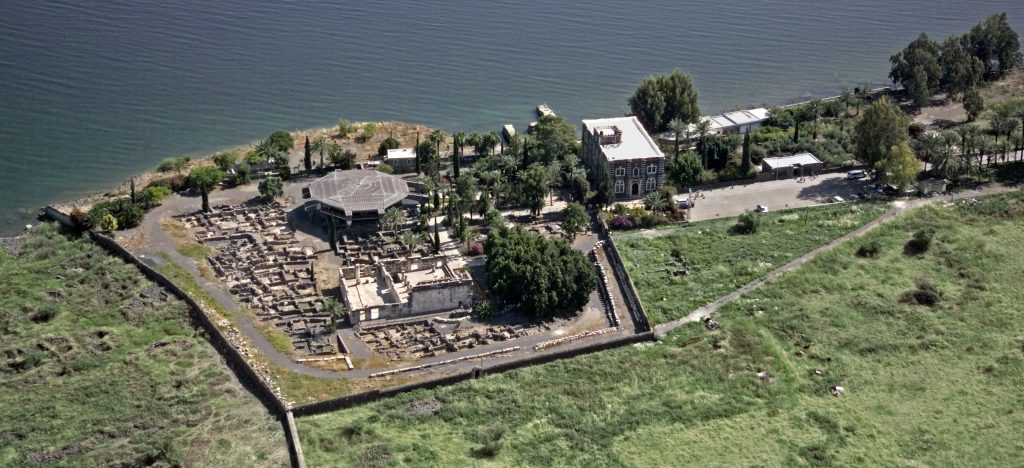
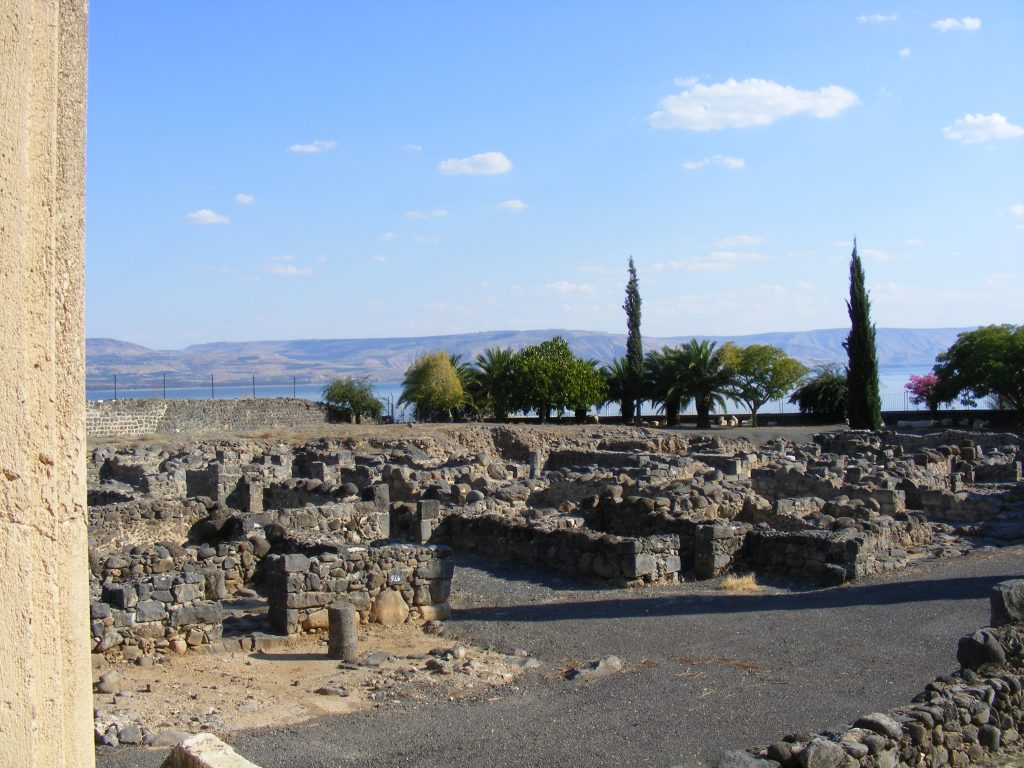
In Mark 1, Jesus goes from a synagogue in Capernaum to the house of Simon and Andrew. The move takes only a verse, but it carries the story from a place of public worship into a household where a woman is ill. On the shore of the Sea of Galilee, you can still see the foundations of tightly arranged homes beside the ruins of a synagogue. The pale building most visitors see belongs to a later century than the Gospel scene. The lower remains and the layers around the old residential quarter bring us closer to the village in which that scene took place. Jodi Magness, Capernaum, site and building phases.
What you’ll learn
- How fishing, the shoreline and courtyard housing shape the setting of the Gospel passages.
- Why the standing white synagogue and the earlier building under it need separate dates.
- What the archaeology and pilgrimage records contribute to the traditional identification of Peter’s house.
Begin with the lake
Capernaum stood near the northwestern shore of the freshwater lake also called the Sea of Galilee. The water meant work, food and a way to travel between settlements. The shore also brought people near roads across northern Galilee. A Roman-period basalt breakwater is reported on the waterfront, although evidence for the exact date of individual stretches is limited. A settlement can leave traces of fishing in different places. At the lake edge there may be a landing or an anchorage. Inland, equipment survives occasionally in dated deposits, and households used ordinary pottery and stone tools for activities that did not end at the shoreline. Grey, Capernaum’s population, work and waterfront.
What would count as evidence for a specific kind of fishing? A hook or stone weight may establish a method, depending on its form and findspot. An object recovered from a fourth-century level is evidence about that deposit and cannot be taken to name the occupation of a person living in the house three centuries earlier. For a separate surviving example of the material equipment people used on the lake, see the Sea of Galilee Boat. It was found elsewhere on the lake and gives a physical example of boatbuilding in the broad time of the Gospel world.
Matthew 4 places Jesus in Capernaum after He leaves Nazareth and sets the move in the region of Zebulun and Naphtali. As the chapter turns to the calling of disciples, men are casting a net or preparing nets with their family. Mark 2:14 names Levi at a tax booth. Readers get a sense of a community where work can take people to the water, along a road or into contact with public officials. The individual fishermen and the person at the booth come to us from Scripture. The nearby lake and the character of the settlement help us picture how those lives were lived.
Through the basalt houses
Work on the ancient ruins at Tell Hum began before excavators had a clear view of the village plan. Charles Wilson investigated the synagogue in the nineteenth century. Heinrich Kohl and Carl Watzinger worked on it in 1905. Franciscan teams pursued excavation and restoration, and Virgilio Corbo and Stanislao Loffreda directed a long series of excavations from 1968 through the 1980s. Each stage affected what was recorded and which remains could be studied together. What a visitor sees includes uncovered wall lines and later conservation. When reading a photo, look for the rock and construction of a wall first, then ask what excavated deposits date it. Franciscan Custody, history of exploration · Magness, modern excavations.
The local building stone is dark basalt. Excavations revealed arrangements in which modest rooms open toward common courtyards. Such a plan says something about a neighborhood from the ground up. Moving in or out of a room could mean passing through a shared work space. Work done outdoors, from food preparation to maintenance, could bring the people using several rooms together. Many standing foundations were occupied or modified over a long span. Their relationship to floors, doorways and pottery helps archaeologists disentangle what belonged to an early arrangement and what was added to it. Grey, residential architecture and household activity.
One way to imagine the residential remains is to follow the shared space before trying to identify a particular room. Basalt walls retain the outline of movement through the neighborhood. Much of what happened in a room survived only as small finds and as changes in the ground. Pottery belonging to a floor can help place a period of use, and a wall running across an earlier opening can show how residents reorganized access. Foundations preserve the layout better than they preserve the experience of those who used it. Taken together, however, the records give an occupied village much more specific than an undifferentiated field of ruins. Grey, plan of Capernaum’s houses and domestic areas.
The story of the paralytic in Mark 2:1–12 gives those small spaces another scale. Word spreads that Jesus is in a house. The doorway fills, and the friends of a man who cannot walk reach Him through the roof. The low walls at Capernaum cannot identify the house in that story. They do make it easier to think about the distance between a doorway, a courtyard and the rooms where people could gather. The movement is important in Mark’s telling. The friends have to devise a way to bring the man near, and Jesus sees their faith before addressing the man on the mat.
One verse takes the reader from a public gathering to a household. The village plan helps us imagine how short a walk that could be.
What you see at the synagogue
The white limestone synagogue is the most conspicuous ancient building at the site. Columns, carved stone and a raised prayer hall stand out among the basalt remains around it. Excavators investigated pottery and coins beneath its floors and in its foundations to date its construction. Coins allow a particular kind of inference. A deposit could only have been closed after its latest coin was minted, provided the material truly belongs to the original construction. It takes additional evidence to find out how much later the deposit was sealed and whether the installation was completed all at once. Magness, the structural and chronological problem of the limestone synagogue.
A late fourth- or fifth-century date appears in site summaries. Scholars have proposed various dates for the building or stages of the work. Magness points to coins dated as late as 491 in a fill associated with part of the structure, an important reason to consider very late fifth-century or later work when reading the visible remains. This is the building we can see. Its dating says little by itself about the century when worship first occurred on this spot. The walls, fills and surfaces under it belong to their own archaeological problem. Magness, foundation deposits and date of the white synagogue · Bornblum synagogue database.
Excavators found early remains, including basalt construction and paving, beneath the limestone synagogue. The Franciscan investigators proposed that earlier remains were associated with a synagogue used in Jesus’ time. They differed on the function and sequence of parts of the basalt wall. Other scholars have questioned whether the excavated floor and other features establish a first-century public synagogue in that precise location. When you read Luke 7, notice that the elders say a centurion built a synagogue for the community. Establishing the history of the stonework beneath the white building is a more specific archaeological question than establishing what Luke says about the town. Custody, earlier remains beneath the synagogue · Magness, the basalt wall and pavement.
Across to the house tradition
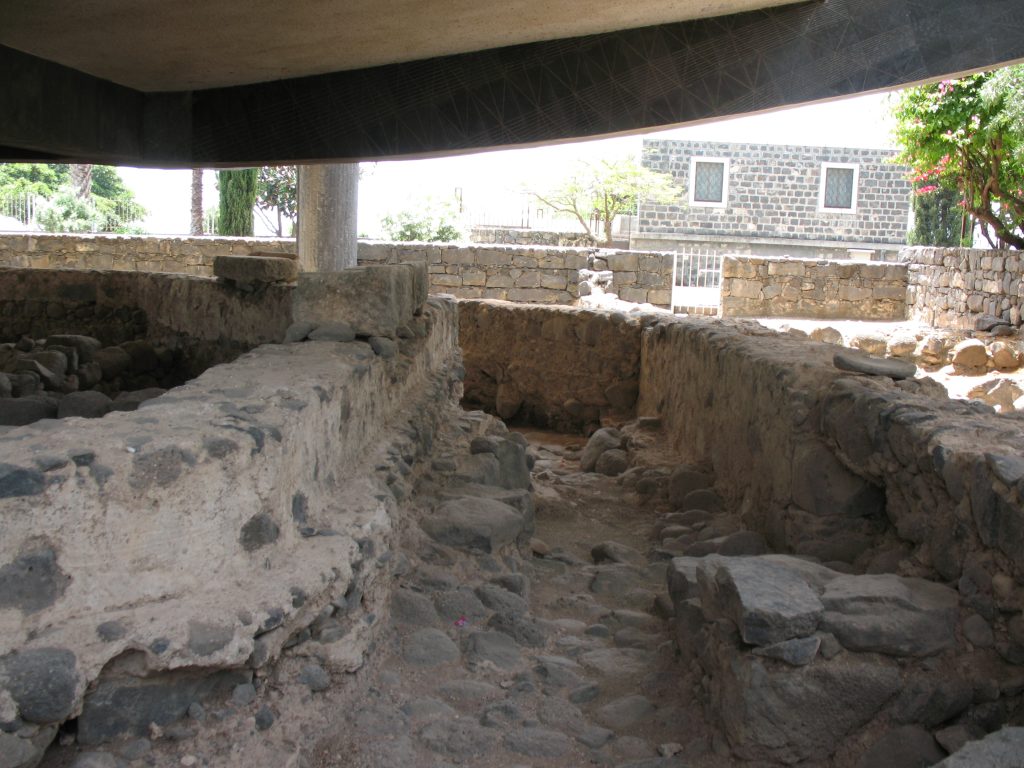
A modern church shelters the archaeological remains traditionally associated with Peter. Corbo and Loffreda reported domestic phases below a more elaborate late Roman structure and a Byzantine octagonal church. The octagon is visible as a planned act of commemoration. One building concentrates attention over a portion of an older neighborhood and becomes a destination in its own right. Archaeologists study surfaces, walls and plaster for evidence of the alterations. The visible plan belongs to the history of worship here and lets us ask how a remembered place became a more public Christian monument. Magness, octagonal church and its predecessors.
Pilgrim testimony helps explain the tradition. A description commonly attributed to the pilgrim Egeria speaks of a church made from Peter’s house at Capernaum, and a later pilgrim from Piacenza mentions a basilica there in the sixth century. The earliest reported remains fit a domestic setting. The identification of the resident depends on the transmission of local memory, the reading of the site and the association of the later worship buildings with the particular earlier room. Some proposed early Christian readings of graffiti are disputed. The excavation establishes a valuable sequence of building and use, while the names of the first occupants are beyond what the household walls can tell us. Magness, the pilgrimage sources and early structures.
Read the village in the order of the story
Read Mark 1:16–34 from the lake to the synagogue and then to the house. The movement tells a story about whom Jesus encounters. The people addressed by His teaching are part of a gathering. The woman whose fever He heals belongs to the ordinary life of a family. By evening a crowd is at the door. John 6 also names Capernaum in the account of Jesus teaching about the bread of life. Looking at the town’s buildings can help us place the rhythm of those accounts, from travel by water and the bustle of work to prayer, teaching and family life.
For Christians who read these events as true, the remains are a reminder of the particular people and places to which Jesus came. The Gospels present Him moving readily through a world of houses, work and worship. At Capernaum one can attend to how close those settings stood, and let that nearness give force to the movement of the story. The village’s later communities also left places in which to gather, worship and remember. Their buildings belong to the history of Capernaum after the events of the Gospels, and they make visible how later generations lived beside those memories.
Sources and further reading
- Jodi Magness, Capernaum — Modern reassessment of excavation reports, the visible limestone synagogue, earlier structures, and the church tradition.
- Franciscan Custody of the Holy Land, Capernaum — Excavation history and Franciscan interpretations of the houses, synagogue and church.
- Matthew J. Grey, Simon Peter in Capernaum — Archaeological survey of the early village with references to Corbo and Loffreda’s original publications.
- Bornblum Eretz Israel Synagogues Website, Capernaum — Published site description, archaeological elements and dating bibliography.