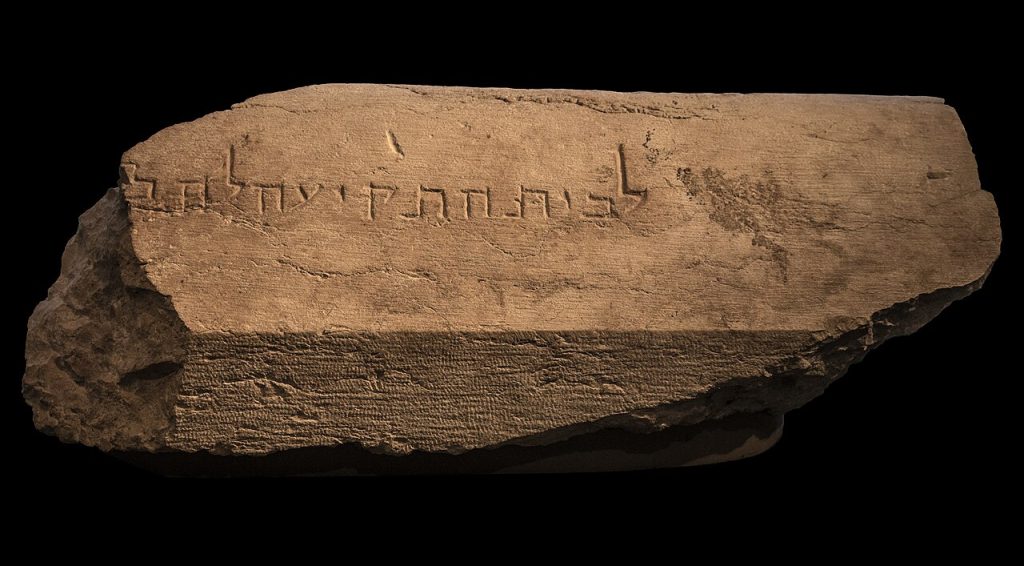
At the southwest corner of the Temple Mount in Jerusalem, an ancient paved street ran beside a wall that rose far above the people using it. Excavators working down by the pavement found a broken building stone with two complete Hebrew words and traces of more letters. The clearest part reads “to the place of trumpeting.” The height of the wall helps explain why scholars have connected the sign with a custom described by Josephus. His account describes a priest sounding a signal for people in the city to stop work for the Sabbath and to resume it the following evening. The stone and the written account let us study how worship in the temple precinct reached into the lives of people beyond its walls. Israel Museum object record. Josephus, The Jewish War 4.582.
Key takeaways
- The stone came to light in Benjamin Mazar’s excavations at the southwest corner of the Temple Mount, a project that began in 1968.
- Deeply cut Hebrew letters name a place for trumpeting. The broken edge cuts through the continuation, and proposed restorations remain tentative.
- Josephus describes a priest signaling the approach and close of the Sabbath. The Mishnah also preserves traditions about Sabbath-eve signals.
- The find puts a tangible detail of the Second Temple period alongside the Bible’s account of Sabbath, worship, and the destruction of the temple.
A stone found below its probable setting
Start with the architecture. The Temple Mount was a large raised enclosure. The walls that supported and bounded the complex belonged to a different part of the structure from the sanctuary within it. A parapet, a low barrier along an elevated edge, was another element of the whole. The Israel Museum identifies the broken inscription as a probable piece of such a barrier. Its suggestion draws on the shape of the object as well as the lettering. The object’s proposed original position was above ground level, while the excavators found it amongst rubble down on the street. The museum’s identification of the building stone.
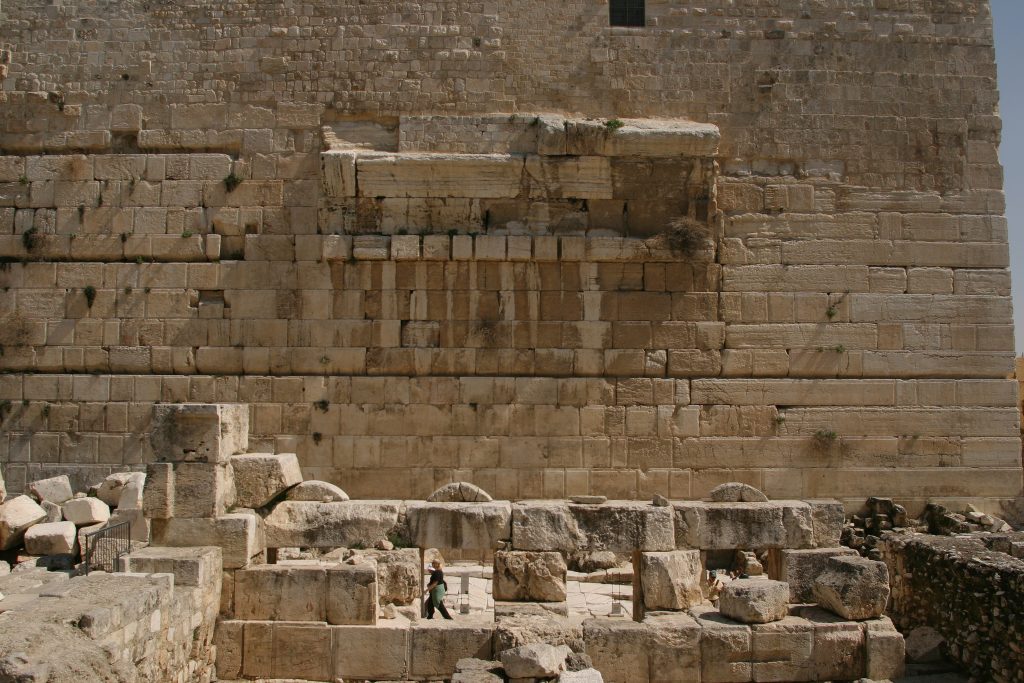
Benjamin Mazar directed large-scale work along the base of the southern wall and around the southwest corner beginning in 1968. Near present-day Robinson’s Arch the excavators exposed parts of a paved street beside the enclosure. Later work documented drainage below the pavement. The wall, the ancient ground surface, and the drainage channel give us three different levels to look for in an excavation report. The inscription was recovered down by that street level. It was shaped for an architectural setting higher up, and its recovery among collapsed material gives us a reason to look at the wall behind it. Israel Exploration Society, Temple Mount Excavations reports. Israel Antiquities Authority report on Robinson’s Arch and the street.
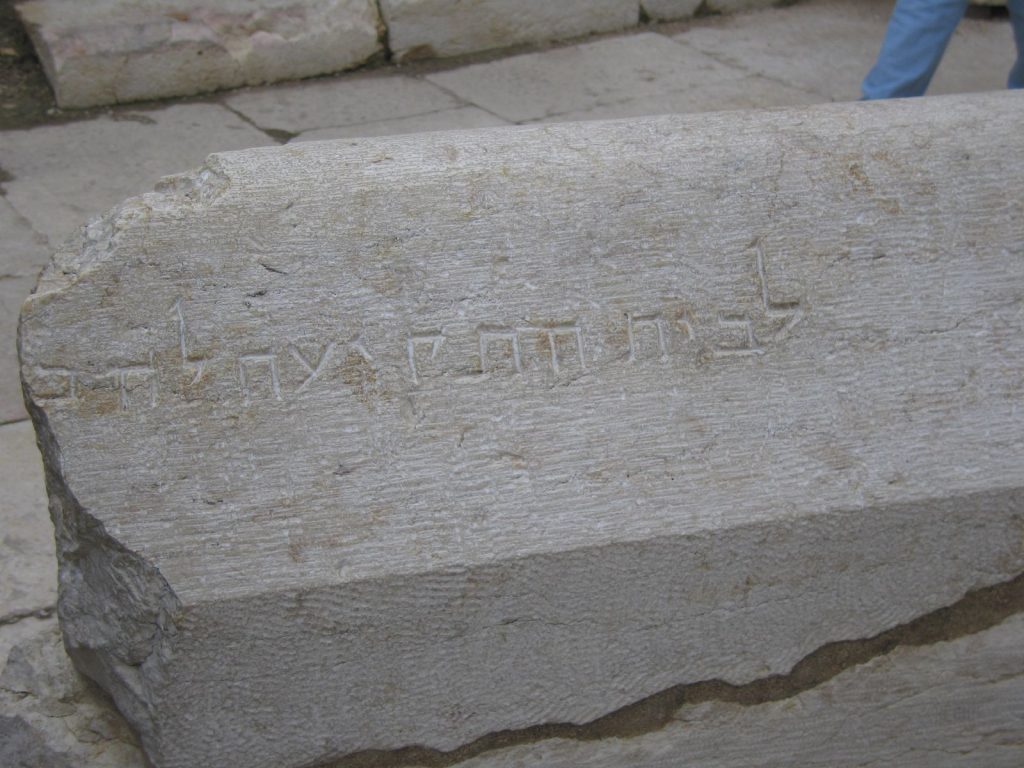
There is a useful distinction between where the stone belonged and where someone actually recorded it. A findspot is the documented place of recovery. The original position is a reconstruction made by studying the fragment, its surroundings, and comparative evidence. Here the two positions are close on a plan and far apart in elevation. A modern replica placed low among the ruins helps visitors see something of the recovery area. Placing a piece up at the top of a drawing serves a different purpose. It shows the reconstruction of the earlier building. Corpus Inscriptionum Iudaeae/Palaestinae entry and findspot excerpt.
The difference also changes how we talk about the fall of the stone. Jerusalem’s Roman-era street remained available for later building and reuse. Moving through the excavation area today, a visitor can see walls and stones belonging to more than one phase, and an individual pile of rubble needs to be read with its own context. In the case of this inscription the fixed observations are the location of the paved street, the association of the stone with fallen material, and the broken edge of its inscription. Together with the probable parapet form, those observations make it possible to connect pieces of the ancient architecture while leaving the exact path of the block’s fall unreconstructed.
Read the surviving Hebrew
The face has carefully cut square Hebrew lettering. Read from right to left, the two complete words are le-beit ha-teqi‘ah, the part translated as “to the place of trumpeting.” When a publication prints a possible continuation such as “for announcing,” the brackets belong to the evidence. They signal a scholarly proposal for how to read past a break in the stone. A complete modern sentence would therefore tell you more than the surviving carving can. The clear words already give the object an unusually specific connection to the activity carried out at the place it marked. Israel Museum transcription and description. Corpus entry with proposed restorations.
The Israel Museum catalogs the stone in the Herodian period and assigns it to the first century BCE. The scholarly inscription corpus’s entry places it in the first century CE. Both situate the piece within the era of the temple complex rebuilt and enlarged under Herod and standing into the first century AD. Its lettering and architectural context can support a period attribution without dating the moment when someone carved it to a year. The surviving fragment has no date or name on it. Keeping the two catalogue judgments in view is a way of stating what archaeology can presently establish about the age of a small object. Museum date and inventory number 1978-1439. Corpus Inscriptionum Iudaeae/Palaestinae, Jerusalem, no. 5.
The broken stone marks out a place. The sources that remember the signal tell us what that place meant for people listening below.
When Jerusalem heard the Sabbath approach
Josephus mentions the custom while describing towers erected during fighting within Jerusalem. One stood over rooms associated with the temple, near a location where a priest used to sound a trumpet. Josephus says the sound gave advance notice of the arrival of the seventh day, and a further signal the following evening let people know when work could resume. The detail is striking because the Sabbath custom interrupts a military account. It helps locate a building and tells us something about what people ordinarily expected from the area. The connection with the carved block is persuasive because the written use and the archaeology both concern trumpeting at an elevated place in the complex. Josephus, The Jewish War 4.579–582. Lutz Doering’s analysis of the ancient descriptions.
Josephus’s description can also be read with more attention to its geography. The tower opposite the lower town and the tower associated with the priestly chambers appear at different points in his list. A modern plan may put the trumpeting station at the southwest corner because of where the inscribed block was found. The exact placement owes something to the archaeological argument. There is no need to make Josephus supply a compass direction expressly for the station. He gives the function and an architectural association. The pavement find gives a location from which to consider the connection. H. St. J. Thackeray’s Greek text and English translation of Jewish War 4.579–582.
Mishnah Sukkah 5:5 describes six additional trumpet blasts on the eve of the Sabbath, linking the first three with stopping work and the next three with marking off sacred time. As a rabbinic compilation put into writing after the temple had been destroyed, the Mishnah preserves a separate kind of testimony from Josephus’s account of the war. Together they help us picture public sound organizing the approach to the Sabbath. They also leave room for questions about timing, which signals different listeners heard, and how broadly a documented Jerusalem practice can be applied. The carved stone supplies no count of the blasts or instructions for a particular instrument. Mishnah Sukkah 5:5. Doering’s comparison of Josephus and the rabbinic traditions.
The temple in the Bible’s account of Jerusalem
Exodus 20:8–11 grounds the Sabbath command in God’s pattern of creation and rest. Deuteronomy 5:12–15 recalls that Israel knew slavery in Egypt and that God brought his people out. The command reaches into every household, extending rest to servants, animals, and resident foreigners. Numbers 10:1–10 gives trumpets distinct functions in the life of Israel, including gathering the congregation and sounding at appointed times. Reading those verses beside the discovery lets us see how public signals and public worship could belong together. Josephus’s particular Sabbath signal is a historical practice in the world formed by those commands.
The Gospels and Acts draw us into the same city from different directions. Luke 2:41–50 describes Jesus going to Jerusalem with his family for Passover and being found among the teachers in the temple. Acts 3:1–10 places Peter and John on their way to the temple at the hour of prayer, when an encounter with a man who could not walk becomes part of the early church’s public witness. Read those accounts with an eye for the people moving through the setting. The building served the calendar, the daily rhythms of prayer, and occasions when Jerusalem filled with pilgrims. The inscription adds the detail of a known place from which an announcement could reach people outside.
Mark has already brought his readers into the courts before the disciple marvels at the buildings. In Mark 11:15–19, Jesus appeals to the scriptural purpose of God’s house in the midst of a dispute about how the space is being used. Listening to that scene before reading the later discourse gives weight to the word temple. It is a place where conduct and worship are bound together, and Jesus speaks about what God intends for it. The trumpeting block illuminates that connection at the scale of a single architectural feature. A priest on the wall had a responsibility that linked temple service to how people in the city would put away their work.
In Mark 13:1–4, a disciple draws Jesus’ attention to the great stones and buildings as they leave the temple. Jesus foretells the buildings’ destruction. Later, on the Mount of Olives, the disciples ask about its timing and signs. As Christians we receive the Gospel’s account as truthful testimony about what Jesus said. Josephus’s sixth book recounts the destruction of the temple during the Roman capture of Jerusalem in AD 70. The damaged stone tells a more local story. A piece of architectural trim once associated with worship was eventually found far below its probable place. The archaeological record lets us distinguish surviving retaining walls, vanished buildings, and displaced fragments as we read. Josephus, The Jewish War, book 6.
Compare the three kinds of evidence
- The block. Hebrew lettering gives the place its name, and the shape suggests an architectural role. Its broken edge controls how far the text can be read.
- The reports. The pavement and southwest corner fix the field context. The museum and corpus give useful alternative date attributions within the wider Herodian context.
- The writings. Josephus and the Mishnah illuminate how public announcements worked. Scripture shows why sacred time and the temple mattered deeply to the people who lived with those rhythms.
An inscription like this is easy to remember because its action is so specific. It draws our attention beyond rulers, conquest, and major buildings to people who listened for a signal and ordered their week around it. Another discovery from the complex, the Temple Warning Inscription, helps us examine a different sort of ancient sign. One concerned access and boundaries. The Trumpeting Place block helps us imagine how the temple made the approach of the Sabbath known to the surrounding city.
Questions readers ask
Is the stone visible at the excavation site?
The archaeological park has a replica. The original is cataloged by the Israel Museum as Israel Antiquities Authority 1978-1439.
Does the inscription say when the Sabbath began?
The surviving Hebrew gives the place of trumpeting. Josephus and the Mishnah are the relevant written sources for the timing and purpose of the signals.
Sources and further reading
- Israel Museum, To the Place of Trumpeting — Primary object record with inventory, museum date, measurements, original photograph, and findspot.
- Corpus Inscriptionum Iudaeae/Palaestinae, Jerusalem, entry 5 — Critical edition for the Hebrew reading and possible restorations. A reproduced excerpt is linked in the article.
- Josephus, The Jewish War 4.582 — Ancient description of the priest giving Sabbath signals.
- Mishnah Sukkah 5:5 — Rabbinic account of trumpet blasts, including those on Sabbath eve.
- Lutz Doering, The Beginning of Sabbath and Festivals in Ancient Jewish Sources — Research on the chronology, languages, and historical setting of ancient Sabbath signals.
- Israel Antiquities Authority, Jerusalem, Robinson’s Arch — Excavation record for the wider context, including the paved street, channel, and enclosure.





