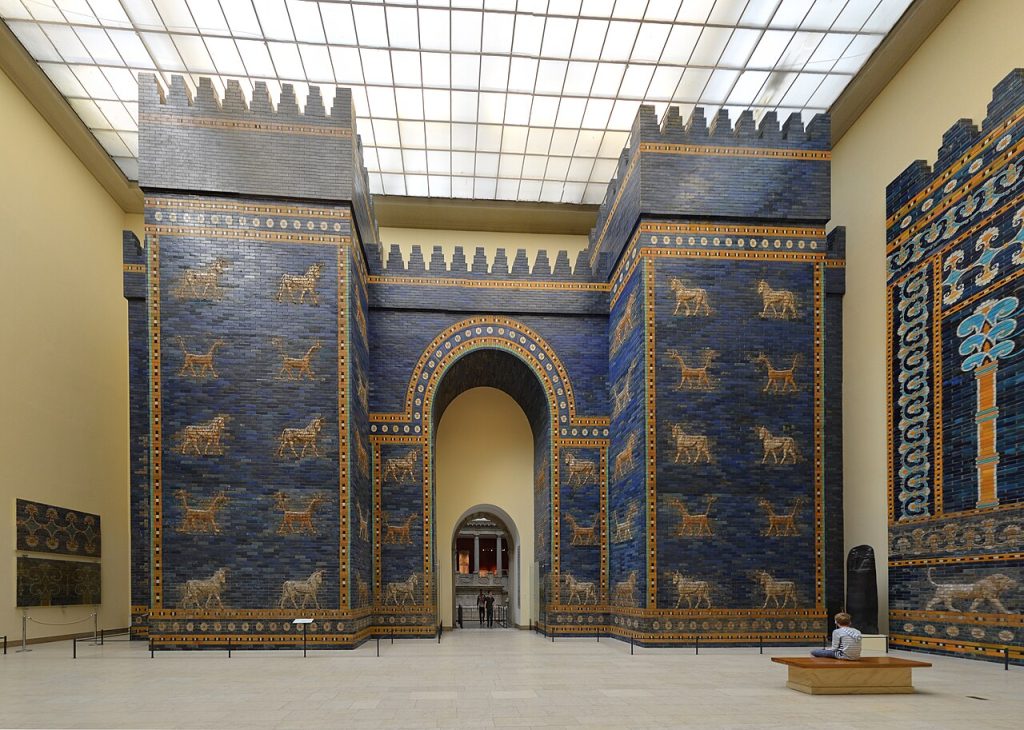
The reconstructed Ishtar Gate in Berlin looks like the sort of thing excavators would have found standing above the ground. Tall blue walls rise around an arch, and rows of pale animals appear against the deep glaze. The excavation began with pieces and traces much closer to the earth. At Babylon archaeologists worked out where the gate stood, how the streets approached it and where its decorated levels belonged. In the museum conservators worked out how fragments could go back together. The picture is unusually helpful for readers of Daniel because we can trace the work backward. At the end of that trail is the royal capital about which Nebuchadnezzar boasts.
What you’ll learn
- Which parts of the Ishtar Gate were excavated at Babylon and how fragments became the Berlin display.
- Why dragons and bulls on the gate belong to a different part of the approach from the lions.
- How dating bricks and reading Daniel give us two ways to understand a monument to royal power.
Start at Babylon, with the street and the foundations
Babylon’s remains lie near modern Hillah in Iraq, in the region through which the Euphrates flows. The great city’s surviving walls, temples and palaces belong to multiple periods. The Ishtar Gate is a particular entrance complex in that larger archaeological landscape. During the Neo-Babylonian period, visitors could approach it by a major processional route. Before looking for the famous animal designs, place a gateway on that route in your mind. A gate controls movement through walls. When it stands on a ceremonial street, it can also stage the way a procession or a visiting delegation approaches the city. UNESCO’s record for Babylon and its archaeological remains.
Robert Koldewey directed German excavations at Babylon from 1899 until 1917. Archaeologists cleared parts of the streets and walls and found glazed fragments in and around excavated areas. Lower construction levels preserved evidence in place. In his published account, Koldewey treats the approaches, street levels and gate as connected features that have to be read in section as well as across a plan. Layers supplied information about what went above or below a wall. Fragments and partially preserved brick reliefs provided different clues about what a person approaching the walls might have seen. Koldewey’s excavation account, including the Ishtar Gate and Processional Street.
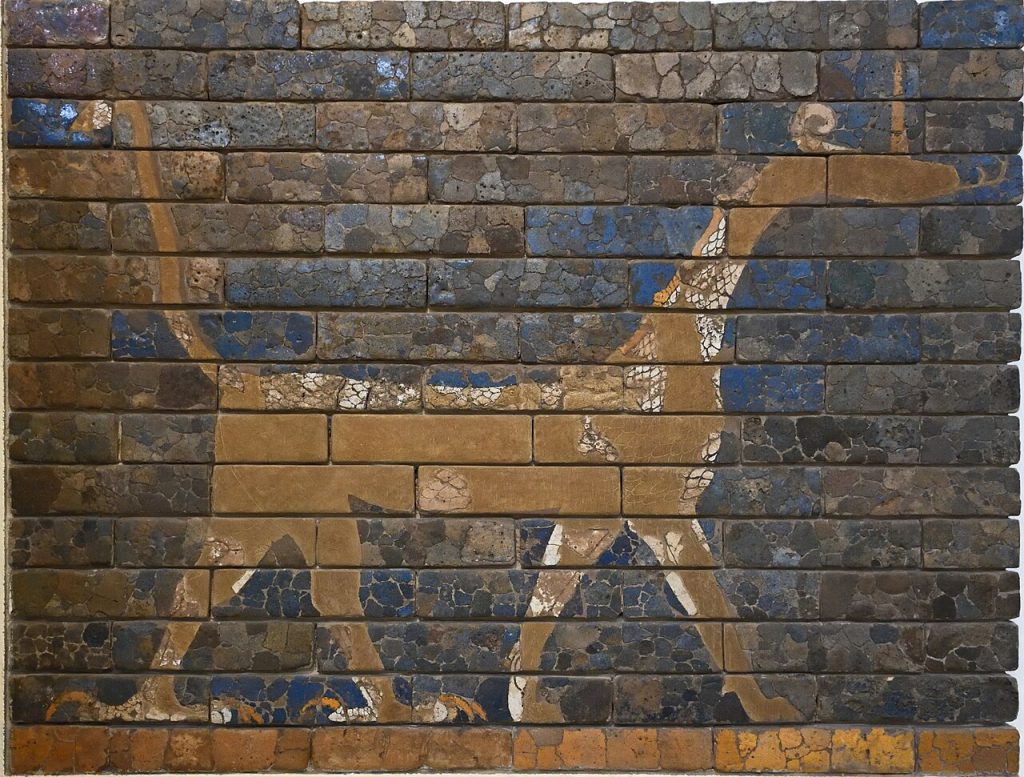
Think of what this means for an excavator. A neatly fitting pair of glazed pieces can restore part of a figure. A figure associated with a wall or pavement helps establish where a design belongs. A layer of fill may contain fragments moved there when a street was raised. Each observation has to answer its own question about position and sequence. A modern photograph of a reconstructed gate is valuable because it offers a view of what all those small observations make possible. The excavation account supplies reasons for treating the pieces as parts of a particular ancient structure.
The researchers group the decoration into three main phases. They describe earlier bricks that were molded to create raised designs without glaze, then flat glazed bricks, then glazed molded bricks. As the nearby street levels changed, the height and form of the gateway had to suit a changing approach. The laboratory team could compare material from the three groups. Those sampled fragments were assigned to phases by decoration type, a point worth distinguishing from the inscribed bricks found in their original construction position. Both lines of reasoning matter when evaluating how firmly a fragment can be placed in the building sequence. Di Chiara and colleagues, archaeological context and sample table.
Which animals belong on the gate?
Glazed brick made it possible to use color on architecture on a large scale. Bulls and long-bodied dragons appear on the gate, arranged in repeated horizontal rows. The composite dragon is often called the mušḫuššu. On the approach, a different arrangement of animals met the people walking the Processional Way. The Metropolitan Museum’s striding lion comes from that street decoration. The lion is a particularly appropriate emblem for Ishtar. Looking closely at its paws, mane and raised outline makes it easier to see how one repeating figure could remain recognizable across a stretch of wall. The Met’s record for a Processional Way lion.
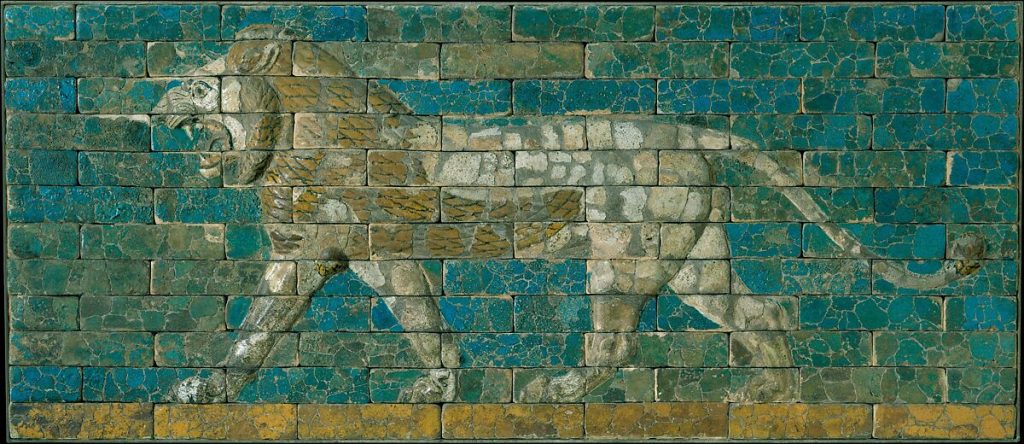
The art was built out of manageable parts. Ancient workers had to make bricks whose faces could carry strips of the design and then bring them into alignment on a wall. A surviving glazed brick might preserve part of a claw, a curl of a mane or only an area of blue. Modern restorers can use recurring patterns to recognize those parts and reconstruct fuller figures. The outlines of the gate’s program become more interesting when we can see the individual joins. A single figure passes over many separate pieces. The monument required a way to coordinate the people who molded, fired, laid and arranged them.
- Look for the blue ground and repetition in photographs of the gate.
- Follow a lion panel to the Processional Way and distinguish that approach from the gateway.
- Read the museum caption for what was reconstructed and what survives in ancient material.
From thousands of pieces to a museum gate
The reconstruction belongs to the twentieth century. The Staatliche Museen zu Berlin describe fragments awarded to the museum through artifact distributions shared with the authorities in Istanbul and Baghdad. In Berlin, teams sorted, conserved and assembled material. Much of what visitors recognize as one large gate depends on that work. The reconstruction was shown when the Pergamon Museum opened in 1930. The museum photograph therefore lets us see an interpretation made with ancient pieces and modern support. It also leads to questions about how archaeological artifacts were divided and moved, decisions with consequences for what visitors can see in different countries today. Berlin exhibition, From Fragment to Monument.
The gate system at Babylon was larger and more complicated than one exhibition wall suggests. The familiar Berlin outline represents the outer gate of the complex. A visitor to ancient Babylon would have seen this structure in relation to other parts of an entrance and its walls, and to the rising levels of a processional street. A visitor viewing the museum reconstruction follows a modern path through a room instead. A model or a plan complements the full-sized display because it helps restore spatial relations that the museum building cannot reproduce. Comparing the two is a useful way to keep the ancient approach and the modern installation in mind at once.
What a fired brick can record
Inscribed bricks preserve the name of Nebuchadnezzar II. That is one way of connecting the work to the period of his reign. A group led by Anita Di Chiara tested another method with bricks assigned to three phases of the gate. When clay is fired, some minerals can retain information about the strength of Earth’s magnetic field as they cool. The researchers compared measurements from the bricks with a curve built from dated archaeological material in the wider region. The results from the phases were close enough to support a relatively short construction sequence. It is a way of using the bricks’ material history to ask a question about the timing of rebuilding. Di Chiara and colleagues’ archaeomagnetic study.
The best fit the study reports is about 569 BC. Treat that as an estimate from a particular comparison, within the known reign, and allow for uncertainty in the measurements and reference curve. The study authors interpret the result as consistent with construction after Babylon’s major campaign against Jerusalem. They do not claim to have found a brick stamped with that year or to have established a calendar date for every movement of the workmen. The method is most informative alongside the inscriptions and archaeological phases, because the different kinds of evidence help determine how narrowly the date can reasonably be stated. The study’s discussion and figure 7.
A monumental gate could express the king’s power every time someone entered the city. Daniel asks what happens when that power becomes the subject of his praise.
The city meant something more intimate to those who had to make a life in it. Jeremiah 29 tells exiled Judahites to build houses, plant gardens and seek the welfare of the place to which they have been sent. Read that passage with the processional street in view. A ruler could commission a monument while ordinary households adapted to life in a foreign city. The texts ask different questions of the same setting. For the king, Babylon could embody his own achievement. To the exiles it was a place of judgment, waiting and responsibility. The buildings help us imagine the city beyond the victories recorded by its rulers.
The Babylon of Daniel and the exiles
Second Kings introduces Babylon to readers through its army’s actions in Judah. The capture of Jerusalem in 597 BC and the later destruction belong to two events with different evidence, explained in the article on the Babylonian Chronicle. The ration tablets naming Jehoiachin take the story on to the king and his household in Babylon. The Ishtar Gate brings a third kind of evidence into that picture. Instead of recording a campaign or an allocation of oil, the architecture bears on the built environment of the king’s capital. Its scale helps a reader picture the city to which the accounts of exile refer.
Daniel 4 follows Nebuchadnezzar from a dream to an encounter with a limit on his power. Looking out over Babylon, the king regards the glory of the capital as his own accomplishment and the expression of his majesty. That is a believable boast in light of what excavators restored of the city he built. The narrative goes on to say that his rule is taken away for a time and that he comes to recognize the authority of the Most High. Daniel does not name this particular gate as the spot where he made his boast. The monument supplies a concrete example of the urban works that make the statement worth hearing. Daniel 4.
Christians read Daniel as true and see the king’s restored humility as central to its account. The bricklayers and their supervisors had created an entrance that could proclaim an empire’s confidence on an impressive scale. Behind the blue glaze were many measurements, fired bricks, walls and human decisions. Daniel directs our attention past the works to the judgment of God on the ruler who takes their glory to himself. Looking closely at the entrance gives his boast a setting. Reading the chapter through to the end gives his praise its proper weight.
Sources and further reading
- Robert Koldewey, The Excavations at Babylon — Excavator’s account of the Ishtar Gate, architectural levels and processional street.
- Staatliche Museen zu Berlin, From Fragment to Monument — Museum record of archaeological distribution, brick restoration and the 1930 reconstruction.
- Di Chiara and colleagues, An archaeomagnetic study of the Ishtar Gate, Babylon — Measurements from three construction phases and calibrated date discussion.
- The Metropolitan Museum of Art, Panel with striding lion — Object comparison from the Processional Way.
- UNESCO World Heritage Centre, Babylon — Location and scope of the excavated ancient city.
- Daniel 4 — Nebuchadnezzar’s account of his dream, boast and restoration.