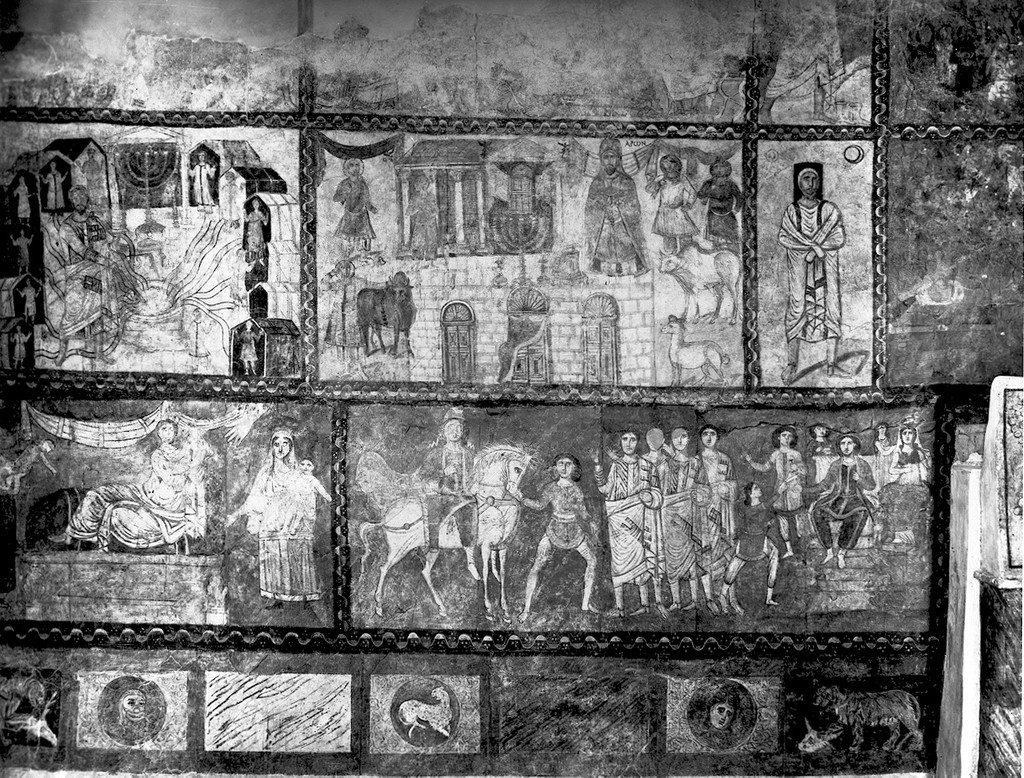
A painted wall in a synagogue beside the Euphrates puts Moses in several places at once. One figure appears near a city, other figures mark successive moments around the sea, and rows of people move through the story. The ancient painters used a single long panel to put scenes from the Exodus in front of worshippers at Dura-Europos. Nearby walls held other biblical scenes, including Ezekiel’s vision of dry bones. Few places give us such a direct view of how an ancient Jewish congregation made Scripture visible in its own space. The room lets us ask where people looked, how they recognized what they saw, and what the paintings added to their encounter with a familiar story. Yale University Art Gallery, Synagogue excavation and archive.
Key takeaways
- The Yale–French expedition uncovered the painted synagogue at Dura-Europos in the 1932–33 season.
- A ceiling inscription gives a date of AD 244/245 for the decorated building’s later phase. An earlier synagogue preceded it.
- Painted biblical scenes surround an assembly hall with a Torah shrine in the west wall. The subjects include the Exodus, Samuel and David, and Ezekiel’s dry bones.
- The original paintings were taken to the National Museum in Damascus. Excavation photographs and Herbert J. Gute’s copies preserve additional evidence.
Where the room survived
Dura-Europos stood above the Euphrates, in what is now Syria. The synagogue was near the city’s western defenses, where the threat of a Sasanian siege led defenders to pile earth over structures along the wall. The city fell around AD 256. The fill that buried part of the synagogue also helped preserve it. This process explains both the remarkable height of the surviving west wall and the more incomplete evidence on other sides of the room. The edge of the embankment cut a slope across parts of the surviving walls. An archaeologist can use that pattern to think about which parts of the room it was possible for the excavators to see. Yale’s account of the embankment and the surviving walls.
The Yale University and French Academy of Inscriptions and Letters expedition uncovered the synagogue in its 1932–33 season. The team had to work out how to document paintings that were more vulnerable exposed than they had been under cover. Yale sent Herbert J. Gute to reproduce the murals, and Henry Pearson supervised work to remove the original paintings. The originals were taken to Damascus and reassembled at the National Museum. Gute’s copies went to Yale. The record therefore contains in-place excavation photographs, photographs made after the move, and painted copies. Each has a purpose, and a caption should tell us which one we are looking at. Excavation history, copies, and the original paintings. National Museum of Damascus account of the reconstructed synagogue.
An older building and a dated renovation
The surviving decorated room was only the later stage in the building’s life. Yale describes a private house adapted for the Jewish community during the Roman period, with the first synagogue usually placed in the later second century. It was later enlarged and elaborately decorated. The Aramaic inscription on a ceiling tile places a building phase in AD 244/245. The architecture shows that a meeting space had a history before that date. The inscription helps date a particular substantial phase of work. Putting the two kinds of evidence together gives us a better account of the synagogue than any date for the entire building taken by itself. Yale’s building sequence and date of enlargement. Karen B. Stern, study of the synagogue ceiling inscriptions.
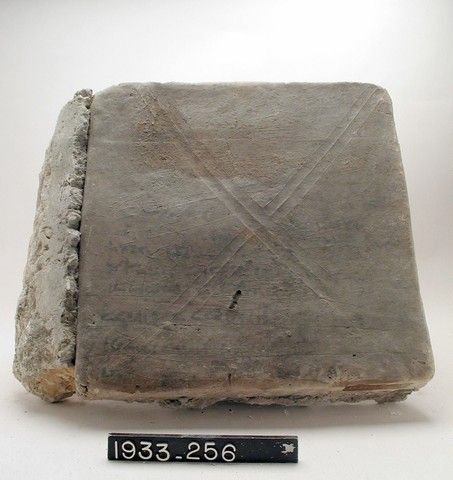
The builders put hundreds of painted clay tiles overhead on wooden supports. Excavation recovered more than two hundred complete or broken tiles. Some carry designs of plants and animals, and others carry Greek or Aramaic inscriptions naming participants in the work. Stern compares them with ceilings and dedicatory writing elsewhere in Dura. This is valuable because even a distinctive synagogue was made by people living among neighbors who knew similar ways of building and decorating. Their use of familiar materials could serve very particular purposes. The inscriptions give glimpses of the people who made the room possible, while the paintings give another kind of evidence for what the room was made to hold. Yale’s documentation of the painted ceiling. Stern’s reconstruction of the adjoining architectural tradition.
The inscriptions give another way to recognize the people behind the building. A Greek tile names a Samuel as an elder of the Jews, while another names people who helped. The Aramaic texts add titles and responsibilities. Researchers compare the names precisely because similar names can belong to more than one person, and the surviving words do not specify every task. These clues can be read alongside the Theodotos inscription from Jerusalem, a record from a different time and place that likewise names people connected with a synagogue. Each helps us see the work required to maintain a gathering space. Stern’s discussion of the Greek and Aramaic dedication texts.
The Torah shrine and the painted walls
The center of the west wall held a recessed Torah shrine. Worshippers entered an assembly room with benches and an arrangement that brought the shrine into view. Its position established an architectural focus before a viewer tried to follow any painted story around the room. Kära L. Schenk studies the temple imagery at the shrine, including how its earlier decoration relates to the surrounding scenes. Views differ about whether the paintings formed a single program with a uniform meaning. For a reader starting with the room, it is possible to identify a focal point and particular scenes, then ask how much more of their relationship the positions and surviving decoration allow us to recover. Schenk’s study of temple imagery at the Torah shrine.
The painters arranged narrative panels in horizontal bands. Some represent more than one moment of a story. Others appear to place an important person or a recognizable object in a scene of its own. A viewer could move from a group of painted figures to a depiction of a sanctuary and then to another part of Israel’s history. Surviving labels in Greek and Aramaic help identify some figures or scenes. Even where a name survives, its presence does not tell us everything about why the panel was put next to a particular neighbor. The room continues to invite both close description and wider interpretation. Kraeling’s final report, panel descriptions and interpretation.
The synagogue gives us a record of Scripture being remembered together. People saw the stories in the same room in which they gathered.
How the artists pictured the Exodus
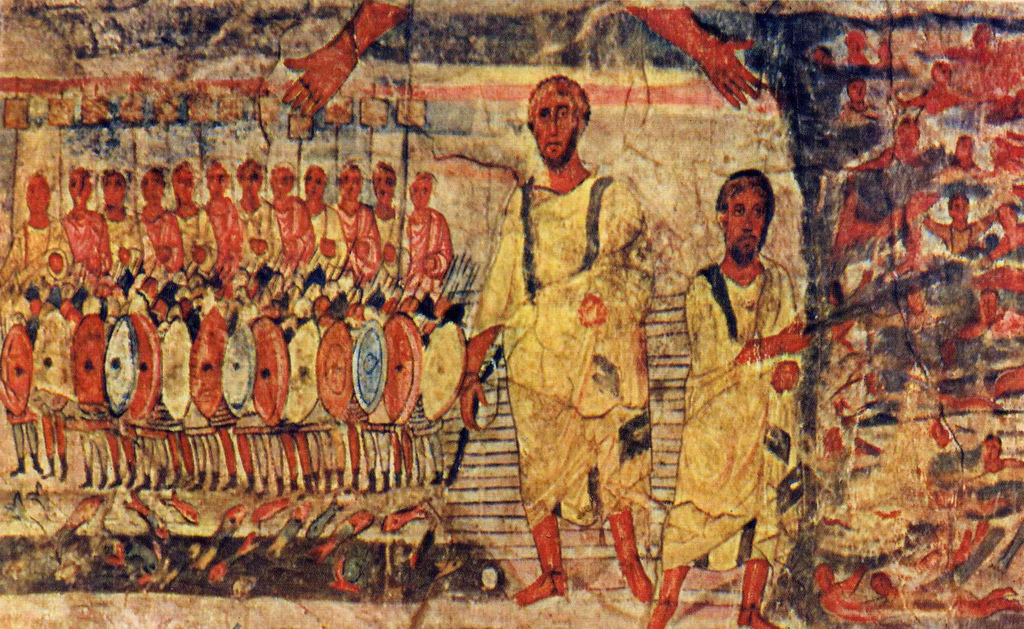
Read Exodus 12:29–42 and 14:10–31 together. The first passage tells of the departure from Egypt. The second takes Israel from fear in front of the approaching Egyptian army to rescue at the sea. The painting compresses more than one moment into a continuous field. Carl Kraeling’s excavation report explains that Aramaic titles help identify three large figures as Moses in successive parts of the panel. The repeated person is a device for showing the movement of the story. In the part where God saves, the painter used hands emerging from above as a visible sign of God’s action. Kraeling’s description of panel WA3 and its accompanying labels.
A painting also makes decisions that a passage of prose leaves to the imagination. The artists gave people particular garments and placed them in lines and groups recognizable to their viewers. Some details draw on artistic conventions shared with other communities of the region. The subject draws directly on the life of Israel as told in Scripture. Starting with what the painting shows, then reading the longer Bible narrative, helps us see how the artist chose to make the departure and rescue recognizable even when both had to fit on one wall. The continuity between the scenes comes from the story and from the repeated figure leading us through it. The final report’s analysis of layout, costumes, and pictorial conventions.
The west wall offers a smaller moment of recognition in the picture of Samuel anointing David. Read 1 Samuel 16:1–13 and notice how the brothers come before Samuel and how God’s choice becomes clear as the story proceeds. In the painting, a label points to the action at the center of it. The image is one moment placed where people could recognize a much longer account. That is a different way to make a story present from putting three appearances of Moses into the larger Exodus scene. Both examples show that legibility was something the painters had to create. Yale’s survey of identifiable scenes on the west wall.
Ezekiel and the restoration of Israel
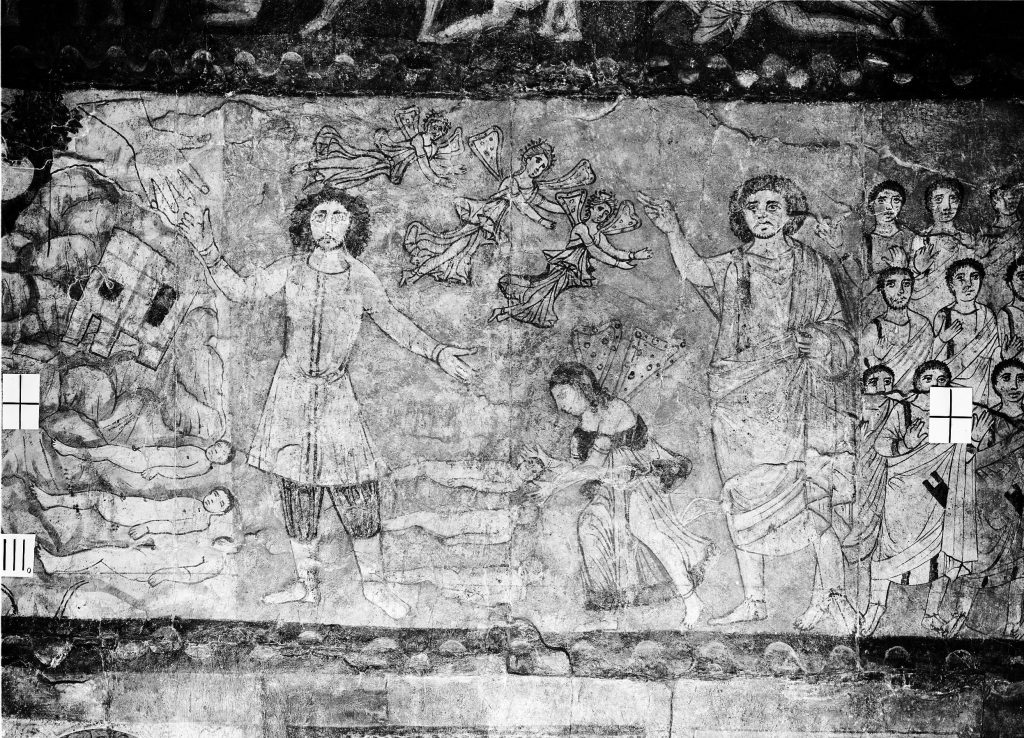
Another wall uses a related way of telling a different biblical story. Ezekiel 37:1–14 opens with the prophet bound by God’s instruction to speak to the bones in a valley. The bones come together and life returns at God’s command. The passage itself identifies the bones with the whole house of Israel and speaks hope to a people whose hope has dried up. The north wall’s painted treatment introduces gestures and figures into a visual sequence that scholars have worked to understand. The words of the prophecy help a reader see why the theme of restoration matters within a room filled with Israel’s remembered history. Kraeling’s analysis of the Ezekiel cycle and the range of readings.
A panel like this rewards patience. There are recognizable actions and a well-established overall subject, even as certain details are interpreted differently. It is worth looking at the sections in relation to one another. The story depends on the command, the acts that follow it, and the explanation of what the vision means. A fragment or close-up can isolate a gesture that originally stood within a longer scene. The excavation drawings, photographs, and the full account of the north wall help bring the sequence back into view. The evidence is that a Jewish community chose to surround itself with this and other scriptural pictures. Yale’s plans and north-wall records.
Read the paintings within their own community
The synagogue is one of several places of worship uncovered at Dura. It can be read alongside the nearby Christian building at Dura-Europos, which also used painted scenes in a place of religious life. The settings were different. The synagogue’s assembly room focused on the Torah shrine, and the Christian building’s surviving paintings were concentrated around a chamber commonly understood as a baptistery. The roles of the pictures follow from specific settings. Comparison can show that neighbors drew on some of the same artistic habits without requiring that one set of pictures be explained by the other. Yale’s plans and comparison with neighboring buildings.
We receive the Bible as true and accurate, and Christians share with Jewish readers a deep interest in the events and promises represented here. In 1 Corinthians 10:1–4, Paul recalls the passage through the sea as he teaches a Christian congregation. The Dura painters show an ancient Jewish community’s own reception of the Exodus. Reading Paul and looking at the murals can make us more attentive to both, as long as we read each in its own setting. The colors, buildings, and inscriptions bring the Jewish community’s encounter with the words of Scripture into view. They are one of the most vivid reminders we have that these stories were read, taught, and remembered together.
Three details to look for
- Find the center of the room. Look at a plan or a full photograph of the west wall before studying individual painted scenes.
- Follow a figure. In the Exodus panel, recognize each appearance of Moses as a new moment in the story.
- Check the image caption. A photograph of the original wall, an excavation drawing, and a painted copy can answer different questions about the same scene.
Questions readers ask
Where are the original murals held?
The originals were taken to the National Museum in Damascus, where the painted hall was reconstructed. Yale preserves Gute’s painted copies, photographs, and other finds.
Were the synagogue and Christian building the same place?
They were separate buildings at Dura-Europos. Each had painted biblical scenes set in a different kind of worship space.
Sources and further reading
- Yale University Art Gallery, Synagogue at Dura-Europos — Primary archaeological photographs, plans, and the institutional excavation history.
- Carl H. Kraeling, The Synagogue, Final Report VIII.1 — The excavation report, including measured plans, inscriptions, and individual wall-panel identifications.
- Karen B. Stern, Mapping Devotion in Roman Dura Europos — Specialist analysis of the ceiling tiles, architectural context, and names and building dates recorded in the inscriptions.
- Kära L. Schenk, Temple, Community, and Sacred Narrative in the Dura-Europos Synagogue — Research on the Torah shrine and the meaning of temple imagery in its architectural setting.
- National Museum of Damascus, Synagogue of Dura Europos — Museum interpretation and history of the reconstructed synagogue hall.
- International Digital Dura-Europos Archive, Image Rights — Yale’s CC0 policy for its archival digitizations.





