A woman named Akeptous gave a table. A Roman centurion paid for the floor around it. A craftsman recorded his work, and another inscription asked that four women be remembered. All three records were set into one mosaic at a Roman-era village near Megiddo. When excavators exposed the floor in 2005, they recovered something a church historian seldom gets to see so clearly. Here were named people who spent money, made things and remembered one another in a room where they gathered to worship. The dedication gives the purpose of the table unusual clarity. It was offered to “God Jesus Christ.” Museum of the Bible photographs and translations of the inscriptions.
Key takeaways
- The floor was uncovered in 2005 in the modern Megiddo Prison compound at the Roman settlement of Kefar ‘Othnay, near the site of ancient Tel Megiddo.
- Three Greek inscriptions name Akeptous, a centurion and a mosaicist, and four women the community was asked to remember.
- The excavators proposed an early third-century date, while other scholars have placed the mosaic near the turn of the fourth century.
- The table dedication shows how one early congregation honored Jesus as God. John and Paul help explain the confession and the likely use of the table.
Where the mosaic was found
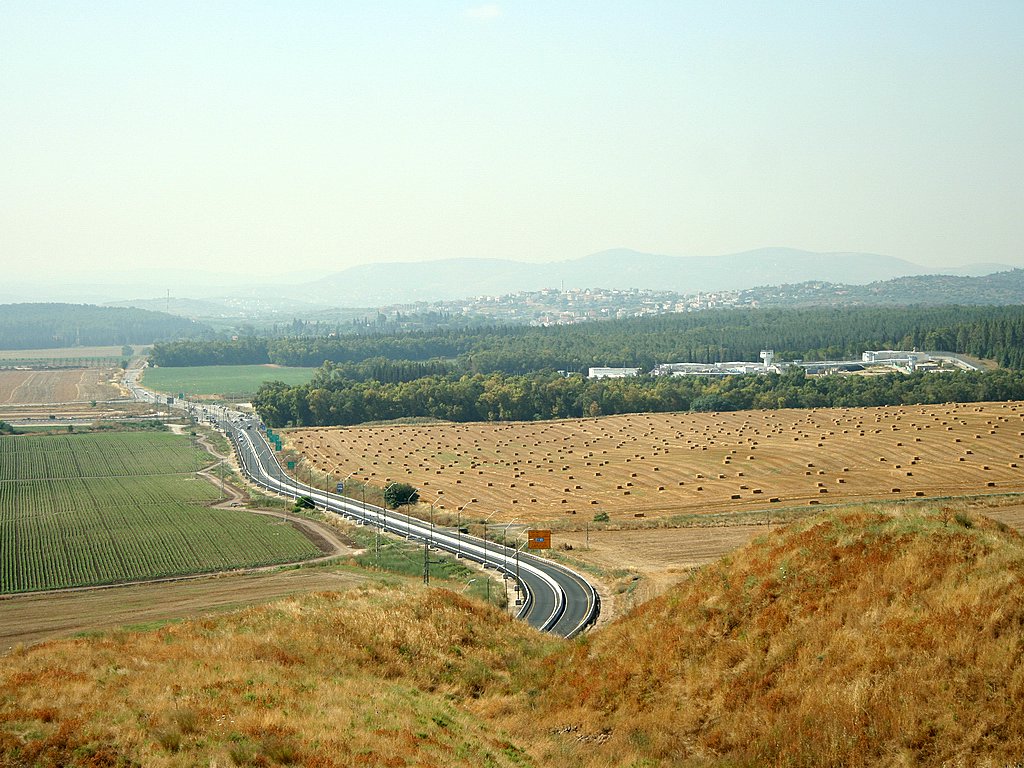
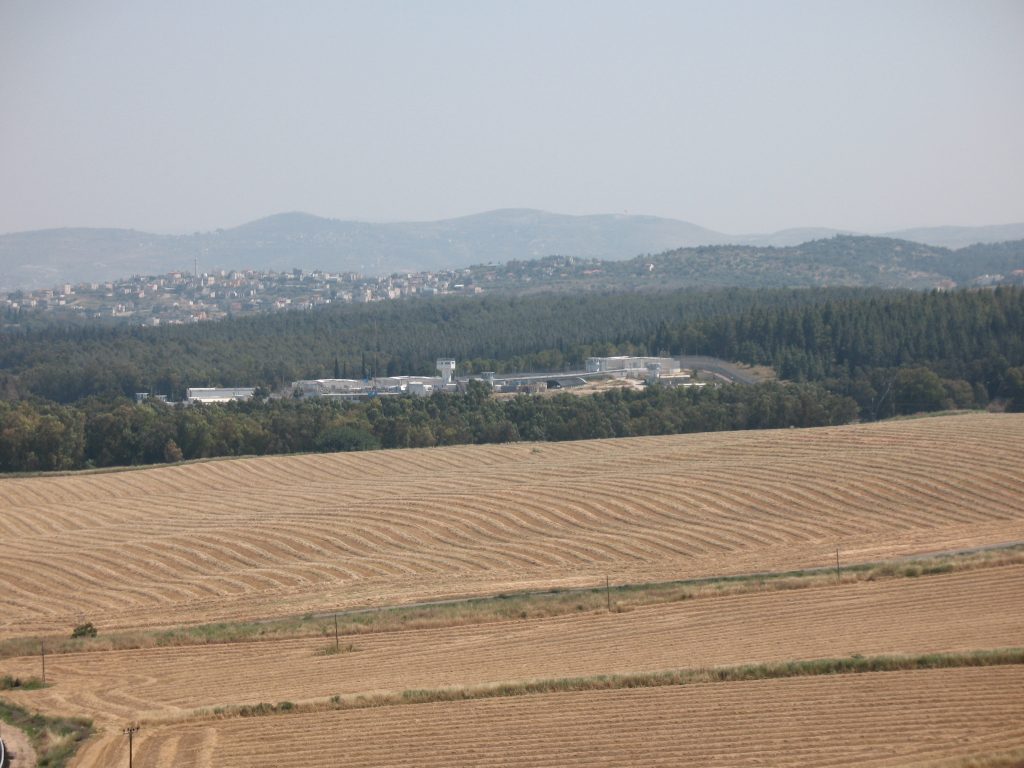
The name Megiddo can send a reader to the wrong excavation. Tel Megiddo is the ancient mound that looks out over roads entering the Jezreel Valley. The mosaic came from a different hill spur, in the modern prison compound near Megiddo Junction. The Israel Antiquities Authority identifies the Roman remains there with Kefar ‘Othnay, also spelled Kefar ‘Otnay in its field report. The name Legio reflects the presence of Rome’s Sixth Legion Ferrata, whose base lay nearby. Excavations in the district let researchers compare finds from the legionary base with finds in the surrounding settlement. Yotam Tepper’s excavation report.
The Israel Antiquities Authority opened the area with the mosaic as a salvage excavation in the last months of 2005, continuing work already under way in other parts of the compound. The site report credits inmates from Megiddo and Zalmon prisons alongside an excavation team that included conservation specialists, a surveyor, pottery specialists and an epigrapher. Their work uncovered a lane and buildings on either side. North of the lane they found a complex at least twenty by thirty meters in extent, with courtyards, rooms and a long entrance corridor. The mosaic lay in a rectangular space in its western wing. Israel Antiquities Authority field report and site plans.
The other rooms matter because they show the kinds of work that went on in the neighborhood. The excavators found cooking vessels, ovens and stone stamps used to mark bread. One of the stamps named a baker and a military unit. From finds like these, the excavators proposed that the wider complex had ties to the nearby army and may have housed officers. The bread stamps establish a military connection to the activities recorded there. The precise use and ownership of the entire complex are interpretations. Across the alley a small bronze figure of a Roman household god survived in a separate building. A Christian room had neighbors whose material remains tell a different religious story. Excavated buildings and small finds.
How to read the floor
The hall measured about five by ten meters. Its walls survived mainly close to foundation level. Pieces of colored plaster and geometric fresco in the debris reveal that the room once had painted walls, and the surviving floor shows how carefully the interior was arranged. Four mosaic panels framed two dressed stones at the center. The excavators interpreted those stones as the base for the table named in the dedication. When you look at the broad photograph, the open center is as important as the decorated edges. A walk around the base would have brought each of the inscribed panels into view. Plan and overhead photographs in Edward Adams’s archaeological study.
- Look north for the fish. Two fish in a central medallion sit amid geometric patterns. The northern panel also carries the centurion’s gift inscription.
- Look south for Akeptous and the four women. The two inscriptions in the southern panel face in opposite directions.
- Look east and west for the borders. Geometric carpets fill the remaining sides of the central space.
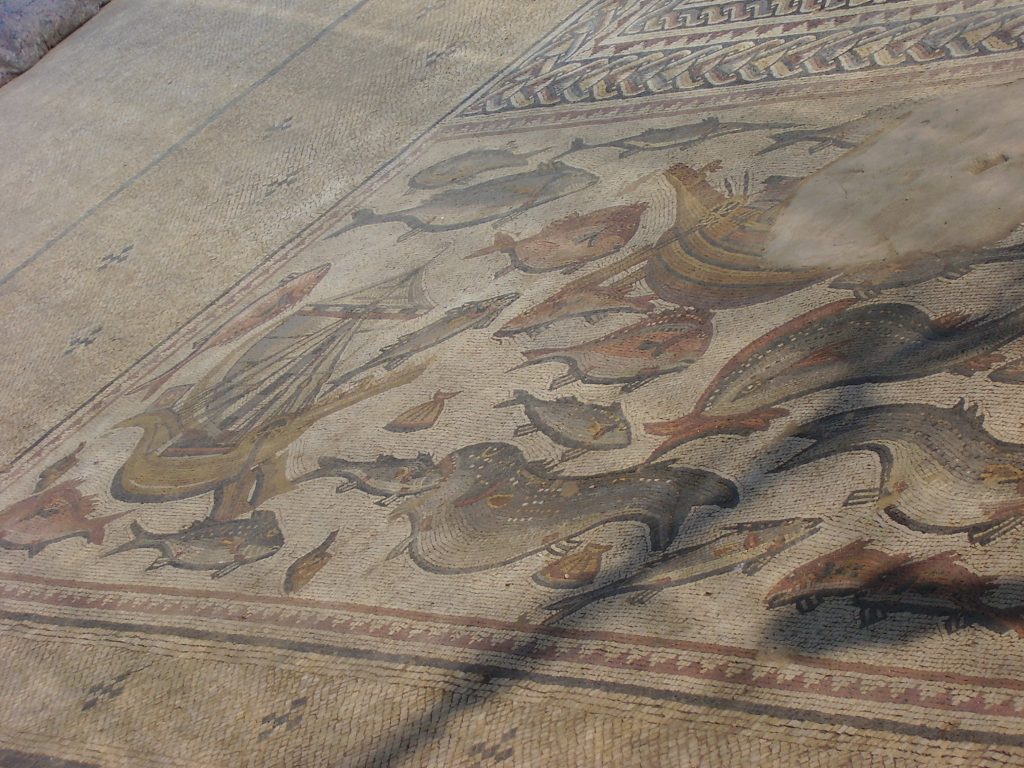
People routinely associate a fish with Christianity today. At Kefar ‘Othnay that reading makes sense because the same room contained the dedication to Jesus. Ancient mosaicists also used fish in houses whose owners’ beliefs remain uncertain. The seascapes of the Lod mosaic show how confidently a late Roman workshop could fill a floor with fish, ships and other sea life. Comparing the two helps establish what does the identifying at Megiddo. The fish acquire their local significance in a whole room with Greek texts and a named recipient. The imagery by itself leaves room for several readings. Glen W. Bowersock’s comparison with the Lod mosaic.
The museum’s annotated photographs let you distinguish the actual lettering from the patches of stone around it. Find the Akeptous panel first. In the middle of the text the titles and name translated as God Jesus Christ are abbreviated, with little strokes above them. The convention is called nomina sacra, or sacred names. Scribes used this convention in manuscripts, and here a mosaicist used it in a floor. The wording of the dedication is still intelligible even though the words themselves are shortened. The inscription identifies Akeptous as devoted to God, specifies what she offered and records the offering as a memorial. Photograph with the name and dedication highlighted.
The people whose names survived
The northern inscription identifies Gaianus, also called Porphyrius, as a centurion. It says he paid for the floor from his own resources and calls him a brother. Recording a benefactor’s generosity in an inscription was familiar in the Roman world. In this room the address is personal as well as public. Others who came to the hall could read a soldier’s name together with the term by which the group knew him. In a separate line Brutius is credited with doing the work. The floor preserves something about who commissioned it and also gives the person who executed it a name. The Gaianus and Brutius inscription.
Across from Akeptous’s inscription appears a request to remember Primilla, Cyriaca, Dorothea and Chreste. We have no description of their lives. Their common mention tells us that somebody wanted these particular names to be spoken or kept in mind, and that the names belonged in the room’s permanent decoration. The words give no reason for singling them out. They may have supported the community in ways that never entered the surviving record. Akeptous’s own role is firmer. We can identify her as the contributor of the table because her inscription spells out the gift. The inscription commemorating four women and the Akeptous dedication.
The floor gives a woman who supplied a table, a soldier who funded a pavement and a craftsman who built it their own places in the history of Christian worship.
How old is the prayer hall?
The excavators assigned the hall to the third century AD. Tepper proposed a date about AD 230 for its establishment, and Leah Di Segni found a third-century date consistent with the form of the Greek lettering and its language. Pottery beneath the floor, finds elsewhere in the building and debris above the floor were among the pieces of evidence considered. The early date remains a proposal. The bedding under the mosaic and the broken jars lying above it belong to different moments in the life of the room. Sherds from the earliest fourth century in the layer above the floor can tell us about that layer, even though they give no calendar year for the laying of the tiles. Adams’s review of the excavation chronology.
Glen W. Bowersock treated the pavement as a work from the late third or very early fourth century. His comparison drew on the nearby legion’s history and on the mosaics at Lod. The gap between an early third-century proposal and a date around AD 300 matters to architectural history because very few early Christian assembly rooms survive. At Dura-Europos on the Euphrates, the survival of a worship space depends on a different sequence of events, including defensive burial before the city fell. The two sites make a useful comparison even while the exact order of their Christian renovations remains open. Bowersock’s dating and comparison.
Why Christians gave Jesus this table
The description of Jesus in the dedication makes immediate sense within the Gospel of John. John opens by saying that the Word was with God and was God. He goes on to say that the Word became flesh and lived among us, and identifies Jesus Christ in the prologue’s account of grace and truth. At the other end of the Gospel, the risen Jesus comes to Thomas, a disciple who had wanted to see the wounds. Thomas addresses Jesus as his Lord and his God. Christians receive both passages as true testimony to who Jesus is. The inscription shows that confession expressed by another community, in the gift of something they intended to use. John 1:1–18; John 20:19–31.
Why give a table in particular? The building plan and the inscription suggest a gathering arranged around a shared act of worship. Paul had already explained why a meal mattered. In 1 Corinthians 10 he connects the cup and bread with participation in Christ and draws out the consequences for believers who share one bread. In chapter 11 he recalls what Jesus said over the bread and cup and tells the Corinthians that they proclaim the Lord’s death when they eat and drink. Paul is correcting a gathering whose wealthier people humiliated those who had little. The meal belongs to a body of believers with responsibilities to one another. 1 Corinthians 10:16–17; 1 Corinthians 11:17–34.
That New Testament background makes the Lord’s Supper a credible interpretation of a table given to Jesus in an early Christian assembly hall. Its precise furnishings, participants and words remain unrecoverable. We can still appreciate what the congregation’s priorities look like in physical form. They located a gift for shared worship at the center, and they recorded the names of some of the people who made their gathering possible. The date question matters for placing the room among early places of Christian worship. The donation itself speaks clearly across the several decades at issue. The table dedication and surviving stone base.
See the mosaic in the museum’s discussion
The exhibition brings together panels originally encountered from different directions. Follow one name at a time when you look at the museum’s photographs or video. Begin with Akeptous and the table, move to Gaianus and Brutius, then find the group of four women. The exercise restores something of the floor’s arrangement. A reader leaves with a picture of a Christian gathering as well as a quotation about Jesus. The quotation survives through the efforts of the people who built the mosaic, the archaeologists who kept the finds in context and the conservators who made the inscriptions readable again. Museum of the Bible’s Megiddo exhibition record.
Frequently asked questions
Does the inscription say that Akeptous presented an altar?
The Greek noun refers to a table. An altar-table used in Christian worship is a common interpretation of its function. The distinction matters when describing both the word that actually survives and the proposed use of the object. Museum translation and photographs.
Is this a find from one of the cities named in Revelation?
The popular name comes from its modern location near Tel Megiddo. The floor was laid in a Roman-era community at Kefar ‘Othnay. Its Greek inscriptions concern local people and their worship. Excavation location and inscriptions.
Do the excavators know the year the mosaic was laid?
The excavation and the Greek inscriptions support a broad Roman-period date. Early third-century and later third- to early fourth-century proposals differ because scholars weigh the evidence differently. An exact year is unavailable. Excavation chronology and assessment.
Sources and further reading
- Yotam Tepper, Israel Antiquities Authority field report — Primary report on the 2005 salvage excavation, building phases, plan, pottery, mosaics and inscriptions.
- Museum of the Bible, The Inscriptions — Annotated photographs and translations of all three inscriptions and an image of the proposed table base.
- Edward Adams, The Ancient Church at Megiddo — Study of the excavation, building plan and inscriptions with photographs and a discussion of the dating evidence.
- Glen W. Bowersock, Religion in Early Fourth Century Roman Palestine — Comparative archaeological reading of the Kefar ‘Othnay and Lod mosaics and a later chronological proposal.
- Yotam Tepper and colleagues, The Roman Legionary Base in Legio-Kefar ‘Othnay — Archaeological study of military small finds in the wider district.
- Metropolitan Museum of Art, The Roman Mosaic from Lod, Israel — Exhibition documentation with images and background for the comparative mosaic.
- Museum of the Bible, The Megiddo Mosaic — Exhibition documentation and links to visual materials.





