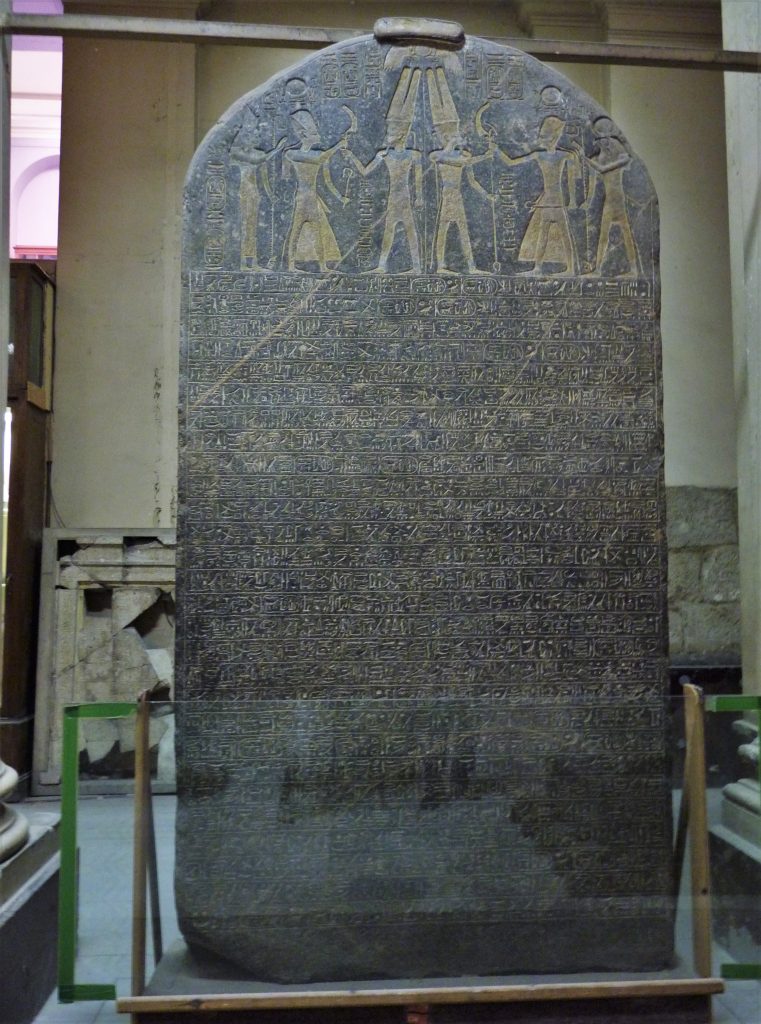
The name appears near the bottom of a stone taller than a person. Above it are lines of Egyptian hieroglyphs celebrating Pharaoh Merneptah’s victory. Most of those lines concern enemies threatening Egypt from the west. Near the end, the poem turns to Canaan and names a people Egyptian scribes called Israel. The pharaoh claims to have devastated them. More than three millennia later, the survival of the stone gives us the earliest widely accepted reference to Israel outside the Bible. It comes from a court that had every reason to magnify Egypt and little reason to preserve Israel’s memory. University of Chicago, Ancient Israel, p. 67
What you'll learn
- Where Flinders Petrie found the granite monument in 1896 and why it bears inscriptions associated with two pharaohs.
- What a group of small signs tells us about the way Egyptian scribes classified Israel around 1208 BC.
- How the inscription intersects with the Bible’s account of early Israel and how to read the pharaoh’s victory claim.
The stone Petrie found at Thebes
In 1896, Flinders Petrie’s expedition was excavating royal mortuary temples on the west bank of the Nile at Thebes, opposite modern Luxor. A mortuary temple served the continuing cult of a deceased king, with space for rituals and offerings. At the temple of Merneptah, the excavators found the granite stele lying in a court. The team’s 1897 report described the stone and reproduced it in a photograph and a drawing. Wilhelm Spiegelberg contributed a study and translation of the Egyptian texts. Today the stone can be identified in the Egyptian Museum’s collection by the accession number JE 31408. Petrie and Spiegelberg, Six Temples at Thebes University College London, Digital Egypt
A stele is an upright monument, typically set up where its inscription or imagery could serve a public, ceremonial or commemorative purpose. This particular granite slab had already performed that service for Amenhotep III, an earlier pharaoh. Merneptah had his own text engraved on the other face. The stone therefore has two histories before it even reaches the excavation. The older inscription still belongs to Amenhotep III. The victory poem on the other side dates itself to Merneptah’s fifth regnal year, usually placed around 1208 BC. A reader who finds slightly different modern dates in publications is seeing the conversion of an Egyptian regnal date to our calendar. Excavation report and plates XIII–XIV University of Chicago dating
The discovery also shows why findspot and subject matter belong in separate notes. Petrie’s record locates the monument in a temple in Egypt. Merneptah’s words refer to places and people beyond Egypt. Archaeologists can use the findspot to explain the original Egyptian audience and the reuse of the stone. They consult the writing and other evidence to locate the groups it names. If you put a pin on a map for the excavation, it belongs at Thebes. That pin tells you where someone found the evidence. It leaves open where the Israelites lived within Canaan. Western Thebes archaeological context Hasel’s analysis of Israel’s setting
How an Egyptian scribe wrote “Israel”
A hieroglyphic name can contain signs that represent its sounds and additional signs that indicate its category. Egyptologists call the latter determinatives. These classification signs guide interpretation without contributing sounds to the name. A sign group can tell the reader to expect a city or a people, much as context helps us decide whether a word on a page names a person or a place. Egyptologists read the signs in the Israel line alongside the similar constructions for the other names in the closing lines. The phonetic rendering reflects how Egyptian scribes represented a foreign name within their own writing system. Hieroglyphic transcription, line 27 Hasel, “Israel in the Merneptah Stela”
In the closing stanza the king names Ashkelon, Gezer and Yanoam. Their names carry signs marking foreign places. Israel has a classification that includes a seated man and woman and marks plurality, within the sign group for a foreign people. Look at the detailed photo and compare it with line 27 in the transcription. The seated figures belong to the spelling, so they carry information even where the small details are easy to miss. The distinction is evidence for an Egyptian understanding of Israel as a recognizable population within Canaan. It gives us their broad setting while leaving the extent and structure of their settlements open. University of Chicago, Ancient Israel, p. 67
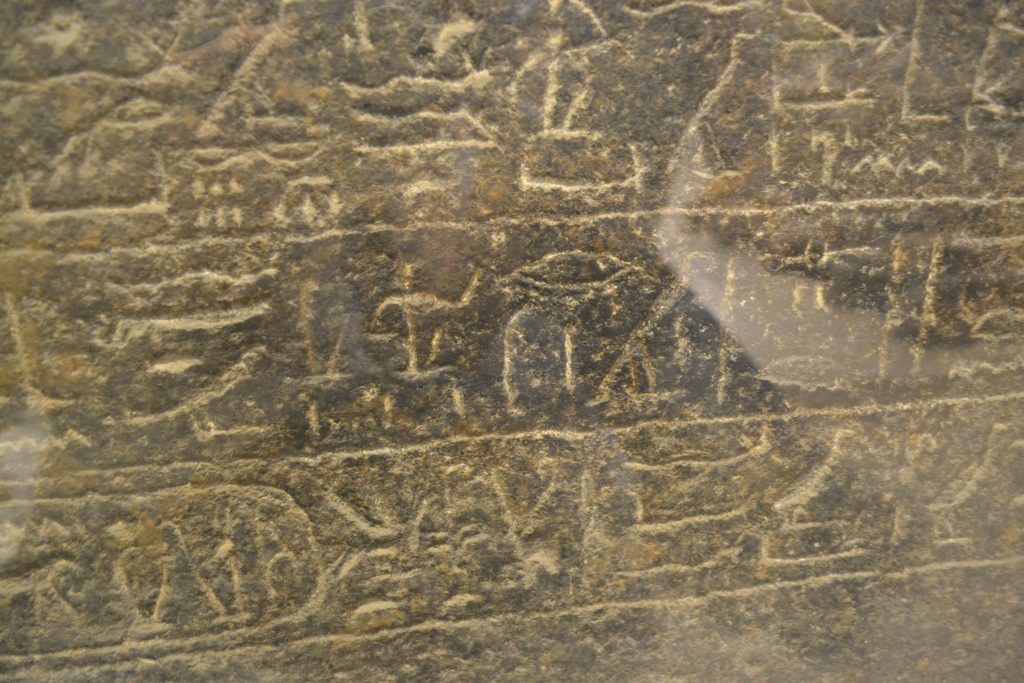
The people sign does more than add color to a translation. Before an excavator can connect an inscription to a biblical name, the reading has to work in the language that produced it. Here the signs for the name, the way the scribe classified it, and its position among Canaanite names all inform the identification. Each piece answers a different question. The sounds help identify the name. The classification tells us how the writer understood the group. The other names supply its geographic setting. Together they explain why the connection is accepted so widely even while scholars continue to debate the character of early Israel’s settlements and agriculture. Hasel’s linguistic and literary analysis
The boast that Israel was devastated
Merneptah commissioned a royal victory poem. Its long account of defeating Libyan forces and their allies leads into a closing picture of enemies subdued and peace restored. The notice about Israel belongs to that climax. In a common English rendering the people are laid waste and their seed is gone. The word often rendered seed has generated debate. Michael Hasel argues from other Egyptian military texts that it means grain, an interpretation with a concrete implication for the people involved. If Merneptah is claiming to have destroyed stores or crops, the line points to agricultural life as well as trying to make the campaign sound decisive. Spiegelberg’s translation of the closing lines Hasel on the meaning of “seed”
The same sentence can preserve an important historical observation and contain a grand claim about what happened to the people it names. One task is identifying the Egyptian reference to Israel. Another is determining what kind of action the Egyptians took, where it occurred and how devastating it actually was. The inscription gives fewer details on those questions. Merneptah presents the enemies of Egypt as brought under control across a broad region. Read the claims against their setting in a victory poem, which celebrates the king rather than giving individual communities a chance to tell us what they experienced. The next centuries of Israel’s history make clear that the people endured.
Near the end of a hymn to Egypt’s power, a scribe left us the name of the very people his king claimed to have devastated.
Reading the stone alongside Exodus, Joshua and Judges
Exodus begins by recounting how descendants of Jacob grew into a recognizable people in Egypt. In Exodus 1:8–14, Pharaoh treats their numbers and possible allegiance in a war as a threat. He imposes forced labor and still they multiply. Joshua 24:1–18 looks back on God’s work across generations. Joshua recalls Abraham’s family, bondage in Egypt, deliverance and entrance into Canaan before he calls Israel to serve the Lord. These are the Bible’s own accounts of where the people came from and why their life together mattered. As Christians we receive that history as true and give attention to the covenant that Scripture puts at its center.
The geographic connection is especially worth pausing over in Judges 1. The chapter describes a series of tribal struggles and lists inhabitants who remained in several locations, including Gezer in verse 29. In the Egyptian poem Gezer also appears, among the separately named places. The shared name invites us to see that early Israel lived in a landscape already populated by cities and other peoples, where military success in one encounter could coexist with continued local resistance. Merneptah leaves the battle details sketchy. Judges, by contrast, follows conditions within the land and the generations after Joshua. Each passage supplies details appropriate to its own subject. Egyptian closing stanza in the excavation report
Judges 2:6–15 pays particular attention to what happened when a generation grew up without the memory of what God had done for Israel. Its account ties the people’s distress to their turning away from the Lord. An Egyptian scribe would use that same world of conflict to glorify Pharaoh; Judges directs readers to the Lord and asks what faithfulness requires. That difference in outlook matters whenever we read archaeology as Christians. We can value a statement from a foreign court and examine its claims with care. The point of reading the Bible remains hearing what God communicates through the history he gives us.
A date to work from
The inscription gives early Israel a firm place in the wider history of the region. By the end of the thirteenth century BC, an Egyptian court knew this people well enough to include its name in an account of Canaan. That fact matters in debates about how early Israel occupied the land. Efforts to date the Exodus or reconstruct the settlement must still bring additional evidence and arguments to bear. The stele never narrates a departure from Egypt or names Moses or Joshua. It does offer a dated point against which a proposed history can be checked. University of Chicago, Ancient Israel, p. 67
The later references to Israel are fascinating to read after the Egyptian one. On the Mesha Stele, a Moabite king describes the northern kingdom’s rule over parts of Moab. The Tel Dan Stele belongs to the era when the kingdoms of Israel and Judah could be distinguished by their royal houses. Several centuries separate those voices from Merneptah’s. The differences in titles, circumstances and point of view are a good reason to keep the whole inscription in view each time a familiar name appears. The Egyptian source gives us an early people, while the Iron Age inscriptions deal with kings and territorial power.
When you return to the full photograph, notice how much of the stone you pass on the way down to the line about Israel. The passage that draws us there was a small part of the Egyptian king’s account. That is part of its appeal. The people familiar to us through Exodus, Joshua and Judges appear as neighbors known to another court and written into its very different account of the same ancient world. Christian readers can take real pleasure in that encounter. Faith in the truth of Scripture gives us reason to look closely at the historical world it describes, down to the signs a scribe chose for the name of a people.
Sources and further reading
- W. M. Flinders Petrie and Wilhelm Spiegelberg, Six Temples at Thebes (1897) — First excavation publication. See chapter V and plates XIII–XIV for context and images, and Spiegelberg’s translation in chapter XIII.
- University College London, Digital Egypt for Universities — Western Thebes find context, reuse history and Egyptian Museum catalogue number.
- Gabrielle Vera Novacek, Ancient Israel (University of Chicago, 2011) — Page 67 discusses the date, the Israel line and the determinative.
- Michael G. Hasel, “Israel in the Merneptah Stela” (1994) — Primary scholarly study of the name, setting and grain interpretation.
- University of St Andrews, Merneptah Stela hieroglyphic transcription — A reading aid based on Petrie’s plates. The editor identifies remaining issues in the transcription.




