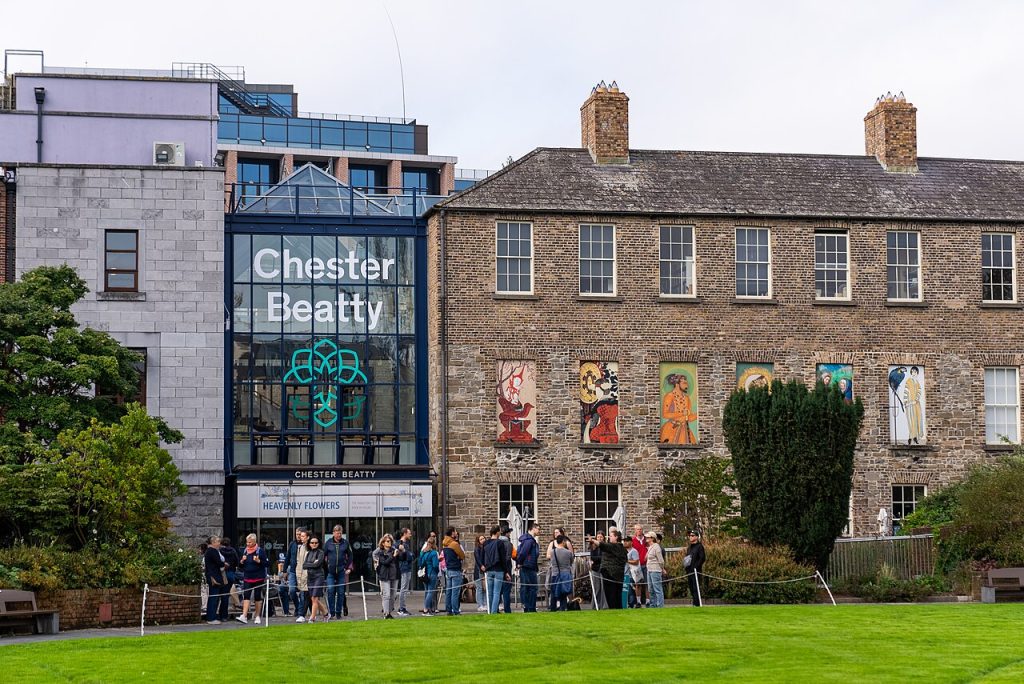
On a page of Papyrus 46, the Letter to the Romans ends and Hebrews begins. The ink is in the same general field of writing, and both texts occupy the same ancient sheet. This page is one of eighty-six surviving leaves of a Greek codex, or bound book, now held in two collections on different sides of the Atlantic. The order of those works is familiar enough to recognize and different enough to surprise a reader opening a modern New Testament. The papyrus gives us an early chance to see what it looked like when Christians put a group of letters into one book. University of Michigan Library, the page from Romans to Hebrews.
Key takeaways
- Papyrus 46 is an early surviving collection of Pauline letters and Hebrews, commonly dated around AD 200. The dating rests principally on the style of the Greek handwriting.
- Eighty-six leaves survive, fifty-six at the Chester Beatty in Dublin and thirty at the University of Michigan in Ann Arbor.
- The surviving book places Hebrews directly after Romans. That order shows how the texts were grouped in this copy.
- Comparison with other ancient books has reopened the question of how many leaves the codex originally had and what the missing ending could have contained.
A book with two custodians
The Chester Beatty uses the designation Biblical Papyrus II for its share. The University of Michigan identifies its portion as P.Mich.inv. 6238. New Testament scholars refer to the combined manuscript as P46. If you open both collections, those identifiers lead to different physical objects that once belonged together. The surviving works run in an order that can be stated from the pages themselves: Romans, Hebrews, 1 and 2 Corinthians, Ephesians, Galatians, Philippians, Colossians, and 1 Thessalonians. Several leaves are incomplete, and the manuscript has lost material at its beginning and end. Its extent is exceptional for an early New Testament papyrus even with those losses. Michigan’s account of the dispersed codex. Center for the Study of New Testament Manuscripts, P46.
The manuscript entered modern collections through acquisitions rather than a documented excavation. Michigan acquired groups of leaves in the early 1930s. Frederic Kenyon published the first set of Beatty leaves in 1934. As more leaves were recognized and published, it became possible to read many more of the contents in sequence. Egypt is given as the country of provenance, while surviving records leave the ancient findspot and its immediate archaeological setting uncertain. Brent Nongbri’s study of records in Dublin and Michigan adds detail to the sequence of purchases and the dealers involved. It also shows how carefully a modern paper trail has to be read when the objects themselves have already traveled. University of Michigan account of the acquisition and publication sequence. Nongbri’s archival provenance study.
In a case like this, the word leaf is worth keeping distinct from page. One leaf has two sides, and each writing surface can be called a page. A sheet folded in the middle becomes a bifolium, two joined leaves with four writing surfaces. When folded sheets are nested together, one half can include material much earlier in the book than the other half. These relationships help explain why separate pictures of papyri can be fitted into one reconstruction. Matching a written sequence is one part of the evidence. Understanding how the writing sits on folded and joined material is another. Nongbri’s study of the codex’s construction.
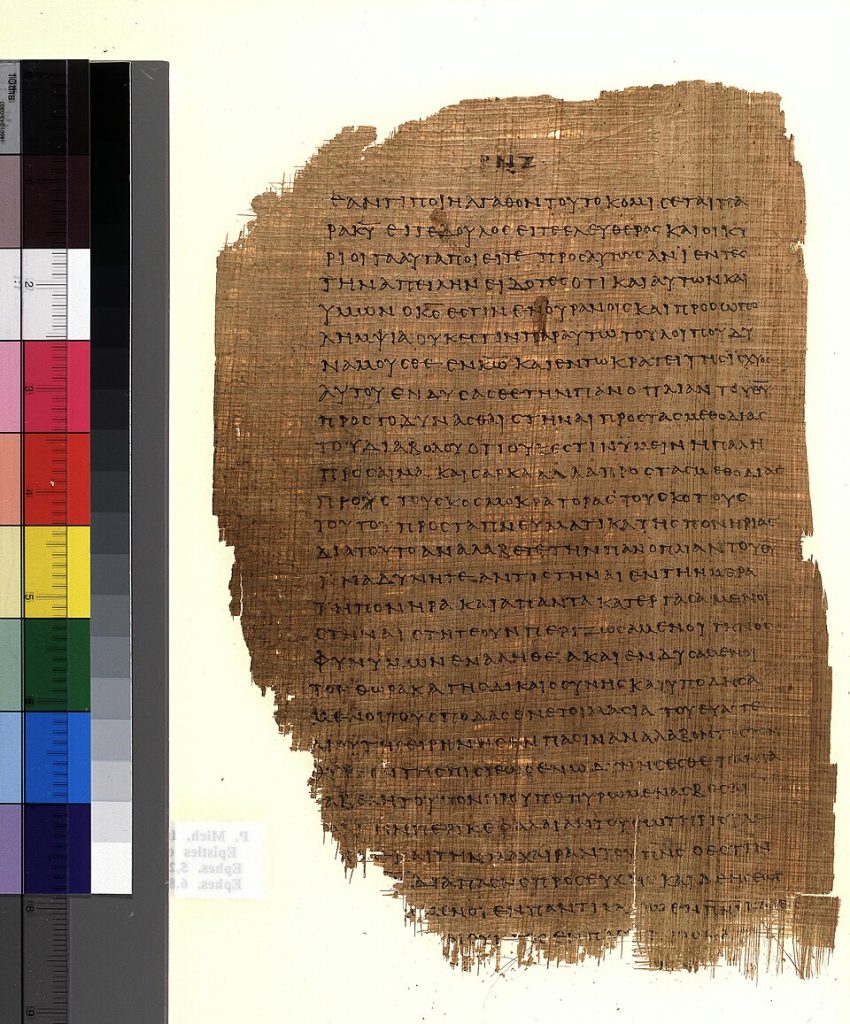
The condition of the papyrus tells a related story. The Michigan exhibit calls attention to wear near the bottom of the surviving pages. A book intended to be used is turned with hands, and the edges feel that use differently from an inner margin. Some of the pages have lost lines at the edges where the material broke away. Looking at two different leaves helps a reader separate the original writing area from the shape left by subsequent wear and breaks. There is a long interval between a scribe preparing a page, a reader turning it, and a curator stabilizing it for photography. All three activities can leave evidence. Michigan’s explanation of wear on the papyrus.
Read the page where Romans gives way to Hebrews
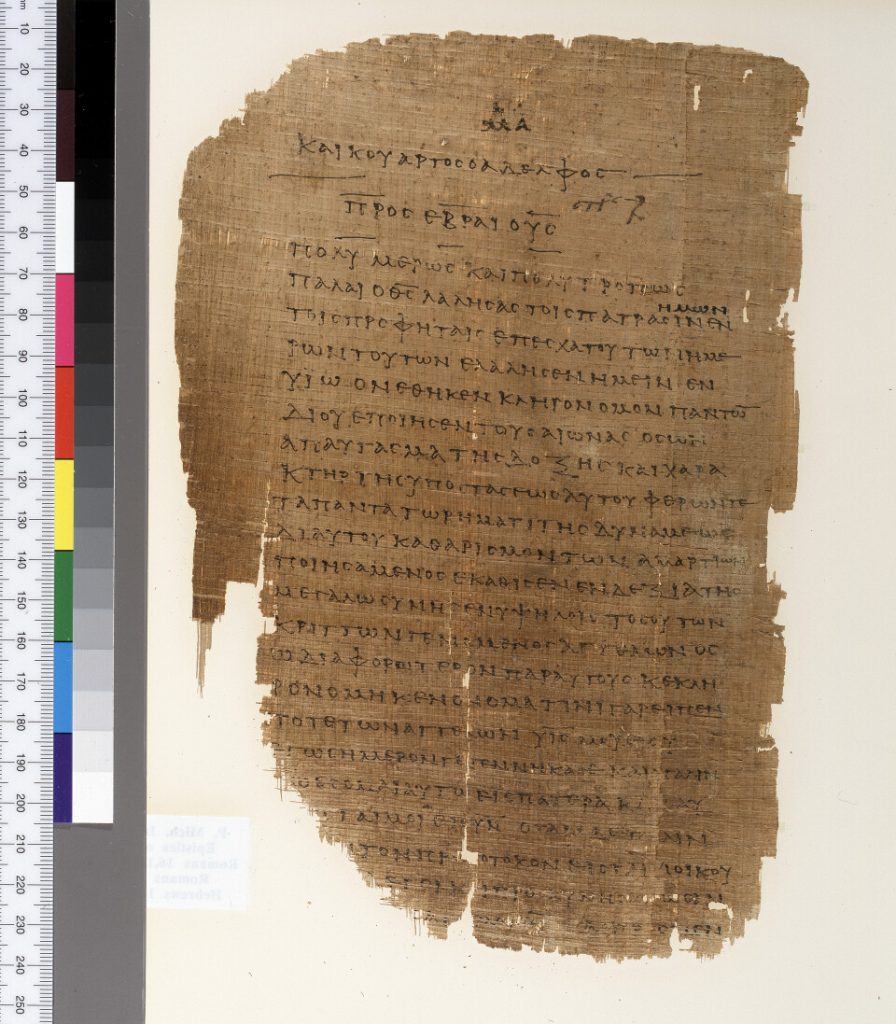
Michigan’s exhibit identifies page 41 as containing the end of Romans and the opening of Hebrews. With an English Bible open beside the photograph, start in Romans 16, where a series of names places the letter in the life of real people and congregations. Then turn to Hebrews 1:1–7. It opens with God’s speaking through the prophets and his speaking through the Son. The two passages are readily recognizable as different works. On the ancient page, their proximity lets us see the intentional act of copying them as part of the same collection. We can discuss their relationship by starting with what the page shows. The original page in the Michigan viewer.
The position of Hebrews has implications for the history of the book and for the history of its reception. A copy containing Hebrews alongside Pauline letters shows that at least one early producer of such a collection grouped them together. An individual book order can reflect judgments and habits carried forward by multiple people. The text of Hebrews does not name its author. The observed arrangement gives evidence of its place alongside Paul in this collection, while the question of who first wrote Hebrews draws on a wider set of textual and historical evidence. A page can answer the first question with unusual directness. University of Michigan’s discussion of the position of Hebrews.
This is a witness to the life of a book. The letters were gathered, put in an order, and copied so that people could read them together.
How old is the surviving copy?
The University of Michigan’s exhibit for this page gives a range of approximately AD 180–220. The interval straddles the boundary between the second and third centuries. That is one reason a label reading “around AD 200” and one reading “late second or early third century” can describe roughly the same evidence. Approximations are important here. The copy has no recorded year of production. Specialists compare the handwriting with other Greek writing and weigh features such as shape, proportions, spacing, and ways of finishing strokes. A range conveys the kinds of differences and continuities those comparisons can reveal. Michigan’s date for the Romans–Hebrews page.
There have been more widely separated proposals. Young Kyu Kim argued in 1988 for the later first century. Pasquale Orsini and Willy Clarysse compared the script with early Greek material and placed it in the early third century. Don Barker discussed both stylistic comparisons and the long life of some traits shared across samples of writing. These differences are worth being candid about because the dating question concerns the production of this particular object. The household and church settings addressed by the letters belong to an earlier history described in Scripture. When present-day readers say that a papyrus was copied around AD 200, they are describing a copy made in a later stage of that history. Kim’s palaeographical proposal. Orsini and Clarysse’s manuscript date study. Barker’s analysis of P46 and other early papyri.
It helps to keep three dates in view when using P46. One is when a particular letter was composed for its first readers. Another is when this group of works was copied together. The third is when the surviving leaves were acquired and published. The first is part of the history of the apostolic churches. The second is an event in the copying of the New Testament. The third is modern and can be studied through acquisition documents and editions. Bringing the three together makes the papyrus more intelligible. It gives direct physical evidence for an early point in the period of transmission.
What can the missing pages tell us?
The surviving pagination lets specialists reason about the original book. Kenyon’s conventional reconstruction gave the codex 104 leaves, formed from 52 folded sheets. That number is an estimate, and it affects discussions of what the last pages might have held. Scholars have asked whether there would have been room for 2 Thessalonians and other writings such as 1 and 2 Timothy and Titus. Jeremy Duff studied the density of letters on later pages and proposed that the scribe may have intended to add leaves to include more texts. His proposal made the construction of the book an explicit part of a discussion that can sound, at first, like a question only about the canon. Jeremy Duff, P46 and the Pastorals.
Nongbri revisited the debate using better-preserved ancient single-gathering books. Their makers sometimes treated blank leaves separately from the pages they numbered. That makes page numbering a less exact measure of the total number of sheets than it may first appear. Nongbri questions Duff’s particular examples for added leaves and finds some flexibility in the estimate of the codex’s original size. He considers it reasonable that 2 Thessalonians followed 1 Thessalonians, while other contents at the end remain uncertain. The evidence creates a useful distinction between the surviving set of letters, the likely next text, and the possibilities for material beyond it. Nongbri’s comparative work on the missing end of the codex.
Why the letters were worth copying
Galatians 1:1–5 shows Paul addressing congregations with a greeting that already speaks of Christ. Romans 16 names particular people who helped in the work. Colossians 4:15–16 asks for a letter to be read and exchanged with the church in Laodicea. Those details let us follow the letters from the people who first received them toward a time when a reader could turn from one congregation’s letter to another in a bound book. P46 belongs to that later stage. For Christians who receive Scripture as true and accurate, it is moving to see the care that went into making these writings available for successive readers.
You can see the hand of that work in an ordinary page of Ephesians. The worn edge and gaps do not prevent a reader from recognizing its lines about faith, prayer, and standing firm. Ephesians 6:8–18 only represents a part of what this book carried. It gives a place to begin because it invites a reader to compare the words of a complete biblical passage with the small surviving details of the old copy. The pictures make it possible to start with ink and the spacing of letters, then return to what the passage says about a congregation’s life before God.
Three observations to make in the images
- Find a book boundary. Use the Michigan viewer to locate the end of Romans and the opening of Hebrews on the same side of one leaf.
- Compare the page shapes. Notice how different tears cut into the writing and how the surviving lines are arranged in a single column.
- Read the collection’s order. Compare the order of the surviving letters with an English New Testament. Keep the lost end in view when considering what else the manuscript may have contained.
A small fragment can give an early witness to one passage, as the Rylands fragment of John does. A book as substantial as P46 gives the additional evidence of an arrangement. Its folds, page numbers, and changes from one letter to the next show that Christians were reading these works in relation to each other. An arrangement can be clear in the middle of a book that has lost its final leaves. That combination of certainty and unanswered questions is what makes this codex worth reading as a physical object alongside the Scriptures it preserves.
Questions readers ask
Did Paul write the surviving pages of P46?
It is a later Greek copy of letters that circulated in the early church. The manuscript’s handwriting provides evidence for the date its scribe copied them.
Does P46 preserve the end of its original collection?
The original end is lost. The sequence of the surviving letters is known, and scholars compare page numbers, contents, and ancient binding practices to consider what might have followed.
Sources and further reading
- University of Michigan Library, Romans 16:23–Hebrews 1:7 — Primary object record and close inspection of the manuscript page and its date estimate.
- University of Michigan Library, The Discovery of P46 — The surviving portions and history of acquisition and publication.
- Brent Nongbri, The Construction and Contents of the Beatty-Michigan Pauline Epistles Codex — Revision of conventional assumptions about quire size and the missing ending.
- Brent Nongbri, The Acquisition of the University of Michigan’s Portion of the Chester Beatty Biblical Papyri — Study of archival acquisition details and possible provenance.
- Jeremy Duff, P46 and the Pastorals — Proposal about the density of the script and the possibility of additional leaves.
- Young Kyu Kim, Palaeographical Dating of P46 to the Later First Century — Published early-date proposal for the manuscript.
- Pasquale Orsini and Willy Clarysse, Early New Testament Manuscripts and Their Dates — Palaeographical comparisons with an early third-century assignment for P46.



